


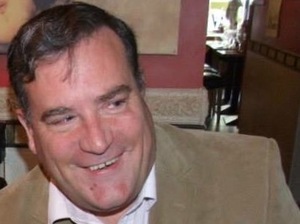
From top: Donegal cottage, 1930s: Dan Boyle
Austerity now.
Austerity Then.
The similarities are not just superficial.
Dan Boyle writes:
It was The Mother’s birthday last weekend. She was born in the 1930s. It occurred to me that the time span between now and then, when applied to before her birth, would have brought her life towards the end of The Great Famine in Ireland and before the start of the American Civil War. So much history enveloped into two life spans.
Thinking of when she was born brought to mind that distinctly harrowing decade of the 1930s. A lot of parallels seem to exist between then and now. It was a decade entered into on the back of a collapse in the global economy, made worse in Ireland. Then we were engaged in an economic war with the British. Now we are economically in thrall to the whims of the Germans. We seem to have lived with austerity more often than we’re prepared to admit.
Then the coming force in Irish politics was a group of people, who several years previously, believed their political goals were best delivered through the barrel of a gun. The leader of that group, patrician like, sought to distance himself from such grubby activity. Thankfully shameless re-positioning like this isn’t practiced any longer in Irish politics.
Then, throughout the rest of Europe, the complacent centre was failing to hold. The disenfranchised and the dispossessed were being attracted to extremes both of the right and the left. Now rejecting old certainties is the reaction of the day.
The comparisons between then and now are largely superficial though. Take the example of poverty. Then poverty was absolute, now it tends to be relative. Then social needs were unmet because of a lack of resources. Now they exist because resources are misallocated.
My mother’s childhood was cloaked in a middle class comfort. Her dad, my grandfather, worked with the newly formed Electricity Supply Board. Apparently it was possible then to establish a state owned company, responsible for the fair and efficient distribution of a public utility.
My own Dad was at the same time living in another Ireland. On another island, Arranmore off the coast of Donegal, in a family home without electricity or plumbing.
How we remember history, especially our personal histories, determines how we make sense of the present. It’s the scale we often get wrong. The relationship between past, present and future isn’t necessarily linear, but it has tended to be progressive.
Are there still flaws? Many, with continuing injustices in place. Are we dealing with these with a sufficient sense of urgency? No, but the amount of what is wrong has been reduced.
In Ireland we have evolved as a society and have progressed as an economy. There have been steps back that have been followed by leaps forward. There have been collective qualities we have lost that we should seek to regain. Technology has helped make life easier but has also made life more complicated.
The future will always be uncertain. We shouldn’t burden it with prophecies of doom. We have no reason to believe that the journey from now to the future will be any less successful than the journey we have made from the past to now.
We should hope though that we don’t choose the route chosen by the rest of the World to escape the torpor of the 1930s. World War Three would be the last in that series.
Dan Boyle is a former Green Party Senator.
Top pic via irish Archaeology