

Tag Archives: Dan on Thursday

From top:  the cast of 1970s children’s favourite ‘The Magic Roundabout’; Brexiteers, from left: Michael Gove, Jacob Rees-Mogg, Boris Johnson, David Davis and Liam Fox: Dan Boyle

It makes more sense to me now. It was an allegory written before the events it so perfectly describes. Growing up watching it I thought it surreal, but now realise it was created as prognostication at is finest.

On the learning the history of what was meant to me a children’s television programme, it seems that the story of the making of the programme was as illustrative as its contents were.

The premise was a set of characters who lived on or around a fairground roundabout, a Magic Roundabout, a perfect allegory for people or things that never went anywhere.

The characters themselves also represented allegorical material capable of describing qualities we see now in abundance – the distance from reality; the slowness of response; the denial of the possible; the comfort of considering themselves separate and apart.

The main character was a long haired dog. His friend a jack out of the box, who moved across the screen propelled by a spring. Other characters included a snail, a cow and a rabbit. The only character which seemed to missing was that of a unicorn.

The programme was quite popular in its own right. In its later years it acquired a considerable adult following, even if many of these watched under a chemically induced euphoria.

It might even be suggested that the programme was to the forefront in preparing a society and its politics, for its eventual infantilisation.

It had all begun in a spirit of entente. Developed in France, where it was broadcast as Le Manège enchanté, one of the its principal animators was English. The BBC expressed an interest in the programme but was unwilling to use subtitles or to dub the French script into English.

What they eventually decided to do, in a typical display of British (English) diffidence, was to use the French films which were then narrated with completely different story lines.

Characters names were also changed. The dog character who in French was called Pollux (and he was a bit of a one) became Dougal in English.

The name change almost caused a diplomatic incident as the French thought it a subtle satirical dig at their President, General De Gaulle. The man, who at that time, was continuing and adamantly saying ‘Non’ to the idea of the United Kingdom becoming a member of what was then called the European Community.

The inability to use the same terms, the same script, or even the same language, saw the British refer to the European Community as the Common Market, which according to tone and emphasis could be loaded with meaning.

I shouldn’t have to join the dots here and state how this relates to where we are now. The Magic Roundabout is Brexit before its time. Brexit is just as surreal, just as mind-bendingly awful.

A melange of characters who just don’t get it, who sadly don’t want to get it. A perverse collection of ideologues who want to impose their deranged narratives in interpreting the same basic material.

Perhaps the best logic that can be applied to this whole sorry mess, is to dwell upon the words of the jack out of the box character, Zebedee, who would end every episode of the British series with the immortal phrase, “It’s time for bed,”.

Dan Boyle is a former Green Party TD and Senator. His column appears here every Thursday. Follow Dan on Twitter: @sendboyle
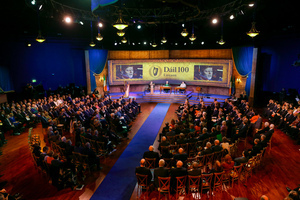
From top: The Ceremonial Commemoration of the Centenary of the First Meeting of Dáil Éireann in the Mansion House; Dan Boyle

It was somewhat surreal to be sat in my old seat. The panorama, while familiar, was made up of other former members of the Oireachtas, some of whom I’d served with most of whom I hadn’t.

We were there to watch a simulcast of proceedings taking place in the Mansion House, marking the 100th anniversary of the holding of the First Dáil.

The event was perhaps a not unsurprising mix of the worthy and the worthless. The readings of the Proclamation, and the Democratic Programme, were useful references points on where we’ve come from and what has been achieved.

The tail spin of the ceremony, the speeches from party leaders (with only or two exceptions) showed how poor the quality of oratory is within Irish politics.

It also sadly showed how few of our political figures lack not only vision for the future, but also an inability to honestly analyse our past.

The anniversary should be an opportunity to examine the health of Irish democracy after 100 years. A chance to ask how free a state we’ve become. The occasion to critically evaluate how Republican our State has been in meeting its aspirations.

We could wallow in how we have believed for far too long, that we could have a country, with a society and an economy, that was self sustaining and self contained.

A situation that led us for several decades to become something of an elected theocracy. A society cum economy whose largest product was the export of its people.

And yet Ireland has been one of the few countries in Europe that has achieved continuous democratic changes in government. This during a period of history where much of the continent of Europe slipped into a totalitarian hell.

Our politics, often mired in frustration, has despite seemingly immovable obstacles, helped to progress us into a quite modern, very progressive nation.

The scale and rate of change, particularly over the past 25 years has often been breathtaking. While much of this has been achieved without being instigated, or even encouraged, by our parliamentary system of government, without those processes the liberal legislation that was brought about would never have been enabled.

Celebrating these achievements is not to ignore the continuing injustices of today, nor is it a drawing to close any parts of our history that we still have not been able to confront.

We should be acknowledging though that we have made considerable advances. We have become richer as a society and as an economy.

We have moved beyond our long held perception of ourselves as being ‘anti-British’ towards becoming a supremely confident nation.

We have phased from that monochrome, homogenised, largely rural culture of one hundred years ago to a pluralistic tapestry admired by many throughout the World, a World with whom we now interact with a supreme confidence.

My overriding impression of the commemoration was a wondering of whether this was it. Are we only to acknowledge a single event in 1919? Or are we also to celebrate, while examining, the many achievements of our parliamentary democracy since?

We should be acknowledging those individuals, and those political parties, who also served. Those who were not there in 1919 and aren’t here now. Parties like Clann na Poblachta and Clann na Talmhan, and the key individuals who were part of these parties. They too have been part of our story.

Dan Boyle is a former Green Party TD and Senator. His column appears here every Thursday. Follow Dan on Twitter: @sendboyle

Top pic: Maxwells

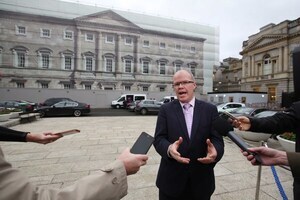
From top: Peadar Tóibín TD who resigned from Sinn Féin to lead a new, socially conservative political movement; Dan Boyle

Academic studies indicate that upwards of 20% of the population of any society can be persuaded by, then become mobilised by the ideologies of the Far Right. This ideology is predicated upon two prongs – an idealised sense of We/Us; and a collective, pathological fear of the other.

The idealised sense of We/Us is what we otherwise call nationalism, a ‘quality’ that somehow through multiple accidents of birth and place, we collectively possess a genetic wholesomeness that makes us different, distinct and altogether better than others.

The necessary polar opposite, but still vital component of this shared smugness, is the pathological fear of others. Far Right ideology encourages that we must not dilute, nor allow the influences of others, make impure that which makes up our supposed genetic superiority.

How we define other can be racial, can be ethnic, can be religious, or can be against those daring to think differently. Any deviance from these ‘norms’ for the Far Right means those identified to be capable of any deviancy.

We live in an era where the Far Right has become, if not dominant, then is certainly in the ascendant.

In France. The Netherlands, Sweden, and Germany, new political groupings have established parliamentary footholds from seemingly out of nowhere.

In Hungary, Poland, Austria and Italy such parties are parties of government. In Belgium and in Spain regional parties are successfully practising a more focussed type of nationalism.

The new European Parliament set to take office this summer will contain a substantial far right bloc. And yet it could be argued that we’ve already passed peak Far Right.

Le Pen, Wilders and Sweden Democrats each performed below expectation in recent elections. The AfD in Germany seem to be swimming in circles of 15% support much of which is coming from the eastern parts of the country.

The phenomena that have been Trump and Brexit, are finally buckling under the contradictions, that seemed obvious from the start, but continued to be ignored by adherents persuaded that truth, the ultimate conspiracy, should always be ignored.

The New Right is not going to disappear. The ideological battle between progressives and reactionaries is likely to continue for several decades. Progressive success is dependent on engaging in practical politics.

A genuine criticism of progressive politics has been the theoretical, almost ivory tower, approach to politics many progressives have adopted. This has allowed the new right to set agendas, even to develop the language in which much current debate is conducted.

In Ireland Far Right parties have never taken hold. Perhaps the folk memory of The Blueshirts and the comical affection Eoin O’Duffy’s and his acolytes have been held in, has meant that any who have followed have been held in risible contempt.

However, the performance of Peter Casey in last year’s Presidential election shows that an instantaneous, unthinking, reactionary vote can be tapped into.

This is the political market that Peadar Tóibín is leading his new political movement towards. In a political system where nods and winks have been the most successful weapon, he could reap cheap, easy, quick rewards should he choose to be so.

Coming in on a platform of social conservatism such an avenue is open to him. I think he is playing a longer term, more clever game. He seems to be putting much deserved emphasis on organisation and structure.

I can see this party significantly altering the template, particularly in rural Ireland, affecting not only Sinn Féin but also Fianna Fáil and Fine Gael.

I wish him and them well. The more political diversity that exists the more truly democratic we become. I only hope that the temptation of the cheap and the nasty can be avoided.

Dan Boyle is a former Green Party TD and Senator. His column appears here every Thursday. Follow Dan on Twitter: @sendboyle

Rollingnews

From top: Ballot papers from the European and Local Elections, May 24, 2014 at the count centre in the RDS, Dublin 4; Dan Boyle.

Since 1999 Local and European elections in Ireland have been held on the same day.

Returning officers at count centres have liberally interpreted our electoral laws, as many voters continue to mark one ballot paper 1,2,3 and 4 in expressing their preference; then marking the other paper 5,6,7 and 8, as if there is meant to be some symbiotic relationship between the two elections.

To some extent there is, if only through holding the two sets of elections on the same day. Both are mid term elections that each have the capacity of making life uncomfortable for the sitting party of government.

The local elections, however, operate to a different set of conditions. These elections are the most candidate centric of elections held in Ireland.

While fewer voters participate in local elections, as opposed to elections to the Dáil, those who do participate make greater demands of the candidates. The reality is that at what we have in Ireland is not local government, but a glorified form of local administration.

Despite this we place expectations on candidates, who seek to become local councillors, that can never be met through the structure local government in Ireland.

Ireland is one of the, if not the, most centralised countries in Europe in relation to local government. Many myths persist about the level of powers that exist, and on whether we involve too many elected people in our local councils.

Too many decisions are made at a national level that can, and should more properly be made, at a local level. Any of the changes that have occurred in Irish local government, over the past twenty years, have been negative. Powers have either been taken away from local councils, and more particularly from elected councillors.

The removal of town councils in 2014 by the Fine Gael/Labour government, pushed through by then Minister for the Environment, Phil Hogan, was probably the most undemocratic decision in the history of our State.

There has never been any sincere attempt to bring about democratic reform of local government. We have seen several attempts of deck chair rearranging.

These changes have been instigated largely at the behest of senior civil servants at the Department of the Environment/Local Government, who zealously guarded the administrative aspect of local government while keeping any hint of improving local democracy underfoot.

The wrong arm of local government was dismissed in 2014. We should have kept town councils, expanded their geographical boundaries and decision-making powers, so that they would become District Councils, based on natural hinterlands.

What we need to be rid of is the County system of government. The 1899 Act, passed in the Westminster parliament, remains the main basis for local government in Ireland. The other jurisdictions where this legislation also applied – England, Scotland, Wales, even Northern Ireland have long since jettisoned county government. We should too.

Because the GAA organises itself on an inter county basis, has meant there has been a reluctance to address this necessary change. English cricket still clings to the myth of now disappeared counties. There is no reason why the GAA can’t do the same.

What we should have is a layer of regional government where, under suitable economies of scale, and where appropriate powers have been devolved from national government (in areas such as health and education) better accountability and improved public participation can be achieved.

It would be nice if this were to form what gets debated during the local election campaign. I wouldn’t be holding my breath though.

Dan Boyle is a former Green Party TD and Senator. His column appears here every Thursday. Follow Dan on Twitter: @sendboyle

Rollingnews

From top: Fine Gael MEP Brian Hayes (centre), who is leaving politics, canvassing in the 2014 European Elections; Dan Boyle

There probably won’t be a general election this year. There would need to be some clarity on Brexit, along with a belief in Fianna Fáil that it can advance in some way. Neither are likely, but if they were to come to pass, an election could take place in September/October.

A decision to hold a general election will be informed by the definite holding of local and European elections in June. Mid term elections are usually not good news for a party in government. Voters are more likely to use these elections to give parties in government a good kicking.

The European elections are those in which independents and smaller parties can make hay. There are three independent MEPs currently representing Ireland, four if you include Brian Crowley (currently in exile from Fianna Fáil).

There is also a strong tradition of electing independents – TJ Maher, Pat Cox, Dana and Kathy Sinnott, all of whom sought to present themselves, in varying degrees, as something apart from traditional politics.

Similar voter volatility has benefited smaller parties from The Worker’s Party winning a seat in 1989; through Joe Higgins winning a seat for the Socialist Party; to the Greens electing two MEPs in successive elections (1994/99).

Sinn Féin made its big impact in 2014 winning three seats, although Mary Lou McDonald had earlier served as a single term MEP.

This time it is difficult to predict what might happen, there are so many variables at play. In the Dublin euro-constituency there is an additional fourth seat to be contested.

Two of the outgoing MEPs will not be standing again. These two, Brian Hayes and Nessa Childers had won the second and third seats on a margin of one third of one per cent, with Eamon Ryan narrowly missing out.

Lynn Boylan for Sinn Féin will likely be re-elected, albeit on a smaller vote. The other three seats could go anywhere.

Senator Neale Richmond is likely to seek selection for the seat held by Brian Hayes. He has received a great deal of media attention as a Brexit spokesperson, although he is unlikely to improve the vote Brian Hayes got last time, a vote that was barely enough then.

Conor Lenihan is seeking a nomination to be the Fianna Fáil candidate. He certainly has a profile, even if in Dublin the FF vote remains its weakest in the country.

These two, if and when selected, would be fighting it out with Ciarán Cuffe of The Greens, Alex White of Labour and Gary Gannon of the Social Democrats, for those final three seats.

The situation seems more clear cut in the Midlands/North West euro-constituency. Matt Carthy should be re-elected for Sinn Féin, although he may suffer from an impression that he may not serve a full term, as he much prefers the prospect of becoming a TD for Cavan/Monaghan.

Mairead McGuinness will I suspect top the poll. Only one of two current independent MEPs Marian Harkin and Luke Flanagan is likely to get elected, with Harkin being in the stronger position.

A dual threat exists for Flanagan – Fianna Fáil with the right candidate will be in the frame for a seat in the region where the party picks up its strongest vote.

Should he choose to run Peter Casey, with sufficient momentum from the presidential election, would amass enough votes to be elected, unfortunately.

In the Ireland South euro-constituency, now with an added fifth seat, Fine Gael’s Sean Kelly should be re-elected. Sinn Fein’s Liadh Ni Riada has had her name recognition enhanced after a far from successful presidential campaign.

Fianna Fáil’s leader Micheál Martin has given his imprimatur to Malcolm Byrne from Wexford. Malcolm and I worked together in the National Youth Council of Ireland. He has a capacity to be a very effective MEP.

What may hinder his prospects are the plans of outgoing MEP Brian Crowley, perhaps the greatest vote gatherer in Irish politics, on whether he will seek to defend the seat he holds. He is unlikely to be given a FF nomination having had the whip removed in 2014.

Even if he were to run as an independent candidate he would face uncomfortable questions on why he wants to extend his mandate, given that due to illness he has not attended a single session of the European Parliament since 2014.

Deirdre Clune‘s ability to retain a second Fine Gael will depend on how the party manages its vote. Labour doesn’t seem to have identified a strong candidate here. This opens the door for the Greens, with Grace O’Sullivan who looks set to add upon what had been a substantial vote in 2014.

These votes will not be replicated in a general election, but they will be analysed to see where the next slippage in our traditional voting patterns occur.

Dan Boyle is a former Green Party TD and Senator. His column appears here every Thursday. Follow Dan on Twitter: @sendboyle

Rollingnews


From top: Lough Meelagh County Roscommon on St. Stephens Day ; Dan Boyle

I remain an optimist about life and the World we live in. I don’t expect bad things to disappear, but I do expect they can be overcome.

It has been a god awful decade. A time when the individual became king. Where we replaced what we had considered greed with the more agreeable concept of realistic expectation. Where the notion of the ideal of a common good has been disparaged to near death.

The negative turns that have been taken won’t ever be completely reversed. Nor should they be. Part of the right/left societal shift at any historical point is corrective. The problem is where change goes beyond the corrective.

We are, and have been living, in such a period. A period in which global wealth (at least in how it is measured) has never been greater, nor has the distribution of that wealth been poorer.

A time where the planet we collectively share, has become an afterthought in our pursuit of what we have foolishly been sold as ‘happiness’.

A space where we selectively decide on what is ‘truth’, preferring to confirm our biases than accept that views other than our own may have greater validity.

A dark age, not yet our darkest hour, but many dawns still await us. Those dawns arrive when we realise we can properly critique the badness that stymies our progress.

And we can recognise that the goodness in what we have rejected, the neglected strengths that have made us who, and what, we are.

In this age of demagogues and demagoguery it has because de rigeur to assail social democratic societies and what they have represented.

It can’t be denied that the era of social democracy has ended with an air of smugness and complacency. It can be argued that there has been much to be smug about.

The twentieth century has been erroneously described as the American century. It should be more properly seen as the Social Democratic century.

As we celebrate the centenary of the partial franchise for women, we are tending to forget the more complete journeys that have been made.

The forty hour working week, paid vacations, maternity leave, largely universal education and health care. Add to this development of welfare safety nets, consumer rights and consideration of environmental wrongs. All advances made, and achieved, during the social democratic century.

Whether this was by the FDR administration, the Attlee government, or the Nordic approach, the intent and the application were largely the same.

These achievements were all the more telling because they were achieved against the competing absolutes of communism and capitalism (red raw in claw and tooth).

Where social democracy lost its way was in being too wedded to the industrial and the utilitarian.

All modern economic theories coalesce around the myth of bigger, faster, stronger, more, believing that all consequences that follow are beneficial. The environmental crises we are experiencing shows that that is evidently not the case.

Perhaps the greater failure of social democracy has been its belief that the greater good of the many, though not all, has been good enough.

We can do and must do better.

Dan Boyle is a former Green Party TD and Senator. His column appears here every Thursday. Follow Dan on Twitter: @sendboyle

Rollingnews


From top: Protestors in Skibbereen opposing plans for a plastics factory manufacturing polymer pellets in the town last February; Dan Boyle

When our family moved from Chicago to Cork, my Dad stayed there for a further five years. He worked as a merchant seaman on the Great Lakes. His intent to build up a nest egg.

During this period we would have see him for a few weeks in and around Christmas time.

At other times we would record cassette tapes we sent to the US/Canada to let him know we were thinking of him and missing him.

As a 10 year old I would have performed my party piece, which found it way onto one such cassette. It was the somewhat mawkish yet still somehow anthemic famine song, ‘Skibbereen’.

The open lines of the song continues to be evocative for me, precisely because of how it came to exist in my life.

“Oh Father dear I often hear you speak of Erin’s isle”

Several verses later while ranging from the near piteous to the near militant, the song ends with a rallying cry ‘Revenge for Skibbereen’.

I think of the song as a link in my relationship with my Dad. It has also given me something of an affinity with the town of Skibbereen.

The place that suffered the worst ravages of the Potato Famine has lot going for it now.

The gateway to the glories of West Cork, the town is surrounded by a necklace of incredibly beautiful coastal villages. Add to those locations the wonderful Lough Hyne, and you have a region that compares with any of the visually stunning parts of the World.

West Cork isn’t without the economic difficulties other regions experience. Despite many persistent obstacles, great efforts have been made to make Skibbereen more economically diverse.

The development of a globally rated local food culture has been part of that process. As has been the establishment The Ludgate Hub, named after a turn of the 20th century computing pioneer, Percy Ludgate, a Skibbereen native, who developed an analytical machine.

This Centre is attempting to provide a template for IT companies to exist and thrive in small towns in Ireland.

Into this mix someone somewhere has decided that Skibbereen needs an industrial component to its economic development.

Over the past year a proposal to construct a plastics factory in the town has been making its way through the planning system.

There has been practically no support for this factory in the town. It is felt it is in no way complementary, and is thought to be openly compromising, of the economic development that has been occurring there.

The opposition has turned into justified anger as planners in Cork County Council, and subsequently Bord Pleanala, have flexibly interpreted planning regulations so that the plastics company has not been obliged to provide an environmental impact statement, or seek an air pollution licence.

Last week Bord Pleanala chose to approve the application, ignoring the need for such safeguards. Tonight another in a series of well attended public meetings will be held in Skibbereen, to consider what further opposition will be made. Details here.

Time to add a few more verses to that song.

Dan Boyle is a former Green Party TD and Senator. His column appears here every Thursday. Follow Dan on Twitter: @sendboyle
Pic via The Southern Star

US President Donald Trump (top) has ‘wisely has identified climate change mania as the communism of our time,’ writes Dan Boyle (above)

Over the past two months there have been a slew of reports informing us of the ecological crisis we supposedly collectively face.

For climate change deniers, and the more cynical among us, these reports represent a conspiracy to eke out an ever more demanding amount of tax from an already overburdened populace.

First to emerge in the scare and pay fraud were the mitherings of the International Panel on Climate Change. A shadowy United Nations front which shamefully has used accumulated scientific data to claim that as a planet we have only 12 years to ensure that the growth in global temperatures does not exceed 1.5 degrees Celsius by 2030. Otherwise as a planet we are locked into the unavoidable consequences of climate change.

The second attempt to undermine life as we know it, were the mumblings of the World Wildlife Fund suggesting that 60% of animal life has been diminished since 1970. What a pity we couldn’t have eaten them all.

The misery guts of the World Meteorological Organisation then sought to frighten us by saying that carbon emissions on having passed 400 parts per million in 2015 were now 405 parts per million in 2017. What’s 5 parts per million between friends? And that’s while ignoring the increase in methane and nitrous oxide and other greenhouse gases.

Then we have the attempt of the US Deep State to undermine the legitimately elected President of the country, the stable genius that is Donald J. Trump. This particular work of fiction claims that US economy in 2100 will be 10% less in value than it is today because of climate change.

With this level of deceit it is reassuring to realise that the religious right opposition to the lies and deceit of the climate change demonology still holds sway.

We should be grateful that President Trump has wisely and successfully identified climate change mania as the communism of our time.

This Trump Effect is recognised by yet another rainforest diminishing report, this time by the Dublin based, pretentiously named Institute of International and European Affairs.

While not its intention, this report shows the Trump strategy on climate change to be brilliant.

Firstly it creates a competing, alternative truth to the hysteria of climate change. Secondly it decries the amount of public money being spent on compiling useless data on the concentration of this or that gas in the atmosphere. It goes on to suggest that it creates a welfare system for scientists.

Thirdly it seeks to hide or block access to this useless data, lest its importance or context be misunderstood.

The holding of the latest iteration of the climate change circus #COP24 in Katowice, Poland is a masterpiece of contrived subtext as well as context.

Sited at the heart of the country’s coal reserves, what better celebration could there be of the fossil fuel that has helped bring real prosperity to those of us living in the developed World.

In Ireland we should also acknowledge the government of a country, that has been even more successful than ours, in refusing to comply with European Union requirements to reduce carbon emissions.

We need to be vigilant to the danger that climate change fraud places on our way of life. We need to prevent its attempt to place prohibitions on life, and on business (as usual), as we have known it.

Let us embrace the motto for the Trump Effect – Burn Baby Burn.

Dan Boyle is a former Green Party TD and Senator. His column appears here every Thursday. Follow Dan on Twitter: @sendboyle

Dr Swift?

Pics: Getty.

From top: Tents used by the homeless in downtown Los Angles; Dan Boyle

Last week I found myself in Los Angeles. It was a nice break, although I was more there as support for a friend who was engaged in a ‘project’.

It was those circumstances that brought me there. That and an ongoing curiosity on whether my prejudices of LA held any water.

Disappointingly they did. LA is every bit of every cliché of the worst of urban planning. A sprawl utterly in thrall to the motor car. There are few buildings of any architectural interest or of great antiquity.

Looping and overlapping roads that once were looked upon with wonder, now look pretty silly. Infrastructure constructed over fifty years ago, shows little sign of being replaced.

The public transport system seems to also reflect this. It is relatively inexpensive but has poor connectivity. We took a 45 minute bus ride from our hotel, straight into Compton, to connect with the Metro.

This had one advantage of getting a better feel for the city. It is hugely segregated with economic disadvantage merging with ethnic status.

There is an army of homeless there. At many street corners individuals can be seen perched on park benches next to purloined shopping trolleys filled with plastic bags containing the worth of their lives.

In the older part of the once industrial part of the city centre, there exists a fairly large tent city. This same area is experiencing some gentrification and an influx of new technology businesses, for whom I suspect, the inhabitants of tent city are something of an inconvenience.

You also become struck by how disproportionate homelessness is among minority groups. A vivid image, that will remain with me, is that of an enormous black man at a Metro station, who along with carrying his life belongings, was also carrying what seemed to be his body weight in plastic bottles. Trying to monetise what he could how he could.

Internally I thought not only ‘there for the grace’ but on how this man seemed to have a better work ethic than I ever could have.

I’m not trying to portray the place as being more dystopian than utopian, nor am suggesting its social problems are unique to it. What I am challenging is the idea of a place that styles itself as a ‘City of Angels’ is anything but.

Its acknowledged tourist meccas also seem to give a hollow glow these days. The golden age being celebrated, is recent in its existence, but now seems to lack depth.

The relationship with food is especially horrible. Practically every street junction has a fast food restaurant, invariably drive in. I constantly struggle with my own weight. In the US I dread to think what I size I would become.

Would I go back there? Possibly. A second visit would be informed by doing things differently. I didn’t grace many pleasure spots and would engage in more guilty pleasures.

I would still want to come home. To Cork, of course.

Dan Boyle is a former Green Party TD and Senator. His column appears here every Thursday. Follow Dan on Twitter: @sendboyle

Top pic: Associated Press

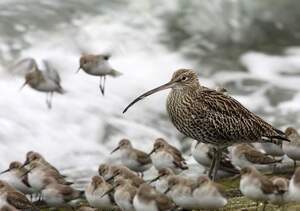
From top: The curlew population in Ireland has been diminished by 96%; Dan Boyle

It’s getting more and more difficult to find a decent environmental scare story. It’s hard to overcome that great wall of indifference, (largely made up, sadly, of decision makers) who instinctively feel that things are not so bad and if they become worse that will be then.

The increasing number of extreme weather events is shaking some out of their torpor. The intensity of the Californian wildfires may be leading some officials to declare that ‘abnormal is the new normal’, others choose to see it as a failure of forest management.

Actual evidence of damage being caused by climate change continues to be ignored because it largely lacks a visual manifestation.

An example of this would be the publication of a recent report showing a decrease of 60% in animal populations in an under fifty year period since 1970.

The indifferent may continue to sway away from statistics like this, thinking we’ve survived the passing of the Dodo and its ilk, what’s another few species?

Slowly the realisation may dawn that we are an animal species. There for the grace of whatever divine presence, that may or may not exist, go us.

Even the most selfish of us should recognise the extinction of any species as a series of canary in the coal mine moments for the human race on this planet. And yes the coal mine reference is deliberate.

We all are component parts of a wider ecosystem. The disappearing parts of that means the rest of us have to work that bit harder. It could be that an extinct species is responsible for something that can’t exist after them. Once gone it may never return.

Yaboo sucks deniers may chorus, in ways that makes me feel that the wrong parts of particular animal populations are being sustained.

Like Climate Change itself, the scale of what’s happening discourages many to do anything. As with general environmental action, it’s the local where effect starts to take place.

Ireland’s record on species protection is nothing to write home about. The Curlew population has been diminished by 96%. The government’s response to this has been to pass a Heritage Bill that allows hedge cutting during breeding periods, a new form of contraceptive for our breeding birds.

The current mania for dredging our rivers in the middle of spawning season is another form of genius.

This weekend a number of events (see below) are happening hoping to improve awareness of species extinction. The main event will be held in Dublin at 2pm outside the Dead Zoo (the Natural History Museum). Other events will be held in Cork (outside of its GPO) and Galway (alongside Salthill promenade).

Awareness is only part of the story. It’s anger that needs to be harnessed. In a focussed and direct way. The lack of appropriate political action is creating growing reserves of anger among environmentalists.

We will, I feel, see growing civil disobedience among environmentalists, weary at the lack of any substantial change on these issues. It’s a change of approach that should be welcomed.

Much better than playing at being dead.

Dan Boyle is a former Green Party TD and Senator. His column appears here every Thursday. Follow Dan on Twitter: @sendboyle

Pic: BBC Wildlife

Meanwhile…