


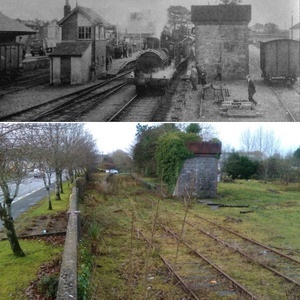

From top: Tobercurry Train Station, County Sligo in the 1950s and the site as it is today; Dan Boyle
I should have taken a picture but I was driving on a busy road, and there was no place to pull in.
Having just driven past Tobercurry, I caught a glimpse of a disused rail line. It was part of the Western Rail corridor that had once connected Sligo with Galway.
It was only a glimpse but the rail and sleepers didn’t seem to be in too bad a nick. It was very overgrown. In the picture were two ponies claiming grazing rights from the mechanised horse that had superseded their ancestors as the main means of transport.
Once I had gotten out of my own mechanised pony, I went to find out what had happened to Tobercurry and its status as a railway town.
I travel frequently in North West regularly passing through Tobercurry. I would be familiar with the short bypass road that ensures that the passing through is as limited as possible
I was saddened to learn that the construction of this road brought about the demolition of the train station and its ancillary buildings.
While learning this information I also came across a press release from 2003 calling for the re-introduction of the Western Rail corridor. It came from then Fine Gael spokesperson on Transport, Denis Naughten.
Too many ironies for me to handle.
Despite that I don’t see political inconsistency or resultant hypocrisy as being the main problem here. Who I consider most guilty of failing to redevelop Irish railways is Irish Rail.
Of course there is political responsibility in failing to provide a sufficient public transport subvention, or anything like an adequate capital budget.
What angers me about Irish Rail is that it doesn’t even try to be an advocate for an expanded rail service.
Throughout its history it has shamelessly overseen the closure of dozens of rail lines throughout the country, never questioning the Department of Transport’s aping of Britain’s Beeching Report.
The handful of lines that have been restored – Limerick/Galway; Cork/Midleton and the repurposing of the Harcourt Street line, have happened despite and not because of Irish Rail.
Even with low hanging fruit like seeking the reopening of the Navan line, an obvious safety valve for the commuter problems of Dublin, the silence of Irish Rail is sadly all too typical.
This inertia has created a vacuum that unused rail lines will remain perpetually unused. Into this void has come the reinvention of discontinued rail lines as greenways.
As a concept it has inherent logic. In practice, when produced, they are increasingly becoming important pieces of social infrastructure.
In Cork the former Cork Passage railway has been magnificently reimagined. The Great Western Greenway in Mayo was encouraged and supported while the Greens were in government. The Waterford/Dungarvan greenway has taken the spec to a new level.
The problem is that this type of planning must eventually reach saturation point, bringing about diminishing returns.
What’s worse is that it brings about lazy thinking that greenways should always be disused rail lines, and that all such unused lines should become greenways.
Along with others I’ve made a submission that a proposed greenway from Youghal to Midleton should not replace the existing rail line. Cork County Council laughably suggests that a greenway ‘futureproofs’ a railway there.
I’m not confident that this mindset can be challenged. If it can, or when it does, we then might have an Irish Rail that seeks to expand its network, and not the moribund vehicle of today whose summit of ambition is to decommissions much of the network it has for the sake of an easy life.
Dan Boyle is a former Green Party TD and Senator. His column appears here every Thursday. Follow Dan on Twitter: @sendboyle
Pics: SligoGreenaway