
Tag Archives: Dan on Thursday

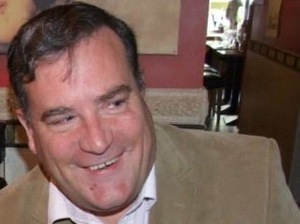
From top: Cork University Hospital, Wilton, Cork; Dan Boyle

The Accident and Emergency department at Cork University Hospital, not unique among Irish hospitals, has in recent weeks not only had far too many people awaiting treatment on trolleys, it also has seen many ambulances queued outside as mobile treatment rooms, preventing them from being available for emergency calls.

It is being suggested, that as a means of dealing with these ongoing difficulties, the hospital should convert its Acute Assessment Unit into a general ward to create additional bed space. I believe that this proposal would not only be counterproductive, it is an idea that is dripping with irony.

The Acute Assessment Unit was developed as an alternative to A and E, a measure that would relieve stress from the usual point of admissions in most hospitals. Initially GPs could refer patients to the unit bypassing the need to go through A and E.

I was a beneficiary of this unit. Around five years ago I acquired a serious bacterial infection. After a visit to my GP, a blood test revealed that my white blood cell count was extraordinarily high. I was the most ill I had ever been in my life.

My GP had me admitted to the Acute Assessment Unit. There I was put in the care of an exceptional consultant and an amazing nursing staff.

I required three laser surgery procedures over three days. The first procedure did not go well. I found myself having difficulty breathing and in a great deal of pain.

It was then I experienced all that is good with our health service. During my difficulty a change of shift occurred, but a junior doctor and the nurse in charge, stayed on a further 90 minutes until I was again breathing normally and the pain had subsided. I will always be grateful for the kindness they showed me.

This I experienced as a public patient. Public by choice. I believe in a public health service. It is one of the obvious failings of the Irish health system that not enough policy makers, and sadly some service providers, don’t.

We spend a lot of money on our health system. More proportionately than our neighbour the UK does on its National Health Service.

Our funding mechanisms are a mess. Around two million of our population are medical card holders at a cost to the State of about €1500 per year per card. This would be divided between holders of hospital service and doctor only medical cards. Two thirds of this cost is spent on drugs.

Two million others take out private health insurance, partially subsidised through tax relief. The average premium is about €2000 a year.

Value for money is not being provided through either funding mechanism. We should no longer accept a bit of this a bit of that approach to our health service.

We should adopt a philosophy that has health promotion ahead of reactive health care. A system which is more community than hospital based.

Health care should not be a lottery. I was lucky, very lucky. I was at the right place at the right time when I became ill. A time when some innovation was being attempted. A shaft of light that allowed a possibility that different might be better.

We seem to be reverting to business as usual crisis management of our health services. This will guarantee ever increasing costs with ever worsening outcomes.

Becoming ill or watching those we care about suffer is already bad enough. Having a health care system that is more ill than we are ourselves, is truly tragic.

Dan Boyle is a former Green Party TD and Senator.  His column appears here every Thursday. Follow Dan on Twitter: @sendboyle

Pic: Denis Scannell
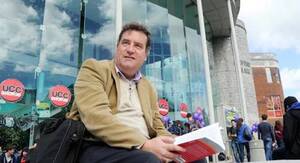
Dan Boyle is to run in Cork City South Central at the local elections in May

I was 28 years old when I was elected in my first election. I was the second youngest person elected to the City Council, the youngest being the son of a then TD. There were a number of others elected who were in or around my age; Micheál Martin (two years older than me) had already served six years on the Council.

Most councillors were 15 to 20 years older than me, which led to a fair amount of condescension being directed towards me in my early years as a councillor. Being the first Green elected had slightly fractured the comfortable template of local politics. I neither spoke their language nor understood their thinking. I imagine the feeling was mutual.

I have been thinking of my original experiences as a councillor while listening to a radio piece on the number of young, first time councillors who are not seeking re-election, which played on the RTÉ This Week programme.

The combination of factors mentioned were understandable and logical. The economic reasons were most cited. Many first time councillors were surprised at the scale of the work involved, and how doing public work compromised their ability to engage in other, better paid work, that would help in securing housing and in raising a family.

Few of these now departing first time councillors seemed to gain any sense of real job satisfaction. When a large number of those you are meant to work with, and for, identify you only in negative terms, those negative reactions tend to get under your skin more.

Some departing first time councillors also found life within political party structures to be somewhat confining, with some political parties being more regimented than others.

I was sorry but not surprised that young political activists have experienced this. A vibrant democracy depends on a regular throughput of new people and ideas. Any attempt to bring about an actual reform of local government in Ireland would be worthless if these negative experiences were not adequately responded to.

I would hope that these prematurely retiring councillors may, sometime in the future, return to the public sphere, being then able to put their experience to a more positive use.

I suggest this to highlight a mirror image problem that also afflicts Irish politics, those who continue in public office but whose continuity has become far too lengthy.

We should begin to embrace the idea of term limits. Contribute to public life but leave space to experience life as it is, outside of the goldfish bowl that it is Irish politics.

Make a better, and more informed, contribution by returning to public life after leaving its often narrow, inwardness and insularity behind.

This was a choice that was made for me. After dealing with the personal disappointment, I’m kind of glad that choice was made. Being outside hasn’t made me any less committed, but it has allowed me the space to look from the outside at the system and its many flaws.

This year it will be seventeen years since I last was a member of a local authority. I was first elected half a lifetime ago. I spent a further ten years in frontline national politics.
The last eight years as Citizen Boyle has given me a far better perspective on life.

I have regrets and many frustrations. The changes I would make would be personal, would be social. There is little I would try to change politically, at least not in terms of my personal beliefs.

I’m putting myself forward again seeking to become part of a system of government I know isn’t working. I want to help this system to work to its potential, to work differently, to work better.

To those stepping aside now I say come back again soon. Together let’s fail some more. Let’s fail better.

Dan Boyle is a former Green Party TD and Senator.  His column appears here every Thursday. Follow Dan on Twitter: @sendboyle

Pic : Denis Minihane/UCC

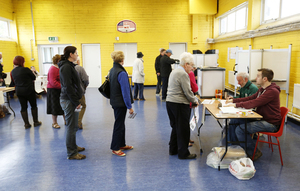
From top: voting during during the last European and Local Elections at Scoil Naomh Aine Presentation Primary School, Clondalkin, Dublin on May 23, 2015; Dan Boyle

On May 24 voters in Cork, Limerick and Waterford will face a rainbow of ballot papers.

In addition to being asked their choice as to who should represent them on their local councils and in the European Parliament, along with the rest of the country, two proposed constitutional changes will be put before them.

A fifth paper will be presented to these voters in the form of a plebiscite to ask whether an office of a directly elected Mayor should be created in these areas.

While this is a government initiative it is unclear to what extent the government actually supports, or believes in, this proposal.

This is a Fine Gael led government that since 2011 has sought to abolish the Seanad, has reduced the number of local councils and councillors, and has done sweet damn all in reversing the centralising of decision making towards national government.

Developing their proposal has been half hearted, to say the least. How the government intends to define the office remains vague. With a voters’ decision now only weeks away there is little indication that the government is being sincere in its intentions on this.

My cynicism has been heightened by reading a recent Irish Examiner article which got hold of cabinet memos that indicated support for this policy is somewhat lukewarm.

I assume the leaking of these memos has been deliberately done by those who are quite happy to talk the language of reform, while never really wanting to rock the boat.

These memos reveal that some cabinet ministers fear ‘too much power’ being allocated to directly elected Mayors.

The views of the Attorney General (which are meant to be confidential) state concerns that transferring such powers to a more local context, risks not availing of expertise that exists at a national, central, level.

Those of us who have seen Cork City Council defer to the Office of Public Works on how the character of the city’s quay walls should be irredeemably damaged, find this contention to be laughable.

Power should be diffuse. Power should be distributed. In devolving power downwards the winners will be our citizens and local communities. The losers will be those who seek to stifle change, afraid to let go, afraid that their citadels will become undefended.

They are ignorant to the extent that decision making has become over concentrated and as a result less efficient.

Politics, especially local politics, would be less reactionary and more inclusive, if decisions were made close to those most affected by such decisions. Resources, instead of being drip fed from national government, could be more directly used at a considerably smaller bureaucratic cost.

A greater sense of ownership among citizens and local communities could come about from an improved local democracy, that better involves them in the decision making process.

The cynic in me doesn’t believe this government actually wants directly elected Mayors, or indeed any real reform of local government. I would encourage voters in Cork, Limerick and Waterford to call the government’s bluff.

However weakly the government is making the case voters should vote for a directly elected Mayor. Establishing this office can provide a platform to reverse the trend of moving decision making powers away from local communities.

These votes in these cities could result in the government wanting what it gets instead of getting what it wants.

Dan Boyle is a former Green Party TD and Senator. He is running in the local elections in Cork in May  for the Green Party.  His column appears here every Thursday. Follow Dan on Twitter: @sendboyle

Rollingnews

From top: Schoolchildren at the climate strike in Dublin city last week; Dan Boyle

As I turned into Emmet Place it wasn’t as I expected it to be. The scale of the number of students there had surprised me. I ruefully thought of protests I had attended in the past, where a few dozen of us would march to highlight some political or environmental wrong.

Outside the Crawford Gallery I met an old friend. Over thirty years we had campaigned together on various causes. We played different roles. I chose the route of public meetings/gatherings, then trying to articulate wrongs through various media. He chose to be more anonymous. Doing research, producing reports, using science, law and logic to far better articulate what was wrong and why.

He was as pleased as I was at the strength of the gathering. He wondered out loud if we had failed over the previous generations.

Here I partly diverged from his thesis. We had failed to make progress, failed to reverse the damage, but we did to some extent stem the poisonous flow. A generational finger in the dyke exercise.

Years of seemingly futile flag waving exercises at least seemed to have kept the narrative alive. The indignity of being so long ignored, so long derided, before acceptance of the reality of environmental crisis has become mainstream.

The sight of so many young people embracing the challenge that preceding generations had failed, has warmed the cockles of an ageing man’s heart.

And they are doing so with an emotional maturity that I have yet to manage. They are earnest but without the air of preachy seriousness in which many of us had indulged. Indulgences that discouraged many climate change waverers from becoming convinced.

This generation is more inclined to use derision as a better method of displaying two fingers towards the ignorant and the inept.

It has been dawning on them that the ultimate responsibility for clearing up this mess lies with them. They are eschewing the ostrich head in the sand approach of their predecessors. They are recognising that life as we’ve known it isn’t worth living, unless we right these wrongs.

It wasn’t only the emotional maturity and environmental nous that impressed me. These young people are coming through life with none of the stereotypical hangups that blighted my generation.

How they related to each other was a source of wonderment to me. Most exuded a this is who I am, this is what I am attitude, deal with it defiance, that I wish I had during my adolescence.

I did not witness a docile and brain dead generation laid waste by video games and the internet. I saw young people able to interact with each other in an almost gender free way. The emotionally hamstrung me of thirty years ago cried out why couldn’t I be like that?

They will learn their own lessons. They will make as many mistakes as we have made, but they will be starting from a better place.

They will be deeper in the mire, though no longer indifferent to the challenges they face. They will fight in a way we didn’t, nor probably couldn’t.

Our generation may have removed some barriers, cleared some ignorance, but theirs remains the harder task.

Theirs is the shorter time span caused by our frittering of the time of knowing what was known.

I had bought into the myth of of a millennial generation that was spoilt, indulged and cosseted from the real world. Seeing what I’ve seen this week I realise how wrong and unfair that portrayal is.

A future is possible. It will be thanks to them.

Dan Boyle is a former Green Party TD and Senator. He is running in the local elections in Cork in May  for the Green Party.  His column appears here every Thursday. Follow Dan on Twitter: @sendboyle

Rollingnews

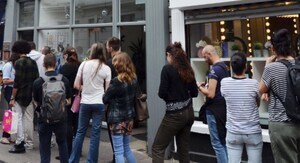
From top: Queue to view a one-bedroom apartment on Tuckey Street, Cork last Summer; Dan Boyle

The electoral area I am seeking to represent contains Cork’s south inner city. As with any urban area, proximity to the centre sees a larger availability of private rented tenancies.

These tend to be older buildings, many of which have been broken down into smaller apartments. Calling door to door it is eye opening to see how many of these properties are sub-standard.

It is the unspoken part of the housing crisis. Too many people and their families are registered as homeless. The housing market, left to its own devices, is producing a spectacular mismatch between supply and demand.

And yet fear of both these factors means an enormous number of people spend their lives living in sub-standard accommodation.

An inspection regime exists, administered by the local authority. The regulations that inform these inspections are the Housing (Standards for Rented Houses) Regulations 2017. The initiation of such inspections is solely the preserve of the tenant – the tenant who lives in fear of losing their tenancy, however sub-standard it is.

This perverse form of governance, is unfortunately, far too prevalent a feature of Irish legislation. Notwithstanding the fact that local authorities lack sufficient resources to provide a robust inspection regime, this nobbled process will never be properly used by those who know that other available, affordable accommodation does not exist.

Bunreacht na hÉireann has tied us up in a constitutional Gordian knot. Legal interpretation has weighed in too heavily in favour of private property rights at the expense of the common good. We may need an explicit new constitutional reference to overcome this. Despite this we should be bolder in drafting and implementing legislation in this area.

Property owning has responsibilities as well as rights. Vacant properties, derelict properties, sub-standard properties should be treated as crimes against society, should be stringently policed and prosecuted with zeal.

Fines for presenting property in these ways should be punitive, then immediately be re-invested into having such buildings brought to their full potential.

Part of the double-think that informs policy in this area is the number of tenants living in sub-standard buildings, who are in receipt of housing assistance payments (HAP) to help them meet the cost of their rent.

This means that landlords of sub-standard properties are not only having a blind eye turned to the type of property they are making available for rent, they are being financially subsidised, rewarded, by the State for making these properties available.

We need to take the onus away from tenants in insisting that they be provided with housing that conforms with minimum standards. Local authorities should be sufficiently resourced to undertake spot check inspections. Complaints should be made by those other than the tenants themselves.

I would argue that this could, should be a role of locally elected councillors. There are precious few actual powers possessed by locally elected representatives.

One ill defined but important role is that of local ombudsman – an on the ground observer of the quality of services; someone to articulate the need to bring them up to standard. These are the voices we are not hearing in the current debate.

These are the responsibilities we need to live up to.

Dan Boyle is a former Green Party TD and Senator. He is running in the local elections in Cork in May  for the Green Party.  His column appears here every Thursday. Follow Dan on Twitter: @sendboyle

Top pic: Twitter

‘I have spent too much time playing this game that I’m not going to play anymore‘, says Dan Boyle (above) of engaging with abusive trolls

There are times in life when everything pales in significance. Where the personal overtakes the public, framing what had once been thought important as not being so important after all.

My life has fallen into such a phase. For most of my life I have been a public person. It remains my intention to continue to engage publicly. What I’ve begun to question is my willingness to accept and tolerate what for the most part is unacceptable and intolerable.

Faced with the facile, the uninformed or just the plain ignorant my instinct has been to engage in some form of reason. My own fuse has often been short and tightly wound. To my shame and embarrassment I have often responded with unfortunate lack of patience aimed at those from whom I have detected no sense or reason.

Despite these lapses I have bitten my tongue more often than I should have. Like most others in public life I have shared the need to be liked, as a prerequisite for attaining ‘support’. The corollary of accepting affection has been an obsessive desire not to cause offence.

It is, of course, a continuum. The yin and yang of life. We might stray from one end of this range to the other, but at least we aspire never to move too far from the middle.

The choices we make contribute to our potential of being marked out by those without boundaries. Being of the wrong tribe, part of a clique less large or traditional, brings obvious responsibility for not fitting in appropriately.

The willingness to attack or to dehumanise is more a feature of social media than face to face contact. I rarely would personally encounter someone who would tell me to my face that I was amoral, that I had blood on my hands, or that they understood why my wife might have left me.

These things have been said to me on social media. If they were intended to provoke a reaction they worked. They made me angry, sometimes indignant, sometimes hurt.

They are not now being said as frequently or as bitterly, although a certain residue continues to persist.

I have spent too much time playing this game that I’m not going to play anymore. I remain open to critical engagement. There is much about what I do that warrants criticism. When fairly delivered, in a proper context, I would hope my response to such criticism would help me do what I do that bit better.

What I will avoid, beyond Lent, is responding to any contemptuous abuse, any reference to my family, any inverted ‘truth’ designed to fit with whatever fatuous prejudice held.

It won’t change the World but it will make my world more sane. I’ve been a fool to have put up with such nonsense for so long.

It won’t make those who I will now ignore as any less angry, but I’m beyond caring about that. The people who matter most to me are those who are closest to me.

If I feel guilty about anything it is the time I should have but didn’t spend with those I love, choosing instead to interact with those who never deserved my time, who have held each other in mutual disrespect.

This may be a long winded way of saying Don’t Feed the Trolls. My goal is to make them starve. I have been the bigger fool for giving them the ingredients

Dan Boyle is a former Green Party TD and Senator. He is running in the local elections in Cork in May  for the Greren Party.  His column appears here every Thursday. Follow Dan on Twitter: @sendboyle

Pic: Allstock


From top: The proposed M28 route from Cork City to Ringaskiddy; Dan Boyle

This week arguments are being heard in the High Court on the decision of Bord Pleanala to agree with an earlier decision of Cork County Council, to approve the route for the construction of a new section of motorway, the M28, to better link the Port of Cork at Ringaskiddy with the existing road network.

The gist of the argument being made is that neither Cork County Council nor Bord Pleanala put sufficient emphasis on the EU Habitats Directive when making their respective decisions.

Their collective oversight seems to have been most negligent regarding a historic quarry at Raffeen, a key point of the proposed motorway route.

Maybe the County Council and Bord Pleanala were unduly influenced by the term ‘quarry’? The site had been untouched for many decades. It has developed into quite a haven of biodiversity.

Something that should been obvious to anyone promoting this project, if they had done anything like an effective Environmental Impact Statement.

There is a good reason that this legal argument could hold sway, given a recent court decision made in favour of Friends of the Irish Environment in relation to the proposed Shannon LNG refinery.

Here the total inadequacy of adhering to the EU Habitats Directive was cited as the ultimate reason why the planning decision was unsafe.

The M28 judicial review is one of several such reviews that have or are being heard, all emanating from the Cork region.

Before the end of 2018 the Save Cork City campaign, protesting OPW proposals to create a concrete sarcophagus for the River Lee, as the least imaginative response to flooding risks, won its judicial review on Cork City Council’s contemptuous ignoring of the Habitats Directive.

Pending judicial reviews remain to be heard on the proposed Ringaskiddy incinerator, the plastics factory being suggested for Skibbereen, and an unloved promotion of a mechanised Kelp farm for Bantry Bay.

Giving permission to hear judicial reviews is by no means a given. The granting of these hearings is an admission that credibility exists in the taking of these cases, combined with the need to have arguments heard.

Part of me welcomes judicial activism in relation to the environment. It highlights the political indifference that has otherwise been the lot of environmental campaigners.

Much of this has been made possible by the application of the Aarhus Directive on the right to freedom of information on environmental matters into Irish law.

The Irish legal system has yet to realise the potential of this directive, but its impact is being felt incrementally.

In government The Greens struggled with an Attorney General who was painfully slow in implementing Aarhus. Within months of The Greens leaving office, a new Attorney General had no such qualms.

What these collective actions surely show is that our quasi judicial bodies, Bord Pleanala and the Environmental Protection Agency are not fit for purpose.

Neither body has ever had an environmental activist as a member of its board. Both have been the creatures of the traditional political parties and most particularly of IBEC.

In case it gets mentioned, while The Greens were in government, no vacancy occurred in either of these bodies.

We should be considering an Environmental Court, or possibly an Environmental Ombudsman.

To persist with a system where the only winners are the legal eagles, does not help campaigners, nor does not suit any concept of natural justice, and most certainly it doesn’t suit the environment.

Dan Boyle is a former Green Party TD and Senator. He is running in the local elections in Cork in May  for the Greren Party.  His column appears here every Thursday. Follow Dan on Twitter: @sendboyle

Map: Cork National Roads Office


From top: Nigel Farage and Donald Trump during the 2016 Presidential campaign; Dan Boyle

Oscar Wilde once described fox hunting as the unspeakable in pursuit of the uneatable. A similar literary formula could be used to describe Brexit. The unbearable seeking the unattainable. The ineffable in pursuit of the incoherent. The graceless looking for honour.

In parallel with the Trump presidency, it and Brexit have been the political realities which never could be described in any fiction, nor lampooned through any satire.

These are the campaigns that have shown there are no depths of hate or ignorance that can’t be plumbed to achieve success, at least in the short term.

Neither phenomenon has been a flash in the pan. Each has been building their coalitions over decades. The Trump coalition a natural consequence of years of softening up the required parts of the US electorate using actual Fake News, purveyed largely by Fox News then amplified, however ridiculously, by the likes of Rush Limbaugh, Ann Coulter and Alex Jones.

No conspiracy has been too cracked, no lie too lurid, to plant as many poisonous seeds into the minds of pliable believers.

The final push has been made possible by WikiLeaks, owned by the once liberally loved Julian Assange, who showed himself no different than many in politics, in putting into practice the maxim that Knowledge is Power, to be used against those you dislike most.

Brexit can best be seen as Margaret Thatcher’s revenge. Her acolytes, shamed at the manner of her disposal, took up her torch striving to stretch her dogmatism to previously undreamt levels. They became John Major’s ‘bastards’ almost scuppering the Maastricht Treaty.

Their failure saw shadow Tories exert external pressure on the party. James Goldsmith, ironically elected as a MEP in France, set up the Referendum Party, ploughing £20million of his money into the venture.

The 1997 British general election was the party’s chosen field in combat. Goldsmith stood against the risible Tory Minister, David Mellor, who lost the seat despite and not because of the intervention.

The Labour landslide meant the Referendum Party’s 2.5% of the national vote had no effect on the national result. Goldsmith died a number of months later. Many who followed his cause drifted into the then nascent UKIP.

Through a succession of European Elections UKIP won 3 seats in 1999; 12 in 2004; 13 in 2009; before becoming the largest UK political party represented in the European Parliament with 24 seats in 2014. This was followed by a number of Tory defectors winning by elections to give the party its first House of Commons seats.

This led Tory Prime Minister, David Cameron, to recklessly promise a referendum in his party’s 2015 general election manifesto.

When held in 2016 that appalling campaign, without any kind of independent oversight, produced the result we continue to live with. Cameron could have reneged, he could have even delayed, and the result would have been so different.

Peak UKIP had already been reached. The party has had four different leaders since the nefarious Nigel Farage stood down in 2016. Its 24 MEPs have been reduced to 7.

Three new political parties have been established in its wake, including the it does what it says on the tin ‘Brexit’ party set up by Farage. One of its former MEPs now claims to represent the re-incarnated Social Democratic party.

Logic doesn’t come into it. While these are the historical facts of how Brexit thinking came into being, and has since steeply declined, they are far from the only factors as to why Brexit exists.

Liberal hubris has also been instrumental. Progress can never progress if too many get left behind. It’s clear with the advent of both Trump and Brexit many have been discarded by what was before.

Brexit isn’t inevitable but it is becoming increasingly unlikely it can be reversed. Maybe the UK needs to live through the inherent contradictions of Brexit before sense and logic returns. We shouldn’t be paying for their mistakes though.

Dan Boyle is a former Green Party TD and Senator. He is running in the local elections in Cork in May  for the Greren Party.  His column appears here every Thursday. Follow Dan on Twitter: @sendboyle

Pic: Getty

From top: Members of the Fingal Battalion Direct Action group outside Minister for Health Simon Harris’s County Wicklow home last Sunday; Dan Boyle

They looked a sorry lot. The half worn balaclavas combined with sunglasses was not the most de rigueur look.

The self styled Fingal Battalion gave the impression they had arrived in Wicklow after a 21st century attempt at the Jarrow March, hiking from Balbriggan to Greystones but frustratingly failling to pick up any support between Howth and Bray.

After 40 minutes on the M50 they finally found soulmates in the form of Wicklow Says No, undoubted second cousins of Ian Paisley and the DUP.

Being angry for anger’s sake must be one useless and pathetic responses in modern politics. Anger, as John Lydon has warbled, is an energy, but a particularly empty one if not effectively harnessed or directed. Anger to be acted on needs to have a strategic purpose.

There is plenty airing these days of who and what most people are against. There is very little exposition on what most people are for.

It is very easy to be reactionary, to create then point at a panoply of hate figures who are there to be blamed; never to recognise responsibility as something that needs to be shared.

Maybe I’m wrong in being bothered about the politics of hate. It’s more of a religion really. Its rites and rituals now fairly commonplace. Its liturgy seems to write itself.

Its demonology affixed to the misplaced great and good, for whom a special place in hell has been bought and paid for several times over.

Like any mainstream religion there isn’t any need for theological consistency either. Followers of GOD on Earth (Gemma O’Doherty) seem to see no irony in demanding a platform, for her and them from the malign, nay evil, Empire of Google

The ultimate irony is that this type of politics of the playground often achieves the opposite of its intentions. It evokes an undeserved sympathy for the inept, the incompetent, the evasive and the incomprehensible.

The many failures of traditional politics lay not in not exposing the intricacies of conspiracies, but in the persistent inability to avoid cock ups.

It isn’t George Soros who’s having meetings about bringing about an end of the World as we know it, it’s the conspiratorialist who believe he is.

One of the sadder and more pathetic aspects of the religion/politics of hate is that anyone who questions these inconsistencies, who challenges these basic tenets, immediately becomes part of the demonology, a conspirator inter pares.

This type of buffoonery not only insults successful protest movements of the past, they also help undermine the credible vehicles of today and their near future counterparts.

That’s the frustrating thing about democracy, built into its modus operandi is the right, even the need, to be wrong.

I’ve been wrong before. I will be wrong again. I’d like to think that I have and will learn from my mistakes. The scary thing about the religion/politics of hate is an ingrained inability to admit they can be wrong.

Their messianic view of the World does not allow for the right to be wrong. To be wrong is to be as bad as they are. If you can’t be moralistic, in this solipsistic World they inhabit, how is it possible to be moral?

Like economics, political thought and actions are subject to cycles. It has been our collective tragedy that a dark phase of these cycles has co-incided over the past decade.

But these things too shall pass. We can choose to let these times overcome us, we can be the change we want to be, or we can live our lives in a state of perpetual bemusement.

Dan Boyle is a former Green Party TD and Senator. He is running in the local elections in Cork in May  for the Greren Party.  His column appears here every Thursday. Follow Dan on Twitter: @sendboyle

Previously: Meanwhile, In Wicklow

From top: Dan Boyle election posters from the 2002 General Election (top) and 2011 General Election (centre); Above Dan today.

My strategy, such as it is, is to let people know people know that I am standing. I’m hoping to at least have some piece of literature delivered to every house in the electoral area.

I want to deliver as many of these leaflets myself so I can carry out some soft canvassing, trying to engage with whomever I come across.

To date I’ve been to six thousand houses, but this is little more than a third of number of houses in the area.

The second phase is to directly knock on the doors. This is what is most important, especially for the local elections. Having met and having a knowledge of a person are the most likely reasons for voters choosing to vote for a candidate.

I’m acutely aware of the demographic changes that have occurred since I have last been a publicly elected representative for the area. Many who had voted for me are no longer of this World.

Few of the first time voters have any recollection of my ever being an elected representative before. My experience, such as it is, counts for little if I can’t combine that with an ability to convince every prospective voter of what I can do, at least for the next five years.

Weekdays I tend to go out on my own. At weekends I get joined by a number of friends. It’s a good way of discovering who your friends are. As well as the personal support, the mutual aerobic exercise achieved by walking about 6km each time can only be good.

It’s a numbers game. About half the electorate will sit out the local elections. I wish more would participate. We desperately need more people to do so.

For some not participating is their verdict on the potency of local government itself. In that they are not wrong, although I believe systems can only be changed from within.

For most it is a cynicism against politics, a cynicism that for many may have become far too ingrained to change.

The process of canvassing is for the most part a largely pleasurable one. People tend to be kind, polite even tolerant. Tirades are rarely encountered. Some sense of discontent can be read into world weary sighs and often withering stares. Even when met with the negative I have always preferred the passion of anger as against the numbness of indifference.

The means of canvassing of political canvassing may be being slightly changed by social media, but I don’t believe that the intensely personal nature of campaigning in Ireland will ever change. Nor should it.

No opinion poll, no focus group, can ever be as effective as an individual voter telling you something on the doorstep.

Criticism, when it occurs, can often to be cutting but is always incisive. One encounter I especially remember is when a constituent said to me :

“The only time we see you these days is when you are the television.”

There really was no comeback to that.

The former speaker of the US House of Representatives. Tip O’Neill, is credited with the aphorism ‘All politics are local’. This has often been represented as politics being about policies.

Politics are about people. That’s what we so often get wrong.

Dan Boyle is a former Green Party TD and Senator. He is running in the local elections min Cork in May  for the Greren Party.  His column appears here every Thursday. Follow Dan on Twitter: @sendboyle