
Tag Archives: Debt

00069347Screen Shot 2014-11-04 at 01.26.12

Tony’O’Reilly at the INM AGM in 2004 (Top) and David Duffy on The Real Deal last night.

You may recall how this summer AIB secured judgements against Tony O’Reilly and companies controlled by him for €45million.

In June the Commercial Court heard that he owed approximately €195 million to eight different banks – with AIB reportedly calling him ‘insolvent’ three times during the hearing.

On The Real Deal, a documentary on Tony O’Reilly (by  RTÉ’s David Murphy) broadcast last night, David Duffy, CEO of AIB, pictured above, said:

“People will make all kinds of comments about what they perceive is the reality. We engage in a very simple process, it’s very consistent and it’s equitable and fair and does not differentiate between one person and another. So there is absolutely no question whatsoever that we took an action for a purpose, other than to treat people exactly as everybody else is treated.”

Further to this, readers may also recall how in June, Colm Keena reported in the Irish Times:

“The purchase of three major Irish businesses over the past two years by the billionaire businessman Denis O’Brien involved total bank write-offs of more than €300 million. The deals saw the businessman invest €230 million to acquire the Siteserv Group, the Topaz Group and the Beacon Private Hospital.”

Mr O’Brien, who has a 29.9 per cent stake, is the biggest shareholder in the Independent News & Media. In April last year the group did a deal with its eight banks, which include AIB and Bank of Ireland, where the banks wrote off €138 million of an overall debt of €422 million, in exchange for a shareholding in the group worth approximately €10 million.”

Good times.

Watch back in full here

Related: Ignominious end to career of Ireland’s first business superstar (Ciaran Hancock, Mark Paul, Irish Times, June 27, 2014)

Sir Anthony O’Reilly described as ‘insolvent’ by AIB (Tom Lyons, Irish Times, June 24, 2014)

Banks write off over €300m in three deals with Denis O’Brien (Colm Keena, Irish Times, June 13, 2014)

(Eamonn Farrell/Photocall Ireland)

jillian

[Jillian Godsil]

Unsuccessful European election candidate Jillian Godsil writes:

“I may not be elected but I am still talking about debt. I wrote this [below]
yesterday and I think it is really pertinent. The banks are doing to people what the religious institutions did before – and again with the compliance of judgmental thinking…”

There are 800 skeletons of small children found in a septic tank in Tuam, Co Galway. This horrific discovery was first made back in the 1960s by two small boys but nothing was done, no investigation made, not even a graveyard instituted. It was left to a local man Padraig to try and create a small memorial and sadly he passed away last week. It was left to local historian Catherine Corless to try and provide a proper and fitting response.

The babies were looked after in a Bon Secours institution, calledronically The Home, from 1920s to the 1960s The babies were all born to unwed mothers; mothers who were thrown out of their family homes to give birth to their bastard children in an institution. If their babies survived they were often forcibly sold into adoption with suitable parents. The death toll of these children was four times the national average. The girls were often forced to work as indentured slaves as a punishment for their crime of having a child out of wedlock.

Some pregnancies would have been as a result of violence and perhaps rape. Some would have been as a result of ignorance of contraception – and the total lack of same in contraceptive-free Ireland, even married women could not easily avail of contraceptives. Some of the woman probably enjoyed it, probably wanted more, and probably wilfully engaged in sex without any due regard to the consequences of getting caught. Dirty girls. They deserved all they got. They should not have had sex outside of marriage – even if they were forced – and they probably had it more than once. It was all their fault.

As for the offspring? They were bastards, and if lucky to survive, would be taken off the dirty girls. They didn’t deserve anything either.

Does that sound familiar? There are 300,000 families in mortgage arrears in this country. There are 27,000 families facing eviction this year. There are more than two suicides every day, many of them from financially inspired reasons. Yet, instead of compassion, we hear the same moralistic tones. They were greedy with debt. They wanted more. They probably had it more than once. They couldn’t control themselves. For God’s sake, could they not control themselves.

They could not keep their dirty hands out of the bank account. Could they not behave and not borrow. Disgusting people, greedy people, dirty people, and dirty debt.

So while the banks, as the religious institutions before them, blame those in debt, take their possessions, lock them in perpetual servitude, shame them and cause misery onto the innocents – the babes in the homes – we, as a society, look on. We tut tut. It was all their fault we say. They were dirty, debt people. They should have known better. They enjoyed themselves while we stayed home and were miserly.

They were greedy, dirty, debt accumulators. Now let them pay the price. As for the children in those homes, where the parents are now dying of debt every day, where there is misery even onto suicide, we do not need to concern ourselves with those children. They are the children of the dirty debt brigade. They are different from our children. We will let them suffer, the little children, even onto the banks’ profits. There but for the grace of God go I. And you.

Jillian Godsil

Wolfgang_-_12525373_402145cGerman finance minister Wolfgang Schäuble.

We were too good.

Speaking in Luxembourg this lunch time on the fringes of an EU finance ministers’ meeting, the German finance minister said that retroactive direct recapitalisation for Ireland was “not probable”. “Ireland did what Ireland had to do… now everything is fine,” Mr Schauble said. His comments underline the growing sense in German circles that Ireland’s strong performance under the bailout has lessened its case for further debt relief on its €64 billion bank bailout.


Germany warns direct aid for banks is unlikely (Suzanne Lynch, Irish Times)

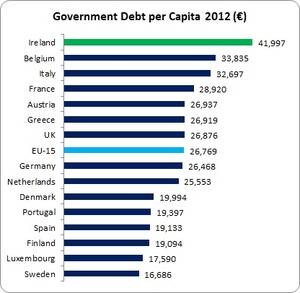
6a00d8342f650553ef019affb02bde970c-500wiHighest debt per capita of any European country.

Economist Michael Taft writes:

…Ireland is at the top, head and shoulders above all other countries – in particular, Italy, Greece and Portugal which the Fiscal Council refers to as countries with a higher debt when measured as a percentage of GDP.  Why the difference?
Measurements which use GDP as the benchmark can distort Irish data given that GDP is flattered by the accounting practices of multi-nationals.  For instance, when using Gross National Income as the benchmark (which is equivalent to GNP) which removes international flow such as profit repatriation, debt in Ireland is 143 percent of GNI.  This is the second highest, only exceeded by Greece.  But the fun doesn’t stop there.  The ESRI has found that even our GNP/GNI is inflated due to multi-national activities (undistributed profits of headquartering multi-nationals).  If this was factored out, we’d be reaching Greek levels of debt….

Sea of Debt (Michael Taft, Unite’s Notes On The Front)

Thanks Justin Moran

90130247

Hundreds of distressed borrowers — including businessman Bill Cullen (above) — have ploughed their assets into a single private trust in a bid to prevent lenders repossessing their properties.

Land and buildings belonging to at least 600 developers, businessmen, and farmers have all been put into this trust since word about it began to spread late last year.

They are hoping the courts and lenders will be unable to get at the assets because of the ancient and complex trust laws.


Debtors protect assets in private trust (Vincent Ryan and Conor Ryan, Irish Examiner)

Is this kosher?

Legal Coffee Drinker writes:

Under Section 59 of the Bankruptcy Act 1988, the trustee on bankruptcy has power to unwind certain earlier transactions by the bankrupt in order to recover assets for the estate.
The transactions which may be set aside are transactions made by the bankrupt as a gift or at an undervalue. These would include payments or transfers into trusts (including family trusts)
All such transactions made within the two years prior to the bankruptcy can be set aside.
They can also be set aside if made between two and five years prior to the bankruptcy petition, where the bankrupt was insolvent at the time of making them. Insolvent means unable to pay his debts.
The two year period in Section 59 is to be extended to three years by the new Personal Insolvency Bill.
In addition, and irrespective of any bankruptcy order, under Section 74 (3) of the Land and Conveyancing Law Reform Act 2009, any conveyance of land made with the intention of defrauding a creditor (i.e. avoiding paying a debt to that creditor) may be set aside by the creditor on application to the court.
So if land has been transferred into a family trust in a situation where there are substantial creditors, the creditor may apply under Section 74(3) to have the transfer set aside even where the debtor has not been declared bankrupt.

(Leon Farrell/Photocall Ireland)


Launch of Public Information Campaign- Insolvency Service of Ireland (ISI)Lorcan O’Connor (right) and Alan Shatter.

€125.97 a month for socialising.

Their shirts cost more.

From the Financial Times:

“On Thursday Ireland’s Insolvency Service set out monthly spending limits for people seeking debt deals from their creditors, highlighting the impact austerity is having on Irish spending habits. A single person will be allowed just €247.04 a month for food, €57.31 for heating and €125.97 for “social inclusion and participation”, an expenses category that includes tickets for sporting events and the cinema.”

A reasonable standard of living does not mean a person should live at luxury level, said Lorcan O’Connor, director of the newly established Insolvency Service of Ireland (with Justice Minister Alan Shatter above). “But nor does it mean that people should be punished and live only at subsistence level.”

“In most cases, people seeking debt deals will also have to give up private health insurance and their cars, although they will be able to keep their vehicles if they do not have access to public transportion.”

“Under Engish insolvency law, which is less proscriptive than Ireland’s new guidelines, “reasonable” day-to-day expenses for bankrupts include holidays, mobile phones and video rentals. While gym memberships, private health care, gambling, cigarettes and alcohol are considered unreasonable, English debtors do not face monthly cash limits.”

Ireland picks through debtors’ lifestyles (Jamie Smyth, Financial Times via CNN)

Previously: It’s Like Getting A Divorce In The 1980s

Pic: Breaking News

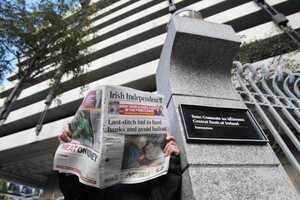
Senior Government figures are becoming apprehensive about the prospect of Independent News & Media (INM), Ireland’s largest newspaper group, having some of its debts written off by State-supported banks.

INM, publisher of the Irish Independent and Sunday Independent, owes more than €400 million to a consortium of eight lenders that includes the State-owned Allied Irish Banks and Bank of Ireland, in which the State has a 15 per cent stake.

Financial pressure on INM has led it to enter talks with its banks to restructure this debt. Political and business sources believe a write-down of up to €100 million may be in play.

Awk-ward…

…again.

Unease in Government over INM debt-relief moves (Arthur Beesley, Irish Times)

(Leon Farrell/Photocall Ireland)