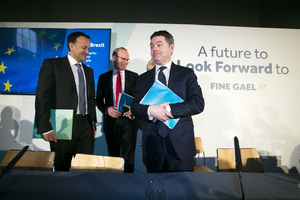



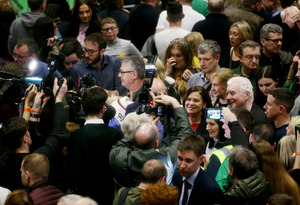
 From top: Sinn Féin president Mary Lou McDonald (centre) celebrates her party’s results at the Generel Election 2020 count centre in the RDS, Ballsbridge, Dublin 4; Derek Mooney
These comments are thrown together very late at night after over 16 hours of intense election count watching. They should, therefore, be taken more as just initial ramblings, than as a thoughtful analysis.
So here are the key things that stand out to me from the result.
First, the are two election winners. One is Sinn Féin – who saw its vote increase by 11% and second is the Green party which has seen its vote increase by 5%.
Between them they have gained a 15% swing, roughly equivalent to three quarters of Fine Gael’s total vote.
On the other side there are several losers, including Ruth Coppinger, Lisa Chambers, Shane Ross, Katherine Zappone. All of these hard working and courteous representatives are looking at seeing their political careers end.
The two biggest losers however, in reverse order were Fianna Fáil and Fine Gael.
As both have lost, the idea that the two together have a mandate to form a grand coalition is a nonsense. So let’s get that off the list.
While Fianna Fáil did, as I discussed last week and the week before, offer modest and cautious change, the voters rejected that – in favour of the more radical option.
The harsh reality of yesterday’s result is that Fianna Fáil has just secured it’s second worse electoral result ever.
That is not the type of result from which you pivot into office and carry on as if the voters have not spoken. That is true whether the potential coalition partner is Fine Gael or Sinn Féin. .
While Sinn Féin did not receive an seismic overwhelming vote and is still essentially in a three way tie with the two defeated parties, it still had the momentum on the day and is the direction in which the biggest chunk of voters moved.
To simply acknowledge this reality. To respect the will of those people who moved to back Sinn Féin is not to suddenly become an advocate of having a coalition with Sinn Féin.
I can acknowledge SF’s mandate without have to embrace it or swear an oath to implement it.
The suggestion that Fianna Fáil now has an obligation endorse that mandate is to ignore what its leader and leadership have told it’s reduced segment of voters over the past weeks, months and years.
This is the point that Jim O’Callaghan, Darragh O’Brien Michael McGrath and others made strongly yesterday.
Not only is there neither the appetite nor the demand for such an arrangement, it would fly in the face of what Fianna Fáil has been promising its own cohort of 22.5%.
Like it or not Fianna Fáil has a contract/obligation not to turn its back on those who only voted for it 24 hours early. They devised to back Fianna Fáil with the clear understanding that Fianna Fáil would not put that Sinn Fein into office.
Not that Sinn Féin feels that it needs to wait for Fianna Fáil to facilitate it. Sinn Féin fate lays within Sinn Féiner’s own hands.
In last week’s column I argued that there were four possible options/permutations. They are now down to three. Those three are:
Fianna Fáil/Fine Gael grand coalition. Not only is this a non runner, in terms of mandates, if may well be that the two parties will not have the seats to deliver this when all the counts are concluded, or when it comes to selecting a Ceann Comhairle.
Option two is the Sinn Féin/Fianna Fáil coalition. Once again, I explained last week why this was not a runner, but the arguments against this became stronger when the size of the respective l mandates were confirmed in the counts.
The third option is another election. This does not come into play for a few weeks yet.
First the strengths and mettle of all three parties will be tested in a series of votes when the Dáil reconvenes in about 10 days.
Each of the parties nominees for Taoiseach – and right now I am careful to say parties nominees, not party leaders, will be voted on in turns.
There will be a full vote on each candidate where the number of TDs voting and against each nominee is recorded.
Right now it is virtual racing certainty that all three will be rejected, though by varying margins.
It is most assuredly not beyond the rounds of possibility that Mary Lou McDonald might, over the next few days, be able to convince other like-minded left-wing parties to support her nomination thereby leaving her as the most supported of the three defeated potential Taoisigh.
We will probably have a few rounds of these votes are a period of weeks to see who blinks, yields or changes position.
But, at some point, there will have to be an endpoint set if all these rounds of votes end in a perpetual stalemate where no candidate can secure more votes in favour than against – either by voting for or abstaining.
It is hard to see how this third option – the second election – will not become increasingly attractive to Sinn Féin over the weeks, especially if it is seem to exhaust all its other options, on their own terms.
If they play it right, Sinn Féin would not be seen as pulling down the shutters. Instead it would have a chance to correct the strategic candidate election errors it made and run sufficient candidates to give it another 10 or 12 seats.
As I said last week, let us be clear that each of these three surviving options are particularly attractive, in various degrees, to Sinn Féin.
Right now I think another election is the most likely outcome. It is not my preferred option, very far from it, but the longer the impasse continues with no significant movement from the parties, then it’s likelihood continues.
Derek Mooney is a communications and public affairs consultant. He previously served as a Ministerial Adviser to the Fianna Fáil-led government 2004 – 2010. His column appears here every Monday.Follow Derek on Twitter: @dsmooney