
Tag Archives: Derek Mooney

hillary

derek

From top: Hillary Clinton; Derek Mooney

He called Brexit wrong.

But know Derek has some ‘hard evidence’.

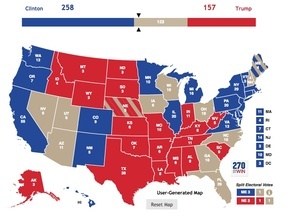
Hillary Clinton will steal win tomorrow’s US election.

Derek Mooney writes:

A week before the UK’s Brexit referendum I wrote an analysis piece for Slugger O’Toole  in which I criticised, at length, the poor preparation and campaign messaging of the Remain side.

But, for reasons attributable to the triumph of hope over experience, I ignored the evidence I had just presented and concluded – on the flimsiest of evidence – that Remain would still win.

I was wrong.

Now, with one day to go, I may be about to do the same thing again by predicting that Hillary Clinton will win the U.S. presidential election – though this time I think the hard evidence is on my side.
realclear

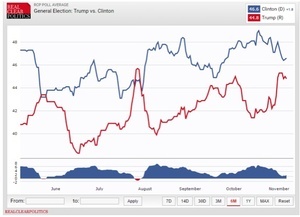
US election polls six month average via Real Clear Politics

If you look at a graph (above) of the US presidential public polls over the past 6 months you will see that there have only been two brief points where Donald Trump was ahead. The first was in June and the second was just after the Republican Convention.

For all the rest of the time she has been in front.

But you notice something else. Whenever the polls start to show him as getting close to winning, her support rises. When he seems out of contention, as he briefly did after the release of the “bus” video, her voters slip away. They only re-emerge, reluctantly, when they realise that he is once again back in contention.

Trump or, more correctly, the prospect of a Trump win has become a better motivator of Hillary’s supporters than the candidate herself. It is as if she has a cohort of ‘supporters’ who are more motivated to support her to stop Donald than they are to support her to make her President.

As we saw from Brexit, there are dangers in depending too much on public polls – and I stress the word public. Political parties do not do poll in the same way as news media.

Political party polling is more targeted and more refined – it looks for movement in specific sectors (demographic/geographic) of the electorate, not the whole mass.

Fortunately, for Hillary, there is evidence beyond the public polling which suggests that she will prevail.

The first is the changing nature of American society. The demographics suit her. Her supporters are mainly college educated, they are also non-white. These two groups are on the increase – more Americans are now college educated and a higher percentage of the America population is non-white.

Trump’s supporters are mainly white, male and non-college educated. For reasons I have explored here several times before; white blue-collar workers (and ex-workers) are angry and disillusioned with the system.

Perhaps some see Trump as their last best chance of having a white and male President, but most just want to stop globalisation and trade deals that have seen their jobs shipped out to Mexico and China. This includes a chunk of blue collar workers in the rust-belt states who supported Obama in 2012 and are now backing Trump.

The other factor favouring Hillary is the way that campaigns are organised and the critical importance of voter databases. These databases are vitally important to US elections in a way that they are not here, due to our increasingly strict data protection rules.

In America both parties know who they need to get to the polls in fine detail. Clinton’s campaign knows county-by-county just how many voters it needs to get out to vote and precisely who they are. Their ground war over the past few days and weeks has been focused on get out the vote (GOTV) operations in a way that much of Trump’s own campaign has not.

Trump himself prefers the air campaign, conducting big rallies and using the media to reach out to the voters. Corey Lewandowski, Trump’s one-time campaign manager, has been dismissive of these ground campaigns, calling them old fashioned.

While the Republicans (GOP) also have a strong ground campaign, especially as it has so many Senate seats to defend, its capacity and/or its willingness to assist the Trump effort varies from State to State. In many areas the GOP is using the probability of a Clinton win as a way to motivate its base to back its Senate and House candidates to counter balance a Clinton White House.

The third factor favouring Hillary Clinton is the Electoral College. Tight elections are the norm in the US. Obama’s margin of victory over Romney in the 2012 popular vote was 5 million out of the 129 million votes cast. Obama was the winner in 26 States, plus Washington DC, while Romney won in the remaining 24. In terms of the Electoral college Obama won by 332 to 206.

In 2000 George W Bush was the winner in 30 of the States, but just shaded the electoral college winning 271. In terms of the popular vote he lost to Gore who won 51 million votes to Bush’s 50.5 million.

The point of these examples is to show that Democrats are traditionally stronger in the States that have the higher electoral college votes – the so called Blue states – another factor giving Hillary the advantage.

Trump’s third campaign manager Kellyanne Conway conceded this point on CNN yesterday acknowledging that Hillary started the race with a secure 240 electoral college votes, based on safe Democrat states.

For these reasons, I think Hillary Clinton will be the 45th President, though I would not be willing to bet on the margin. My own best guess is that she will get 290 electoral college votes, but it all depends (once again) on Florida.

The one thing I am prepared to bet on, is that the furore and turmoil of this divisive and nasty campaign will not end with the result. If anything, it is likely to get worse. The next President may well be faced with a task and a challenge which the conduct of the campaign has ensured they cannot fulfil.

Derek Mooney is a communications and public affairs consultant. He previously served as a Ministerial Adviser to the Fianna Fáil-led government 2004 – 2010. His column appears here every Monday afternoon. Follow Derek on Twitter: @dsmooney

Top pic: Getty
imagederek

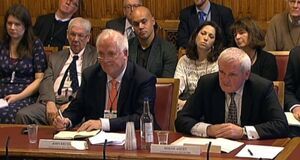
From top: Former taoisgh Bertie Ahern and John Bruton at the House of Lords; Derek Mooney

The provisions of the British Irish Agreement are not something that the pro-Brexit DUP or anyone else can wish away.

Derek Mooney writes:

Like about 98% of the adult population I rarely, if ever, watch RTÉ’s European Parliament Report. While this has more to do with the ungodly hour at which it is scheduled, rather than any lack of interest in what our MEPs might be up to, last night was an exception.

By chance, I happened to catch the first half of last night… actually it was this morning’s programme… which included a short discussion on the impact of Brexit on Ireland.

On the panel were three Irish MEPs. Two from this side of the border: Sinn Féin’s Liadh Ní Riada and Fine Gael’s Mairead McGuinness and one from the other side of it, the DUP’s Dianne Dodds.

Though the discussion was interesting enough in itself, with both Ní Riada and McGuinness arguing their case well, its real value was the insight that Mrs Dodds feisty contributions gave us into the DUP’s Brexit mindset.

Her comments and the thinking underpinning them allow us to see where the Northern Ireland First Minister is coming from and may even assist in interpreting [First Minister] Arlene Foster’s recent DUP conference address.

When the two MEPS from this side of the border reminded Mrs Dodds that over 56% of voters in the North had chosen to remain in the EU she countered, as many DUP and pro Brexit unionists do, that the North is part of the UK and must be bound by a UK wide vote.

The presenter Tony Connolly followed up on this point, referring to the majority consent provisions of the Good Friday Agreement.

He slightly tripped himself up however, incorrectly suggesting that the DUP had signed up to the Agreement. Mrs Dodds was quick to correct him saying that the DUP “did not sign up to the Belfast Agreement” adding that “our party vociferously opposed the Belfast Agreement”.

She is correct on her party’s historic opposition, however her belief – and doubtless the belief of many of her DUP colleagues – that they somehow are not committed and bound by the Good Friday/Belfast Agreement is based on a false premise of their own construction.

They ignore the deeply inconvenient fact that the Agreement was passed by 71:29 by Northern Ireland voters on a massive 81% turnout and that other agreements, which Mrs Dodds cited, that the DUP have since signed up to since are predicated on that Agreement.

They also omit a very significant aspect of the Agreement, one which many of us down here also forget, namely that the document we refer to as the Good Friday/Belfast Agreement is not just the deal reached among the parties in Northern Ireland, it is an internationally recognised agreement between the two Governments.

This point was made forcefully at the UK House of Lord’s EU committee last Tuesday by former Taoiseach, Bertie Ahern, when he gave evidence alongside former Taoiseach John Bruton on the impact Brexit will have on UK./Irish relations, both political and economic.

As Mr Ahern reminded them, the British Irish Agreement (BIA) is the bedrock of that settlement.

Even though it appears at the start of the document; the portion we think of as the Good Friday Agreement (it is referred to as the multi-party agreement in the document) is actually the annex to the British Irish Agreement. Not that its position matters greatly, as the BIA commits the two Governments – as a matter of international law – to its implementation.

The provisions of the British Irish Agreement are not something that Mrs Dodds, First Minister Foster or anyone else can wish away. Indeed, the BIA will have to be a part of the post Brexit treaty between the UK and the EU.

The reason for stressing the significance of the BIA is evident from the first line of Article 1.

It says that both sovereign governments

“recognise the legitimacy of whatever choice is freely exercised by a majority of the people of Northern Ireland with regard to its status…”.

Later in the same Article, it says:

“…it would be wrong to make any change in the status of Northern Ireland save with the consent of a majority of its people;”

These lines are crucial. Though they appear in the BIA in the context of a move to a United Ireland, those core principles apply equally to any change in Northern Ireland’s constitutional status: majority consent within Northern Ireland is required.

The DUP cannot have it both ways on this. It affirms its allegiance to the sovereign government which contracted the agreement and is thus bound by it. It put its case against the deal to the people on the Good Friday Agreement in 1998, and it lost. Just as it put its pro-leave case to the people of Northern Ireland last June and lost again.

Yes, it is in a bind, which may explain some of the hyperbole from its recent conference, but welcome to politics.

The DUP may not like the fact that the people of Northern Ireland voted against Brexit and would prefer to remain within the EU, but that is the situation and accusing Dublin of talking down the North will not distract from that reality.

The DUP put a pro Brexit position to the voters, though it did so unconvincingly with some senior DUP-ers privately indicating their preference for Remain, and the voters rejected it.

Now it has an obligation to reflect that majority view as well as its own defeated minority view. The “D” in DUP does supposedly stand for democratic, afterall.

Despite Mrs Foster’s playing to the gallery last Saturday with some southern bashing, the DUP cannot construct majorities to suit its political needs, no more than it can construct its own facts.

Derek Mooney is a communications and public affairs consultant. He previously served as a Ministerial Adviser to the Fianna Fáil-led government 2004 – 2010. His column appears here every Monday mid-afternoon. Follow Derek on Twitter: @dsmooney

Pics: RTÉ

map

derek

From top: Swing states that can decide the US Presidential Election; Derek Mooney

The battleground stakes will decide the US Presidential election while Ireland’s political battleground is the new and first time voter.

Derek Mooney writes:

There are now, mercifully, only two more weeks of campaigning left in the U.S. presidential election. These campaigns seem to start earlier and last longer with each electoral cycle.

This one started early in 2015 with Hilary Clinton launching her bid in April, and Donald Trump launching his, descending a golden escalator, in June.

Paradoxically, while the modern presidential campaigns have been expanding in length, they have (until this cycle) been contracting in their reach, with the focus going to the 9 or 10 swing/battleground states seen as potentially winnable by either side.

They are the States that both candidates and their surrogates have visited most regularly. They are where the campaigns have focussed their biggest spends. Voters living in States such as Florida, Ohio Virginia, can expect to receive multiple messages from either candidate seeking their vote.

Live in one of the other 40 or so States and you won’t get much attention.

You won’t get the big campaign visits, the telephone canvassing or the big TV adverts. It is as if your vote is not as important or as valuable, as your State is seen as being firmly and unshakeably in either the Dem or GOP column and not in play.

The same is true in the UK. About 56% of the seats in the UK. are viewed as so secure and safe as to be hardly worth contesting. Both the Labour and Tory parties each have a slew of safe seats where their majorities are so large that they could, in the caustic words of the late Tony Banks MP, run “a pig’s bladder on a stick” and get them elected.

So, just like the US., UK. general elections are fought and decided in a number of swing/battleground constituencies.

This is no coincidence. One of the main reasons for US. and UK. elections being played out in only a portion of constituencies is the voting system. Both use the first-past-the-post system where the winner is the one who gets more votes than the next highest person.

The U.S. presidential system has the added complication of the Electoral College of 538 votes. Each State has a number of votes in the Electoral College, roughly proportionate to its population and these are allocated to the winning candidate, but let’s not make this too complicated just now.

One of the other consequences of using a first-past-the-post voting system is that it usually leads to – and probably enshrines – a two party system: hence the Dems and GOP in the U.S. and the Tories and Labour in the UK.

Our PR system means that every vote counts and that you cannot ignore large swathes of territory or take groups of voters for granted. The multiple seat aspect makes our system even more competitive again. In multiple seat constituencies the campaign battle is often fought on two fronts with the competition occurring not just between parties, but also between candidates from the same party.

As a former campaign manager I can tell you that I often spent as much time and energy tracking the activity of our own party running mates as I did of the other crowds.

This is not to say that campaigns do not target swing voters or battlegrounds areas as in the US or the UK. it is just that they are not as easily identifiable or grouped geographically.

New and first time voters are one such a key battleground as parties know that new voters no longer just vote the way their parents did.

Irish voters have become more willing to change their party allegiance. They are now, to use a phrase a colleague of mine coined some years ago, more politically promiscuous. This is not something new. The trend was evident as far back as the 1990s, though it was blurred by the strength and attraction of the Bertie factor back then.

Voters have to be won over and won back at each election. Their loyalty cannot be presumed from electoral cycle to electoral cycle.

OK, although I have just spent the last 600 plus words trying to explain why we do not have definable electoral battlegrounds here like those in the UK. and the US., let me try a dreadfully unscientific exercise to show where we might have some non-definable, non geographic battlegrounds.

Though the hard numbers may differ, most of the recent opinion polls have shown minimal movement between the parties and groupings since the last election.

The results have been fairly consistent put Fianna Fáil and Fine Gael within an ass’s roar of each other with support levels in the mid-to-high 20s, trailed by Sinn Féin in third place in the mid to high teens, and then by the “others” – who largely stay where they were, or drop slightly.

So, taking this minimal movement as a starting point let me take a huge leap and submit (i.e. presume) that all bar the last seats in the 40 Dáil constituencies can be considered reasonably safe – though I know that such a suggestion will send the incumbents into paroxysms of rage.

So, if an election were to be called in the near future the virtual “battleground” of these 40 last seats would break down as follows (based on who now holds these final seats):

Fine Gael 18
Fianna Fáil 8
Sinn Féin 3
Labour 4
Others 7 (Inds, Ind Alliance, AAAPBP, Green)

Fine Gael’s total here is somewhat overstated as it held some of these final seats against another FG candidate. If you crudely correct for that (by going to the second last seat in each case) you get the following “battlegrounds”:

Fine Gael 13
Fianna Fáil 8
Sinn Féin 6
Labour 4
Others 9 (Inds, Ind Alliance, AAAPBP, Green)

This still leaves Fine Gael potentially quite vulnerable. It is far more susceptible to a swing against it than any other party, with the exception of the Labour party which has 4 out of its 7 seats in this potential battleground. Fianna Fáil is in a stronger position with about 82% of its current lot of seats looking secure. The figure for Sinn Féin is about 74%.

Obviously this back of the envelope exercise ignores a range of critically important factors including election timing, retirement of sitting TDs, automatic re-election of the Ceann Comhairle and, of course, how the next election campaign is fought and how big is the swing, if any.

This is just intended as a very general indication of the virtual battlegrounds which may be in play.

The good news is that these battlegrounds are so virtual and undefinable that every vote will count.The bad news is that because every vote will count, when the next election comes you can expect to be asked for that vote several times over, unlike the good people of the least swing State in the U.S. Kansas.

Derek Mooney is a communications and public affairs consultant. He previously served as a Ministerial Adviser to the Fianna Fáil-led government 2004 – 2010. His column appears here every Monday mid-afternoon. Follow Derek on Twitter: @dsmooney


Britain's Prime Minister Theresa May, centre, poses for a photo with Northern Ireland's First Minister Arlene Foster, left and Deputy First Minister Martin McGuinness, prior to their meeting, Stormont Castle in Belfast, Northern Ireland, Monday July 25, 2016. May met Northern Ireland’s leaders in Belfast Monday in a bid to allay Northern Irish concerns about Britain's vote to leave the European Union. (Charles McQuillan/PA via AP)

derek

From top: Britain’s Prime Minister Theresa May, with Northern Ireland’s First Minister Arlene Foster (left) and Deputy First Minister Martin McGuinness, prior to their  post-Brexit meeting at Stormont Castle in Belfast, Northern Ireland,on July 25; Derek Mooney

The onus now lies on the Irish government to take up the slack and communicate Ireland’s special island case across Europe in the interest of the 26 counties and in the interest of the North too.

Derek Mooney writes:

On Friday the Politico.eu website published details of the UK’s Brexit Cabinet Committee, including a who’s in and who’s out of which Cabinet Ministers had made it on to this powerful committee.

As Politico noted, controversially the secretaries of state for Scotland, Wales and Northern Ireland are not given permanent positions around the decision-making table. Instead they may attend committee meetings “as required” by the Prime Minister.

The significance of this omission should not be lost on us here. Not only is the British government struggling to come up with a clear and consistent negotiating position, it increasingly seems that issues relating to how Brexit will affect this island are now way down the priority list.

Within days of her ascent to high office, Theresa May went to Edinburgh to assure the Scottish First Minister, Nicola Sturgeon, that the Scottish government, along with devolved administrations in Northern Ireland, and Wales, would be fully ‘involved’ in the negotiations with the EU.

She did the same when she travelled to Cardiff and, eventually, to Belfast, as I discussed here at the time.

The UK government is now resiling from that commitment with its position shifting from having the devolved Administrations “involved” to only having them “consulted”. This is the phraseology the UK Brexit Minister, David Davis was using when he spoke in the House of Commons last week; telling an SNP MP:

“…we will consult and have detailed discussions with the Scottish Administration, and those in Wales and Northern Ireland, before we trigger article 50…”

On Sunday’s Andrew Marr Show, Scotland’s First Minister said she found it “frustrating, if I can be diplomatic about it” that Theresa May’s promise of being fully involved had not been honoured so far and suggested that she wants to see progress on this at a meeting of the heads of the devolved administrations with Prime Minister May next Monday.

Where the Scottish Government has been vigorous and active in its preparations, the Northern Ireland Executive has been languid and passive. Up to this weekend the only real action on Brexit preparations that the Executive had taken as a coherent unit was to write a letter to the British Prime Minister.

Not that the two main parties in the Executive: The DUP and Sinn Féin, have managed to do that much individually either.

Just before the summer the DUP leader and First Minister, Arlene Foster, managed to briefly scupper the Irish Government’s proposal of an island forum, while Sinn Féin did its usual trick of organising a few street protests calling for a border poll, neatly masking its masterly inaction in office.

This situation did change a little over the weekend with the Deputy First Minister, Sinn Féin’s James Martin Pacelli McGuinness, telling the Guardian newspaper that the EU should grant Northern Ireland special status.

He also said that the big challenge is “whether the government in the north and the south can come to a common position… about what we want to see come out of these negotiations.”

Doesn’t that presume that the executive in the North can come to an agreed position first?

Well… better late than never, I suppose.

I am sure that Mr McGuinness’s final discovery of a position yesterday had absolutely nothing to do with the Northern Ireland Assembly debating an SDLP motion today that there should be legal recognition of the unique status of Northern Ireland to safeguard the interests of the people of Northern Ireland.

The NI assembly is debating that motion as I write. Sadly, as with many major issues in the North that debate is being conducted in broadly sectarian terms with the SDLP, Sinn Féin and Alliance supporting the case for special status and the DUP opposing it. The UUP says it kind of supports the idea, but just not to the extent of actually voting for it.

The debate, or at least the portions I heard, are very far out of kilter with the views of the voters. Over 56% of voters in the North supported remaining in the EU, but the numbers get even more interesting when you look at the voting preferences of those who voted.

According to a major (sample size 4,000) Ipsos-MORI poll, conducted on behalf of Queen’s University, over 92% of those identifying themselves as SDLP supporters and 86% of those identifying as SF supporters, voted to remain. The numbers for Green and Alliance party voters are equally high at around 80% each.

On the other side only 30% of those identifying as DUP voted Remain, though the figure was much higher, at 46%, for the UUP.

The higher UUP figure may be due in part to the UUP leadership urging a Remain vote in the referendum, though it may also suggest that UUP voters are more middle class, as middle class unionists were more likely to vote Remain than Leave.

So, where does this leave us?

For starters it tells us that the many on the Unionist side are content to leave the views of 40% of their own supporters and the majority of the entire population of the North go unrepresented.

It also show that they will be facilitated in this by the meek response of an Executive, including McGuinness and co, who seem ill-prepared for consultation about, never mind full involvement in, actual negotiations.

The onus now lies on the Irish government to take up the slack and communicate Ireland’s special island case across Europe. This is in the interest of the 26 counties and in the interest of the North too.

The government’s “all-island Civic Dialogue on Brexit” which will meet on November 2nd is a reasonable start, though dropping the word “forum” from its title was a pointless concession.

But it is only that: a start. There is a great deal more work to be done if Irish interests are to be protected and safeguarded.

Derek Mooney is a communications and public affairs consultant. He previously served as a Ministerial Adviser to the Fianna Fáil-led government 2004 – 2010. His column appears here every Monday mid-afternoon. Follow Derek on Twitter: @dsmooney

trumpclintoncuyh530vyaajvqaderek

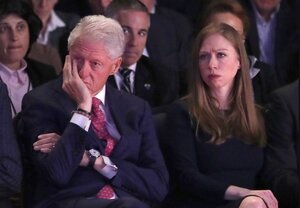
From top: Donald Trump and Hillary Clinton at last night’s US presidential Debate; Bill Clinton and Chelsea Clinton at same; Derek Mooney

After last night’s debate, Donald Trump will likely have done enough to stop his Presidential bid from free falling but this campaign has yet to reach its nadir.

Derek Mooney writes:

My usual routine is sit down to write these ‘Mooney on Monday’ pieces around midday. I write for about 90 minutes. I take a 30-minute break, after which I return to review and edit what I have scribbled and send the resulting draft to my Broadsheet controller.

Today’s offering is different as I am writing it at 6am (ish) after watching the second Clinton/Trump debate. Is debate the right word… probably not. Maybe mudslinging fest is a better description.

As a debate it was awful. It was so awful that it moved the veteran CBS Washington Correspondent, Bob Schieffer, to complain bitterly that: “America can do better than what we have seen here tonight. This was just disgraceful”.

Schieffer’s observations were not limited to the 90 minutes of the Town Hall style debate but neither were they about both candidates.

There was one clear culprit. Less than two hours before the debate commenced, with many in his Republican Party (GOP) abandoning him, Donald Trump held a surprise press conference featuring four women, three of whom have accused Bill Clinton of sexual misconduct.

It was the moment when the 2016 US Presidential Election campaign almost ended and the Trump reality show began. It was not even a veiled threat to Hillary Clinton, the implication was clear: you go after me on my comments about women and I talk about your husband’s infidelities… and worse.

It was a curtain raising stunt that set the tone low and presaged the tone dipping even lower as the evening continued.

For the most part that is what happened. Trump started out badly, particularly over the first thirty minutes when the debate centred on last Friday’s 2005 ‘Hot Mic’ recording of Trump talking in lewd terms about women.

He was at his blustering and petulant worst. He lashed out at everyone, including the moderators, claiming that “It’s three against one” as he accusing them of taking Mrs Clinton’s side. (Note: A post-debate CNN analysis found that the moderators had enforced equal time: Trump: 40m 10s, Clinton: 39m 5s.)

Unlike the first debate where Trump had a good first 20 minutes and then started to slump, Trump did it the other way around this time. He upped his game as the debate continued and managed to score points against Hillary, mainly via some good jokes and one liners rather than any substantive policy wins.

Conversely, (this is one of those post-coffee edits where I realise that I have focused just on Trump) Hillary Clinton seemed to have lost the edge and bite she sometimes showed in the first debate.

Perhaps as a response to his pre-debate baiting, she stuck with the Michelle Obama mantra: where they go low, we go high. She engaged directly with the questioners and spoke to them in contrast to Trump who did not even attempt to.

Hillary allowed Trump take a few free hits at her, perhaps concluding that the tape had done him sufficient damage or, more cunningly, that he was of more use to her limping through the final few weeks, than being defenestrated now.

Either way, the net effect is that Trump will likely have done enough to stop his campaign free falling any further. This was no small achievement.

Only a few hours earlier the gossip was the GOP leadership had concluded that his campaign was already dead in the water and was now set to shift money from promoting Trump to backing GOP House and Senate candidates in tight battles.

While he has stopped the slide accelerating, maybe even halted the decline for the moment, he has done nothing to reverse it. He did OK, but he still didn’t win the debate.

He did not try to convince swing/undecided voters that he has the temperament or judgement to be President. Indeed, as the next few days play it is likely that three things he said during the debate may, individually or collectively, come back to damage him further.

First, was his pledge to instruct the Justice Department to appoint a special prosecutor to prosecute Clinton over the email server debacle, later saying “you’d be in jail” if he was president.

This is how depressingly low this campaign has sunk – one candidate threatening to imprison the other upon their election. The USA meets the Ukraine. Not to mention the fact that, post Nixon, no President actually has that power.

Second, Trump disavowed his running mate Mike Pence’s support for creating humanitarian safe zones, including a no-fly zones, for civilians in Syria, saying: He [Pence] and I haven’t spoken and I disagree. This sounded like policy making on the hoof from Trump, not to mention dumping on your own VP selection,

Third, Trump admitted he didn’t pay income taxes, responding: “Of course I do” when Anderson Cooper asked if he used an almost €1Bn loss to avoid paying personal federal income taxes.

Add to this the swirl of rumours of other tapes and recordings ready to be produced where he says things as bad, or worse, than the Hot Mic tape and you see that his campaign – and this election – may not yet have hit its nadir.

Earlier this year Trump looked set to position himself as the “outsider” coming in to challenge the political establishment and the political elite in both the Republican and the Democratic parties.

As I set out here in early June, there was a sizeable section of the American public, people who believe their country is on the wrong path, ready to ignore Trump’s inflated rhetoric and his crass behaviour because they saw him as a political battering ram they could use to smash an establishment and system which they see as out of touch with their concerns and needs.

They factored in his weaknesses and foibles, hence why his excesses were not really hurting him significantly in the polls. But that was when he was talking about their concerns and their issues.

That has not been his tack of late. Now Trump spends most of his time talking about Trump, partly in response to the Clinton campaign – but either way the voters who once saw him as their flawed champion now increasingly see him as too damaged and too flawed to batter anything.

This election is hers for the winning in a way it wasn’t only a few weeks ago.

Derek Mooney is a communications and public affairs consultant. He previously served as a Ministerial Adviser to the Fianna Fáil-led government 2004 – 2010. His column appears here every Monday mid-afternoon. Follow Derek on Twitter: @dsmooney

Pics: AP, Getty


90421168derek

From top: passing out parade at Templemore, Garda College in August; Derek Mooney

The guards are fundamentally wrong to threaten industrial action but their deep frustration and absolute exasperation is understandable.

Derek Mooney writes:

If the Luas and Dublin Bus pay disputes are anything to go by then the choreography of future pay rows, particularly public sector ones, is likely to run as follows:

Step 1. Both sides negotiate for months without success.

Step 2. Employees go on a limited strike, inconveniencing the public

Step 3. The strike action continues for 3 – 4 weeks while both sides posture on TV and radio news shows

Step 4. Both sides then ‘suddenly’ return, without preconditions, to the negotiating table

Step 5. Employers find extra cash for pay increases they previously said was not there

Would it not be better for everyone, most particularly the public who these public services are meant to… well… serve…, if the unions and management could just skip steps 2 and 3 and jump straight to step 4?

Or, could it be that steps 2 & 3 are an essential part of the process and are needed to bring everyone to their senses or, at least, to a better frame of mind?

Has our industrial relations process developed (or, should I say ‘descended’?) to a point where, on one side, the workers need a couple of days on the picket line to let off steam and, on the other side, management need to suffer a few days of lost business, in order to create a more conducive negotiating atmosphere?

If this is the case, and it increasingly appears that it is, then we will have a bit of a winter of discontent ahead as other public sector groups get themselves geared up to dust off the picket signs and placards.

The situation is not helped by the news that the body established by the last FG/Lab government to oversee industrial relations mediation and the improvement of workplace relations and hailed at the time – by both Fine Gael and Labour Ministers – as marking a new era for employment rights and industrial relations: The Workplace Relations Commission (WRC) is just not working.

According to a recent survey conducted for the Employment Law Association of Ireland, half of the legal and industrial relations practitioners surveyed are dissatisfied with the new Workplace Relations Commission and think that the new WRC system is even worse than the much-criticised version it replaced only one year ago.

The survey’s key findings here and the Irish Examiner op-ed by the association’s chair, Colleen Cleary, both make for grim reading, though the association does identify the main problems and helpfully proposes a series of changes and reforms to make the new system work efficiently and effectively.

One group who will not likely benefit from these changes, if they are made, is An Garda Síochána as they fall outside the State’s normal industrial relations processes – and understandably so.

I fully subscribe to the principle that the Gardaí and the Army should not have a right to strike, given the significance of their roles and their importance to our safety and security.

However, if we are to ask them to surrender a very important and powerful industrial relations tool, we must also ensure that this does not weaken their ability to negotiate fair rates of pay and good working conditions.

I think the GRA are fundamentally wrong to threaten industrial action, not to mention their being possibly in breach of both the Garda Síochána Act 2005 and the Garda Síochána (Discipline) Regulations 2007, but their deep frustration and absolute exasperation is understandable.

As Gardaí see it, the State is telling them to follow a set of rules which it refuses to honour itself.

In the view of the GRA the State has not lived up to its commitments in the Haddington Road agreement as the review of Garda pay levels and industrial relations promised under that deal was never completed.

The GRA now find themselves in a negotiating no-man’s land with the Department for Public Expenditure now having responsibility for addressing many of their grievances, but the conciliation and arbitration system devised to deal with such issues is based on the Department of Justice, a department which has gone without a permanent Secretary General for two years.

Added to this are disputes and commotions which have seen a Justice Minister, a Departmental Secretary General and a Garda Commissioner resign, retire or relocate and a series of statements from senior Garda officers which suggest that all is well and everything and everyone inside the force is hunky-dory.

Is it any wonder their morale is low? And all that is before you even get to the subject of pay rates.

Kind words and high praise from Ministers and Deputies during Leaders Questions and Dáil debates is no substitute for good pay. A starting pay of €23,750 is not generous.

Yes, there is range of allowances (over 50 as far as I know) and, according to one calculation, a new Garda can probably expect to get allowances for unsocial hours etc. equal to about 25% of their salary – but that is still a low basic rate of pay.

By announcing four days of industrial action in November, the GRA has put itself on a hook which the Minister and the government must assist the GRA to prise itself off.

Mainly because we cannot have a situation where Garda go on strike, but also because this Minister has played some role, via inertia and listlessness, in creating the conditions that allowed it to happen.

Derek Mooney is a communications and public affairs consultant. He previously served as a Ministerial Adviser to the Fianna Fáil-led government 2004 – 2010. His column appears here every Monday mid-afternoon. Follow Derek on Twitter: @dsmooney

Rollingnews

questiontime

derek

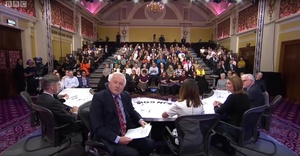
From top last week’s BBC Question time Derek Mooney

There are two chances of a second vote on Brexit

Derek Mooney writes:

I have to confess that my heart sinks a little whenever I hear English Tories or English nationalists, like Nigel Farage, mention Ireland during their rants about the EU.

The reference is usually patronising or condescending or – even worse – is given in the form of advice that would have us join them in their march back to a glorious era that never existed.

This is why my heart sank when Julia Hartley Brewer, a British Talk Radio host, Leave campaigner and former political editor, stated on last Thursday’s BBC Question Time that the EU had forced Ireland, and other countries, to vote again on EU referendums.

Her comments came during the course of a discussion on whether Britain might have another referendum on Brexit – a proposal put forward by the failed Corbyn challenger, Owen Smith MP or that the UK might have a separate vote on the final deal hammered out on the conclusion of the Art 50 negotiations, an idea put forward by Tim Farron’s Liberal Democrats.

Though hearing Hartley-Brewer getting it badly wrong on the notion of the EU ‘forcing’ us to vote again made my heart sink a little,

it sank even further when I realised that she and her fellow panellist that night Jacob Rees-Mogg MP (who looks like he is being portrayed by Joyce Grenfell) may actually have a point, just not the one they think.

Though I and other Remainers may wish it to be otherwise, the hard fact is that Ireland’s voting again on the Nice and Lisbon treaties is not relevant to the UK’s situation for one simple reason: turnout.

In the first referendum on the Nice Treaty (Nice I) in 2001 the turnout was just under 35% – the result then was 54% No: 46% Yes. At second referendum on the Nice Treaty (Nice II) in Oct 2002 the turnout shot up to just under 50% with Yes getting 63% and No dropping to 37%.

It was a broadly similar situation in the case of the two Lisbon Treaty referendums. In Lisbon I in June 2008 the turnout was 53%. No won by 53%:47%. At Lisbon II the turnout had again increased, this time to 59% with Yes now winning by 63%:37%

In both cases the turnout in the first referendum was low to start with, in the case of Nice I it was exceptionally low, just in the mid-30s, so there was a convincing argument to be made for a second vote, particularly when you felt that a second referendum would have a higher turnout.

This was not the case in the UK’s Brexit referendum.

The turnout there was a whopping 72%. This is a substantial turnout. It is much higher that recent UK General Election turnouts, indeed you have to go back to Tony Blair’s 1997 election victory to find a UK general election turnout of over 70%.

The huge political risk you take by having a re-run second Brexit referendum in these circumstances is that you get a lower turnout. It is politically saleable to try to reverse one mandate with a smaller one?

To be clear, turnout alone was not the reason why there were re-runs of the Nice and Lisbon referendums. In both cases post referendum polling and analysis found that the main reason for voting “No” or abstaining was a lack of knowledge of either treaty.

Both “Yes” and “No” voters were highly critical of what they viewed as a dearth of clear, accessible information on the treaty’s merits.

While the Remainers can clearly point to a lot of misinformation from the Leave side, not least the claims that leaving would mean £350 million extra per week for the NHS, they cannot yet point to any substantive research or analysis suggesting any changes in opinion.

Noted UK pollster, Prof John Curtice, reckons that there is little evidence of a “significant rethink” three months on from the result with those who voted Remain still convinced that they were right and likewise for the Leavers.

Very few minds have been changed, though let us see if that remains the case as the details of the Brexit deal on offer emerge during the course of the next year or so.

The problem with all this abstract discussion on a second referendum is that it takes the focus away from the very real and tangible issues with the first result: most crucially that the Hartley Brewer, Farage and others do not want to honour the clear Remain majorities in Northern Ireland and Scotland.

Instead they want to use the votes of English and Welsh people to forcibly drag Northern Ireland and Scotland out of the EU against their declared will.

This is no small issue, yet it is receiving scant attention in the UK and, sadly, here.

Voters in both Northern Ireland and Scotland voted convincingly to stay in the EU, by much bigger margins that the people across the UK voted to leave.

Many of those voters in Northern Ireland hold Irish passports and are thus also EU citizens, even if the UK leaves.

Can that citizenship – and the guarantees and privileges it offers – simply be snatched away from them on the say so of 50%+ of voters in the south of England?

As people like Michéal Martin and Colum Eastwood have repeatedly said over the past few weeks and months; trying to drag the North out of the EU against its will ignores the layered complexities of the Irish political process.

It is a refutation of the basic principles of the accommodation achieved in the Good Friday Agreement and that is something that concerns all of us on this island.

We should be debating and discussing this now. We should be looking at the significant consequences of Brexit for our economy, for our trade – both North/South and East/West, our education system, out health service.

We should not allow the foot dragging by the British Government on outlining its terms of exit to stop us from forcefully setting out our concerns and our alternatives.

We need the speedy establishment of the all-island political/civic forum I called for here at the end of June. I know the Taoiseach and his team messed up their first attempt to get the idea up and running, but they need to go again and get it right this time

Derek Mooney is a communications and public affairs consultant. He previously served as a Ministerial Adviser to the Fianna Fáil-led government 2004 – 2010. His column appears here every Monday mid-afternoon. Follow Derek on Twitter: @dsmooney

90424911

derek

From top: Sinn Fein’s Mary Lou McDonald and Gerry Adams (centre) at a party strategy meeting in Ballyfermot at the weekend; Derek Mooney

How Sinn Féin conducts its change of leadership will determine if the transition into a ‘normal’ political party is genuine or merely an illusion.

Derek Mooney writes:

Yesterday was a busy media day for Sinn Féin’s Deputy Leader, Mary Lou MacDonald. Within the space of an hour she had appeared on RTÉ’s The Week in Politics and BBC 1’s Sunday Politics.

Mary Lou was doing what she does better than anyone else in Sinn Féin: taking no prisoners, firmly holding the party line and all without seeming unduly hostile or aggressive.

During the course of her one-on-one interview with BBC Northern Ireland’s Mark Carruthers; Mary Lou described Sinn Féin as being a party “in transition”.

Given the context, this was a reference to either: the potential for generational change in the Sinn Féin leadership, or to Sinn Féin’s ambition to be more seen as a potential party of government.

Perhaps it was a reference to both – either way, I am sure Mary Lou meant the phrase to convey the sense of a political party undergoing change and development.

I happen to agree that Sinn Féin is “in transition”, except that the transition I believe it is undergoing is into becoming a normal political party. It is a transition that it has been undergoing for some time, with varying degrees of success, but it is still an ongoing process.

Sinn Féin is not so much a “party in transition” as it is “transitioning into a party”.

The party leadership is an obvious example. It is not the only example.

Normal political parties do not have T.D.s collecting convicted Garda killers from prison upon their release, nor do they hail convicted tax evaders as “good republicans”, but for the purposes of this piece, let’s just focus on the autocratic nature of Sinn Fein’s leadership.

Though he is over thirty-three years in the role, we are expected to believe that no one over that time in Sinn Féin has ever been unhappy with Gerry Adams’ leadership or ever willing to challenge openly it.

For most of those 33 years obedience to the leadership of Adams and McGuinness has been a core principle – one that seemed to trump everything else.

But as the fictitious Chief Whip, Francis Urquhart, observes in the opening sequence of House of Cards: “Nothing lasts forever. Even the longest, the most glittering reign must come to an end someday.”

The blind obedience has started to slip over recent years. From the resignations of various Councillors North and South in the years after the 2007 election to more recent murmurings, including the resignations of 18 SF members in North Antrim in protest at the manner in which a replacement MLA was appointed and the Chair of Sinn Fein’s Virginia-Mullagh Cumann writing to the Irish News to say it was time for Adams to step down.

Even the most disciplined and united of political parties have various groups or factions not entirely happy with the leader.

Our most popular and electorally successful party leaders like Jack Lynch, Garret Fitzgerald or Bertie Ahern have had their internal party critics, even at times when their leadership seemed at its most secure and assured.

They either feel the leader is too progressive or too conservative, too weak or too strong, or they believe that their personal talents and skills may be better recognised if there was a new leader in place.

These stresses and pressures are customary in a normal political party. They are the forces that keep a political party democratic. They are also forces that grow over time, particularly after a leader has been in place for a decade or more.

Now, after over three decades of Gerry Adams’ leadership, it seems that Sinn Féin has a plan to do what other political parties do routinely and relatively seamlessly: change leader.

Except in Sinn Féin’s case it is a “secret” plan. Even the current Sinn Féin Deputy Leader concedes that she does not know what precisely is in this plan.

In most political parties the process for electing a new leader is transparent. People can see how potential leadership candidates are nominated and who has a vote in electing the new leader.

In some cases, this is done by an electoral college such as in Fine Gael where members of the parliamentary party have 65% of the votes; party members 25% and county councillors 10% or, as in the case of the Labour Party, it is done via a one member one vote system with all valid party members having a vote – though as we saw in the recent contest only the parliamentary party can nominate the candidates.

How will it happen in Sinn Féin? The stock answer from Adams and others is that the Sinn Féin Árd Fheis will decide, but how will that play out?

Will it really decide?

Will there be a real contest with rival candidates travelling to constituencies to meet those voting in the leadership election and set out their competing visions?

Or, will a new leader ‘emerge’, as the British Tory party leaders once did, following the intervention of a group of shadowy figures in Belfast with that decision gaining the semblance of democratic authority with a set-piece ratification at an Árd Fheis.

While I won’t hold my breath waiting for that change of leadership to actually happen, I am also a political realist and recognise that asking any leader to be specific as to when they plan to stand aside is to ask them to surrender their leadership at that moment.

How Sinn Féin conducts the change of leadership, whenever it happens, will be a major test of its transition. It will determine if the transition is merely an illusion or it is a sincere and genuine attempt to become a real political party.

Though I am clearly no fan of Sinn Féin, I believe that it is more the latter than the former, particularly as the organisation takes on new members and is compelled to allow more internal debate. Time will tell if I am right to be so optimistic.

Derek Mooney is a communications and public affairs consultant. He previously served as a Ministerial Adviser to the Fianna Fáil-led government 2004 – 2010. His column appears here every Monday mid-afternoon. Follow Derek on Twitter: @dsmooney

Rollingnews

90419278

derek

From top: Independent Alliance junior minister John Halligan; Derek Mooney

Does John Halligan see his Junior Ministerial title as something that gives him a platform to speak out on issues that matter to him rather than a role coming with explicit responsibilities and duties?

Derek Mooney writes:

Though he may not realise it: John Halligan’s pronouncements over the weekend may just be a very small part of a world-wide phenomenon.

No, I am not claiming there is global movement to secure a second catheterisation (cath) lab for Waterford. What I am saying however, is that his statements, particularly his most recent ones, contain many of the elements of the decline of public language in politics that we have heard elsewhere.

I accept that Halligan and the local consultants in Waterford hospital are sincere in desperately wanting a second cath lab, but wanting something is not the same as needing it – especially when resources are not unlimited.

For that reason it was agreed as part of the Programme for Government negotiations that an independent clinical expert would be appointed to determine if the second lab was needed.

Halligan agreed to that proposal. The expert was appointed. The expert then produced a report which concludes that services should be improved but that a second cath lab was not necessary.

That is doubtless a bitter pill for Halligan to swallow, made all the more unpleasant from Halligan knowing that he had himself agreed to the process. He staked his local political credibility on the report concluding it would be necessary, indeed he told a local newspaper that it was just a “formality”.

He made a bet and he has lost it – in almost every sense of that phrase.

His response to this predicament of his own making is to take a leaf out of the political playbook of the likes of Brexit campaigner Michael Gove or even Donald Trump and conclude that the people have had enough of experts. So, he lashes out at everyone else threatening to bring all hell (I thought he was an avowed atheist) down on top of this government.

Has it occurred to Halligan or the Halligan-istas that he is potentially guilty of the same base cute-hoor behaviour he has condemned others for in the past?

If the case for Waterford is as strong as he, and the consultants in Waterford, say it is – then shouldn’t that case stand on its merits, rather than be imposed by political blackmail via threats of taking down the government?

As James Lawless, TD, Halligan’s opposite number in Fianna Fáil pointed out this week, Halligan has spoken out on almost every topic under the sun apart from those for which he was given specific responsibility as a Junior Minister: the promotion of science, technology and innovation.

While we all knew Halligan was a junior minister, I suspect that I was not alone in being a bit unsure as to what department he was assigned until Lawless reminded us of it last Friday.

Perhaps Halligan regards his Junior Ministerial title as more honorific than specific: something that gives him an elevated status, a platform from which to speak out on issues that matter to him, rather than a role coming with explicit responsibilities and duties?

To judge from his capacity to lurch from crisis to crisis it would appear that Halligan is not familiar with the great political truism of the late Mario Cuomo; you campaign in poetry, but you govern in prose. Perhaps he is, but has misheard it as you campaign in poetry, but govern in rhetoric.

To be fair, he would not be the first. Indeed, get outside of Waterford and he would be absolutely lost in the crowd as we can witness from the Brexit campaign and the ongoing US. presidential election.

Facts give way to feelings. Something is true because I feel it is… or, it should be, rather than because it can be independently and impartially verified. Everyone’s motives, bar mine, are suspect. Four legs good, two legs bad.

It is not a new trend, George Orwell was considering it back in the mid-1940s in his essay “Politics and the English Language”. It comes around like a Sine curve every couple of years and seems to be approaching its peak, once again, though this time accelerated and amplified by modern technologies.

A new book entitled: Enough Said, What’s Gone Wrong With the Language of Politics? by New York Times CEO and former BBC Director General, Mark Thompson examines the current slide in political discourse on both sides of the Atlantic.

Unsurprisingly, given the timing, Donald Trump comes in for some attention with Thompson picking up on Trump’s failings as an orator, but also pointing out that his often clumsy staccato delivery masks Trump’s deceptive I-tell-it-like-it-is “anti-rhetoric”, claiming that “This is the way generals and dictators have always spoken to distinguish themselves from the cavilling civilians they mean to sweep aside.”

Thompson also points the finger at Social Media. While I have taken issue with this argument in a previous Broadsheet column, Thompson does expand far beyond the simplistic it’s all Social Media’s fault and looks at other related factors, such as; the increasing number of people who get their news and views from partial online sources: sources which confirm their views and prejudices, rather than challenging them impartially. Score one for the MSM (mainstream media)

So, where does poor John Halligan fit in on this global trend?

Not high, but he is in there: inflated rhetoric; crude threats; convinced he alone is right; certain that everyone on the other side is duplicitous; dismissive of experts. He ticks most of the boxes, while ticking the rest of us off.

Derek Mooney is a communications and public affairs consultant. He previously served as a Ministerial Adviser to the Fianna Fáil led government 2004 – 2010. His column appears here every Monday mid afternoon. Follow Derek on Twitter: @dsmooney

Rollingnews

90418104derek

From top: Independents – back row from left: Katherine Zappone, Finian McGrath  and Shane Ross – and Fine Gael TDs assemble at the Aras after the 2016 election; Derek Mooney

Spinning against your own junior partners may play well with dispirited Fine Gael members,

But collapsing the government will dishearten them even more.

Derek Mooney writes;

“To provide spurious intellectual justifications for the Secretary of State’s prejudices”

This is how the late Maurice Peston (father of ITV’s political editor Robert Peston) responded in the early 1970s when a senior UK civil servant asked him to explain how he saw his role as Roy Hattersley’s newly appointed Special Adviser (Spad).

It was more than just a casual witty remark from the Professor of Economics: it specifically referenced the fears the Department of Prices and Consumer Protection had about having an acknowledged policy expert in their midst and gainsaying their more generalist advice.

For a serious and nuanced consideration of the role of the Special Adviser in the Irish context the research work of the University of Limerick’s Dr Bernadette Connaughton is a good starting point, especially her August 2010 Irish Political Studies article.

In that article Connaughton argues that while the main role of most Irish Ministerial Spad is that of a ‘minder’ or gofer – working vertically within Departments to help their Ministers’ obtain results – Spads can, as a collective – also have the potential to contribute effectively to the political coordination of policy-making by working horizontally across Government.

As someone who spent almost six years in partnership governments, and someone who contributed to Dr Connaughton’s research, I can attest to the truth of the latter part of her argument.

From my experience the most effective Spads were those whose commitment is as much to the whole of government as it is to their individual minister.

I suspect the troubles and turmoil which has beset the current Government are due in no small measure to the absence of this.

When Fianna Fáil cut the number of ministerial advisers in 1997, before that each Minister had a separate Special Adviser and Programme Manager,

it did so by effectively merging the two roles so that each Special Adviser was also fulfilling the role of departmental programme manager, being responsible of assisting the Minister get that Department’s portion of the Programme for Government (PfG) implemented.

Each party in Government still retained a single Programme Manager – each responsible for co-ordinating the delivery of their party’s elements of the PfG. This co-ordination was done both between the two programme managers, and also through the individual Spads, making the weekly meeting of advisers particularly important.

At these meetings, which took place of the afternoon before Cabinet meetings, the individual Spads would advise the group on memos their Ministers were brining to Cabinet the following morning and gauge the reaction from others.

While Cabinet memos are circulated to other Department before cabinet for reaction, some Departments are less forthcoming in expressing their views in advance than others.

Often times the first real signal that another Department (by which I mean the Department at “official” level, rather than “political”) might have an issue with what your Minister was proposing came at these meetings.

Another key component in this process were the group of Spads working for the Taoiseach. Each of them usually co-ordinated with 3 or 4 Departmental Spads to also work as an early warning system for issues and problems.

As with all information channels, these systems worked best when they worked both ways – not that I think they worked both ways all the time during the time of the FF/Green government, but that’s an article for another day.

They also worked best when the larger party recognised that partnership in communications should not just be pro-rata and that the smaller party in Government has to be given a bit more space and room than their size or strength of numbers dictates.

The major party sometimes needs to roll with the punches when the junior partner attempts to assert its identity and influence. It doesn’t have to respond to every snide comment, particularly those from the “reliable sources close to the Minister”, indeed the senior partner’s responsibility is to take the heat out of situations, not inflame it.

This is something that the spin conscious Fine Gael appeared not to learn in the last FG/Labour government.

I know this may seem heretical for many in Fine Gael, particularly those who saw the headlines in the Irish Times or listened to Marian Finucane every weekend and convinced themselves that the Labour tail was wagging the FG dog, but when you look at the Government’s policy output, the evidence is clear – Fine Gael got its way most of the time.

Fast forward to this week and you realise that publicly accusing one of your independent Ministerial colleagues of “showboating” doesn’t achieve anything, apart from having one of that Minister’s allies responding in kind saying: “Fine Gael’s problem is they don’t like any dialogue and just want it all their own way” as Philip Ryan reported in yesterday’s Sunday Independent.

I can understand Fine Gael’s frustration in not having a single junior partner – with a single identity and a single voice – sitting at the table with it, but that is the reality and it is long past the time for it to develop the internal systems to address that.

Just continuing to do what it did when it was in government with Labour, isn’t going to work… indeed, as we have seen over the past few months it is not working.

If Fine Gael wants the independents to work cohesively as a group within a wider partnership, then it has to equip those independent ministers with the supports and internal early warning systems they need to allow the Spad system to work horizontally as it should.

The office of the Taoiseach has a vital role to play in that, especially when there is no single and identifiable programme manager to speak on behalf of the group of independents.

It needs to recognise that those non Fine Gael faces around the table are not just interlopers, they are their partners in Government and while occasionally spinning against them may play well with its own dispirited back-benchers, collapsing your own government might even dishearten them more.

Derek Mooney is a communications and public affairs consultant. He previously served as a Ministerial Adviser to the Fianna Fáil led government 2004 – 2010. His column appears here every Monday mid afternoon. Follow Derek on Twitter: @dsmooney