

Tag Archives: Derek Mooney

90413458derek

From top: Members of the Irish Defence Forces take part in a parade for the 100th anniversary of the Easter Rising in Dublin last Easter; Derek Mooney

The author shoots down the prospect of a Europe Army and urges a fact-based assessment of Ireland’s defence needs.

FIGHT!

Derek Mooney writes:

Though you may not have noticed it – there was, over the last few weeks, an attempt to start a public debate on Irish Defence policy. While the Irish Examiner, in particular, did its level best to get it going, the discussion soon fizzled out.

The reason why the debate never really got going may be due to the fact that we tend to only discuss defence policy in public in response to some significant event or, more frequently, to some outlandish and unfounded claim.

On the rare occasions that we have any debate on defence in Ireland, they tend to be either end of the extreme ranging from claims that we are abandoning neutrality, a claim made continuously since the 1970s, to questions as to why we even have a Defence Force.

Though there is a real and clear public pride in our Defence Forces, both at home and abroad, there is also a surprising paucity of knowledge about Defence policy.

With this in mind, I want to use this week’s Broadsheet.ie offering to put some basic facts about Irish Defence policy out there, in the vain hope that the next public debate on Defence may be based on fact and reality, not myth and assertion.

Let’s start with a few basics.

The Irish Defence Forces comprise the Army, Air Corps and Naval Service and should total 9,500 men and women. The current manpower figure as set out in a parliamentary reply to Fianna Fáil’s Lisa Chambers, is just under 9100.

There are approximately 460 Irish troops currently serving overseas on a range of UN led and mandated peace-keeping and humanitarian missions.

These include: 60 naval service personnel on the humanitarian search and rescue operations in the Mediterranean; about 210 troops on the UNIFIL mission in Lebanon and approx 140 troops serving in the UNDOF mission on the Golan Heights in Syria.

Though these numbers are way down from the average of 800 plus personnel serving overseas less than a decade ago, it still represents a sizeable Irish contribution to international peace and security, which in turn contributes to our own national security.

We spend about €900 million per year on Defence, though the vast bulk (over 70%) is accounted for by wages and pensions.

When it comes to value for money the Defence Forces lead the way.

The reform and modernisation programme undertaken between 2001 and 2010 make it a model of how public sector reform can be done right. Productivity was increased, numbers were reduced and the savings were invested in vastly improved equipment and training.

Now let’s turn to the policy side. First and foremost, Ireland is militarily neutral. While this is usually defined as not being a member of a military alliance, it also means that we decide for ourselves how much we spend on defence and – most importantly – how, where and when we deploy our troops overseas on humanitarian and peace-keeping/peace enforcement operations.

This is done via the “Triple-Lock” mechanism of UN mandate, Cabinet and Dáil approval. Triggering this triple lock is required before 12 or more Defence Force personnel are deployed overseas under arms.

This enshrines not only our military neutrality but our commitment to multilateralism and the UN.

We use the phrase UN mandated, which means that a UN resolution is required. Nowadays many UN mandated missions are not UN led, i.e. “blue helmet”, but rather led by regional organisations – such as the EU, The African Union, NATO etc – on behalf of the UN. This was the case in the 2008 EU For Chad mission, which was commanded by an Irishman, Gen. Pat Nash.

I was in the Dept. of Defence during the Chad/Central African Republic mission, which was established to deal with the crisis created in the region on foot of the Darfur famine.

I saw how the Triple Lock was implemented smoothly and speedily. UN resolution 1778 was passed at the end of Sept 2007, Cabinet Approval was given in October, unanimous Dáil approval by the end of November and by December an initial deployment of Army Rangers and support elements were on the ground in Eastern Chad establishing the Irish Camp.

Any difficulties in deployment were not due to the Irish or the Triple Lock but rather to the frustrating slowness of other EU countries, particularly the non-neutral ones, to respond especially when it came to offering air and medical support to the mission.

Nothing I saw at those defence meetings in Brussels led me to think that an EU Army was a realistic possibility, leaving aside the fact that we have a veto (EU requires unanimity on common defence) on it and that the Irish Constitution (Art 29.4.9) precludes Irish membership of a common defence.

Speaking of air support brings me back to the Irish Examiner article mentioned at the outset. From my perspective this appears to be based on the inaccurate, if not sensationalised misreading, of an already inaccurate report.

I say inaccurate as the original material suggests that is not Ireland which has asked the RAF to protect our airspace from terrorist threats, but rather that it is the British who have asked for Irish permission to fly into our air space in the event of terrorist air attacks heading for Britain.

When viewed this way the story is not quite as sensational, nor is it the slam dunk argument for Ireland rushing out and purchasing a fleet of F-16s.

I am not absolutely opposed to our buying a few F-16s – though if we are going to go into the fighter aircraft market why not opt for some newer F-35s?

I am sure the Air Corps would be overjoyed to have them, though I suspect the Departments of Finance and Public Expenditure might baulk at the tripling or quadrupling of annual defence expenditure necessary to keep these fighters in the air 24/7, especially when we consider the real and actual threat assessments.

So, let us have a full debate on defence (and foreign) policy by all means, but let us ground it in fact and reality.

Derek Mooney is a communications and public affairs consultant. He previously served as a Ministerial Adviser to the Fianna Fáil led government 2004 – 2010. Follow Derek on Twitter: @dsmooney

mckay

derek

From top: Jamie Bryson watches Daithí McKay giving testimony to Stormont’s Finance Committee; Derek Mooney

The recent Stormont resignations are an indication of the level of strict and unfaltering discipline that still operates within Sinn Féin.

Derek Mooney writes:

If there is one thing the Provos do well, it is commemorations. Give them the slightest reason and out come the banners, wreathes, black polo-necks, replica uniforms and the gang is ready to march anywhere.

So zealous are they to remember and memorialise that the objects of their commemoration do not even require any direct connection. All that is needed is a rallying cry, a route map, a bit of media attention and they are all set to go.

It is therefore curious, given this penchant for marking the contribution and sacrifice of others, that neither former Sinn Féin M.L.A. Daithí McKay nor Sinn Féin activist Thomas O’Hara can expect to find their colleagues publicly commemorating them anytime soon.

Last week, McKay resigned his Stormont seat and O’Hara was suspended as a Sinn Féin member after the Irish News accused McKay, then chair of Stormont’s Finance committee, of arranging for O’Hara to coach a witness due to appear at McKay’s committee in September 2015.

The witness, loyalist blogger Jamie Bryson, was there to give evidence about allegations of political corruption linked to Nama’s £1.3 billion “Project Eagle” sale of Northern Ireland property.

At the Committee hearing Bryson made allegations of kickbacks to a senior politician and, at the conclusion of his evidence, accused then Northern Ireland Peter Robinson of being that politician.

This is in line with the advice Bryson received from O’Hara on Sept 19th in their Twitter direct message exchanges:

O’Hara: When talking about Robinson refer to him as ‘Person A’. So say all you have to say about him referring to him as Person A. Then in your final line say: Person A is Peter Robinson MLA. Means that the committee cannot interrupt you and means that you don’t have to say robbos name until the very last second. So then it’s job done!

Shortly after the Bryson evidence, McKay was at the Dáil’s Public Accounts Committee on October 1 to discuss his committee’s investigations into the Project Eagle deal.

Responding to a specific question from Deputy Shane Ross on Bryson’s evidence and why the NI Finance Committee had decided to call him, McKay replied:

“It is well known that he [Bryson] has blogged at some length on this. It is also well known that he appears to have a lot of material which some believe may have been fed to him from another source. It was an issue of debate for the committee. What the committee agreed to do was to set a bar. The bar that has been set for him and future witnesses is that they have to prove that they have some connection to the terms of reference of the inquiry.”

Oh the irony of McKay talking about Bryson being “fed” and his setting the bar high.

So, why does any of this matter?

Well, there is more to this episode than just dodgy goings on by Sinn Féin at Stormont. Nama’s Project Eagle was the single biggest property sale in Irish history.

The investigation by Stormont’s Finance Committee was supposed to establish the truth behind the accusations of wrong doing.

Perhaps that Stormont Committee was never going to be able to uncover the truth behind the deal and expose whose fingers were in the till, but as the SDLP Leader, Colum Eastwood, has pointed out:

“Sinn Féin’s interference in that democratic investigation has only served the purposes of those who are alleged to have corruptly benefited from the Project Eagle deal in the first place”.

It is hard to imagine that was Sinn Féin’s primary intention, yet it is the likely outcome of it.

So why, after months of posturing and calling for a full public investigation of this massive property deal, would Sinn Féin undermine an element of that investigation?

Were they just eager to get Robinson’s name on the record or could they have had other pressing political considerations at the time?

At around this this time last year senior PSNI officers were linking a murder in east Belfast with the Provisional IRA. That killing was thought to have been in revenge for a killing in May.

We are now expected to believe that undermining of what is a very legitimate public concern was all done by two lone wolves: McKay and O’Hara without any input, sanction or direction from others? Really?

The current N.I. Finance Minister, Sinn Féin’s Máirtín Ó Muilleoir has described the contacts between Bryson and the Sinn Féin officials as “inappropriate”.

He denies any involvement with or knowledge of their communications, though he was a member of the McKay committee when Bryson gave his evidence and was even mentioned twice in the O’Hara/Bryson exchanges.

If the positions were reversed down here and it was a Fine Gael or Fianna Fáil Minister facing such questions, it is hard to imagine Messrs McDonald, Doherty or Ó Broin being quiet as phlegmatic and dismissive as Ó Muilleoir appears in his statement this morning.

The fact that both McKay and O’Hara have so readily been thrown under the bus without even a whimper from either is not only a testament to their loyalty and commitment but an indication of the level of strict and unfaltering discipline that still operates within Sinn Féin.

Can you imagine a T.D., Senator or Councillor in any other party being so ready to walk away so silently?

No, me neither.

While it is tempting to speculate that Michéal, Enda or Brendan might yearn to have such command and mastery over their flocks, I suspect they are content to forego such control as they see the bigger picture and know that democratic accountability is not well served by such martial docility.

Derek Mooney is a communications and public affairs consultant. He previously served as a Ministerial Adviser to the Fianna Fáil led government 2004 – 2010. Follow Derek on Twitter: @dsmooney

Top pic: Irish News

trump

jeremy-corbyn

derek

From top: Donald Trump; Jeremy Corbyn; Derek Mooney

The US presidential Election and the British Labour Party leadership race offer candidates that are so dislikeable it is a ‘no win’ whatever the results.

Derek Mooney writes:

I don’t know about you, but I am firmly of the opinion that when it comes to profane expressions; you can never have enough.

Hence my delight when I saw a post from Mentalfloss appear on my Facebook timeline last week offering 8 grand but forgotten profane expressions. Excellent, I thought, some additional material.

Sadly, the expressions – though colourful – were not that profane.

They did, however, include some handy old-fashioned phrases and analogies to sum up such predicaments as: taking forever to get to the point “Robin Hood’s Barn” or, being hesitant or indecisive: Buridan’s Ass.

The one that appealed most to me, however, was Morton’s Fork: the dilemma of being trapped no matter which way you go.

According to Mentalfloss:

“The expression refers to John Morton, Archbishop of Canterbury in 1491, servant to Henry VII. Henry was trying to restore the stability of the English monarchy by fighting The War of the Roses, and needed more money from his clergy to do it. (The clergy in question weren’t the impoverished monks and priests, but their wealthy bishops and cardinals). The clergy did not want to give away their money, so they took one of two approaches. Either they came in rags and said they were too poor to contribute, or they came in ridiculous finery saying they needed every penny to maintain the dignity of their position. Morton wasn’t having it. His “fork” led to a dead end, no matter which way you took. If you’re a high clergyman in rags, you’re obviously storing away all the money you extract from your underlings and beneficiaries. If you’re opulent, you’re obviously rich and can spare plenty of money for your King. Either way, hand it over.”

Or, to put it another way: it is a 15th century Catch-22 or Hobson’s Choice: a no-choice/no-win situation.

While Mentalfloss offers a sample usage involving a teenager looking to play an Xbox while off school sick, might I suggest (and here I reach my Robin Hood’s Barn) two better illustrations: the choices facing (a) voters in the USA and (b) members of the British Labour party.

In the case of the US, America voters are now presented with candidates from the two main parties both of whom they dislike intensely.

A recent Gallup Poll (conducted between Aug 5 and 11) showed Hillary Clinton with an unfavourable rating of 55% (and favourable of 40%) – a net un-favourability score of -15%.

The same Gallup Poll showed Donald Trump with an unfavourable rating of 63% (versus a favourable of 32%) – a net un-favourability score of -31%.

The two candidates are attaining historic levels of unfavourability. Before this election no major presidential candidate had a double-digit net negative “strong favorability” rating. Trump now holds the record for the lowest ever rating – with Hilary Clinton having the second lowest ever.

This is not the same thing as saying they are equally bad as each other. Trump is ahead of Clinton in the despicable stakes by a country mile, as veteran US news reporter Dan Rather put it in a recent Facebook post:

“…we must beware of false equivalencies. Many have construed Hillary Clinton’s statements about her email server as lies. And critics also point to other statements from her past where she has been perhaps less than truthful. Clinton should be held accountable for those statements. The press should vigorously question her and investigate where the truth lies. But the sheer amount of the verbal fertilizer being spewed by Trump must not be reported as a “he said, she said. Calling him on it is not partisanship, it’s citizenship.”

The situation is not looking a lot brighter for Labour party supporters in the UK. Last weekend the UK Independent ran a poll rating the key political players. It found that the two candidates for the leadership of the UK Labour Party both have net unfavourability ratings – and both in the double digits.

Indeed, the order of magnitude was not dissimilar to the US presidential race with the incumbent Jeremy Corbyn getting the Trump place with a net unfavourability of -28% (just one point worse than Nigel Farage) and his challenger, the relatively unknown Owen Smith taking the Clinton role with a -14% net unfavourability score.

By contrast the new UK Prime Minister and Tory party leader Theresa May scored a net favourability of +14%.

Even more worrying for Corbyn and Smith, and for the entire British Labour Party, a recent vote among members of the GMB union as to who the Union should back in the Labour leadership only attracted a turnout of 8% (for the record Owen Smith beat Corbyn 60/40 among those union members who voted).

For the record, if I had a vote in the USA I would undoubtedly vote for Clinton, just as – if I were a member of the British Labour party – I would vote for Owen Smith.

But, in both cases, I would be doing so grudgingly as the countless French voters who backed Jacques Chirac in the second round of voting in the 2002 French Presidential election.

Like them, I would not be voting positively for someone, I would be voting enthusiastically against someone – in their case the then far right leader: Jean-Marie Le Pen.

Many of them, particularly those who had voted for Socialist or Centrist candidates in Round One went to the polls with disinfectant and/or clothespin to show their reluctance to back Chirac. Chirac scored just under 20% in Round One, but won a massive 82% in Round Two.

They resolved their face-off with unappealing options, as will those faced with similar dilemma’s later this year in the own Morton’s Fork-up.

Derek Mooney is a communications and public affairs consultant. He previously served as a Ministerial Adviser to the Fianna Fáil led government 2004 – 2010. Follow Derek on Twitter: @dsmooney
Pics: PA/Getty

Germany European Central Bankderek

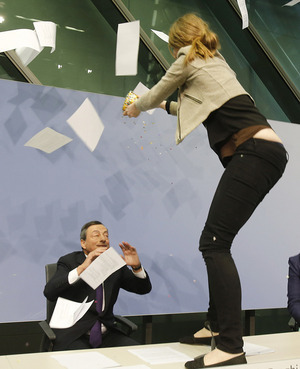
From top:A protestor throws confetti at European central bank President Mario Draghi during a press conference last year; Derek Mooney

We have come terrifyingly close to global depression and are drawing nearer to a 21st century form of fascism.

But just as we avoided one we can escape the other

Derek Mooney writes:

Three cheers for the system. Hip hip…. No? Nothing…?

This comes as no surprise. After the tumult and turmoil of the past few years it would require a hopefulness that bordered on the foolhardy to expect to hear anything even vaguely complimentary said about the system.

At so many levels, it failed us. The institutional accountability and oversight that we thought would prevent bank and financial crashes proved inadequate at best, and downright mendacious at worst.

It is a failure that reaches beyond the crash and extends right up to the present day with so many people seeing the present recovery as something that is happening in communities and areas other than theirs.

This feeling that is not unique to Ireland. We see echoes of it in the Brexit result in the UK with the high numbers of people in the former industrial heartlands of the midlands and the north of England voting to leave the EU.

We see it too in the support for Trump among blue collar workers in the “rust belt” states of the U.S. and in the support for Marine Le Pen’s Front National last December, particularly in the formerly industrialised areas of the North of France.

These were the parts most badly hit, not just by the crash, but by the advent of technology and globalisation before it. They have seen factories closed and jobs moved overseas. Not only that but it has all happened so fast, without time to adjust.

So, the lesson is straight forward: those most badly hit by the changing world and global financial crash are understandably those most likely to have lost most faith in the political and economic system.

So far, so logical. But there is a school of thought that suggests that the system – by which I mean economic and political systems – has not failed us as much as we might think.

Step forward political scientist and expert in international relations Prof Daniel Drezner. In his book: “The System Worked: How the World Stopped Another Great Depression” Drezner maintains that the Global system worked, albeit inelegantly.

He says that the efforts of central bankers and other policymakers within the G-20 IMF, WTO and other global institutions prevented the international crash becoming a full-fledged depression, like the 1930s Great Depression.

Indeed, he argues that while the global economy remains fragile (his book was written in 2014), that these global institutions survived the “stress test” of the crisis, and may have even become more resilient and valuable in the process.

This is not much comfort when you have lost your job and are struggling to find another. Knowing that the global system stopped the crisis toppling into a depression doesn’t make it easier to accept a big reduction in a living standard that was not all that high to start with.

Nonetheless, Drezner has a point. He reminds us how close we all came to falling into the abyss of another great global depression.

His comparisons with the 1930s crash, and how we narrowly avoided it, are important as that economic and social collapse contributed to the collapse of trust and confidence in the systems of government then and the consequent rise of fascism in Europe.

So, just as we came close to another great depression, have we – or are we – coming perilously close to a similar political drift?

Many commentators see it in the global rise of populism. They see that Brexit vote in the UK, Putin’s reign in Russia, Le Pen’s progress in France and, most significantly, the rise of Donald Trump as evidence that populism is on the march, and a goose stepping march, at that.

They see it in the demagoguery, the inflated rhetoric and – above all – the rejection of facts, evidence and expertise shown by Trump, Putin, Le Pen et al.

Doubtless, as we have come terrifyingly close to global depression, we may indeed be coming close to the return of some 21st century form of fascism, but just as we avoided one, I suspect we are also about to narrowly avoid the other, but only if the centre ground of politics holds and is not complacent.

While Marine Le Pen will almost certainly make it through the first round of voting in the French Presidential election next year, she is likely to be well beaten in the second round, a head to head contest between the top two candidates, especially if she is pitted against Alain Juppé.

As for the US, as the Trump gaffes and buffoonery of the past few weeks have shown, Donald Trump is less Benito A. Mussolini and more Rufus T. Firefly. (Firefly was Groucho Marx’s fictional leader of Freedonia in the 1933 movie Duck Soup).

This is not to say that Trump is a joke – far from it. But just as he is no joke, neither is he the Devil incarnate.

Comparisons between Trump and Hitler are not just over the top, they miss the important point that his rise represents: a deep dissatisfaction and disillusionment among a large swathe of blue collar voters with the prevailing system.

This is something I explored here in early June: Trump is riding a zeitgeist that he didn’t create, but that others have missed.

In France, in the U.S., indeed just about everywhere, the political centre ground is being tested and it must come up with solutions that are not just a return to business as usual.

As Michéal Martin observed in his John Hume Lecture at the recent MacGill Summer School:

“…for us to rebuild levels of political trust and engagement with the public, the path of a more reflective, expert and centre-ground politics is the only credible way forward”.

Maybe then, as EM Foster remarked in the introduction to his 1950 collection of political essays: Two Cheers for Democracy,

“We may still contrive to raise three cheers for democracy, although at present she only deserves two.”

Derek Mooney is a communications and public affairs consultant. He previously served as a Ministerial Adviser to the Fianna Fáil led government 2004 – 2010. Follow Derek on Twitter: @dsmooney
Top pic: Getty

foster:mayandmcguinnessderek

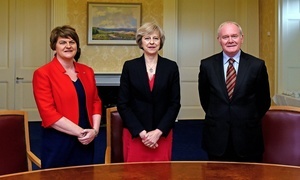
From top: Northern ireland First Minister Arlen Foster, UK prime Minister Theresa May and deputy first prime minister of Northern Ireland, Martin McGuinness this afternoon in Stormont buildings; Derek Mooney

The political dynamic in Northern ireland is set to change and leaders North and South need to be prepared.

Derek Mooney writes:

The new British Prime Minister Theresa May is in Northern Ireland today to meet with the First and Deputy First Ministers to discuss the potential impact of Brexit on the North and its implications on this island North and South.

Standing on the steps of Stormont Castle Theresa May repeated what she said on her first day as Prime Minister, reminding those present that she would govern “for the whole of the United Kingdom – of which Northern Ireland is a valued part”.

Fortunately, no one was so unchivalrous as suggest that it may not be quite “as valued” as other parts and point out that today’s Belfast trip comes over a week after Mrs May had already travelled to Edinburgh to meet the Scottish First Minister, Nicola Sturgeon and to Cardiff to meet the Welsh First Minister, Carwyn Jones.

Without a doubt the position of the North and the economic and political relations between the North and the South will dominate political debate between the sovereign governments of these two island the EU for the next few years.

These have not gotten off to a great start with the UK Minister responsible for the Brexit negotiations David Davis MP telling on Sky News’ Murnaghan programme that “one of our really challenging issues… will be the internal border we have with southern Ireland”.

Davis then went on to add that… “we are not going to go about creating other internal borders inside the United Kingdom”.

The internal border? Could it be that he just misspoke due to some lisp-like speech impediment that makes “ational” sound like “al”, ergo “international” comes out sounding like “internal”?

If only that were the case.

Sadly, this is not the only example of Davis failing to grasp the significance or complexity of the issues thrown up by the UK vote to leave the EU.

Indeed, when you look back over Davis’s statement and comments during the referendum it is hard not to conclude that his difficulties were not with EU membership as much as they were with globalisation, but back to the matter in hand.

Not only will Brexit dominate discussions between the British and Irish governments, it will also dominate political discussions in the North, though not necessarily at Stormont as that may not suit the DUP or Sinn Féin.

Though 56% of those who voted in Northern Ireland voted to remain in the EU, it is also significant that many more people voted in the Brexit referendum than voted in the Northern Ireland Assembly election held just seven weeks earlier.

Almost 90,000 more people voted in the referendum than in the Assembly election: 790,523 at the referendum versus 703,744 at the assembly.

I am not suggesting that all these 90,000 were in favour of remaining in the EU, clearly they weren’t – but – I have heard anecdotal reports from experienced tally people of significantly higher voter turnouts in middle of the road nationalist/republican areas than seen in the last few elections.

One possible reason for this increase, apart from dissatisfaction with the political choices on offer to them, is that many of these returning middle-class, broadly nationalist voters had been reasonably content with the status quo up to the referendum.

They saw the UK and Ireland’s common membership of the EU as driving forces behind the gradual normalisation of their daily lives. They were seeing peace, stability and progress being delivered and the border slowly disappearing, so they felt no need to become politicised.

At the May 2016 Assembly election Sinn Féin’s vote dropped by 3% and the SDLP’s vote dropped by 2%.

Now, they see their vote to remain in the EU and continue that progress being frustrated and blatantly ignored by a Government at Westminster that does not share their outlook.

It is something that the Ulster Unionist Party leader Mike Nesbitt recognised in his post Brexit result comments when he said that

“There are quite a number of nationalists who over recent years have been relaxed about their aspiration for a united Ireland and have seen it as an aspiration, rather than something they want to act to make a reality, and they are very angry.”

As the Brexit process continues and as its negative implications for this island – North and South – emerge we can expect to see that anger turn into something more constructive and the re-politicisation of this middle ground cohort within the North grow.

Couple this shift with the higher Remain vote among younger voters and you can see that the political dynamic in the North is set to change and political leaders North and South need to be prepared.

As part of that process of preparation we need to have an all-island Forum on Europe up and running before the end of the year.

Invitations to attend and take part should be extended to all, but participation should be voluntary and no-one should have a veto.

The Taoiseach and the government fumbled the Forum idea once, they need to regroup, steady their nerves and get it right.

Derek Mooney is a communications and public affairs consultant. He previously served as a Ministerial Adviser to the Fianna Fáil led government 2004 – 2010. Follow Derek on Twitter: @dsmooney
Top pic: Charles McQuillan/AFP/Getty Images

572cc574c36188b7568b456dderek

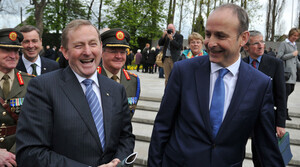
From top: Enda Kenny and Micheál Martin; Derek Mooney

The real danger to Fine Gael seats does not come from a quick general election but from this Dáil and this Government lasting for two or three budgets.

Derek Mooney writes:

“The answer is, mate – because I wanna do you slowly…”

This was Australian Prime Minister Paul Keating’s 1992 acerbic put down to the opposition leader John Hewson’s claim that Keating, who had just become PM a few months earlier, was shying away from facing him in an early general election.

Though the positions are somewhat reversed here, and our own dear Michéal Martin would never be uncouth as the great Keating, there is a slight hint of the same approach, though it is Fine Gael doing Fine Gael.

During the very brief course of the even briefer heave against Enda Kenny, unnamed Fine Gael back bench TDs were confiding to the army of Leinster House political correspondents how fearful they were that Martin and his newly engorged phalanx of Fianna Fáilers would quickly pull down the Government and plunge the country into a snap general election from which, they reasoned, Fianna Fáil would emerge even bigger and stronger.

If this is the level of their insight, then it is easy to understand why Enda Kenny didn’t select these back benchers for high, medium or even low office.

The real danger to Fine Gael seats does not come from a quick general election but from this Dáil and this Government lasting for two or three budgets.

The threat to those seats does not come from gridlock, lost Dáil votes or delayed decisions. The threat does not even come from Enda Kenny’s leadership, though it is tempting to add the word ‘alone’ there.

The threat comes, instead, from Fine Gael’s failure to grasp that its recent losses were not just part of the ups and downs of the Irish political cycle, but rather because it failed to realise that politics has changed and that the voters have changed.

In 2011 Fine Gael styled itself as the party of political reform. It was going to change the way politics was done forever, it was going to end the Punch and Judy dynamic and show cronyism the door.

Its support levels rose to the heights it had reached under Garret Fitzgerald on the back of that promise of reform.

But, just like Garret’s crusade, it proved to be all spin and precious little action.

Instead of trying to aim for real reform Fine Gael looked backwards and determined that strong government is good government and that people would think that too if you told them it enough times.

It didn’t even grasp the basic rule of coalitions that the majority partner needs to give the junior partner, particularly its back benchers, sufficient space to exert its own identity – though they were, in fairness, aided and abetted in this by some Labour Ministers.

The irony of Fine Gael’s current predicament is that it is now operating in a system of ‘new politics’, but it is one that it did not design or propose. It is a ‘new politics’ primarily engineered by Fianna Fail and foisted upon the Government by Dáil arithmetic.

It is a ‘new politics’ that is still being talked about, but is not yet truly up and running.

The two key organisational elements of it, a committee system that is not an arm of government, in which every TD’s voice matters and a budgetary system that includes full oversight and scrutiny will not ready to properly start working until after the Summer recess.

Though there will doubtless be teething problems and institutional resistance to both, the success or failure of ‘new politics’ is predicated on these working properly over time.

The longer that Fine Gael, as a party, is seen to be reluctantly and unenthusiastically embracing these reforms, the longer it will prolong the pain for itself.

While its recalcitrant backbenchers may be right in identifying Enda Kenny’s leadership as part of its woes, its problems run much deeper.

They include clear identity and purpose and the longer Fine Gael delays addressing these issues the longer it allows itself to be Keating.

Derek Mooney is a communications and public affairs consultant. He previously served as a Ministerial Adviser to the Fianna Fáil led government 2004 – 2010. Follow Derek on Twitter: @dsmooney

90424330derek

From top: Taoiseach Enda Kenny at yesterday’s National Day of Commemoration Ceremony, Kilmainham Hospital, Dublin; Derek Mooney

Enda Kenny may be not a great Taoiseach, but he does understand power politics and has a honed instinct for survival: particularly his own.

Derek Mooney writes:

“Don’t tell a man to go to Hell unless you can send him there.”

This basic rule of politics should be carved into the walls of Fine Gael’s fifth floor parliamentary party room, perhaps somewhere prominent where Deputy Brendan Griffin can see it.

The rule itself comes from no less a political master than President Lyndon B. Johnson and appeared as one of his ‘rules for life’ in a 1987 People magazine article.

The implications of the rule for Enda Kenny’s current travails are obvious enough.

While Fine Gael backbenchers can hope to see Enda Kenny quit as much as they want. They can even send one of their number on to Morning Ireland to say it but, until they have the means and the wherewithal to do the deed, then it doesn’t matter.

About 34 of the 50 Fine Gael TDs returned to the Dáil are now on the government payroll (i.e. as Ministers, Junior Ministers or Committee Chairs) and while not all of them are absolutely committed Kenny-ites; neither are they about to put their current sinecures at risk in an unsuccessful heave.

But while Enda Kenny is undoubtedly damaged by the events of the last few weeks – indeed, of the last few months – he is not ready to go just yet.

It is not his first time facing a leadership challenge. Questions about Kenny’s leadership that had been rumbling for years erupted into a full blown heave following an Irish Times poll published on June 12 showing Fine Gael in second place, 4% behind the Labour Party.

Yes, you read that right: in June 2010 an Ipsos MORI poll showed Labour as the most popular party with 32% support. What a different 6 years of Gilmore, Howlin, Burton, Quinn, Rabbitte and Kelly in government can make.

The Ipsos MORI poll numbers appeared on Friday night. By Monday Kenny had sacked Richard Bruton as Deputy Leader.

A day later ten of the nineteen members of his own frontbench had withdrawn support and were publicly questioning his leadership. None more devastatingly than Leo Varadkar who told RTÉ’s Prime-time:

“I have had to ask myself that key question, the 3am question, if we are in government and there is a national crisis, if there is a sovereign debt crisis for example and Patrick Honohan rings the Taoiseach and who do I want to answer that phone, I want Richard Bruton to answer that… The people are saying to us they don’t have confidence in Enda Kenny.”

Even with over half his frontbench and almost all his likely successors publicly lined up against him – Kenny won out.

While his challengers were making their way to TV3, Newstalk and RTÉ to tell everyone else why he had to go, he and his supporters were working the phones and digging out every contact they could find to put pressure on the people with the votes: the TDs, Senators and MEPs to stick with Enda.

Though Fine Gael never revealed the result of the secret ballot, most believe it was a tight squeeze, but a win counts as a win and Kenny, whose leadership was nearly ended in June 2010, continued on to become the first Fine Gael to be returned to a second term as Taoiseach.

Meanwhile five out of the ten frontbenchers who said in 2010 that they had no confidence in Enda Kenny, now serve around the Cabinet table with him: Fine Gael’s: Richard Bruton, Simon Coveney, Michael Creed and Leo Varadkar and the now independent Denis Naughten.

So, do these and other Fine Gael TDs believe today’s Enda Kenny is a better and more skilled leader than the 2010 one?

Possibly they do …or …just maybe, they perceive that Enda is not yet as weakened as he was back in 2010?

Though there are several candidates interested in succeeding Enda, there is no clear favourite. Most of them fall into the the successor category: someone not too critical of the outgoing leader and hopes to seamlessly take over from him with a minimum of fuss.

Arch-successors would include the likes of Simon Coveney, Frances Fitzgerald or even Paschal Donohoe or Simon Harris.

On the other end of the scale, Varadkar might reasonably be considered a challenger, someone who sees themselves as challenging the status quo and wanting to take the party in a different direction from their predecessor.

The successors will not strike out against Kenny, they will wait a little more until he is almost ready to go, while the challenger will not move and send out a stalking horse to take on Kenny until he is sure he has more votes than the successors.

It is this stalemate that will keep Enda and his Government drifting on its road to nowhere for a while more.

It will take more than statements from a handful of backbenchers to take Kenny out – the ground under Enda is undoubtedly shaky but it has not shifted… well not just yet.

Derek Mooney is a communications and public affairs consultant. He previously served as a Ministerial Adviser to the Fianna Fáil led government 2004 – 2010. Follow Derek on Twitter: @dsmooney

Rollingnews

cityhall

derek

From top: Dublin crest on the floor of City Hall, Dublin; Derek Mooney

In his column last week the author suggested re-constituting the Forum on Europe on an all island basis. Now it’s nearly government policy. He’s that good.

This week: the hazards of a directly elected Dublin Mayor.

Derek Mooney writes:

What is it about bad political ideas? When it comes to tenacity and resilience they put the cockroach to shame. While the cockroach simply trundles along looking loathsome and malodorous, bad ideas manage to get worse over time and yet somehow develop an enticing perfume.

So it is with the idea that Dublin should have a directly elected Mayor. Once again this superficially alluring proposal is being promulgated by some, including – though not exclusively – the Green Party.

It is as if its proponents had looked across the Irish sea, seen the absolute mayhem that the first two elected Mayors of London: Ken Livingstone and Boris Johnson, have wrought on the political scene so far this year and thought: hmm, how could we get some of that here.

It is not as if this is a new idea either. It has been trotted out in a couple of incarnations over the past decade and a half.

The first to run it up the flagpole was the former Fianna Fáil Minister, Noel Dempsey who provided for it in his 2001 Local Government Act. No one saluted, so it was wound back down.

It was then resuscitated by John Gormley in 2008, by way of a Green (discussion) paper and a subsequent draft piece of legislation, but it never made it into law.

Perhaps on the basis of three times is a charm, Big Phil Hogan wheeled out the proposal for a directly elected mayor again via his June 2012 local government reform document: Putting People First.

He envisaged the people of Dublin getting to vote on the idea in 2014 – but only if the members of the four Dublin Councils agreed. Three Councils did: Dublin City, Dun Laoghaire/Rathdown and South County, but the fourth: Fingal didn’t and so no plebiscite was held.

While the broad policy objective of giving more power to Dublin and having decisions about Dublin being made by people who are answerable to Dubliners is laudable, it appears to me that the directly elected mayor model is one with the least hope of delivering on that goal.

Any directly elected Mayor of the Dublin region would, after the President, have the biggest electoral mandate in the State, except that it would, unlike the President’s, be explicitly political.

Even on a turnout of only 50%, a directly elected Mayor for the Dublin Region (equal to the Dublin European constituency) would need to get over 200,000 votes.

That is some electoral mandate for one elected official to have and could potentially position them in opposition to the Taoiseach of the day, particularly where the Mayoral election was mid-way through a Dáil term.

Indeed it is hard not to imagine that Mayoral elections would be hi-jacked by opposition politicians as a platform to attack the Government of the day.

It is like having a referendum in Dublin on the policies of the government after two years, mid way through their implementation, but without the means to amend or change them?

Political gridlock in the Capital would almost be inevitable with a directly elected Mayor of Dublin, claiming to speak for about one third of the country, questioning and challenging the policies of the elected government.

Not that this capacity for political gridlock is limited to situations where the Mayor and Taoiseach were from opposite sides.

Look at the tension there was between Boris Johnson as Mayor and David Cameron as Prime Minister or between Ken Livingstone and Tony Blair/Gordon Brown as each operated what were effectively rival courts across the Thames.

Indeed the likelihood of political gridlock would be all the greater if the Dublin Mayor has no real responsibilities or powers to occupy themselves.

Most of the directly elected models that have been suggested thus far have envisaged the Mayors having co-ordinating roles, such as chairing the Transportation Authority. That is not going to keep them so busy that they won’t have time to make mischief for the government of the day.

The other question is what is to be done with the current tranche of 171 City and County Councillors across the four separate Dublin Councils?

You would hardly need all those directly elected Councillors sitting on four separate councils when you have a directly elected Mayor as that would be unnecessary duplication and waste, so how many do you cull? 80%? That would leave 34/35 to populate a regional Assembly.

Say you only cut 65% of them – leaving you with a regional consultative assembly of about 60 Councillors – that still means reducing the level of direct democracy and direct linkages between the citizens of Dublin and their elected representatives.

But isn’t part of the aim of having a directly elected Mayor to have greater linkages and answerability.

The case for greater joined up thinking and more decisions about being made by those answerable to Dublin is clear, but the directly elected mayor/super mensch is not the way to achieve that.

We need a model of city government that is based on the transfer of actual authority and finance raising power not just one individual’s ego and ambition.

Derek Mooney is a communications and public affairs consultant. He previously served as a Ministerial Adviser to the Fianna Fáil led government 2004 – 2010. Follow Derek on Twitter: @dsmooney

220616-northern-ireland-brexit-mderek

From top: Sinn Féin Remain poster in Northern ireland earlier this month; Derek Mooney

We have not spent decades of painstaking negotiation to break down barriers for them to be risen higher by a battle for the leadership of the Tory party.

Derek Mooney writes:

For as long as I can recall it has been a central tenet of Unionism that the status of Northern Ireland should not change without the political consent of the majority of the people living there.

Yet, that it precisely what is set to happen over the coming years, with senior members of the DUP cheering it on

Despite the fact that a clear majority – some 56% – of the people of Northern Ireland who voted, including large numbers from both traditions, stated that they wanted to remain in the EU, their wishes are about to be ignored.

It seems that a majority in the North is only a majority when the DUP is a part of it.

Thursday’s referendum result has changed things dramatically for the North and for the whole island. There will be the immediate implications, including many of the ones for which the Government has prepared, as set out in its contingency plans published last Friday.

But there are others, two of which I would like to set out briefly here.

First, is the integration of the economic interests of communities across this whole island. As the SDLP leader Colum Eastwood has said:

“…there can be no return to a physical border across this island. There must remain freedom of movement for people, goods and services across Ireland… we must ensure that any border is only operational around the island of Ireland, not across it.”

This last point is vitally important. Though the Brexiteers, including the Secretary of State for Northern Ireland, Teresa Villiers, dismissed any suggestion of implications for the border during the campaign, it is clear that there will.

If and when the UK eventually leaves the EU that border would potentially become a frontier between an EU State and non-EU State.

This is ominous as the EU is already looking at ways of increasing security at its external boundaries, as evidenced last week by the European Parliament’s LIBE committee vote to “systematically check all EU citizens entering or leaving the EU

There is an overwhelming economic, social and political case against resuscitating the 499km border between the two parts of this island as an international boundary.

We have not spent decades of painstaking negotiation to break down barriers for them to be risen higher by a battle for the leadership of the Tory party.

The EU has been an important, though unheralded, part of the peace building process. Between 1995 and 2013 the EU spent €2 billion on promoting reconciliation in Northern Ireland and the border counties.

But it has done more than that. It has provided a supra-national cross border framework and support that has avoided any major policy cleavages across this island.

Rather than having the EU border across this island, let it run around the island with the customs and border controls sensibly located at ports and airports.

But we need to go further. We need to recognise that despite differences in identity, that Northern Ireland has and will continue to have a great deal of economic and social common interest with the Republic.

To give expression to this common interest the Irish Government to needs to fashion an all-island EU strategy and use its seat at the Council of the European Union to champion the interests of Northern Ireland, particularly the border regions, along with the interests of the 26 counties.

The government should start reaching out now to civic society across the North to become its connection to the EU and should formalise these relationships, perhaps initially through re-establishing the Forum on Europe on an all island basis.

Second, is the loss of the UK as a valuable EU ally. In two or three years’ time we will no longer have the UK to help us act on a brake on EU measures of which we disapprove.

Given our similar structure and similar outlooks, in the area of social dialogue for example, our two governments have – regardless of political hue – worked together. During the recent discussions on the introduction of an EU wide system of Data Protection, Ireland and the UK worked together to make significant and sensible changes.

But the UK has opted to go and so we need to look for new allies. We need to look to the smaller EU states who would share our concern at the excessive influence of the larger states, but also to the other like-minded nations on these islands.

To this end an Taoiseach should be reaching out to Scottish First Minister Nicola Sturgeon in the coming weeks to see how Ireland and Scotland could work together in our mutual benefit as the fate of the UK, Scotland and Northern Ireland in the EU unfolds.

Enda may have no choice but to start talking with Nicola Sturgeon, as she seems to be the only leader on the neighbouring island with anything even approaching a plan for the future..

Derek Mooney is a communications and public affairs consultant. He previously served as a Ministerial Adviser to the Fianna Fáil led government 2004 – 2010. Follow Derek on Twitter: @dsmooney
90422150

derek

From top: Joan Burton at a candle light vigil for slain Labour MP Jo Cox; Derek Mooney

A rush to simplification and the urge for immediate commentary and analysis and you have a dangerous mix.

Derek Mooney writes:

As people struggle to come to terms with how Jo Cox MP could be so brutally and slain outside her constituency clinic, many have focussed on the coarsening of public debate and the abuse, both actual and online, aimed at politicians.

Though there has undeniably been a coarsening of public debate in recent years, we should not delude ourselves that there was once a golden age when all political discussion was genteel and free from ad hominem attacks.

There wasn’t.

Politics has always been a rough trade where vigorous and full bodied exchanges are the order of the day. Take this robust response from Frank Aiken T.D. in Dáil Éireann in July 1959, which I found while doing some research on Irish diplomatic history.

Incensed by Fine Gael claims that he was too supportive of Chinese representation at the U.N. and that he had chosen to attend a U.N. meeting instead of the funeral of Pope Pius XII, Aiken, who was Foreign Minister at the time, fumed:

He [Deputy McGilligan] is a low type who would climb on the body of a dead Pope to have a crack at Fianna Fáil.

Can you imagine the memes if someone said that today?

But blaming Social Media alone for the eroding of civility in public discourse, as some have done in recent days, is to miss a bigger point.

Of course there are armies of irresponsible anonymous online warriors out there ready to pour a stream of bile and abuse on anyone who disagrees with them or points out that their heroes have feet of clay.

They are on both the left and right. Indeed, some of the most illiberal vitriol can come from those styling themselves as liberal, but whose social media output is anything but.

There are lone wolves and there are organised hoards. Our own domestic example of the hoard are the Shinner-bots, a virtual battalion of anonymous trolls (with the emphasis on ‘anonymous’).

Within minutes of Gerry Adams being criticised online for his disgraceful ‘Django’ tweet, the Shinner-bots were insulting and lambasting anyone who dared to question the actions of the dear leader.

Their goal: smother the critics by saying and posting anything necessary to shut down the discussion and drive their opponents offline.

Sadly, politicians and journalists, particularly female, come in for equally appalling treatment on social media. The attacks on journalists are probably more pernicious, as the aim is to influence their reporting not by weight of facts and debate, but by simple bullying.

But the point to remember is that the vast majority of people do not post or talk about politics on social media. Just in the same way as the majority of the people who vote for an individual TD do not contact them by email, letter or phone.

Most people are part of what Richard Nixon (OK, not the first name to leap to mind when talking about open dialogue) termed: “The Silent Majority”, the people who are following events, but who are not protesting, speaking out or expressing their political opinions beyond the ballot box or the odd discussion at home or in the pub.

Blaming the coarsening of debate on social media alone is akin to attributing the rise of Hitler to the invention of valve radio.

It is a factor, particularly the facility for anonymous posting which certainly has helped the erosion of mutual respect in discussion, but there are other significant ones, including the dumbing down of political debate.

This dumbing down is practised by politicians and journalists alike.

In the 1968 U.S. presidential election the average candidate soundbite used on the TV evening news was 42 seconds. By the 2000 election, that had shrunk to about 7 seconds.

The trend was not limited to broadcast media. During the same period the average quote from a candidate appearing on the front page of the New York Times went from 14 lines to about 6.

We now do politics as if it was a skills test on a reality show: Your task is to set out how you will sort out Irish healthcare in 30 seconds… explain the rational for the UK remaining the EU in 140 characters.

Couple this rush to simplification with the urge for immediate commentary and analysis and you have a dangerous mix. In the days before social media, talk radio and rolling 24-hour news, politicians and journalists alike had the time to consider their responses and the space to expand on them.

Political analysis and political responses are now expected be immediate, hurried and brief. But what is the virtue of the immediate short response, be it in a radio interview or online?

If expecting a Minister to give their immediate gut response to a particular issue is now the norm, then how can we slam others for doing the same online, when they do it under their own name?

Derek Mooney is a communications and public affairs consultant. He previously served as a Ministerial Adviser to the Fianna Fáil led government 2004 – 2010. Follow Derek on Twitter: @dsmooney