Tag Archives: Disclosures Tribunal

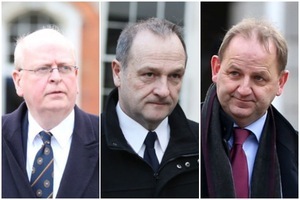
Clockwise from top left: Marian Finucane; Gerald Keane and former Garda Commissioner Martin Callinan

Tomorrow morning.

The Disclosures Tribunal will resume with celebrity solicitor Gerald Kean taking questions first.

Sgt Maurice McCabe and former Garda John Wilson sued over comments made by Mr Kean during a panel discussion on the Marian Finucane Show on RTÉ Radio One on Sunday, January 26, 2014.

The radio appearance came two days after the then Garda Commissioner Martin Callinan met Fianna Fail TD and then chairman of the Public Accounts Committee John McGuinness in a car park on the Naas Road – Friday, January 24, 2014.

At this time there were discussions within PAC over whether or not Sgt McCabe would go before it to discuss the quashing of penalty points, following the publication of a report by the Comptroller and Auditor General into the matter in October 2013.

Mr Callinan had appeared before the PAC on Thursday, January 23, 2014, to discuss the same report – which found that one in five motorists avoided penalty points because their cases were not pursued. For 2011 and 2012 – the C&AG found approximately 2,900 cases were terminated for around 700 vehicles, with three or more cases terminated each.

Mr McGuinness claims at the car park meeting of January 24, 2014, Mr Callinan told him Sgt McCabe abused his children and nieces and that he was making a “grave mistake” in relation to the PAC.

Mr Callinan denies Mr McGuinness’ claims.

In October 2013, the then Minister for Justice Alan Shatter told the Dail that Sgt McCabe and ex-Garda Wilson had not cooperated with an internal garda investigation into the quashing of penalty points by Assistant Commissioner John O’Mahoney – which found there was no widespread quashing of points.

In March 2014, Mr Shatter apologised in the Dail for making this claim.

The tribunal has already heard that after Sgt McCabe heard Mr Kean’s comments, he wrote to Mr Kean and that Sgt McCabe received a letter back from Mr Kean.

These letters haven’t been shown to the tribunal yet.

Further to this…

The transcript from the Marian Finucane Show (the other panellists were then Minister for Communications Pat Rabbitte, former Assistant Commissioner Martin Donnellan, former editor of the Sunday Tribune and managing destination editor with the Lonely Planet Noirin Hegarty):

Gerald Kean: “I am very, very clear in my opinion and I think it’s reflected by Mary Carr in the Mail [Irish Mail on Sunday] today that matters of criminality should be left within An Garda Siochana to deal with and if, as some political commentators and media persona have said this week, they don’t have confidence in the Garda Siochana, then we’ve a really serious problem because I do have confidence in the Garda Siochana. And I do think that matters of criminality, where there’s allegations of criminality have to be dealt with within the force.”

Marian Finucane: “But the force investigating the force?”

Kean: “Well that’s what the force is there for. Let me put it this way to you. And I mean I’m not sure, I don’t understand why this hasn’t been highlighted in the media. If we take, for example, the one that I have an interest in, these penalty points and the role of the Commissioner of An Garda Siochana [Martin Callinan] there.

“There’s two words – I know Noirin and Martin were talking beforehand about – first of all, you know, this criticism of him saying before the Public Accounts Committee that it’s ‘my force’ and this – well, with all due respects, the head of the Armed Forces calls ‘his men’.

“Nobody’s suggesting the Commissioner is at home with the Deputy Commissioner [Noirin O’Sullivan] and Assistant Commissioners sitting around  the fire planning a coup de tat. I mean ‘my force’ denotes pride, it does.

“And I did my usual yesterday, I contacted guards all over the country. I spoke to 13/14 members of the force, now they’re mostly guards – one inspector and one sergeant – and they basically are saying, there’s nothing wrong with that.

“It is his force, he’s the leader, he’s not suggesting, for one moment, it’s not a very important organisation that’s there for the benefit and at the behest of the State – of course he’s not. It’s just a turn of phrase.

“And then I know there’s this question about him referring to ‘disgusting’. You know, when you put that in context, what he’s saying is that he’s always stated, and I’ve been in the presence, I only met the man personally once, so he’s not somebody I know that well, but I know at one function he advocated, in no uncertain terms, the importance of whistleblowers and the importance of protecting them but…”

Finucane: “But yet, but yet, there was fierce undermining of…sorry, Noirin, you wanted to come in on…”

Kean: “Well, yeah, the undermining is the fact that when whistleblowers, first of all, do not co-operate in any way shape or form with the investigation, the investigative committee under Inspector [sic, Assistant Commissioner ] John O’Mahoney] who’s a very respected man, they didn’t co-operate with that at all. They go in, they breach the Data Protection Act, that’s clear. I mean I think that is clear.

“And from the information that I have, it looks as if they breached Data Protection, which is a criminal offence, and then what they do is they spoonfeed this information to certain Independents in Dail Eireann, instead of the proper practice, procedure. I don’t believe for one minute that the Minister, or sorry, that the Commissioner and Deputy Commissioners and Assistant Commissioners are going to condone for one moment any illegality that takes place within An Garda Siochana.”

Finucane: “Gerald? Do you remember Donegal?”

Kean: “Yes, I do. Yeah I do. But I’m not saying, sorry, I didn’t say there’s no wrongdoings within An Garda Siochana.”

Finucane: “Yeah.”

Kean: “I said I don’t accept that the Minister, or sorry that the Commissioner, the Deputy Commissioners, the Assistant Commissioners, all sit around and said ‘let’s bury this, let’s bury this’. I don’t accept that.”

Noirin Hegarty: “I would say to Gerald, I would disagree completely. Look at the facts. These whistleblowers did go through the proper procedures within the gardai. It would be generally viewed that it was somewhat of a whitewash internally in terms of how they dealt with this, then they went to elected members of Dail Eireann. Now they’re before the Public Accounts Committee with information. There isn’t transparency in this.

“If you’re the leader of an organisation, like the Commissioner of the Gardai and somebody comes to you to give you information that you don’t want to hear and your first instinct, or even your second or third instinct, is to discredit that person or to shut them up in some way, then your part of the problem and I think what we saw this week with Martin Callinan was that he may well be part of the problem.

“He talked about ‘my force’ and I don’t agree with you, the head of the Armed Forces doesn’t refer to ‘his men’. Number one, it’s not just men anymore, it’s men and women.

Finucane: “They forget that.”

Hegarty: “They do forget that. But he also referred to the whistleblowers  as ‘disgusting’. Now this is highly charged, personal language – what is disgusting about bringing into the public arena something you feel very strongly about.

“In fact , the price that the whistleblowers have paid has been enormous. John Wilson was effectively forced out of the gardai and the sergeant [Maurice McCabe] has been named now and people know who he is and I can only imagine that there are reprisals internally are there. John Wilson had a rat tied to his door so his family have paid an enormous price for him coming out and saying, he didn’t have to do this at any point.

“And I think what you’re seeing is that culture eats strategy for breakfast. So no matter what you’re saying about internal garda procedures, at this point there needs to be some kind of an independent inquiry to restore faith.

“Because why should there be a golden circle that get their penalty points written off.

Finucane: “Martin Donnellan…”

Hegarty: “Because you’re a celebrity , because you’re a journalist, or because you’re whoever, it’s wrong. It should be one law for everyone.”

Kean: “But the Commissioner said that. The Commissioner said that.”

Hegarty: “But, in practice, it’s not what’s happening. Look at the figures, Gerard. You see. For example, seat belts, something like 500 penalty points for seat belts written off two years ago, then it went down to 300, there were none last year – nobody had their penalty points quashed for not wearing their seatbelt. Now if that doesn’t tell you that there was a problem, and that people are waking up to it, what does?”

Finucane: “Well, can I just come to Martin Donnellan on that, because I mean the point that Gerard made and that I believe is universally accepted is there is respect for the gardai, there is a desire for them to do their job, etc, etc, etc. But they have to be seen to as well, would you not say?”

Martin Donnellan: “Well, you know, the gardai, since 1922, they operate on the moral authority of the people of this country – there’s no doubt about that. So that’s the way they’re founded and set up. And I trained back in the late 1960s and during the training and during our mentoring out in stations, we were encouraged to use our discretion and when we went in, poor judges brought people in for various offences, minor and serious, but generally minor in the District Court, and you had some young fella for his first offence, and it might be a small amount of cannabis, it might be breaking a window and the judge used, the judiciary used discretion all the time.

“And the judge would say to the gardai and it was said to me many a time: ‘do you think we should give this guy a break here. If I give him a criminal conviction, he may not realise it now but it is going to come again’ him later on in life – he’s going to have a criminal conviction and that is the way I came up through the job.

“I saw discretion being used very wisely and it’s part of what the gardai do. Now. Ok. We’ll come along now to the penalty points and the, the, you see, as I look at this from outside now. Five and a half years gone now…”

Finucane: “You’re still part of the family.”

Donnellan: “I am indeed. And maybe fell out with them a little bit at times and, you know, but I learned the best form of success is revenge anyway. A very wise man said that to me. But discipline, we’re a disciplined, the gardai are are disciplined organisation. Now, it’s OK, like I don’t know Mr Wilson, and I don’t know the sergeant [Maurice McCabe] so I don’t know how they got to the situation or how it developed to where we are now – where we have. Now. I read a paper the other day with shock, where it said that up to 200  officers are, we’ll say, cancelling notices corruptly, now that’s a very, just think about that for a minute, that’s unlawful. It’s unlawful, it’s corruption, it’s unlawful.”

Finucane: “But do you take Noirin’s point?..”

Donnellan: “I see Noirin’s point..”

Finucane: “…that when the whisteblowers came out in the open, suddenly the number goes down to zero.”

Donnellan: “Correct, yeah, and I agree. Even [Assistant Commissioner] John O’Mahoney has been mentioned here already. He did an investigation. He’s one of the best and most competent investigators in this country. I worked with that man at various ranks but the Commissioner put him in charge and I could see why. But the people that made the allegations, what I would like to know is, had they the full facts? They downloaded stuff from computers, ok? They went then and they made assumptions. This, that these were incorrectly or unlawfully…”

Finucane: “Well they noticed patterns.”

Donnellan: “Of course they did. But did they go behind the issuing or the cancellation of them? Now, I agree with you. If some-…”

Finucane: “They were knocked off PULSE, as I understand, straight away – so that is circulating wagons. And I mean, I’m quoting [Judge Peter] Smithwick when he talked in his [tribunal] report about within the gardai, loyalty was prized above honesty..”

Donnellan: “Well, I can say this much to you, as far as I’m concerned, and the people I, I prosecuted, arrested guards and prosecuted them and jailed them. That was part of what I did. I did internal investigations aswell.

“Now, OK, Judge Smithwick said loyalty took precedence over honesty, I think that is not correct. He’s entitled to his opinion, he sat at that [tribunal] for five years, he’s an eminent member of the judiciary, but that’s a very big reach I do think. Because…”

Finucane: “But you see that is what people are saying, some people, not all people, they’re saying about the Commissioner.”

Donnellan: “I know it is, listen I don’t want to go talking about the Commissioner or his choice of language or whatever. But. Listen. We’re a disciplined force, I do not believe that Garda Wilson and the sergeant were effectively dealt with in the first place. Unless that they’re saying ‘well, listen, I’m going to go further with this’. I heard a saying a long, long time ago when we’d be dealing with somebody, he’d say ‘listen, if I go down on this, I’ll bring a lot with me’. So maybe they wanted to go to a higher forum…”

Finucane: “You cannot allege that against them either.”

Donnellan: “No, I am not alleging, I’m not alleging but..’

Finucane: “That can’t be done..”

Hegarty: “That’s why we need…”

Talk over each other

Pat Rabbitte: “I don’t think Marian that we can judge the issues here today. The issue is whether or not it’s properly before the Public Accounts Committee. I agree with what Martin says about discretion in all walks of life, including the Garda Siochana and I understand what he’s saying as well about what the mood in the country and amongst the gardai was when he was a young garda growing up in the force, so to speak. The past is a foreign country, the gardai and the rest of us now operate in a more complex and difficult environment and the issue is, ought the Public Accounts Committee examine this question.

“And it seems to be, since the day, the Secretary General of the Department of Justice handed over the job of Accounting Officer to the head of the Garda Siochana, that he is responsible to the Public Accounts Committee for monies misspent, or monies badly spent or monies forgone or not collected on behalf of the Exchequer so, that much is very clear.

“Now the issue is narrowing it down to whether or not the Public Accounts Committee ought to be entitled to take witnesses and whether in particular take the witnesses that are the whistleblowers in this case. I don’t know what Gerald’s opinion is, as a lawyer.

“My own opinion is that: so long as the committee has satisfied itself that they have a credible witness and he or she, he in this case, follows a legitimate, answers, follows a line of answering legitimately questions that are put to him, that he is entitled to be heard.”

“He’s not entitled to use it as a platform to promote an agenda of his own, if he had such an agenda or to make allegations…”

Finucane: “Well allegations against named people would be outrageous…”

Rabbitte: “…against particular colleagues who wouldn’t be there to defend themselves. That, it seems to me, would not be permitted. And but, is the Public Accounts Committee entitled to take evidence if they have settled in their own minds that he’s a credible witness, and that they’re entitled to ask legitimate questions relating to monies forgone. It seems to me they are.”

“Whether or not there has been any criminality, as Gerald says, is a separate issue for a different forum. But in terms of whether monies have been forgone, that ought to have been collected for the State, it seems to me the Public Accounts Committee are entitled to pursue it.”

Kean: “I think the important thing is that, we all agree, and I think it’s accepted, that the vast majority members of An Garda Siochana here deserve our support and confidence. But it annoys me when people are not getting the facts right.”

“And Noirin is simply, absolutely, totally incorrect when she says that the whistleblowers have done everything they can within An Garda Siochana, on this matter that’s been investigated, it’s just simply wrong. She’s believing what she’s reading in the papers.”

“The fact of the matter is that Inspector [Assist Comm] John O’Mahoney who we accept is a wonderful, I’ve never met the man but I’ve heard great things about him. But he was set up to investigate this and these two gentlemen…”

Finucane: “I’ve no doubt the other men  are wonderful men too, do you know what I mean?”

Kean: “I’ve no doubt about that aswell. I’m not denying that at all. But what I’m saying is they did not cooperate with that investigation. And by the way, just so you’re aware of these…as a result of John O’Mahoney’s investigation, three or four members of the force have been sent forward for disciplinary action.

“Secondly, many new reforms have been put in place, based on his, which were needed, we’re not saying, nobody is suggesting, of course there were wrongdoings. But in addition to that, which people don’t know, is the anti-fraud mechanism which is in place has sent four relatively senior members of An Garda Siochana files to the DPP for criminal prosecution.”

Finucane: “But you sound like that’s outrageous? That is the way it is supposed to be..”

Kean: “No, no..It should be that way, yes, but what I’m saying is, you’re absolutely right.  And every one of them who’ve done a wrongdoing should go. But what I’m saying is that for some reason ‘it’s as if there’s a whitewash here’, nobody is aware that they are trying to do something and that’s under the Garda Commissioner, and I think that reflects badly on the rank and file members if there is just one-way criticism of An Garda Siochana. I believe that An Garda Siochana are well able to deal.

“And if, by the way, at the end of that, they don’t get a say, and if they don’t, if the whistleblowers, who have a very legitimate right to air their grievances, if they don’t go through the proper channels to get that, well absolutely fire on ahead.”

Hegarty: “But on the one hand, Gerald, you’re saying the whistleblowers have an absolutely legitimate right to air their grievances, on the other hand it’s clear that this hasn’t been dealt with.

“You’re speaking as if this is done, it’s over, it has been investigated thoroughly and we can move on from here.

“Clearly, we can’t.”

Kean: “Nobody said…”

Hegarty: “What I’m saying is, nobody, well you are…”

Kean: “I’m saying that you can’t, you can’t have it, in fact I’m saying the very opposite, you can’t investigate it thoroughly when an inspector is set up to investigate and the two whistleblowers don’t cooperate, they don’t cooperate…”

Previously: The Commissioner, The ‘Knacker’s Horse’ And The Two ‘Headbangers’

Rollingnews


From top: Fromer Garda Commissioner Martin Callinan, John Wilson; Maurice McCabe

The Disclosures Tribunal will resume at 9.30am with Fianna Fáil TD and former chairman of the Public Accounts Committee (PAC) John McGuinness will continue to give evidence.

Olga Cronin will be live tweeting for the sheet here.

After Mr McGuinness, Garda Paul Hynes – who was former Garda Commissioner Martin Callinan’s driver – will give evidence.

Scheduled to follow Garda Hynes are the Comptroller & Auditor General Seamus McCarthy and Fine Gael TD John Deasy.

As he gave evidence yesterday, Mr McGuinness recalled events running up to and including January 2014 when, he claimed, there were rumours swirling around Leinster House about Sgt Maurice McCabe.

At this time, Sgt McCabe was attempting to unveil the quashing of penalty points – among other matters – and was scheduled to appear in a private sitting of the PAC on January 30, 2014.

Separately, the then Garda Commissioner Martin Callinan was not pleased that Sgt McCabe had given documentation to the PAC and was scheduled to go before it.

Mr McGuinness, a Carlow/Kilkenny TD, claimed that on two occasions in January 2014, he witnessed Mr Callinan referring to Sgt McCabe as someone who abused children.

Mr McGuinness claims after a meeting of the PAC on January 23, 2014 – during which Mr Callinan made his infamous “disgusting” remark – that Mr Callinan referred to Sgt McCabe as someone who “fiddles with kids” while referring to both Sgt McCabe and Garda Wilson as “fucking headbangers”.

In an article about this PAC meeting by Irish Times journalist Miriam Lord, in February 2017,  Ms Lord recalled being among the gardai and politicians who milled around after the meeting finished. She wrote:

“I remarked to somebody that I wasn’t at all impressed by his [Callinan’s] attitude and evidence.

“I got back a tirade in the most colourful of language about Maurice McCabe and what an awful person he was and if I only knew the half of it I wouldn’t be so quick to criticise the commissioner.

“The “half of it” included insinuations about inappropriate sexual contact with a minor. This didn’t come as news – the rumours were already floating around.“

Mr McGuinness also claims that, a day later, on January 24, 2014 – when they met in the car park of a hotel on the Naas Road – Mr Callinan told him “[Sgt McCabe] had sexually abused his family and an individual, that he was not to be trusted…”

Mr Callinan is denying he said what Mr McGuinness alleges on both January 23 or January 24, 2014.

The tribunal also heard yesterday that Mr McGuinness told his party leader Micheál Martin of the car park meeting not long after it occurred. Mr Martin has told the tribunal that in February 2014:

“…he [McGuinness] mentioned that a short while previously he had met the then Garda Commissioner Martin Callinan in a hotel car park and I recall him mentioning that the Commissioner had told him that Sergeant McCabe was not to be trusted and that he was a child abuser. He gave no further details.”

This notification to Mr Martin was two months before Mr Martin met Ms D with the assistance of Irish Independent journalist Paul Williams.

This week and next, the witnesses are expected to be mainly asked about matters in relation to 2012, 2013 and 2014 and the penalty points controversy over those years.

Media reports – and contacts pertaining to these reports – are also likely to be examined, given Supt Dave Taylor has told the tribunal he was instructed to negatively brief journalists about Sgt McCabe by Mr Callinan with the knowledge of the then deputy commissioner Noirin O’Sullivan.

As it stands, both Sgt McCabe and Mr McGuinness have told the tribunal that Supt Taylor told them that this smear campaign was circulated to journalists, some senior gardai and certain politicians via text messages.

But Supt Taylor denies telling them he communicated negatively about Sgt McCabe via text and, instead, it was though word of mouth.

As the next week’s witnesses will be discussing matters pertaining to the period in which Sgt McCabe and former Garda Wilson were trying highlight the quashing of penalty points and the media…

The following is a timeline of these matters in 2012, 2013 and 2014…

[Below that are comments that Sgt McCabe has made about certain media reports in relation to him during those years and some actions that he’s taken…]

January 2012: Sgt Maurice McCabe went to the Garda Confidential Recipient, Oliver Connolly, with a dossier of 12 complaints alleging Garda malpractice and incompetence regarding serious cases of criminality.

The dossier included allegations of malpractice and incompetence in relation to the case of Mary Lynch – a taxi driver who was assaulted by Jerry McGrath who went on to kill Sylvia Roche Kelly. Mr Connolly handed over details of these complaints to the then Minister for Justice Alan Shatter, who then handed the dossier over to the then Garda Commissioner Martin Callinan.

GSOC investigated a section of the Sylvia Roche Kelly case and it recommended that disciplinary action be taken against two officers. But Garda Commissioner Martin Callinan declined to discipline the two officers.

February 2012: It’s understood Mr Connolly spoke to Mr Shatter and told him about the whistleblowers and that Mr Connolly met with Mr Shatter again before Easter and discussed the allegations.

February 9, 2012: Mr Connolly met Sgt McCabe, who taped their conversation. They discussed Sgt McCabe’s complaints. Mr Connolly tells Sgt McCabe that no further action will be taken on his complaints. Mr Connolly also warns Sgt McCabe: ‘I’ll tell you something Maurice – and this is just personal advice to you – if Shatter thinks you’re screwing him, you’re finished.’ Mr Connolly advised Sgt McCabe to avoid going to the media and to go through the courts system. Mr Connolly assures Sgt McCabe that Minister Shatter looked into Sgt McCabe’s complaints in detail.

March 2012: Garda John Wilson and Sgt Maurice McCabe make a complaint to Mr Connolly about the quashing of penalty points. Mr Connolly gave this complaint to the Garda Commissioner Martin Callinan.

May 2012: Sgt McCabe sends Mr Connolly more information, alleging the quashing of penalty points.

July 2012: Sgt McCabe gives Taoiseach Enda Kenny information of alleged misconduct concerning penalty points and offered to meet Mr Shatter, with his legal team, including former Attorney General and former Minister for Justice Michael McDowell, and to provide him with files and information. Mr Kenny replies to Sgt McCabe and says Mr Shatter would deal with his request.

August 2012: Sgt McCabe writes to Mr Kenny again, in relation to the penalty points.

September 2012: Sgt McCabe writes to Mr Kenny again.

December 4, 2012: After receiving no response from the Garda Commissioner, the two garda whistleblowers approach then United Left Alliance TD Clare Daly to voice their concerns to her.

United Left Alliance TDs Clare Daly and Joan Collins use parliamentary privilege in the Dáil to name Judge Mary Devins as someone who had their penalty points quashed.

December 7, 2012: Commissioner Callinan issues a press statement in relation to the penalty points, saying he has appointed Assistant Commissioner John O’Mahoney to look into the allegations before adding: “There is no question of what has been described as a culture of non-enforcement of penalties being tolerated by An Garda Síochána.”

December 11, 2012: Under privilege in the Dáil, United Left Alliance TD, Joan Collins names several high-profile people who had penalty points quashed including rugby player Ronan O’Gara, Irish Independent crime reporter Paul Williams and Judge Mary Devins, again.

December 14, 2012: Sgt McCabe is visited by Chief Supt Mark Curran.

Sgt McCabe secretly records his conversation with Chief Supt Curran.

Reading out a document, Chief Supt Curran told Sgt McCabe:

“Correspondence from commissioner.

“Direction to desist searching Pulse and dissemination to a third party, of sensitive personal data regarding cancellation of fixed charged notices.

“The commissioner understands that you have been searching and printing out from pulse documents that contain sensitive personal data regarding the cancellation of the fixed charge notices.

“The commissioner further understands that it is your intention to provide a third party with that documentation. It is noted that sensitive personal data in relation to fixed charge cancellation have already appeared in the public domain.

“The commissioner has sought the advice of the Attorney General and has consulted with the Data Protection Commissioner in respect of this matter.

“You are aware that there is power as set out in the Garda policy procedure and guidelines for canceling these fixed charge notices in certain instances in such circumstances.

“Having consulted with the above mentioned authority, the commissioner is satisfied that you’re continued access Pulse data and disclosure of such it and personal data to a third party is likely to be in breach of the Data Protection Act and other legislation, as well as being prejudicial to the current investigation being undertaken by Assistant Commissioner John O’Mahony.

“OK, so that is the instructions to you in his direction.

“The direction is as follows: The commissioner is now directing you to desist from the practice of accessing Pulse and or disclosing to third parties sensitive personal data regarding the cancellation of fixed charge notices by members of An Garda Siochána. If you have any further concerns and without prejudice of your rights under the Confidential Reporting Mechanism, such matters can be brought to the attention of Assistant Commissioner John O’Mahony, Crime and Security, who will fully investigate those matters.”

Sgt McCabe and Chief Supt Curran then had the following exchange:

McCabe: But I didn’t do any of that?

Curran: Well, I’m only telling you that that is the directions from the commissioner.

McCabe: And what happens under the Garda Siochána Act, where you are allowed hand over stuff, under Section 62 and the whistleblower charter, what about that?

Curran: I think you need to raise that with Assistant Commissioner Mahony, honestly that might be the way you pursue it.

McCabe: That’s a serious accusation.

Curran: The directions on it, and just to make sure we are both clear, I’ll read it out to you again.

McCabe:  No, I am very clear. He is accusing me of handing stuff over, [Curran then reads out the first paragraph in the report again]  So he is saying I did that.

Curran:  The commissioner has facts on which he is basing these comments on. So I’ll read it out one more time so you understand. [He reads it all out again].

McCabe: He is basically saying that I gave the information to somebody else, so the whistleblower charter is gone, finished, cause he is saying there. If the Data Protection Commissioner asks me for stuff what do I do, do I say no to him? He has asked for stuff.

Curran: No, no, don’t. If you want authority to do anything or if you have an issue there in relation to those matters, you can talk to Assistant Commissioner John O’Mahony. Or you can send your concerns here in relation to that.

McCabe: So I can’t go near the whistleblower charter anymore? Obviously!

Curran: You cannot.

McCabe: I can. [Curran reads out the report again]. He’s after accusing me of stuff there that  I didn’t do and that is shocking. The only person I forwarded stuff to was An Taoiseach, so I’ll have to take it up with him. Cause he must be the third party? Shocking stuff.

Curran: I know but that’s his legal advice.

McCabe: But even the Data Protection Commissioner, he asked me for stuff, so what do I say to him, no?

Curran:  Well that’s the instruction and you’ll be in breach of discipline and any other possible acts if you ignore it.

McCabe: So am I allowed email Enda Kenny about that.

Curran: I can give you an answer, my own personal answer but I think you should address it with John O’Mahony. The direction is down here that he will deal with your concerns.

McCabe: Shocking stuff. So basically, I can do nothing.

Curran: What you need to do is do what you’re meant to do, your day-to- day duty.

McCabe: Oh, and not report anything which is wrong which…

Curran: This is a direction from the commissioner, you are searching Pulse for a particular reason.

McCabe: I got a complaint in relation to that from a garda, I carried out my duty.

Curran: Did you report that?

McCabe: I carried out my duty.

Curran: Did you report it here?

McCabe: I carried out my duty, I carried out my duties in relation to that.

Curran:  Did you report it thought the channels?

McCabe: I carried out all my duties in relation to it.

Curran: OK.

McCabe:  I used the whistleblowing charter. Let’s not argue, as regards the last paragraph, you’ll have no issue with me here anymore.

Curran: That’s all I want to know.

McCabe: You won’t chief, you won’t, no. But it’s just amazing. I did not think it was that, I thought it was something.

Curran: No, you should follow that, it is a direction.

McCabe: Yes, it is, and I will follow that, I won’t disobey any direction and you can make note of that, Paddy, I won’t disobey any directions in relation to that. You have my full compliance. But, I’m just amazed…

McCabe: Do I get a copy of that?

Curran: No.

McCabe: OK, well it won’t happen anyway. I give you my word on that. It’s not your problem anyway, you were sent to read it out to me.

January 29, 2013: Just after midnight, Clare Daly is arrested on suspicion of drink driving. She’s brought in a patrol car to the Kilmainham Garda Station where she is placed in a cell on her own at one point.

She provides a urine sample and when she’s released a female Garda tells her to ‘come back when you are sober’. She is released at around 1.30am.

Ms Daly is handcuffed during her arrest. Details of her arrest are leaked to the press. She says she had taken a hot whiskey for a cold during a meeting at a house prior to her arrest.

At around 4pm, Ms Daly is contacted by RTE and becomes aware for the first time that members of the media knew of her arrest.

February 8, 2013: Clare Daly receives the official result of the urine sample. It was 45 milligrammes per 100 millilitres of urine – 33% below the allowable limit. Ms Daly tells RTÉ that she made a complaint to GSOC about the leaking of the arrest to sections of the media and that the body was investigating this.

April 19, 2013: Irish Independent publishes journalist Gemma O’Doherty’s story that penalty points attributed to the car of Garda Commissioner Martin Callinan were quashed.

More than a week previous – after Ms O’Doherty had called to the home of Mr Callinan to confirm that she had the right address for the quashed fixed charge notice – she was given a dressing-down by her bosses at Independent News and Media and told her behaviour was that of a ‘rogue reporter’.

Some weeks later, she loses her position as Travel Editor and then, another few weeks later, she’s informed that she’s being made redundant.

She’s told if she doesn’t take it voluntarily, she will receive notice of compulsory redundancy. She doesn’t accept it voluntarily and therefore immediately receives compulsory redundancy. Ms O’Doherty goes on to sue INM and Mr Rae.

An Employment Appeals Tribunal would later hear INM apologised to Mr Callinan after INM learned Ms O’Doherty had called to the home of Mr Callinan.

April 21, 2013: Sgt McCabe writes to Enda Kenny to relay his concerns over not being interviewed for the internal Garda inquiry by Asst Commissioner O’Mahoney into the quashing of penalty points, saying he had “serious concerns regarding not being contacted or interviewed regarding my allegations. It would appear that the (O’Mahoney) investigation is complete and if this is the case it’s a shocking development. One would imagine that I would be one of the first to be interviewed”.

May 15, 2013: Assistant Commissioner John O’Mahoney’s report into the quashing of penalty points concludes there was no widespread quashing of penalty points.

May 27, 2013: Sgt McCabe emails Enda Kenny about the penalty points controversy, in which he refers to what Mr Connolly warned him, writing: “Mr Shatter is in the public spotlight at the moment, and unlike him, I do not intend to play the man and not the ball. It is suffice to say that my figures are correct, my allegations are correct, and despite receiving information that Mr Shatter would ‘go after me’ if I brought the matter further, I am standing firm.”

August 2013: A woman referred to as Ms D – who made an allegation in 2006, when she was aged around 14, against Sgt McCabe which was found to have no foundation by the DPP – speaks to a HSE counsellor about the matter.

The 2006 complaint referred to an allegation of ‘dry humping’ which she told gardai happened in 1998, when she was around six, during a game of hide and seek.

When the complaint was made, in December 2006, it was 11 months after Ms D’s father, a Garda colleague of Sgt McCabe, was disciplined for arriving at the scene of a suicide drunk and whom Sgt McCabe told to leave the scene.

After Ms D speaks to the counsellor in August 2013, the matter is erroneously sent to Tusla – erroneous because the matter had already been investigated by the gardai and was found to have no foundation – but it is conflated with a rape allegation wholly unrelated to both Ms D and Sgt McCabe and it sits in the Tusla office until May 2014.

August 15, 2013: Tusla social work team leader Keara McGlone writes a “private and confidential” letter to Superintendent Noel Cunningham – who investigated the 2006 allegation against Sgt McCabe.

In the letter, Ms McGlone wrote:

“I note from the social work file that you conducted a criminal investigation into these allegations in 2007. However, it appears the alleged perpetrator was not met with by Health Service Executive at that time.”

“I would like to meet with you to discuss the case prior to making any contact with the alleged perpetrator.”

Supt Cunningham never replied to Ms McGlone’s letter.

September 16, 2013: Broadsheet reports that penalty points attributed to group editor of the Irish Independent, The Herald and The Sunday Independent, Stephen Rae – incurred on November 5, 2009 – were quashed.

September 20, 2013: A Justice Department senior official writes to Sgt McCabe telling him he should give any material he had to a member of the Oireachtas, or an Oireachtas Committee or to another legally-allowed recipient.

October 1, 2013: The Comptroller and Auditor General issues a report which finds one in five motorists avoided penalty points because their cases were not pursued. For 2011 and 2012 – the C&AG found approximately 2,900 cases were terminated for around 700 vehicles, with three or more cases terminated each. [Sgt McCabe gave the C&AG information to help them with their report into the quashing of penalty points].

October 2, 2013: In light of the C&AG report, Minister for Justice Alan Shatter refers to the two whistleblowers when he accuses them of not cooperating with the garda investigation that had taken place, saying: ‘In so far as individuals who raised issues, are alleging that the Garda reports published are untrue, let them bring forward the chapter and verse and proof of that. I’m open to being convinced, but they haven’t done so. Indeed, having engaged with members of this House, and published material, they didn’t cooperate with the Garda investigations that took place. Now I don’t know why that is.’

Late October [day unknown], 2013: Sgt McCabe writes to Minister Shatter asking him to explain who told him that Sgt McCabe was “offered the opportunity… to submit any evidence or other relevant information…. but did not do so”, before adding that he was “never afforded a right of reply or a right of response” after he complained about alleged quashing of points by certain gardaí. Sgt McCabe asks the Justice Department to supply him with any documents that suppoted the claim that he had not co-operated.

November 15, 2013: Garda Commissioner Martin Callinan writes to PAC chairman John McGuinness and requests that documentation given to the PAC by Sgt McCabe be returned to him as Sgt McCabe was not authorised to send it to PAC.

Mr McGuinness subsequently replies to Mr Callinan to say the PAC had received legal advice and that the documentation was “lawfully” before the PAC. Mr McGuinness also tells Mr Callinan that the PAC had arranged for personal information on the documentation to be redacted.

December 3, 2013: Sgt McCabe writes to Minister Shatter again to say he’s “very concerned that someone has told Minister Shatter information about me of a very serious nature and I am being refused the right to know the identity of the person or persons who advised him. I want to know now who advised Minister Shatter of this and when. If you refuse to give me this information I would like to know the reason why you are refusing me? I have the right to know who passed this information to Minister Shatter and when.”

December 4, 2013: A Justice Department senior official emails Sgt McCabe saying Sgt McCabe was offered the chance to provide more evidence to the head of the internal penalty points inquiry, Assistant Commissioner John O’Mahony, saying “our understanding on this comes from the Garda Commissioner”.

December 24, 2013 [Christmas Eve]: Commissioner Callinan writes to the PAC chairman John McGuinness again, repeating his request for the documentation. In this second letter, Mr Callinan tells Mr McGuinness that in his pending appearance at PAC – to discuss the C&AG report into the quashing of penalty points – he will not be able to “discuss individual cases”.

January 2014: According to evidence given to the Disclosures Tribunal by Fianna Fail TD John McGuinness, rumours were circulating around Leinster House that Sgt Maurice McCabe was a paedophile.

He claims there was considerable pressure to prevent Sgt McCabe and former Garda John Wilson from raising the issue of the penalty points in the Oireachtas and that “malicious rumours” about Sgt McCabe were spread to that effect.

January 17, 2014: PAC chairman John McGuinness writes back to Mr Callinan and repeats that the documentation in relation to the penalty points controversy is “lawfully” with the PAC and, again, explains that the documentation is “devoid of any information from which any person can be identified”.

In addition, Mr McGuinness tells Mr Callinan that the PAC “shall not discuss any individual case of prosecutorial discretion whereby fixed charge notice may have been cancelled”.

Thursday, January, 23, 2014: Garda Commissioner Martin Callinan, accompanied by the then deputy Garda Commissioner Noirin O’Sullivan, appears before the Public Accounts Committee, during which Mr Callinan makes the infamous “disgusting”comment about Garda whistleblowers Sgt McCabe and Garda Wilson.

He said it was “disgusting” that two members of a 13,000-strong Garda force would make “extraordinary allegations” while there’s not a “whisper” from other members of the Gardaí of “corruption or malpractice”.

Mr Callinan has told the Disclosures Tribunal that his comment was in reference to the manner in which Sgt McCabe and Garda Wilson brought the matters into the public domain and not the men themselves.

Assistant Commissioner John O’Mahoney, who carried out the internal Garda investigation into the penalty point allegations, attended the same meeting.

During their discussions, Sinn Féin’s Mary Lou McDonald asked Mr O’Mahoney: “Am I right to state that at no stage in the course of Assistant Commissioner O’Mahoney’s investigation did he speak to or interview the whistleblowers?” Mr O’Mahoney replied: “That is correct.”

The TD asked why and Mr O’Mahoney replied: “First and foremost the documentation provided to the Commissioner and subsequently to me was unsigned and unattributed. I proceeded with my examination on the basis I was dealing with anonymous allegations.”

He added: “I waited for their contact but it did not come.”

(Fine Gael TDs John Deasy and Eoghan Murphy are members of PAC at this time).

Fianna Fail TD John McGuinness claims, after the PAC meeting, as everyone milled around outside the committee room, he went to thank Mr Callinan for appearing when, in his words, the following happened:

“I approached the Garda Commissioner, he immediately went into a story, or telling me about an incident involving John Wilson, where there was a difficulty in Grafton Street I think it was, the police were called to that, John Wilson was one of the individual Gardaí that attended at that incident, and in the Commissioner’s words, he pulled the ‘knacker off the horse’, because it involved horses and individuals, he got on the horse himself, rode it back to the barracks and tied it to the railings of the barracks; ‘and the other fella fiddles with kids; they’re the kind of fucking headbangers I am dealing with’.”

Mr McGuinness has told the tribunal that the ‘fiddles with kids’  comment he alleges Mr Callinan made about Sgt McCabe was “disgusting”.

Supt Dave Taylor has told the tribunal he heard Mr Callinan make the ‘fiddles with kids’ comment but not the comment about Garda John Wilson.

Mr Callinan, in a statement to the tribunal, denies making either claim and says they are “simply incorrect and untrue”.

Mr Callinan also claims that after the PAC meeting he asked Mr McGuinness if Garda Wilson would give evidence to PAC and that Mr McGuinness responded: “You must be joking, sure he’s a fucking header.”

Mr McGuinness says this is not true.

Separately, the Comptroller & Auditor General Seamus McCarthy has told the Disclosures Tribunal that he met Mr Callinan at this PAC meeting and that…

“Commissioner Callinan referred to Sergeant McCabe by name and made statements to the effect that Sergeant McCabe was not to be trusted, that he had questions to answer, and that there were allegations of sexual offences against him.”

Mr Callinan claims:

I did not at any point state that Sergeant McCabe was not to be trusted nor that he had questions to answer. I did not state that there were any allegations of sexual offences against him.

Irish Times journalist Miriam Lord wrote an article about this same PAC meeting in February 2017, in which she said the following:

“On that day, members of the Garda delegation mingled with journalists and observers as they left the PAC session.

“A lot of them knew each other. There was the usual small talk around the coat racks, but there were mutterings about the commissioner’s evidence.

“I remarked to somebody that I wasn’t at all impressed by his attitude and evidence.

“I got back a tirade in the most colourful of language about Maurice McCabe and what an awful person he was and if I only knew the half of it I wouldn’t be so quick to criticise the commissioner.

“The “half of it” included insinuations about inappropriate sexual contact with a minor. This didn’t come as news – the rumours were already floating around.”

“I looked around at the uniformed officers, the top layer of law enforcement in Ireland, and thought of the venomous denunciation of whistleblowers which had just happened at the committee.

“And I thought about those words in the concourse, and the vehemence of their delivery.

“It didn’t tally with descriptions of McCabe I’d heard from politicians and colleagues. Cussed, dogged individual he might be, but there was never a question about his character.

“The words left a bad taste. There was something not right. I didn’t believe them.

“Then, we weren’t to know that Tusla had received a complaint about McCabe in August of the previous year, claims which were passed onto the Garda. The man at the centre of them didn’t know either.”

Friday, January 24, 2014: It’s reported in the media that Commissioner Callinan has consulted the Attorney General’s office about preventing Sgt McCabe from going before PAC.

Friday, January 24, 2014: Fianna Fail TD and chair of the Public Accounts Committee John McGuinness meets the then Garda Commissioner Martin Callinan in a car park on the Naas Road. It follows phone calls made by Mr Callinan to Mr McGuinness.

Mr McGuinness has told the tribunal his recollection of this meeting is as follows:

“I arrived in the car park, as arranged, and I presumed that we were going to meet in the hotel, so when I saw the Commissioner approach, I was in the process of getting out of the car, but he in turn went around quickly to the passenger side of my car and sat in.

And then he immediately got into the conversation to do with the Maurice McCabe and the issues.

“I suggested to him at the beginning of this conversation, as I did the day before, that like any other employer that perhaps the best way out of this was for him to talk directly to Sergeant Maurice McCabe and to determine what exactly the issues were and resolve it that way, without it having to, you know, go into the public realm and him dealing — trying to deal with it that way.

“And it was at that stage that he said to me that no, it had gone beyond all of that and that there was issues to do with Maurice McCabe and his behaviour and he suggested that there was — he had sexually abused his family and an individual, that he was not to be trusted, that I had made a grave error in relation to the Public Accounts Committee and the hearings because of this and that I would find myself in serious trouble.”

“He gave me to believe that there was an investigation ongoing in relation to the allegations and that they were at an advanced stage and I immediately presumed from that that Sergeant Maurice McCabe would be charged with something or other.

“…I believe that he said that there was a file, I presumed that this was a file that was going to whatever prosecutor would be involved in the case.

Mr Callinan has denied Mr McGuinness’s version of events.

The tribunal has heard of a draft letter written by Mr Callinan for Mr McGuinness – but was never sent to Mr McGuinness – and that Mr Callinan claims he drafted it on either January 23 or January 24, 2014.

In it, Mr Callinan outlines a number of steps he suggested the committee take in respect of Sgt McCabe’s pending appearance before PAC (which eventually occurred on Thursday, January 30, 2014).

The tribunal has heard that it’s Mr Callinan’s case that the matters outlined in the draft letter are the matters they discussed in the car park.

Mr Callinan has further told the tribunal that it was Mr McGuinness who raised the DPP and Sgt McCabe. Mr Callinan has told the tribunal that:

“During the course of the meeting, Deputy McGuinness asked why was Sergeant McCabe raising these issues. He asked if it was because of the file that went to the DPP.”

“”It was clear that he was already aware prior to our meeting that Sergeant McCabe had been the subject of a criminal investigation. His query in this regard was not in response to, nor was it prompted by anything I had said.”

When asked if Sgt McCabe told Mr McGuinness of the DPP directions in respect of Ms D in 2007, Mr McGuinness told the tribunal he wasn’t aware of any criminal investigation until Mr Callinan raised it and that when he previously asked Sgt McCabe about the rumours which had been circulating, Mr McGuinness said the following happened:

“From my memory of it, we were dealing with the gossip and so on, but there was nothing ever specifically said about a prosecution, and the only time that that came into my consideration was when I had met Commissioner Callinan on the 24th.

“It took him [Sgt McCabe] some time to respond to me when I put it to him, because he was quite shocked and upset, and he told me that they were unfounded. That was enough for me.“

At the tribunal, Patrick Marrinan SC, for the tribunal, put it to Mr McGuinness that he and Mr Callinan’s account of the car park meeting were completely at odds.

He said:

“The two can’t be reconciled with each other. He is saying that the meeting was about the fact that Sergeant McCabe was going to be giving evidence, his concern about data protection issues and that he discussed these issues with you and he put the proposals that are set out in the draft letter that I have opened to you, but that you were the one, in fact, who raised the issue in relation to Sergeant McCabe’s motivation in the first instance and that, in fact, it was you who introduced the allegation of a sexual assault as opposed to a number of sexual assaults.”

Mr McGuinness has told the tribunal that his account of events are “absolutely true”. He added:

“All of the issues that Commissioner Callinan raised in terms of data protection, and so on, were already dealt with, and he was absolutely aware of the position of the Public Accounts Committee because we had written to him in December. So those matters had already been dealt with…”

Sunday, January 26, 2014: Celebrity solicitor Gerald Kean is interviewed on RTE’s Marian Finucane show. Kean is on the panel with the then Minister for Communications Pat Rabbitte, former Assistant Garda Commissioner Martin Donnellan and former Sunday Tribune editor Noirin Hegarty.

During the panel discussion, Kean emphatically tells the panel that Sgt McCabe and former Garda Wilson did not cooperate with Asst Commissioner John O’Mahoney during his investigation of the claims about penalty points.

Both Mr Wilson and Sgt McCabe later sue over the comments.

January 28, 2014: Minister Shatter reveals that GSOC will hold a new penalty points inquiry.

January 30, 2014: Sgt Maurice McCabe gives nearly three hours of evidence to the Public Accounts Committee.

February 2014: Fianna Fail leader Micheal Martin has given a statement to the tribunal to say that in February 2014:

“[John McGuinness] mentioned that a short while previously he had met the then Garda Commissioner Martin Callinan in a hotel car park and I recall him mentioning that the Commissioner had told him that Sergeant McCabe was not to be trusted and that he was a child abuser.”

February 12, 2014: Enda Kenny announces that he has asked the Department of Justice to furnish him with a report into the alleged comments about Shatter going after Sgt McCabe.

February 12, 2014: Minister Shatter says: “There’s a reference to some transcript. I’m not privy to the transcript, I don’t know anything about the meeting that took place, I don’t know how the transcript was created.”

February 18, 2014: Broadsheet posts the full transcript of the conversation between Oliver Connolly and Sgt Maurice McCabe.

February 19, 2014: Garda Confidential Recipient Oliver Connolly is sacked.

February 21, 2014: Broadsheet posts a letter dated December 17, 2012, which was sent from the assistant secretary at the Department of Justice, and which was forwarded to Enda Kenny and Leo Varadkar’s departments.

The letter is, in the main, in response to an email Sgt McCabe sent on December 12, 2012 in relation to the quashing of penalty points.

But it also refers to the dossier of serious complaints that Sgt McCabe made to the confidential recipient in January and which had been passed on to the Taoiseach, via Fianna Fáil’s Mícheal Martin.

February 23, 2014: Philip Ryan, the Sunday Independent, reports that attempts were made by Garda colleagues to blame Sgt McCabe for releasing Jerry McGrath from custody before McGrath went on to kill Sylvia Roche Kelly.

February 24, 2014: At lunchtime, Broadsheet posts a letter sent by Sgt Maurice McCabe to Jon Leeman, of GSOC, on October 27, 2011, after GSOC decided to discontinue its investigation into complaints made by Mary Lynch – expressing his dismay over the decision.

February 24, 2014: At 4.30pm, Broadsheet posts The Thin Blue Timeline – a comprehensive timeline about recent Garda controversies including the matters pertaining to Garda Wilson and Sgt McCabe.

February 25, 2014: In the early evening, RTE’s Paul Reynolds reports that Garda Commissioner Martin Callinan claims he ordered Garda Wilson and Sgt McCabe to cooperate with John O’Mahoney while he was doing his report into penalty points and that this instrction was sent to them both on December 14, 2012.

Later, RTE’s Six One news repeats the report that Mr Callinan directed Sgt McCabe to cooperate with Assistant Commissioner O’Mahoney on December 14, 2012.

RTE reporter David Davin Power reported:

“We’re told this evening that Maurice McCabe was indeed directed by the Commissioner to cooperate with the inquiry. Now he didn’t in the end give evidence to the inquiry, we don’t quite know the circumstances of that but if, as we’re told, there was a direction given to Sgt McCabe that obviously provides Alan Shatter with a defence because of course he’s in the dock for suggesting that Maurice McCabe didn’t cooperate with the inquiry. If he was given a direction and he didn’t ultimately give evidence to the inquiry, there’s obviously a grey area there, but there is a potential defence for the minister.”

February 25, 2014: Later that evening, on RTE’s Prime Time, a statement from Sgt McCabe is read out by Katie Hannon and she reports details from the transcript of the conversation between Sgt McCabe and Chief Supt Curran (see above) from December 2012.

Sgt McCabe’s statement to Ms Hannon said:

“My attention has been drawn by members of the media today to a statement or press release that appears to have been released to the media earlier today in relation to me.

“The un-headed statement or press release is, I regret to say, both gravely misleading and false.

“It suggests that the Garda commissioner wrote to me 14 months ago ‘and told [me] to co-operate with the investigation into the allegation that penalty points had been cancelled’.

“It claims that the commissioner ‘issued a direction’ to me ‘to co-operate with the investigation being carried out by the assistant commissioner’ and ‘directing’ me to bring any information or concerns I had ‘to the inquiry team’.

“It goes on to say that ‘the Garda Síochána is a disciplined force and that members are required to comply with directions issued by the commissioner’, implying that I wrongfully failed to comply with the commissioner’s direction to cooperate.

“The statement further suggests that I did not comply with the commissioner’s direction during a period when I was on sick leave and that I ‘did not contact’ the assistant commissioner until ‘April 2013, by which time the investigation had been completed’.

“I was never directed by the commissioner to co-operate with the O’Mahony investigation as alleged. On 14th December, 2012, I was asked to remain back after duty in Mullingar Garda Station to meet with Chief Superintendent Mark Curran. I did so.

“When he arrived he read me out a document. I have, fortunately, a full record of what transpired and it is attached to this statement. As appears from the record, the chief superintendent refused my request to furnish me a copy of that document. I presume that this was in accordance with his superiors’ instructions.

“The fact that I was denied a copy of the direction may have encouraged the author of the statement issued today about me to grossly misrepresent the terms of the commissioner’s direction as read out to me and as recorded by me.

“I was never contacted by anyone conducting the O’Mahony investigation which completed its report without making any attempt to speak with me or to seek my input or co-operation into its inquiries. I never withheld any information or co-operation from the O’Mahony investigation as is now suggested.

“When I learned that its report had been completed without making any attempt at all to contact me, I protested at what had happened, as the record shows. At that point I was offered a totally meaningless opportunity to speak with Assistant Commissioner O’Mahony.

“As a member of the Garda Síochána, I have tried to uphold its integrity by complying with my duty and being truthful in my dealings with my superiors and with the public office holders with whom I have been dealing in relation to these matters.

“I must leave it to others to judge whether those standards are shared or have been adhered to by those who issued the false and misleading statement concerning me today.”

February 26, 2014: Alan Shatter tells the Dail

“Clearly there is a difference of views and perception between An Garda Síochána and Sergeant McCabe with regard to this issue. I have explained the basis on which I made my statement and I can take it no further. However, I want to make it clear, because of some public comment that has been made, that there is no basis for the suggestion that the Garda Commissioner in any way misled me in relation to this matter. Nor is there any basis for an allegation that I in any way misled the House. I appreciate that different Members of the House may perceive these matters differently. It is unfortunate that perceptions are coloured on occasion by political differences.”

March 3, 2014: It’s reported that Sgt McCabe will write to the Ceann Comhaire Sean Barrett and ask Justice Minister Alan Shatter to correct the Dáil record over Mr Shatter’s comments that he and John Wilson didn’t cooperate with Assistant John O’Mahoney’s penalty points inquiry.

March 8, 2014: Paul Williams, of the Irish Independent, meets and interviews Ms D.

March 12, 2014: The Garda Inspectorate publishes its report into the penalty points controversy. In it, “consistent and widespread breaches of policy” are highlighted, while many of the concerns of the whistleblowers are vindicated.

March 20, 2014: At a Road Safety Authority conference in Dublin Castle the then Minister for Transport and Fine Gael TD Leo Varadkar calls on Garda Commissioner Martin Callinan to withdraw his ‘disgusting’ remark in relation to the garda whistleblowers Sgt Maurice McCabe and former Garda John Wilson. He calls the two men ‘distinguished’.

March 21, 2014: The Data Protection Commissioner Billy Hawkes publishes the Data Protection Commission’s new audit on Garda compliance with the Data Protection Act. It found ‘disturbing instances of…improper access’ of PULSE by individual gardaí.

Speaking after its publication, Mr Hawkes backs Garda Commissioner Martin Callinan’s criticism of Sgt Maurice McCabe and former Garda John Wilson.

He told RTÉ:

“Once the whistleblowers had discharged, if you like, their moral duty to report malpractice within An Garda then there was not a basis for them continuing to access the Pulse system and even less so for disclosing confidential information about people to third parties.”

March 25, 2014: Mr Callinan steps down from his position as Garda Commissioner and Noirin O’Sullivan takes over as acting Garda Commissioner.

March 26, 2014: Justice Minister Alan Shatter apologises to Sgt Maurice McCabe and former garda John Wilson for telling the Dáil in October 1, 2013 that they didn’t cooperate with Asst Comm O’Mahoney’s report into the quashing of penalty points.

April 12, 2014: The first of Paul Williams’ articles about Ms D is published.

April 15, 2014: The second article about Ms D, by Mr Williams is pubilshed.

April 16, 2014: The third article about Ms D, by Mr Williams, is published.

April 30, 2014: Tusla social worker Laura Connolly plucked Sgt McCabe’s unallocated file randomly from a filing cabinet and sent a Garda notification, after she further conflated the already conflated allegation of abuse.

Ms Connolly also opens separate files on Sgt McCabe’s four children – two of whom were over 18 at the time. They all include the entirely false allegation that Sgt McCabe was alleged to have abused a six-year-old girl and that the abuse involved both vaginal and anal penetration.

April 30, 2014: On the same day as Sgt McCabe’s unallocated file is taken out of a filing cabinet, Ms D meets the leader of Fianna Fail Micheal Martin.

Mr Williams has told the tribunal that Ms D asked him to organise this meeting but Ms D told the tribunal it was Mr Williams who suggested or advised she meet Mr Martin.

She said:

“…he said to me that it was Micheál Martin who brought Maurice McCabe’s cases to the attention of the Dáil and it would be good if you could meet with him and explain why you want your case to be included.”

“…Absolutely nobody prompted me. And I would just like to clarify that Paul did not put me up to going to speak with anyone. He suggested that it may be something that would help as I was very, very frustrated at how my case had been handled and that these were possible people that may be able to get my case to be included in the dossier of cases that were being re-examined.”

Mr Williams has told the tribunal that he gave Ms D a lift from the train station to the Dail, where she met Mr Martin, and then dropped her back to the train station. He said they didn’t discuss what she would say before the interview.

May 3, 2014: The fourth article by Mr Williams – about Ms D – is published.

May 6, 2014: Sean Guerin SC recommends that a Commission of Investigation be held into allegations made by Sgt McCabe – this gave rise to the O’Higgins Commission of Investigation in 2015.

May 7, 2014: Supt Leo McGinn, the district officer in Bailieboro, receives Tusla social worker Laura Connolly’s referral and sends it up the chain of command.

May 7, 2014: Minister Shatter resigns.

May 16, 2014: The false rape allegation against Sgt McCabe is sent to Garda Commissioner Noirin O’Sullivan.

May 20, 2014: Gardai in Baileboro receive an amended referral from Tusla – after it becomes aware of the false rape error – but this, the tribunal has been told, was never passed on to Ms O’Sullivan.

The fake rape allegation remains in the commissioner’s office until the start of 2017.

June 17, 2014: Ms D met with the then Fine Gael TD Alan Shatter, who had just recently stepped down from his role as Minister for Justice. [Readers will recall the rape error on Sgt McCabe’s file was discovered in May 2014]

Of this meeting, Paul Williams told the tribunal:

“I think in June Ms D asked me would I get in touch with Mr. Shatter. At this stage he was gone from justice, he had resigned. “

Asked why he was organising this meeting, he said:

“Because she asked me.”

But Ms D told the tribunal:

“It was Paul Williams contacted me and told me that he had been in touch with him and that he was aware of the situation and aware that I wanted my case to be included in the Guerin Report and that he wanted to speak with me about the matter.”

And in a statement to GSOC, Ms D said:

“Within the last two weeks Paul Williams contacted me and said that Alan Shatter had asked to meet me. Paul Williams told me that my case had been known by a few people in senior ranks in the Gardaí and Government for some time. I met Alan Shatter in the Merrion Hotel on Tuesday 17th June. He wanted to speak about my case and told me he was speaking before the Dáil on Thursday and wanted to mention my case to see if it could be fitted into the new investigation that had been conducted in cases in the Cavan-Monaghan area.”

Similar to when Ms D met Micheal Martin, the tribunal heard Mr Williams also met Ms D on the day she met Mr Shatter.

Mr Williams said he couldn’t recall him and Ms D having a conversation about the matter.

Meanwhile…

Readers may wish to recall evidence given by Sgt McCabe in February of this year at the tribunal – especially when he was asked about the infamous “disgusting” remark made by Mr Callinan at the PAC on Thursday, January 23, 2014.

Sgt McCabe said, if he had his time back, he wouldn’t raise the penalty points matter.

He told the tribunal:

“… if I was to do it over again, I would never, never have highlighted the penalty points, because it was that and that stage when, you know, when I got — I started to get all the hassle. And I think that Martin Callinan — sorry, assistant — or ex-Commissioner Martin Callinan, as I said before, I think after that comment I think the flood gates were opened, you know. It was hard to take. It’s extremely hard to take.”

In addition…

Sgt McCabe was asked about comments made by solicitor Gerald Kean on RTE Radio One’s Marian Finucane show on Sunday, January 26, 2014 – in which Mr Kean emphatically alleged that Sgt McCabe and Garda John Wilson didn’t cooperate with Asst Comm O’Mahoney.

Sgt McCabe said of Mr Kean’s comments:

“It was a Sunday, I was on duty, I was working in the patrol car, and I heard it on the radio, I was on my own. I pulled in, I was very annoyed, and I rang the programme, and I just said, you know, that is wrong. And they asked me would I go on the programme, and I says I can’t, I’m a serving member, but that’s wrong, what has been said.”

Sgt McCabe subsequently wrote to Mr Kean and Sgt McCabe received a reply from Mr Kean.

The tribunal is expected to hear about this correspondence later this week.

Sgt McCabe and Garda John Wilson went on to sue over the comments.

Furthermore…

Sgt McCabe was also asked about Mr Williams’s articles in the Irish Independent in April 2014 and May 2014 – based on the interview Mr Williams carried out with Ms D in March 2014.

Readers will recall that, after the DPP investigated Ms D’s complaint, a letter from the DPP’s office sent to the State solicitor for Cavan Rory Hayden on April 5, 2007, stated:

“Even if there wasn’t a doubt over her credibility, the incident that she describes does not constitute a sexual assault or indeed an assault… there is no basis for prosecution.”

Of Mr Williams’ articles, in which he repeated Ms D’s claim against Sgt McCabe, Sgt McCabe told the tribunal:

“…it was awful. I mean, I have been cleared, completely, and I should have been left alone….I can’t prove it, but I knew it was in relation to what I was doing, in relation to penalty points.”

Reader should note Sgt McCabe has sued over one other radio report in 2016.

This was a report by John Mooney, of The Sunday Times, on Northern Sound.

It was about the results of the O’Higgins Commission of Investigation, before the report from the commission was published.

Previously: Disclosures Tribunal on Broadsheet

Left to right (row one): Fianna Fail TD John McGuinness, solicitor Gerald Keane; (row two) Comptroller & Auditor General Seamus McCarthy, Fine Gael TD John Deasy, Fianna Fail leader Micheal Martin; (row three) Noel Brett, formerly of the Road Safety Authority, former Labour leader Pat Rabbitte and former general secretary at the Department of Justice Brian Purcell

On Monday.

The Disclosures Tribunal – which is examining allegations of a smear campaign against Garda whistleblower Sgt Maurice McCabe – is scheduled to resume at Dublin Castle at 10am.

It will be first hearing from Fianna Fail TD John McGuinness.

Mr McGuinness claims that, on January 24, 2014 – the day after the then Garda Commissioner Martin Callinan made his infamous “disgusting” remark about Garda whistleblowers John Wilson and Sgt Maurice McCabe at the Public Accounts Committee – he met Mr Callinan in the carpark of Bewley’s Hotel in Newlands Cross and that Mr Callinan told him Sgt McCabe abused his children and nieces.

Mr McGuinness was the chairman of the Public Accounts Committee at the time and Sgt McCabe was scheduled to appear at PAC – to discuss the penalty points issue – a short time later (on January 30) – despite efforts by Mr Callinan to prevent this appearance.

In relation to Mr McGuinness’s claim, the tribunal has already heard that Mr Callinan has told the tribunal the following:

“I did not at any time state to Mr McGuinness that Mr McCabe had sexually abused anyone or that he was not a credible person… I never at any stage indicated to Mr McGuinness that Sergeant McCabe had sexually abused family members.”

In addition, the Comptroller & Auditor General Seamus McCarthy is also to appear next week.

Readers will recall Mr McCarthy has told the tribunal that he met Mr Callinan at the PAC meeting on January 23, 2014 and that…

“Commissioner Callinan referred to Sergeant McCabe by name and made statements to the effect that Sergeant McCabe was not to be trusted, that he had questions to answer, and that there were allegations of sexual offences against him.”

In his response, Mr Callinan said:

I did not at any point state that Sergeant McCabe was not to be trusted nor that he had questions to answer. I did not state that there were any allegations of sexual offences against him.

As it stands, the witness list includes the following:

Monday, April 9: Fianna Fail TD John McGuinness and Garda Paul Hynes – former Garda Commissioner Martin Callinan’s driver.

Tuesday, April 10: Comptroller & Auditor General Seamus McCarthy, Fine Gael TD John Deasy, Noel Brett, former of the Road Safety Authority.

Wednesday, April 11: (no sitting).

Thursday, April 12:  Solicitor Gerald Keane, retired Chief Supt Diarmuid O’Sullivan, director of communications at An Garda Siochana Andrew McLindon.

Friday, April 13: Mr McLindon (continued).

Monday, April 16: Fianna Fail leader Micheal Martin; former Labour leader Pat Rabbitte, John Kennedy, Superintendent Frank Walsh (former Garda Commissioner Noirin O’Sullivan’s private secretary) and former general secretary at the Department of Justice Brian Purcell.

More to follow.

Disclosures Tribunal

Previously: Disclosures And Non-Disclosures

Disgusting

Former Garda Commissioner Noirin O’Sullivan attends the tribunal on January 24

At the Disclosures Tribunal. Judge Peter Charleton has repeatedly made the point that transcripts of the O’Higgins Commission of Investigation show that nobody explicitly put to Sgt Maurice McCabe at the commission “did you sexually abuse a child?”.

Michael McDowell SC, for Sgt McCabe, has agreed with this as many times as Judge Charleton has raised it.

The context for this is that a woman, referred to as Ms D, made an allegation against Sgt McCabe in December 2006 which was found to have no foundation by the DPP in April 2007.

Judge Charleton described the DPP’s directions “as close to an exoneration as anyone could get”.

Ms D’s allegation of ‘dry humping’ was incorrectly conflated into a rape allegation after she went to see a counsellor in August 2013 in what the tribunal was told was a clerical error.

It was further conflated when it was sent to An Garda Siochana and the Garda Commissioner Noirin O’Sullivan in May 2014 – even though gardai involved in sending the false rape allegation up the chain of command knew the original 2006 allegation had nothing to do with rape.

Fast forward to the O’Higgins Commission of Investigation, between May and December 2015 – which was tasked with looking at complaints about policing in Cavan and Monaghan – and we know “gross falsehoods”, in the words of Mr McDowell, or “factual inaccuracies”, in the words of former Garda Commissioner Noirin O’Sullivan, were levelled against Sgt McCabe at the O’Higgins inquiry – which mainly centred on the DPP’s directions in respect of Ms D’s 2006 complaint.

The falsehoods/inaccuracies committed to paper followed Colm Smyth SC, for Ms O’Sullivan and other senior gardai, telling the commission that his instructions were “to challenge the integrity” of Sgt McCabe – something he would later, in November 2015, say was a “error”.

Judge O’Higgins put it to Mr Smyth on May 15, 2015: “One can suggest to a witness that his evidence shouldn’t be believed because of something, but an attack on somebody’s credibility, on his motivation or integrity, is something that really doesn’t form part of this inquiry. It would be necessary, I think, for you to go further and say that the complaints and the actions of Sergeant McCabe on your instructions were motivated by — his motivation was dishonest or wrong. In other words, that he made these allegations not in good faith but because he was motivated by malice or some such motive and that impinges on his integrity. If those are your instructions from the Commissioner, so be it. ”

Mr Smyth replied: “So be it. That is the position, Judge.”

The aforementioned falsehoods/inaccuracies were raised in evidence at the outset of the commission, committed to paper in the form of a 20-paragraph letter submitted on behalf of the Chief State Solicitor Eileen Creedon to the commission on May 18, 2015, and, in some cases, committed to paper again when written submissions were later made to the commission on June 11, 2015.

One of the falsehoods/inaccuracies was an allegation that Sgt McCabe was angry with the DPP and that he wanted the DPP’s directions challenged.

This was made before the O’Higgins Commission heard that Sgt McCabe had been briefed fully of the DPP’s directions and was very satisfied with them.

Another falsehood/inaccuracy was in the CSS letter which referred to a meeting Supt Noel Cunningham had with Sgt McCabe.

Supt Cunningham was accompanied at the meeting, in Mullingar in August 2008, by Sgt Yvonne Martin.

Of this meeting, the CSS letter – about which Sgt Martin was never consulted – stated:

“Having been appointed to investigate Sergeant McCabe’s complaint against Superintendent Clancy, now Superintendent Noel Cunningham, having attempted on a number of occasions to meet with Sergeant McCabe, eventually met with Sergeant McCabe by appointment on the 25th August 2008 in Mullingar Garda Station, to receive details of his formal complaint. Superintendent Cunningham was accompanied to this meeting by Sergeant Yvonne Martin.

“Notes were taken at the meeting and countersigned by Sergeant Martin and a detailed report of the meeting was prepared by Superintendent Cunningham, and its contents agreed with Sergeant Martin and forwarded to Chief Superintendent Rooney. In the course of this meeting Sergeant McCabe advised Superintendent Cunningham that the only reason he made the complaints against Superintendent Clancy was to force him to allow sergeant McCabe to have the full DPP directions conveyed to him.”

What actually happened was, the tribunal has heard, Sgt McCabe was asked, in February 2008, by Supt Michael Clancy, to write a report about matters pertaining to the D family after two public confrontations with Mrs D and Ms D in October 2007 and that Supt Clancy suggested he would try to get the DPP’s directions to the D family.

There was no complaint made against Supt Clancy and there was no threat of force either.

And, finally, the submissions – about which Sgt Martin was also never consulted – stated:

“Sergeant McCabe then made a series of complaints against other officers in Bailieboro Station, including Superintendent Clancy against whom he alleged a lack of support. Chief Superintendent Rooney appointed Superintendent Cunningham to investigate these complaints. Superintendent Cunningham attempted to meet Sergeant McCabe to discuss the complaints and finally did so on 25th August 2008. On this occasion, Superintendent Cunningham was accompanied by Sergeant Martin.

It is understood that Superintendent Cunningham will give evidence that Sergeant McCabe said at that meeting that the complaint which he had made alleging lack of support, as referred to in the preceding paragraph, was a bid by him to have the full DPP directions conveyed to him and the complaining party. This is recorded in a report of the meeting prepared jointly by Sergeant Martin and Superintendent Cunningham.”

The submissions repeat the incorrect claim from the CSS letter and say Supt Cunningham will give evidence to that effect but this doesn’t occur.

It should be noted the CSS letter was delivered on May 18, the submissions were submitted on June 11 and Sgt McCabe’s transcript of the Mullingar meeting was circulated to the legal parties at O’Higgins on June 19.

Then, on June 24, the matter of any force being applied by Sgt McCabe was dropped.

In respect of these gross falsehoods/factual inaccuracies, Mr McDowell has been firm that Sgt McCabe believes that by raising the Ms D allegation – in terms of the DPP’s directions on the same – that this was a strategy deployed to discredit Sgt McCabe at the commission.

Specifically, Mr McDowell has told the tribunal: “..we believe and we say, and Sergeant McCabe is adamant on this, that it was dragged back in in a collateral way to embarrass him, to query his motives, to make him — to demean him in the eyes of the Commission…”

Ms O’Sullivan has maintained that what occurred with the three matters about the DPP directions referred to above were merely mistakes or errors – and that this was her understanding in 2015.

Further to this…

Last Thursday…

Judge Peter Charleton posed the question: “What are we here for?”.

He was speaking about the term of reference E which specifcally states:

To investigate whether the false allegations of sexual abuse or any other unjustified grounds were inappropriately relied upon by Commissioner O’Sullivan to discredit Sergeant Maurice McCabe at the Commission of Investigation into Certain Matters in the Cavan/Monaghan district under the Chairmanship of Mr. Justice Kevin O’Higgins.

Yesterday, in the Sunday Business Post…

In respect of the question posed by Judge Charleton last week, Katie Hannon wrote:

“He [Charleton] had been hearing submissions from counsel for the former Garda commissioner’s legal team at the O’Higgins Commission, who made the case that this module had come about “entirely on the basis of leaks of false information” that fake allegations of sexual abuse were relied on to discredit Sergeant Maurice McCabe at the O’Higgins Commission.

“It would indeed be a major outrage if two months of a tribunal had been wasted in investigating an erroneous leak. But the reality is that the leaks that caused such public disquiet at the time never suggested that McCabe had been accused of child sexual abuse before the commission.

“Indeed when Frances Fitzgerald was in the witness box the chairman asked her, as the minister who had presided over the drafting of this term of reference, “Where did the notion that anybody had made false allegations of sexual abuse and put them to Sergeant McCabe at the O’Higgins Commission ever come from?”

“Fitzgerald responded: “Well, it’s very hard to say exactly where it arose. But it seemed to be . . . it seemed to be an innuendo that, you know, was around, and that . . . in terms of, I think there may have been, there may have been some media coverage in relation to it.”

“If such media reports exist, this correspondent has not been able to find them. At the time the leaks emerged from the O’Higgins Commission, it had never been publicly reported that McCabe had been the subject of a false child abuse allegation.

“That only came into the public domain nine months later [in February 2017] when the Tusla file and the unfounded Ms D allegation emerged.

“Until then, the leaks suggested that McCabe’s motivation had been challenged on the basis that he had admitted to making allegations of garda malpractice because he had a grievance against a senior officer.

“After the Tusla revelations, journalists were in a position to report that this alleged grievance was in relation to the handling of the DPP directions relating to the Ms D case by a senior officer.

“The question raised by the leaks was whether the Garda commissioner was stating that she fully supported McCabe in public while challenging his motives behind the closed doors of the O’Higgins inquiry.

“Justice Charleton’s question to the former minister is a pertinent one: why did the Department of Justice ask the tribunal to inquire into an allegation that had never been made?

…

“Counsel for McCabe, Michael McDowell, told the tribunal this week that his client had been accused by Nóirín O’Sullivan of being a “disaffected” sergeant on the basis of a number of false premises advanced by her legal team before Justice O’Higgins.

“He [Michael McDowell SC, for Sgt McCabe] contends that the D case was introduced at the commission in a peripheral way in a bid to discredit his client.

“That McCabe was accused of angrily demanding to have the DPP directions relating to this case changed to completely exonerate him, in circumstances where McCabe was “thrilled” with the DPP’s directions.

“That McCabe was accused of having admitted in a meeting to an improper motive for making his allegations of garda malpractice because he was trying to force the hand of a senior officer to have those directions given to the D family.

“That while a report and notes of this meeting were produced which didn’t mention this confession, it was only after McCabe produced a verbatim transcript of the entire meeting that this charge was dropped.“

Meanwhile…

The term of reference E hasn’t been the only matter blamed on media reports.

Readers will recall how when Ms O’Sullivan gave evidence at the tribunal she, similarly to Ms Fitzgerald, also blamed supposed false leaks or “distorted truths” in the media for deciding to refer both Supt Noel Cunningham and Sgt Yvonne Martin to the Garda Siochana Ombudsman Commission (GSOC) in May 2016.

And in the same way that Judge Charleton has asked why the Department of Justice asked him to inquire into an allegation that had never been made – it could be asked: why did Noirin O’Sullivan ask GSOC to inquire into an allegation that she believed was just a mistake?

The decision to refer Supt Cunningham and Sgt Martin to GSOC came very shortly after reports about the O’Higgins Commission of Investigation by Mick Clifford, of the Irish Examiner and Katie Hannon, of RTE, on Thursday, May 12 and Friday, May 13, 2016.

Readers will recall that, prior to the publication of his article in the Irish Examiner on May 13, Mr Clifford sent the following press query to An Garda Siochana:

“We at the paper understand that the counsel for the Commissioner, on instruction, told Mr. O’Higgins that it would be the Commissioner’s case in the inquiry that Maurice McCabe had acted out of malice. This submission took place in the early days of evidence hearing. We also understand that Mr. O’Higgins was told that evidence to that effect would be produced but ultimately never was. In relation to that, we are just asking if Commissioner O’Sullivan wished to comment on the above assertions.”

In response to his press query, Mr Clifford, the tribunal heard, was told that because of the provisions of the Commissions of Inquiry Act, Ms O’Sullivan couldn’t comment.

Of the May 13, 2016 article, Ms O’Sullivan told the tribunal it:

“.. published a particular line, and erroneous facts in terms of the O’Higgins Commission and proceedings at the O’Higgins Commission, which started what I can only describe as a vortex.”

Over the next two weeks there were swirling communications between Ms O’Sullivan, Tanaiste Frances Fitzgerald, Terry Prone, of the Communications Clinic, and Ken O’Leary, from the Department of Justice, about both the Commissioner and the Minister for Justice’s response to the matter – but Ms O’Sullivan was adamant in her evidence to the tribunal that this wasn’t a co-ordinated response.

In addition, on Monday, May 16, 2016, Ms Fitzgerald and Ms O’Sullivan met and, according to the agenda of the meeting, they specifically discussed what happened at the O’Higgins Commission of Investigation, and Mr Clifford’s articles about the same.

The tribunal heard Ms O’Sullivan said of this meeitng:

“I made it very clear to the Tánaiste at that meeting that what we were dealing with was a report in a newspaper which did not factually portray what had actually transpired at the O’Higgins Commission, and most certainly did not portray my position or my view.

“And on the basis of that, I felt very strongly, as I said earlier here, that it had become a very political issue, and that I, as a public servant and as Commissioner of An Garda Síochána was being put into a position where my role and the statutory position was being politicised in a way that was unacceptable to me. And I outlined to — insofar as I could, because even in my conversations with the Tánaiste, I was also very conscious of section 11 and the proceedings being private.

“But I outlined as broadly and as fully as I could within the constraints of that what the position was, and what had actually transpired at the proceedings and particularly my position in relation to Sergeant McCabe.”

The tribunal also heard that, two days later, on May 18, 2016, Ms O’Sullivan’s liaison officer at the O’Higgins Commission of Investigation Chief Supt Fergus Healy was called into Garda HQ for a meeting to discuss what happened at O’Higgins.

In his evidence, he referred to being “grilled”.

On the same day, CS Healy created a report on the matter for Garda HQ which was also to be part of a briefing for the minister.

In it, CS Healy wrote about the meeting in Mullingar Garda station on August 25, 2008 – and repeated the so-called “error”.

Mr Healy wrote:

“Inspector Cunningham was accompanied to this meeting by Sergeant Martin. Inspector Cunningham advised counsel that an ancillary but important issue arose at the meeting in that Sergeant McCabe advised Inspector Cunningham that the only reason he made the complaint against Superintendent Clancy was to force him to allow Sergeant McCabe to have the full DPP directions in respect of said investigation conveyed to him. Notes were taken.”

This was an initial draft and didn’t get sent.

In his final report, CS Healy wrote:

“In the course of consultations, it transpired that the then-Inspector Cunningham had conducted an investigation wherein Sergeant McCabe had been involved. A meeting was held in Mullingar Garda Station with Inspector Cunningham and Sergeant McCabe by appointment on the 25th August 2008. Inspector Cunningham was accompanied to the meeting by Sergeant Yvonne Martin.

“An ancillary but important issue arose at the meeting in Sergeant McCabe advised Inspector Cunningham that the only reason he made the complaint to Superintendent Cunningham was to force him to allow Sergeant McCabe to have full DPP directions in respect of the said investigation conveyed to him. Notes were taken at the meeting and countersigned by Sergeant Martin and a detailed report of the meeting was prepared by Superintendent Cunningham and its contents agreed with Sergeant Martin and forwarded to Chief Superintendent Rooney.

“In this regard and during the course of proceedings in pursuit of the truth and establishing the facts, while being fair and balanced to all witnesses, a submission was made by counsel for the Garda Commissioner to introduce to the Commission of Investigation the reasoning for Sergeant McCabe’s complaints in the first instance. Counsel for the Garda Commissioner was requested by the Commission of Investigation to set out a chronology of the issues pursued to assist the Commission of Investigation in establishing the facts.

“This request was complied with on 18th May 2015 when a document [CSS letter] was provided to the Commission of Investigation which included references to the meeting in Mullingar and ancillary matters recorded by Inspector Cunningham and agreed by Sergeant Martin arising at that meeting.

“The Commission of Investigation instructed counsel for the Garda Commissioner to provide to Sergeant McCabe’s counsel, Mr. McDowell, with a copy of the document. Following further discussions, the Commission of Investigation proceedings adjourned.

“It transpired that the Commission of Investigation had been provided with [as read] Sergeant McCabe with a tape recording of the meeting in Mullingar on 25th August 2008. The Commission of Investigation got a tape transcribed but declined to allow matters arising in relation to the ancillary issue concerning Sergeant McCabe to be discussed at the hearings.

“A discussion ensued as to what were the exact instructions of the Garda Commissioner. A heated exchange took place at the Commission of Investigation in this regard. Arising from the document provided to the Commission of Investigation, counsel for Sergeant McCabe argued that Sergeant McCabe’s character was under attack.

“The proceedings adjourned to confirm instructions. Counsel sought instructions as to tab B. Consequently, the Commissioner’s instructions were confirmed in line with those advised at the commencement of the Commission of Investigation and there the matter rested. However, on day 29, 4th November 2015, Judge O’Higgins sought clarification on the Commissioner’s instructions.

“Mr Colm Smyth, for the Garda Commissioner, clarified the position, which is contained in the transcript of day 29 of the hearings. It must be noted that counsel for the Garda Commissioner had no control of witnesses called to give evidence at the Commission of Investigation. That was a power that was laid solely within the remit of the Commission of Investigation. In addition, permission had to be obtained from the Commission of Investigation to cross-examine witnesses.”

Then the following day, May 19, 2016, it was decided that Supt Noel Cunningham and Sgt Yvonne Martin would be referred to GSOC.

This decision was made at a meeting of the same day which was attended by Frances Fitzgerald, Frances Fitzgerald’s advisor Marion Mannion, Secretary General at the Department of Justice Noel Waters, Ken O’Leary, Garda Commissioner Noirin O’Sullivan and Deputy Commissioner John Twomey.

In a note of the meeting – which was given to the tribunal the day before it discussed it – it’s noted:

“— said that the most appropriate place to allegation that two officers lied is GSOC“

The tribunal heard, from Ms O’Sullivan, that it was Deputy Commissioner John Twomey who said this.

On May 20, 2016 the Garda Press Office made Ms O’Sullivan aware of further press queries from The Sunday Times, The Irish Examiner and Irish Independent, in relation to her instructions at the O’Higgins Commission .

On May 21, 2016 Ken O’Leary, from the Department of Justice, was emailing Ms O’Sullivan a draft letter from Ms O’Sullivan which was to be sent to the Department of Justice.

Later on May 21, 2016, the tribunal heard that Supt Noel Cunningham wrote to Ms O’Sullivan about the press matters, however the letter wasn’t read out to the tribunal.

Asked about this letter, Ms O’Sullivan said:

“Superintendent Cunningham was quite understandably upset and distraught at some of the material that had appeared in the public domain, which was a misrepresentation of his position also.”

It’s not known if or how Ms O’Sullivan responded to this correspondence from Supt Cunningham.

On May 22 and May 23, 2016, there were further drafts sent from Mr O’Leary to Ms O’Sullivan in relation to the report which was to be sent to Tanaiste Frances Fitzgerald and to form the basis of her second public statement on the matter.

On May 24, 2016 Deputy Commissioner Twomey sent the draft again to Ms O”Sullivan with comments from Terry Prone. This time the draft was referred to as Last Chance Saloon.

Later that night, at 10.50pm, Mr Twomey sent what turned out to be the final version of the draft to Ms Prone, for her “comments and expertise”.

This letter – which eventually gave rise to Ms O’Sullivan second statement on the matter – was eventually sent to Tanaiste Frances Fitzgerald on May 25, 2016.

It contained the line:

“There has been a suggestion in recent reportage that two senior officers had sought to misrepresent before the Commission the contents of a meeting they had with a sergeant in Mullingar in 2008. In those circumstances and in order to resolve any public disquiet, misplaced or otherwise, which may arise, and in the interests of fairness to all involved we requested, pursuant to your powers within the Garda Síochána Act, that you refer that aspect to the Garda Síochána Ombudsman Commission for the purposes of investigating it in the public interest.”

Of this letter, Ms O’Sullivan said:

“This was a very important letter. I saw it probably as one of the most important letters that I had been required to write in my career, and I very much felt that my, my reputation, but also my position as Commissioner of An Garda Síochána, was very much dependent on it. It was very important that the Tánaiste would be as fully informed, as I said, as possible, and it was very important that we got the factual accuracy right.”

Ms O’Sullivan’s public statement – which was borne out of the letter to Ms Fitzgerald – was published on May 26, 2016.

It was through this statement that the public were told, for the first time, that Supt Cunningham and Sgt Martin – in respect of the the matter concerning the Mullingar meeting – were being referred to GSOC.

Given that Ms O’Sullivan told the tribunal that she understood the three matters pertaining to the DPPs directions to be simply errors, some might find it confusing that she went ahead and referred the two gardai to GSOC.

When questioned about the decision to refer both Supt Cunningham and Sgt Martin to GSOC, Kathleen Leader, BL for the tribunal, had the following exchange with Ms O’Sullivan, before Judge Charleton pressed Ms O’Sullivan further.

Leader: “Just finally, Ms O’Sullivan, in relation to the GSOC referral arising out of the O’Higgins Commission, did Chief Superintendent Healy not ever tell you that Sergeant Martin didn’t attend at the Commission, never gave evidence at the Commission, and he, in fact, had one telephone call whereupon he asked her was she available to give evidence?”

O’Sullivan: “I don’t believe that we ever discussed it in detail, but the purpose of the referral was in the public interest, to ensure — so the allegation that was in the public domain was the fact that two members of An Garda Síochána, and we now know that Sergeant Martin actually, I note that she has corresponded with the Tribunal, but two members of An Garda Síochána had intended to perjure themselves at the O’Higgins Commission of Investigation, and my understanding is, that was the issue that we were referring to GSOC, along with, separately, some other issues that had been raised to us by another party who was in attendance at the Commission.”

Leader: “But I think the issue was that people had perjured themselves, so do you not think maybe it was a bit severe to send Sergeant Martin to GSOC, via the Minister, when nobody had actually spoken to her about her evidence to the O’Higgins Commission?”

O’Sullivan: “Chairman, I am not aware that anybody was found to have perjured themselves at the O’Higgins Commission. That was certainly never brought to my attention.”

Leader: “The charge was in the public domain at that time?”

O’Sullivan: “Oh, yes, the charge in the public domain —

Leader: “Yes.”

O’Sullivan: “– was that — well, Chairman, if I can explain it like this: GSOC were set up to have independent oversight of investigating serious issues in relation to members of An Garda Síochána. I think I have attempted to explain to the Tribunal the position I found myself in at this time, nobody was going to accept my word that this was the case, and that was the fact of what I was facing to deal with, the appropriate mechanism to have these matters dealt with, in fairness to both Superintendent Cunningham and Sergeant Martin, to have their names cleared, so to speak.”

Later

Charleton: “I mean, how could she be committing perjury as she had never even given evidence? I mean, it seems — I know that’s been reported, but newspapers — sorry, I beg your pardon, the paper won’t refuse ink, but, I mean, why compound that, is the question by Ms Leader?”

O’Sullivan: “It was completely erroneous, Chairman, but this was what was in the public domain and this was what was causing the political and public disquiet and this was what had been erroneously reported in a number of media outlets and this was what was in the public and political mind, and, as I say, the position I found myself in, if I were to say that Sergeant Martin, for example, hadn’t done something, actually I don’t think anybody was within the frame of mind.”

Charleton: “If you had said she had never given evidence, I would imagine people might well have believed you.”

O’Sullivan: “Not necessarily, Chairman, the position that we found ourselves in —

Charleton: “Well, then the second thing was, if you actually read her statement, and this has come up a number of times, but, well, you know, she may well have her rights, but this statement which she gave, which could perhaps have been, to use the now very popular word, deployed at the O’Higgins Commission, was completely backing up Sergeant McCabe —

O’Sullivan: “Oh, completely.”

Charleton: ” — in relation to the Mullingar meeting, in the event that there was a misunderstanding about that.”

O’Sullivan: “Yes, completely, Chairman, and I think the unfortunate situation that everybody found themselves in, the erroneous facts and the distorted truths that were put into the public domain led to a situation which was completely unfair to everybody involved in this process from the outset…”

Again.

If it was Ms O’Sullivan’s belief that what the O’Higgins Commission was told about the Mullingar meeting was just an error, why did Ms O’Sullivan refer Supt Cunningham and Sgt Martin to GSOC?

Why didn’t she inform those present at the meeting on May 19 that, rather than a lie, it was simply a mistake?

Judge Charleton commented recently about the decision to refer the two gardai to GSOC, saying:

“That is something that I won’t understand until my dying day, particularly Sergeant Martin.”

Why did the Department of Justice ask the tribunal to inquire into an allegation it knew had never been made against Sergeant Maurice McCabe? (Katie Hannon, Sunday Business Post)

Previously: Disclosure Tribunal: Anomalies

Sgt Maurice McCabe (foreground) on the third day of the Disclosures Tribunal on January 24.

From 10am in Dublin Castle.

The legal teams for the various witnesses to the Disclosures Tribunal will give their submissions to chairman of the tribunal Supreme Court Judge Peter Charleton in respect of the evidence heard since January.

Olga Cronin will be tweeting live here.

The evidence has primarily focussed on the O’Higgins Commission of Inquiry.

This is because Judge Charleton is tasked with deciding whether the former Garda Commissioner Noirin O’Sullivan inappropriately relied upon false allegations of sexual abuse or any other unjustified grounds to discredit Sergeant Maurice McCabe at the O’Higgins commission.

Readers will recall the O’Higgins inquiry looked at allegations of poor policing in the Cavan/Monaghan area made by Sgt McCabe, with Judge Kevin O’Higgins overseeing 34 days of privately held hearings from May 14, 2015 until December 17, 2015.

At the outset of the commission, on May 15, 2015, Colm Smyth SC, for Ms O’Sullivan, retired Chief Supt Colm Rooney, Supt Michael Clancy and Supt Noel Cunningham told Judge O’Higgins that it was his instructions – as re-confirmed twice that afternoon by Ms O’Sullivan – to challenge the integrity, motivation and credibility of Sgt McCabe.

Mr Smyth would later – in November 2015 – tell the commission that in respect of him having previously stated it was his instructions to challenge Sgt McCabe’s “integrity” – this was an error on his part.

But he maintained it was his instructions to challenge Sgt McCabe’s motivation and credibility – as a means to “test the evidence” of Sgt McCabe.

It should be noted that, during the entire time of the commission, Sgt McCabe was never made aware that a wholly false allegation of child rape was sitting in a file in the then Garda Commissioner Noirin O’Sullivan’s office.

This false allegation of rape came about in August 2013, after a woman referred to as Ms D – who made an allegation against Sgt McCabe in 2006 which was found to have no foundation by the DPP – spoke to a HSE counsellor in 2013 about the matter.

The 2006 complaint referred to an allegation of ‘dry humping’ which she told gardai happened in 1998, when she was around six, during a game of hide and seek.

When the complaint was made, in December 2006, it was 11 months after Ms D’s father, a Garda colleague of Sgt McCabe, was disciplined for arriving at the scene of a suicide drunk and whom Sgt McCabe told to leave the scene.

After Ms D spoke to the counsellor in August 2013, the matter was erroneously sent to Tusla – erroneous because the matter had already been investigated by the gardai and was found to have no foundation – but it was conflated with a rape allegation wholly unrelated to either Ms D or Sgt McCabe and it sat there until May 2014, when it was further conflated and sent to An Garda Siochana shortly after articles appeared in the Irish Independent about Ms D and her 2006 allegation against Sgt McCabe.

The articles didn’t contain the names of those involved or the geography but when Sgt McCabe gave evidence to the tribunal he said he knew the articles written by Paul Williams were about him and he said he got texts and calls from people who also knew they were about him.

After the false allegation was sent from Tusla to the gardai and travelled up to Ms O’Sullivan in May 2014, it sat in a file in Ms O’Sullivan’s office up until the start of the tribunal last year.

During the closing submissions of the Tusla module at the tribunal last month, Judge Peter Charleton referred to the false allegation as “horrible” and he posed the following to the counsel for An Garda Siochana:

“I’m told, on the one hand, that the Commissioner simply read through it making absolutely no comment and not in any way reacting to it, and secondly, I am expected to accept that she has absolutely no recollection of reading it.”

In his response to Judge Charleton, Mícheál O’Higgins SC, for Ms O’Sullivan, said:

“…the relevance of the letter was not evident to her when it was brought to her attention…”

It should be noted that Ms O’Sullivan has told the tribunal that, although she can’t recall reading the false rape allegation, she was never corrected on it and that she was never told that the material sent to her contained a major error.

And yet, she also told the tribunal that back in 2008/2009 – when she was an assistant commissioner in Human Resource Management – she knew of Ms D’s allegation against Sgt McCabe.Continue reading →

The Disclosures Tribunal heard claims that Supt Dave Taylor (above) told Sgt Maurcie McCabe (top) that a ‘spiritual person’ had told him to confess his role smearing the whistleblower

This week.

At the Disclosures Tribunal…

Which is examining allegations of a smear campaign being orchestrated by former Garda Commissioner Martin Callinan, with the knowledge of fellow former Garda Commissioner Noirin O’Sullivan, against Sgt Maurice McCabe…

Sgt Maurice McCabe told the tribunal details of information relayed to him during a meeting Fianna Fail TD John McGuinness in Dublin’s Merrion Hotel in May 2016 and, separately, Supt Dave Taylor on September 20 2016, at Supt Taylor’s home.

While giving evidence about both of these meetings, Sgt McCabe became very upset.

Readers should note, the tribunal has heard Mr McGuinness agrees with everything Sgt McCabe has told the tribunal about their meeting, save for one minor detail.

In contrast, it’s heard Supt Taylor’s account of his meeting with Sgt McCabe differs greatly.

However, the tribunal has also heard that Supt Taylor’s own evidence to the tribunal has also changed over time with chairman Judge Peter Charleton noting:

“…there has been perhaps a somewhat, look, one could say a softening or a vagueness in relation to the three statements made by David Taylor, particularly to our investigators, in relation to Nóirín O’Sullivan and what she knew…”

In any event.

Of his meeting with Mr McGuinness – the date of which is unclear other than it was May 2016 – Sgt McCabe told the tribunal on Monday that Mr McGuinness, who was then chair of the Public Accounts Committee (PAC), told him that he had met Martin Callinan in a car park on the Naas Road on January 24.

This would have been a day after Mr Callinan made his “disgusting” remark to PAC about Garda whistleblowers and days before Sgt McCabe was due to appear before the committee to talk about the quashing of penalty points.

Sgt McCabe told the tribunal:

“He told me that he met the former Commissioner Martin Callinan at the Red Cow Inn, or that pub, and he said that I wasn’t to be trusted and he said that I had sexually abused all my children and my nieces. He said to me, I didn’t like to tell you before — you know, up to this point.

“At times I’m glad that he actually didn’t. But I asked him what was the circumstances about it, and he said he was asked to meet him at the Red Cow and he said this is what he said. And he also said that he grabbed his arm as he was getting out of the car and said, ‘it’s very serious, it’s very serious’.

Yesterday, JohnMcGuinness’ legal representative Daren Lehane BL said his client’s evidence will be the same as Sgt McCabe – except he will say he told Sgt McCabe Mr Callinan told him that Sgt McCabe had abused “your children” and nieces, as opposed to “all” your children and nieces.

Readers should note on May 26, 2016, during a speech in the Dail about the death of Shane O’Farrell in Monaghan, Mr McGuinness mentioned this meeting with Mr Callinan in the Dail.

He told the Dáil

Every effort was made by those within the Garda Síochána at senior level to discredit Garda Maurice McCabe.

The Garda Commissioner confided in me in a car park on the Naas Road that Garda McCabe was not to be trusted and there were serious issues about him.

The vile stories that circulated about Garda McCabe, which were promoted by senior officers in the Garda, were absolutely appalling. Because they attempted to discredit him, he had to bring forward various pieces of strong evidence to protect his integrity.

Continue reading →

From left: barrister Michael McDowell, Sgt Mauric McCabe, Lorraine McCabe and solicitor Sean Costello arrive at Dublin Castle this morning.

The Disclosures Tribunal is resuming in Dublin Castle this afternoon.

Garda whistleblower Sgt Maurice McCabe has continued to answer questions about the alleged smear against him by senior ranks of An Garda Síochána.

Olga Cronin (you may know her from the telly!) is live tweeting from Dublin Castle on on the Broadsheet feed here.

Rollingnews.

Meanwhile…

Hello you.

RTÉ Crime Correspondent Paul Reynold attends the Disclosures Tribunal where he heard Sgt McCabe outline claims of bias against Mr Reynolds during his reporting for the station on the outcome of the O’Higgins Commission.

More to follow.

Rollingnews

Sgt Maurice McCabe at Dublin Castle this morning

This morning.

From 10am.

At the Disclosures Tribunal in Dublin Castle.

Sgt Maurice McCabe will give evidence in respect of all the tribunal’s modules.

It will be the first time Sgt McCabe will have spoken in a public forum.

He will field questions on a false rape allegation which was levelled against him in a Tusla file and sent to the then Garda Commissioner Noirin O’Sullivan in May 2014 – which he didn’t learn of until he received a letter from Tusla stating the organisation was investigating him for rape on December 29, 2015.

Sgt McCabe will also be asked about his treatment at the O’Higgins Commission of Investigation which took place between May and December 2015, and looked at his allegations of poor policing in Cavan/Monaghan.

He will also be asked about an alleged smear campaign against him by senior gardai – as alleged by former head of the Garda Press Office Supt Dave Taylor.

Sgt McCabe is also scheduled to give evidence tomorrow morning, also from 10am.

On Thursday, the legal representatives for the various parties are scheduled to  give oral submissions on the O’Higgins module – which attempted to decipher whether or not the former Garda Commissioner Noirin O’Sullivan inappropriately used unjustified grounds to discredit Sgt McCabe at that commission.

Broadsheet will be tweeting live from the proceedings here

Leah Farrell/Rollingnews

From left: Michael McDowell SC, Supt Noel Cunningham, Sgt Maurice McCabe

The Disclosures Tribunal will hear submissions tomorrow from the legal representatives for the various parties in relation to the evidence it heard last summer.

This refers to the false rape allegation that ended up being sent to the then Garda Commissioner’s office in May 2014 and remained there until early last year (more of this below).

But what of the evidence we heard more recently, from January 12 to February 8 in respect of the tribunal’s term of reference E:

“To investigate whether the false allegations of sexual abuse or any other unjustified grounds were inappropriately relied upon by Commissioner O’Sullivan to discredit Sergeant Maurice McCabe at the Commission of Investigation into Certain Matters in the Cavan/Monaghan district under the Chairmanship of Mr Justice Kevin O’Higgins.”

Readers will recall how the tribunal has been looking at what happened in terms of the then Garda Commissioner Noirin O’Sullivan’s legal strategy during the O’Higgins Commission of Investigation between May 2015 and December 2015.

This commission, overseen by Judge Kevin O’Higgins, was set up to look at about a dozen Garda investigations in the Cavan/Monaghan area between 2007 and 2010, following complaints made by Sgt Maurice McCabe about these investigations.

Readers may wish to note the following key events or incidents ahead of and during the O’Higgins Commission of Investigation in May 2015…

Involving solicitor Annemarie Ryan, of the Chief State Solicitor’s office, Chief Supt Fergus Healy, who was the then Garda Commissioner Noirin O’Sullivan’s liaison officer at the O’Higgins Commission of Investigation, Ms O’Sullivan, retired Chief Supt Colm Rooney, Supt Noel Cunningham, Colm Smyth SC, Michael McNamee BL, and Garret Byrne BL…

Monday, May 11, 2015: The consultation involving Chief Supt Fergus Healy and the legal team – for Ms O’Sullivan, retired Chief Supt Rooney and Supt Cunningham – Mr Smyth, Mr McNamee and Mr Byrne. Ms Ryan was also present.

Tuesday and Wednesday, May 12 and 13, 2015: The consultations involving Chief Supt Rooney and Supt Noel Cunningham with the legal team and which were also attended by Chief Supt Healy. Ms Ryan was also present.

Thursday, May 14, 2015: Chief Supt Healy’s obtaining of instructions from Commissioner O’Sullivan in a phone call.

Friday, May 15, 2015: The evidence given to the commission by retired Chief Supt Colm Rooney, when questioned by his and Commissioner O’Sullivan’s senior counsel Colm Smyth, which prompted a legal row and gave rise to Chief Supt Healy seeking Ms O’Sullivan to reconfirm her instructions – that her legal team was to challenge the motivation and credibility of Sgt McCabe.

At the time, Mr Smyth also said his instructions were to challenge Sgt McCabe’s integrity but he later, in November 2015, told the commission this was an error on his part.

The call by Judge O’Higgins for Ms O’Sullivan’s legal team to prepare a document, on her behalf, outlining what claims they were preparing to put to Sgt McCabe as, Judge O’Higgins said, “nobody is going to be ambushed”.

Saturday and Sunday, May 16/17, 2015: The preparation of that document by legal counsel and circulated among and contributed to by retired Chief Supt Rooney and Supt Cunningham. This ended up being the letter from the Chief State Solicitor’s Office.

Monday, May 18, 2015: The production of this letter – which contained significant errors referred to in the tribunal as “factual inaccuracies” by Ms O’Sullivan and “gross falsehoods” by Michael McDowell SC, for Sgt McCabe – to the commission and Sgt McCabe’s legal team.

Perhaps the most grievous error in this letter was the claim that Sgt McCabe had informed Supt Cunningham, at a meeting in Mullingar in August 2008, that the “only reason” he made a complaint against Superintendent Michael Clancy “was to force him to allow Sergeant McCabe to have the full DPP directions conveyed to him”.

This is in respect of the DPP directions related to the Ms D case (see below)

The letter stated:

“Superintendent [Noel] Cunningham was accompanied to this meeting by Sergeant Yvonne Martin. Notes were taken at the meeting and countersigned by Sergeant Martin, and a detailed report of the meeting was prepared by Superintendent Cunningham, and its contents agreed with Sergeant Martin, and forwarded to Chief Superintendent [Colm] Rooney.”

“In the course of this meeting Sergeant McCabe advised Superintendent Cunningham that the only reason he made the complaint against Superintendent [Michael] Clancy was to force him to allow Sergeant McCabe to have the full DPP directions conveyed to him.”

The reality is Sgt McCabe had prepared a report for Supt Clancy – at Supt Clancy’s request after he had been confronted by members of the D family in public in October 2007.

It is still not clear how this wrongful allegation – proven false by a tape recording of the meeting subsequently given to the commission by Sgt McCabe – ended up being committed in writing in this document of May 18, 2015.

It also was later repeated in written submissions made to the commission in June 2015.

In respect of this blackmail claim, Colm Smyth SC has told the tribunal:

“…we weren’t given the correct version, and there was a clear misunderstanding – not so much a misunderstanding, there were clearly wrong instructions.”

He also told the tribunal:

“Can I say this: it was remiss of me not to apologise to Sergeant McCabe in relation to that matter. It should have been done.”

When Supt Cunningham gave evidence, he also conceded this allegation was wrong but explained he simply hadn’t spotted it.

He said:

“I’m embarrassed by the mistake, because I would be usually very careful in everything I did, and I’m embarrassed if it has in any way caused any distress to Sergeant McCabe, because it certainly was never any intention to do that, because it was, Judge, a mistake, nothing more, nothing less, Judge.”

Either way.

That Chief State Solicitor’s letter – mistakes and all – was handed into the commission and to Sgt McCabe’s legal team on the morning of Monday, May 18.

And Mr Smyth, apparently not realising he was mistaken, mentioned the blackmail allegation twice on that Monday during the day’s hearings and included mention of it in respect of this meeting Sgt McCabe had with Supt Cunningham, who was accompanied by Sgt Yvonne Martin, in Mullingar in August 2008.

On the morning of May 18, 2015, at around 10.50am, Mr Smyth first mentioned it – soon after Mr McDowell referred to the Chief State Solicitor’s letter as “a conflation of falsehoods, evasions and untruths”.

Mr Smyth:

“…the complaints he was making were complaints about the working and about the administration and about the management and about issues touching on probationer Garda in Bailieborough station and are relevant to this module as much as they are relevant to other modules.

“It flows right through all modules, the motivation and the credibility of Sergeant McCabe in making the allegations he made. And he withdrew, he was prepared to — the only reason we have Yvonne apparently Sergeant Yvonne Martin who is a witness to a statement that he made.

“The only reason he made the allegation she made on 28th of February in a letter which was sent to Superintendent Clancy ultimately was that he was making those allegations to force the hand of Superintendent Clancy to seek further clarification from the DPP.”

Later, at around 4pm, when Sgt McCabe was being cross-examined, Mr Smyth raised the blackmail allegation again when they had this exchange:

Smyth: “There was a meeting there in Mullingar Garda Station and that meeting was the sergeant — and at that meeting was Sergeant Yvonne Martin, is that correct?”

McCabe: “That is correct.”

Smyth: “I think there were notes taken at that meeting?”

McCabe: “There was, by each side.”

Smyth: “A detailed report was prepared by Superintendent Cunningham, there is no dispute about that.”

McCabe: “There is, I didn’t see it, he has given his version.”

Smyth: “All right. It was forwarded, that report, to Superintendent Rooney, this is the issue I want to ask you about.”

McCabe: “Yeah.”

Smyth: “In the course of that meeting, Sergeant, you advised Superintendent Cunningham that the only reason you made a complaint against Superintendent Clancy was to force him to allow you to have the full authority directions conveyed to you?”

McCabe: “That is absolutely false.”

Smyth: “Right.

McCabe: “Absolutely, Judge.”

Smyth: “The only reason, and this will be the evidence of Superintendent Cunningham, the only reason that you wrote those list of complaints for Superintendent Clancy, do you understand, that you made the complaints about Superintendent Clancy was that you wanted to put pressure on Superintendent Clancy to get the full directions from the authority conveyed to you.”

McCabe: “That is absolutely false. Absolutely.”

Smyth: “Fair enough.”

McCabe: “I have a clear recollection of that meeting…”

Sgt McCabe had more than a recollection.

He had a tape recording of the meeting which proved the allegation was false.

The tribunal has since heard what may be deemed to be attempts to downplay the significance of Sgt McCabe’s tape.

Solicitor Annemarie Ryan claims she gave the commission and Sgt McCabe’s counsel Supt Cunningham’s report of this Mullingar meeting – which matches the tape – on the morning of May 18, along with the Chief State Solicitor’s letter.

But Mr McDowell has categorically told the tribunal this didn’t happen.

In addition, the tribunal has heard that, according to the transcript of the O’Higgins Commission of Investigation, on May 19, 2015, Supt Noel Cunningham was stood down from giving evidence that day as his report wasn’t given to Sgt McCabe’s counsel at that point.

In any case…

The false blackmail allegation was later repeated in submissions which were submitted in June, saying:

“Sergeant McCabe then made a series of complaints against other officers in Bailieboro station, including Superintendent Clancy, against whom he alleged a lack of support. Chief Superintendent Rooney appointed Superintendent Cunningham to investigate these complaints. Superintendent Cunningham attempted to meet Sergeant McCabe to discuss the complaints and finally did so on the 25th August 2008. On this occasion, Superintendent Cunningham was accompanied by Sergeant Yvonne Martin.”

“It is understood that Superintendent Cunningham and Sergeant Martin will give evidence that Sergeant McCabe said at this meeting that the complaint which he had made was a bid by him to have the full DPP directions conveyed to him and to the complaining party. This is recorded in a report of the meeting prepared jointly by Sergeant Martin and Superintendent Cunningham.”

It’s curious the mistake was repeated if Supt Cunningham’s report was already in the possession of a member of his own legal team.

Furthermore, Supt Cunningham has also given evidence that he submitted his report to solicitor Annemarie Ryan a second time, ahead of the submissions being entered, and yet the mistake was committed to writing a second time.

And worse, Michael McNamee BL told the tribunal he and Colm Smyth SC and Gareth Byrne BL were all taken totally by surprise on June 24 when they learned of the blackmail  allegation error.

And, to make things even more confusing, Judge Peter Charleton has told the tribunal that Sgt Martin wrote her own report of the Mullingar meeting in 2008 which, he said, “everybody accepts is accurate”.

And he has also told the tribunal that the idea put forward in the submissions – that Sgt Martin was somehow going to corroborate whatever evidence Supt Cunningham was going to give – Sgt Martin “never said any such thing”.

But perhaps the following is even more significant…

The tribunal has repeatedly heard that if the mistaken or false allegation of blackmail put by Mr Smyth to Sgt McCabe on May 18, 2015, had been identified by people in the room at that point (namely Supt Cunningham) – then perhaps the matter would have been cleared up.

Last week, at the tribunal, Supt Cunningham was specifically asked if he heard Mr Smyth putting the false allegation to Sgt McCabe and he said he couldn’t recall if he had heard it clearly.

He said:

“I can’t say, Judge, I was hanging on every word, and I can’t say, Judge, that I was as clear as I am now reading that transcript, on that day, as I am today, Judge…I don’t recall being that clear in my mind, Judge, on that day. I don’t recall being that clear in my mind, Judge.”

Mr McDowell put it to Supt Cunningham that he didn’t alert anyone to the error and Supt Cunningham said:

“If I had heard it — if I had been clear in my mind, I’d have said that is wrong, because it was clearly wrong..”

This brings us back to Chief Supt Fergus Healy’s evidence.

When he was giving evidence about this exchange between Sgt McCabe and Mr Smyth – in which Sgt McCabe said the blackmail allegation was “absolutely false” – Mr McDowell asked Chief Supt Healy:

“Did either of them [Colm Rooney or Noel Cunningham] come to you that evening and say, hold it, there’s a car crash about to take place here, counsel is putting a completely wrong version to Sergeant McCabe, that isn’t what we meant and that isn’t what we told counsel?”

Chief Supt Healy said:

“They may not have come to me, they may have gone to counsel, I don’t know, but certainly I can’t remember what arose after that. But counsel was questioning the witnesses and putting issues to them, so it was a matter for counsel to deal with that.”

And yet.

When questioned earlier by Kathleen Leader BL, for the tribunal, Mr Healy did recall Mr Cunningham coming to him on May 18.

But it doesn’t appear that it was to correct the false allegation that had been put to Sgt McCabe.

Following on from questions concerning Mr Smyth’s cross-examination of Sgt McCabe on May 18 – during which Sgt McCabe said the blackmail allegation was “absolutely false” – Ms Leader referred to a note Chief Supt Healy had taken on May 18 about what happened that day.

This note, the tribunal heard, includes the phone number of Sgt Yvonne Martin.

And where did Chief Supt Healy get Sgt Martin’s number from? Supt Noel Cunningham.

Ms Leader and Chief Supt Healy had the following exchange:

Leader: “Now, just alongside that [referring to the notes] there is a phone number which is redacted from our circulated materials.

Healy: “Yes.”

Leader: “Is that Sergeant Martin’s phone number?”

Healy: “Yes, yes.

Leader: “If you could tell us what exchange took place in relation to Sergeant Martin?”

Healy: “I think at that particular time Sergeant Martin’s name was mentioned in the proceedings and I’m not 100 percent sure but I think it was Superintendent Cunningham was either articulating to me that this person was important with respect to what had happened and he basically gave me these details that are in the note, and in the course of that, I had a — I rang Sergeant Martin, just to tell her that she may be required at the Commission.

“And, after that, I never had any contact with her at all. Mr Hegarty, who was a solicitor, who was at the proceedings, had approached me and had mentioned to me that I had contacted him — contacted her and I just at that stage realised that he was her representative and I took a backward step from there, I had no more contact with her.”

Leader: “And to be clear and fair to Sergeant Martin, I think it’s been established, and correct me if I am wrong, that no details of what had happened in the Commission that day were shared with her?”

Healy: “Oh, no, no. It was just a call to put her on notice per se. After that, there was no detail whatsoever discussed at all with her.”

Leader: “Okay. She was never asked to comment –”

Healy: “No.”

Leader: “..in any way in relation to what had been put forward at the Commission?”

Healy: “I had no conversations with her on that front at all. It was just by way of a courtesy call of a notification. Whether it was going to arise or not, I had no control over that at all. And then, as I said, when it became clear to me that there was a separate legal representative acting on her behalf, I didn’t engage any further.”

So.

Does this indicate that Supt Cunningham did hear the exchange in which the false allegation was put to Sgt McCabe and did speak to Chief Supt Healy about it?

Does it indicate that, instead of correcting him, Supt Cunningham indicated that Sgt Martin was someone who was “important with respect to what had happened” – as alleged by Mr Smyth in his questioning of Sgt McCabe?

Was Sgt Martin ever told, by her supposed legal representative, what was said in her name on May 18, 2015?

This would seem crucial given the tribunal has heard solicitor Ms Ryan say she believes Sgt Martin never had sight of the Chief State Solicitor’s letter which mentions her.

Also.

It’s important to note that the tribunal has heard Sgt Martin has given a statement to the tribunal.

It has heard that part of that statement states:

I was requested to attend a meeting on 25th August 2008 with Superintendent Noel Cunningham and Sergeant Maurice McCabe at Mullingar Garda Station. The purpose
of my attendance at this meeting was to witness the notes taken by Superintendent Cunningham.

– I did not take part in the discussion between Superintendent Cunningham and Sergeant Maurice McCabe.

– In May 2015, nearly 7 years later, I received a telephone call from Superintendent Cunningham who informed me that he had given Chief Superintendent Fergus Healy my phone number and that I would be receiving a call from him regarding the above meeting.

– Subsequently I received a telephone call from Chief Superintendent Fergus Healy who told me that I might be required to attend at the O’Higgins Commission of Investigation to give evidence in relation to the above meeting.

– I received no further communication from Chief Superintendent Healy, Superintendent Noel Cunningham or anyone connected with the Commission.

– The contents of this statement are based on my memory of the meeting and a review of the documentation relevant to the Commission which has been provided to me by the Chief State Solicitor’s Office on foot of a High Court Order.

– For completeness, I never attended at the Commission of Investigation, nor have I ever, to this day, been contacted by the Garda Commissioner, her legal team, GSOC or the media, to clarify my involvement in or recollection of the above meeting. Further, I was never stationed in Bailieborough Garda Station nor did I have any dealings with any of the members attached to it.”

Readers will note this section of her statement that the tribunal has heard doesn’t mention she had a legal representative at the commission.

Meanwhile…

The report of the O’Higgins Commission of Investigation doesn’t list Sgt Martin as being represented at the commission, presumably because she wasn’t a witness.

But solicitors’ firm Smyth O’Brien Hegarty is listed as representing almost 20 gardai.

See here

Meanwhile, in terms of tomorrow’s submissions…

Readers will recall how a retrospective allegation made against Sgt McCabe by a 14-year-old daughter (Ms D) of a Garda colleague (Mr D) of Sgt McCabe’s in 2006 – which the DPP fulsomely found, in April 2007, had no basis for prosecution and which Sgt McCabe was informed of by the state solicitor for Cavan Rory Hayden on the day the directions were issued – resurfaced in 2013.

This came about when Ms D attended a counselling session with a RIAN counsellor.

It was then unnecessarily re-referred – in so much as it had been previously investigated – to TUSLA but instead of it being the “humping” allegation made in 2006 by Ms D, it was referred to TUSLA as a rape allegation, unbeknownst to Ms D.

This allegation of rape sat in an unallocated TUSLA file until May 2014 when it was almost simultaneously found to be a mistake and yet travelled officially all the way up to the then Garda Commissioner Noirin O’Sullivan’s office – even though certain gardai involved in moving it up the chain of command knew about the 2006/2007 allegation and knew that there was no such rape allegation made by Ms D against Sgt McCabe.

The tribunal has already heard that, within days of the mistake in the TUSLA referral being discovered, the then Assistant Commissioner Kieran Kenny received an amended referral but never passed it on to Ms O’Sullivan.

The false rape allegation was still on file in the commissioner’s office until the tribunal began in early 2017.

The Disclosures Tribunal is examining the knowledge and circulation of this rape allegation among senior gardai – and whether the false allegation and/or file was knowingly used by senior gardai to discredit Sgt McCabe.

Previously: Disclosures Tribunal on Broadsheet

Rollingnews

Top: Maurice and Lorraine McCabe arrive to the Disclosures Tribunal last week; Above from left: Head of HR at An Garda Siochana John Barrett, former Chief Administration Officer Cyril Dunne, Michael McDowell SC, for Sgt Maurice McCabe and Supreme Court Judge Peter Charleton

Yesterday.

At the Disclosures Tribunal.

Head of HR at An Garda Siochana John Barrett resumed giving evidence, before Supt Noel Cunningham was questioned (more about Supt Cunningham’s evidence later).

Mr Barrett claims that, following a meeting involving former Garda Commissioner Noirin O’Sullivan and former Chief Administration Officer Cyril Dunne, he was asked to stay back and Mr Dunne made a comment to him in relation to Sgt Maurice McCabe and the O’Higgins Commission of Investigation which took place in 2015.

He says that he was told by Mr Dunne “we’re going to go after him in the Commission”.

Mr Barrett said he believes the “we” was a reference to the executive of An Garda Siochana.

Mr Dunne – who is scheduled to give evidence tomorrow afternoon – denies this ever happened.

Mr Barrett didn’t take a note of this alleged remark and can’t specifically recall when this meeting took place.

But, based on looking at emails, he believes it was on May 13, 2015 – the night before the hearings of the O’Higgins Commission of Investigation began.

On Friday, the tribunal heard Conor Dignam SC, for Ms O’Sullivan, say she was in the UK on May 13, 2015 and left the UK at 5.35pm.

Yesterday Mr Dignam told the tribunal Mr Dunne has said he wasn’t in Garda HQ – where the alleged meeting took place – from 6pm on May 13, 2015 as he had “important” meeting related to a sports club in Wicklow of which he is honorary secretary.

In any case.

Mr Barrett maintains the remark was made to him and Mr Dunne maintains it wasn’t.

Yesterday, Judge Peter Charleton, who is overseeing the tribunal, put specific questions to Mr Barrett.

He asked Mr Barrett about his view of Noirin O’Sullivan as a Garda Commissioner in 2015 and why he didn’t contact her immediately after this comment was made to him.

He asked why it took him two years to tell Sgt McCabe about the alleged remark.

And he then asked him about his relationship with Mr Dunne – drawing attention to the fact there had been newspaper reports that suggested there was some conflict between them.

The questioning prompted Michael McDowell SC, for Sgt McCabe, to say that if questions put to Mr Barrett might infer that Mr Barrett had some kind of grudge against Mr Dunne then either the judge, or some counsel, should ask Mr Barrett out straight if that was the case.

Some tetchy exchanges then followed between Mr McDowell and Judge Charleton.

This is how it unfolded…

Judge Peter Charleton: “When we go back to this time, you are in Human Resources, it’s 2015, it’s early 2015, and you are in the job quite a short time, I think. You joined, what, the end of 2014?

John Barrett: “Yes, 3 October ’14.”

Charleton: “Yes. So you had got to know the Garda Commissioner by then?

Barrett: She was — I met her before I accepted the job. She hadn’t interviewed me, but I went to meet her in her office before I joined the job.

Charleton: And you made what offer?

Barrett:I felt that she was going to try and bring about change in the organisation.

Charleton: Did you feel she was a genuine person?

Barrett: At that point I had absolutely no difficulty with the mission that she set out to me.

Charleton: That is not the question I am asking you, Mr. Barrett.

Barrett: Yes, I did feel she was genuine.

Charleton: Did you feel she was a truthful person?

Barrett: I did, I did, absolutely.

Charleton: All right. And did you feel, in terms of the engagement with Maurice McCabe and the whole idea of whistleblowers perhaps not being right, not always necessarily being saints, but the necessity to listen to them and try to learn from what they were saying —

Barrett: Absolutely.

Charleton: — did you feel she was genuine about that?

Barrett: Yes, I believed that.

Charleton: And did you feel the efforts that you were putting in place, including the lengthy efforts that are detailed in the minute where you were driving along in your car, did you feel that they were actually engaged in, not from the point of view of public relations but from the point of view of setting things to right?

Barrett: I absolutely believed that, and at the end of that journey, Judge, I was quite pleased with the day’s work, yes.

Charleton: You were personally investing heavily in this as well?

Barrett: Yes, my credibility, my time, my energy.

Charleton: In the event that this turned into a success, clearly it would be a success that you would have led as Head of Human Resources?

Barrett: It would have been a collective effort. And I am not driven by individual accolades, but I would have taken some considerable personal pride had it been successful.

Charleton: So there you are, you are in May, you are in the job seven months.

Barrett:Yes.

Charleton: And your boss turns to you, having asked you to remain behind after a meeting with the Commissioner, who is genuinely attempting to move the Gardaí forward and to engage with those who make protected disclosures, and your boss tells you: by the way, we are going to ruin it all before the O’Higgins Commission?

Barrett: He didn’t say that.

Charleton: Well, I am finding it hard to construe it any other way. We are going after Maurice McCabe before the O’Higgins Commission. How do I construe that, Mr Barrett?

Barrett: I am alarmed by it, but I don’t understand it fully, Judge, that is the reality. I didn’t understand.

Charleton: You told me, Mr Barrett, that you had a visceral reaction to it. Visceral, of course, refers to your stomach, your intestines.

Barrett: Yes.

Charleton: Why did you have a visceral reaction to it?

Barrett: I have genuinely invested, time, energy, commitment in trying to move this thing to a point away from conflict. Maybe it’s naivete on my part, but I thought, simply, Judge O’Higgins was going to review all of the facts of the matters that were arising on the terms of reference and make a judgment on those facts, that it wasn’t going to be adversarial in its — that was my view. And clearly, what I had — just the shot fired across my bows was, this is something different. And I was conscious in hearing it, and it’s easy to be wise after the fact, of Maurice — of Sergeant McCabe’s doubts about the bona fides of the organisation when we first met in February. And I hadn’t won Sergeant McCabe over to suddenly believe that the organisation was, you know, after changing its perspective entirely. So this was a work in progress.

Charleton: And your visceral reaction, is what I asked you about.

Barrett: I felt my stomach tighten.

Charleton: Why?

Barrett: I have — it’s just a feature of who I am, sir. I respond to things physically if they either shock or surprise.

Charleton: Did you feel that the process you had started was going to be ruined in consequence of what Mr Dunne revealed to you?

Barrett:  I didn’t know that, but what I did know was, the process I was embarked upon was bearing fruit and I was protective of it.

Charleton: Well, what interpretation did you put on the remark you say that Mr Dunne made to you?

Barrett: The only thing that I, as I said in the transcript, the only thing that I did was, I took a further look at the terms of reference and left the —

Charleton: That is not what I am asking you. I am not interested in the terms of reference. I know the terms of reference. Right. You looked at them. What interpretation did you put on the remark that Mr Dunne made to you?

Barrett: That there would be conflict at O’Higgins of some sort.

Charleton: And how would that impact on the work that you embarked on?

Barrett: I felt that it would damage it. I felt it could possibly damage it.

Charleton: Do you mean possibly, or were you more definite about that, given your visceral reaction?

Barrett: Possibly. It could possibly damage it.

Charleton: Was it not appropriate, therefore, for you to ring the Garda Commissioner, a person whose genuineness you believed in and a person you trusted, and said, look, there may be a problem in relation to the O’Higgins Commission and the way it’s being approached, could we have a word about it?

Barrett: I very much regret not doing that, Judge.

Charleton: I am wondering why you didn’t do it? I am not wondering about your regrets, Mr. Barrett. I am wondering why you didn’t do it?

Barrett: I think that I was probably swept forward into all of the other things that were going on and didn’t do it and let the matter unfold. To a degree, I vested trust in the process. I perhaps shouldn’t have.

Charleton: Maurice McCabe trusted you?

Barrett: He did.

Charleton: And by not doing this, you were prepared to see somebody else, on your account of things, undermine his trust in the organisation, of which, by the way, you are a part.

Barrett: It weighs heavily on me.

Charleton: Whether it weighs heavily on you now or not, is neither here nor there. I am asking, why did you not react by ringing the Garda Commissioner and asking her what was the explanation for this and pointing out to her, look, there may be issues ahead in the event that this particular strategy is followed through, which conflicts with the strategy that we had already agreed and settled upon in numerous meetings?

Barrett: I don’t have a good answer to that, Judge. I don’t. I should have, and I didn’t. I was troubled by it. And then the matters unfolded over the coming weeks. I sought to continue to build a bridge with Maurice. The record shows that it’s sustained. Many of the initiatives that were spoken of, as far back as February, did not continue.

Charleton: It took you two years to tell him about this remark that you say happened.

Barrett: Yes.

Charleton: Why did it take you two years?

Barrett: Because the nature of my engagement — I am representing the organisation in my dealings with him. There are very specific issues arising in that relationship, as I saw it. I was, as I said yesterday — or Friday, in seeking to try and maintain Chinese walls, I wanted to represent the organisation.

Charleton: I really don’t understand this phrase about Chinese walls. I really don’t know what you are talking about when you say “Chinese walls”. It’s a phrase, by the way, that is used in relation to large firms of solicitors that seem to be representing opposite sides of Government agencies through the same firm. Now, I don’t know what it means, but let’s move on. Yourself and Mr Dunne, have you stayed in contact since he left the organisation?

Barrett: I shook his hand when I met him here on the 8th.

Charleton: That’s not what I asked you.

Barrett: We meet periodically.

Charleton: Mr Barrett, that’s not what I asked you.

Barrett: No, we are not socially engaged.

Charleton: Why not?

Barrett: I have no good answer for that. I mean, we had a professional relationship. There are many people for whom I have had — who have been working colleagues that I am not professionally engaged with, and there are people I have long, long engagements with.

Charleton: That is fair enough. For those perhaps who read the newspapers, it may appear that the two of you have been in conflict in relation to the interpretation of certain issues over the course of the last year or so. Would that be correct or incorrect?

Barrett: The issue is the —

Charleton: Forget about the issue. Just please answer the question.

Barrett: On one specific case, yes.

Charleton: On what?

Barrett: The financial irregularities at the Garda College.

Charleton: And you are saying what and he is saying what?

Barrett: Well, this matter was played out in front of the Public Accounts Committee.

Charleton: Just tell me, if you wouldn’t mind, please.

Barrett: The issue of how those matters were investigated and dealt with.

Charleton: And your view on the matter is directly contrary to his?

Barrett: Partly contrary to his. Partly. At the very beginning of that process, which was May of 2015, Cyril and I were in lockstep as to what needed to be done.

Charleton: It’s made headlines, hasn’t it?

Barrett: I haven’t studied the headlines in the last number of days, but I have followed it as it played out in the PAC.

Charleton: Thank you very much.

Barrett: Thank you, sir.

Michael McDowell: Judge, I think if it is going to be found in relation to this witness that he was motivated by a grudge against Mr. Dunne, somebody, yourself or your counsel, should put that —

Charleton: Now, Mr McDowell, that is going too far.

McDowell: Sorry, it’s not.

Charleton: No, it is going too far.

McDowell: Otherwise your questions seem to be irrelevant, Judge.

Charleton: What exactly is the point you are making, Mr. McDowell?

McDowell: Precisely the point I made; that if it is going to be inferred, from the matters that you have just raised with the witness, that he fabricated this remark on the part of Mr. Dunne as part of settling some grudge, that should be put to him fair and square by somebody.

Charleton: And you suggest it should be done by me?

McDowell: You asked the questions about his relationship with Mr. Dunne. Your counsel didn’t. If that is — if it is relevant, I think you should go the whole way with him, Judge.

Charleton: And all the remarks you have made during the course of this Tribunal about this being an inquiry, Mr. McDowell, do they not apply to me as well? Am I not entitled to inquire?

McDowell: Well, I think, Judge —

Charleton: And do you think —

McDowell: May I make this point, Judge?

Charleton: And do you think — well, I need to make a point too, Mr. McDowell, because you are very free with your language.

McDowell: I am not free with my language.

Charleton: Do you think, Mr. McDowell, that all the warnings about the judge entering into the arena are lost or do they not apply in these circumstances?

McDowell: You are not a judge; you are an inquisitor here. And if you have — if it was relevant to make those points to the witness, I think the — that the inference that appears to be blatant in them should be put to him.

Charleton: Mr Dignam asked the questions as well, didn’t he?

McDowell: And Mr Dignam has his instructions. I am just saying that somebody should put this to him. Chairman, can I make this point to you —

Charleton: Well, Mr. McDowell, it very often happens — it seriously very often happens that two people meet, they discuss matters, one comes out saying the following happened and the other comes out saying no, that didn’t happen at all. Now, it could happen, as well, that those people don’t exactly get along. Perhaps it’s because of a lack of an emotional connection that misunderstandings occur, but Mr. McGuinness has cleared it up. There is no misunderstanding here. It’s not a question of, for instance, we are adopting our strategy and it’s not going to be easy for Maurice McCabe. It’s a question of the ‘remark’, in inverted commas, being absolutely correct. Now, I really have to inquire, in circumstances where a person who allegedly made the remark says he didn’t make it and where the person to whom that remark was repeated within weeks, it seems, says, well, that never happened, as to precisely what is going on, and I think I am entitled to do that, Mr. McDowell. And I feel if I didn’t do that, I’d be failing in my duty to make an inquiry.

McDowell: Well, Judge, maybe perhaps I can put the question to the witness then.

Charleton: If you wish to put the question, you are certainly entitled to do so. But please don’t ascribe to me anything that you don’t know is in my mind.

McDowell: Judge, you asked the questions. I queried its relevance other than in this context.

Mr McDowell then went on to question Mr Barrett…

McDowell: Anyway, Mr Barrett, in case anybody would draw the inference from your evidence that you have fabricated this remark by Mr Dunne and that you have done so in part to settle some score with him or because you have a very poor relationship with him or you fell out with him, what have you got to say about that?

Barrett: “None of those assertions are true. Mr Dunne hired me into the organisation. I respect his background, I respect his integrity. We have a difference of view on one significant matter, which related to how we should proceed in relation to the investigation of financial irregularities at the Garda College. That is a matter of public record. I shook his hand here on the 8th January. I feel no animosity whatsoever from Mr Dunne, and that is a matter of fact.

Yesterday’s transcript can be read in full here

Previously: Diametrically Opposed