Der Howard tweetz:
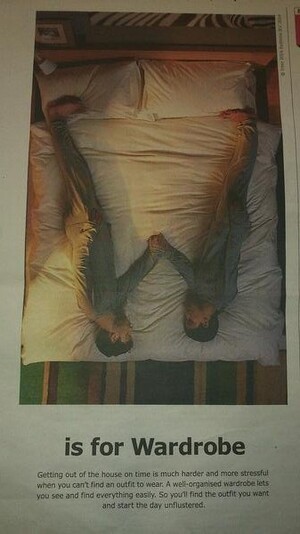
An ad with two men holding hands in bed, Ikea? Jaysus don’t let @BAItweets see that!!!



Der Howard tweetz:
An ad with two men holding hands in bed, Ikea? Jaysus don’t let @BAItweets see that!!!

[Freelance journalist and owner of Suburbia magazine, Edward Smith, pictured with Graham Norton]
In the Irish Independent, Edward Smith writes:
My particular blood type is rare and actively sought by the IBTS [Irish Blood Transfusion Service].
Known as the universal donor, it’s the only blood type that can be given to anyone in emergency situations. My father is a universal donor too and receives text messages from the IBTS regularly, requesting a donation, but I get turned away at the door.
I’m being robbed by the IBTS of the chance to potentially save someone’s life. I feel punished by this policy. I’m perfectly healthy, but I have a boyfriend and, consequently, I’m permanently excluded from donating.
At the blood donor clinic in Dublin, all appeared as one might imagine, until I mentioned I had a boyfriend. I was asked to join a nurse in a private room where I was told I was not eligible to donate.
Thanks Emmet Martin

“I am a Roman Catholic diocesan priest, have been so for over 30 years, and I am gay. I came out to myself six years ago, I have since come out to my family and a small number of close friends. I am delighted that Mary McAleese has spoken out about the issue of being gay. I agree with all she has said. I feel she has spoken out for me and many priests like me, who are gay. She is a voice for us, as we are not free to speak out. I live in constant fear of being found out or being outed. I don’t believe that I’m ‘intrinsically disordered’ as my church would have me believe.
That term is insensitive, offensive and deeply hurtful to me, as I’m sure it is to others like me. The people in my parish tell me that I am a gentle, compassionate and sensitive priest. If Jesus was to sit down with a group of gay people, I am absolutely certain that their first experience would be a welcome and a reassurance that they are loved unconditionally by him. Why is it then that their first experience of my church is of condemnation, rejection and judgement. The content of its teaching and homosexuality and the way it communicates it seems very cold – clinically and pastorally insensitive. It’s approach is too simplistic and does not take into account the complexities and uniqueness of each person’s life. It seems that instead of helping to ease and lift the many sufferings of gay people, we are adding to them. I have no doubt Jesus would not approve.”
You could always LEAVE?
Further to the comments made by former President Mary McAleese – that the Catholic church is in denial about homosexuality – RTÉ reporter Brian O’Connell spoke to and was in correspondence with a number of Catholic and Church of England gay priests.
Their words were broadcast on RTÉ’s Today With Seán O’Rourke this morning and included the testimony (above) and another man who told how his order organises retreats for gay priests.
Mr O’Connell said:
“On these retreats, they stand around the altar in a group and they share their stories and their experiences and, for them, it allows them to be true to themselves and he said when they’re standing in front of a congregation, a couple of days later during Sunday mass, they feel that they’re being somewhat true to themselves. He also had the experience that his orientation isn’t a problem, as long as he remains celibate, that’s within his order. He has fallen in love at times over the years and he left the church for a period, but was always drawn back. He told me actually about a recent case where a gay man in his parish came to see him and was telling him about the struggles he had around his sexuality. And this priest actually decided to open up to his parishioner and he told him that, well, he too was gay. And, he said, this made things so much easier for his parishioner and gave him a comfort and he was able to talk more openly with him.
And, right at the end of our chat, Seán, I asked him did he feel conflicted about being part of a church that has such strong views on homosexuality. And his answer, which I wrote down, I thought was quite elegant. He said to me ‘we’re told in the gospel that the truth will set you free. The official church has not asked to know our truth. One problem with the church today is that it keeps on answering questions people are not asking. As a gay priest I am being told things about myself, by people who are either ignorant or in denial and don’t do anything to find out what it is like for me. That, to my mind, is what is really sinful’. I thought that was a good way of summing it up.”
Listen back here
Previously: How Does She Know?

[The Delhi Queer Parade in 2012]
Sex between consenting gay partners in India is once again illegal
The decision means same-sex relations in India are once again subject to a 153-year-old law, passed under British rule, which defines them as “unnatural” and punishable by a potential 10-year jail sentence. The law was in effect repealed in 2009 by a landmark ruling by the high court of Delhi, the capital.
Activists had expected the supreme court simply to rubber-stamp the earlier ruling. The institution is known for its broadly progressive judgments, which often order politicians or officials to respect the rights of the poor, disadvantaged or marginalised communities.
“It’s a tremendous blow. It’s unprecedented for a court with a long history of expanding rights to reduce dignity not protect it,” said Gautham Bhan, a prominent activist.
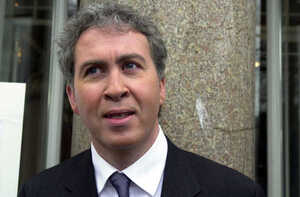 (Judge Colm Mac Eochaidh)
In August 2012, the Refugee Appeals Tribunal turned down an application for refugee status from an Iranian asylum seeker, now aged 36.
The man arrived in Ireland in June 2007, telling the Irish authorities that he is gay. He told them he and was afraid of being persecuted in Iran because of his sexuality.
He said he fled Iran after a male neighbour raped him. He explained the background to the incident involved the neighbour, whose father was a colonel in the Iranian police, inviting the 36-year-old to watch a gay pornographic DVD before blackmailing him into having sex.
The neighbour told the 36-year-old that he would tell his father that he supplied the neighbour with the DVD if he wouldn’t engage in the act.
The 36-year-old claimed the neighbour’s father appeared and attacked him in the midst of the rape. In a letter written by the man’s mother and submitted to the Tribunal it is alleged that the neighbour’s father took a picture or video of the incident on his phone.
The letter also states that the neighbour’s father showed these pictures to the applicant’s mother. The 36-year-old claims he fled to his aunt’s house following the incident and was then smuggled out of Iran concealed in his uncle’s friend’s car and later a truck.
The man received a negative recommendation at first instance from the Office of the Refugee Applications Commissioner (ORAC) in October 2007 but the man appealed this to the Refugee Appeals Tribunal, which upheld the negative recommendation.
He then challenged this decision of the Tribunal and was granted leave to apply for judicial review. But a re-hearing of this appeal lead to the Tribunal again upholding the recommendation of the ORAC.
But In July of this year, Judge Colm Mac Eochaidh, quashed this decision and, in September, outlined his reasons for doing so.
Lawyers for the Iranian man levied a series of complaints against the Tribunal member who decided to uphold the negative recommendation. But the main complaint was that a Tribunal member concluded the man was not gay.
However, Judge Mac Eochaidh found that the manner in which the Tribunal assessed the credibility of the man’s sexuality rendered its decision unlawful.
In his findings, Judge Mac Eochaidh wrote:
“The Tribunal Member believes that the applicant was inconsistent in his evidence and that an answer to a question in his s. 11 interview undermined certain other responses given. The Tribunal Member states that: “the appellant’s contention to the Tribunal that he was an unwilling participant [in the alleged rape incident] and resisted advances made by his neighbour was undermined by his admission later to the Tribunal that he found the same man attractive and had, as a result, made suggestive overtures to him in the past, which he had given as the reason as to why that neighbour may have known that the appellant was allegedly gay. This was in response to the presenting officer putting his response to question 63 of the s. 11 interview to him”. It is noted that at question 63 in his s. 11 interview the applicant was asked: “Did other people know you were gay?” To this the applicant replied: “I kept myself to myself, I didn’t let other people know, I didn’t know what gay meant.” The court finds it difficult to comprehend how the applicant’s claim to be an unwilling participant in the incident could be undermined by his admission that he had found his neighbour attractive. Further, it does not follow that the applicant’s behaviour towards his neighbour prior to the incident contradicted a statement by the applicant in his s. 11 interview that he did not make it known publicly that he was a homosexual. In my view, the Tribunal Member’s contention in this regard flies in the face of commonsense contrary to the standard set by Henchy J. in State (Keegan) v. Stardust Victims’ Compensation Tribunal [1986] I.R. 642 and is illegal.”
Judge Mac Eochaidh also addressed a complaint about the manner in which the Tribunal member dealt with the evidence of a Mr O’Ceallaigh, formerly of Galway Gay Men’s Helpline.
He wrote:
“While it is true to say that the evidence of a witness is not necessarily determinative of an applicant’s claim, it must be properly assessed and taken into consideration. In this regard the Tribunal Member notes: “When the Tribunal asked the witness directly if he thought it was at all possible that the appellant may have been pretending to be gay, he stated that he was at a loss as to why anyone would pretend to be gay. It was pointed out to him that such a stratagem would not be at all unusual for the purposes of fabricating or bolstering a bogus asylum claim. This seemed to never have occurred to him previously. One must approach this witness’s opinion on the appellant’s sexuality with a degree of caution therefore.” However, on viewing the solicitor’s attendance note of the Tribunal hearing it appears that the above statement by the Tribunal Member is a mischaracterisation of the evidence of the witness. The attendance note records that when the witness was asked whether he thought the applicant was genuinely homosexual or trying to convince him, he sated: “[I] Have asked myself [the] same question a number of times. Yes I would know. I cannot think of [a] single instance I felt he was in any way trying to convince me he was gay. I have known a lot of people from Asia, School of Oriental and Africa Studies, known gay men from Central Asia. I am not unfamiliar with people from this culture. I’m absolutely convinced A. is not a straight man…This is clearly an obvious context where this could happen. I’ve been in hour after hour where he’s in severe emotional distress. I’ve put a lot of my time over [the] last five years supporting this guy. I wouldn’t be doing this if I thought he was a straight guy.” It would appear that by mischaracterising the evidence of the witness the Tribunal Member has erred in failing to fairly weigh the evidence and give it sufficient weight in the assessment of the applicant’s claim.“
Judge Mac Eochaidh has granted the man leave to seek judicial review and ordered the Tribunal to rehear his case.
Read Justice Mac Eochaidh’s decision in full here
Thanks Mark Malone
 Branding for the 2014 Winter Olympics in Sochi, Russia
A Russian lawmaker has said the ‘gay propaganda’ law will remain enforced during the Sochi Winter Olympic Games in 2014.
Vitaly Milonov, co-sponsor of the ‘non-traditional relationships’ bill, said the government cannot decide when to selectively enforce the law.
It comes as the International Olympic Committee said the Russian government had ‘assured’ them all athletes and spectators will be safe from arrest.
Russian lawmaker: We will arrest gay athletes, tourists at Olympic Games (Gay Star News)
 (Traian Popov, from Bulgaria, and American Julian Marsh)
“It was just kind of a shock, like winning the lottery,” said Marsh who was celebrating his 55th birthday with Popov at when they got the news. “The amazing, overwhelming fact is that the government said yes, and my husband and I can live in the country we chose and we love and want to stay in.”
Pic: The Doma Project