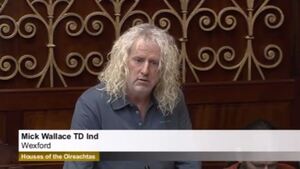
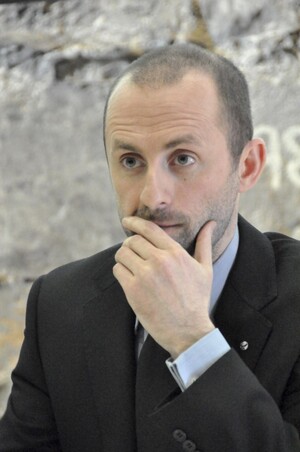
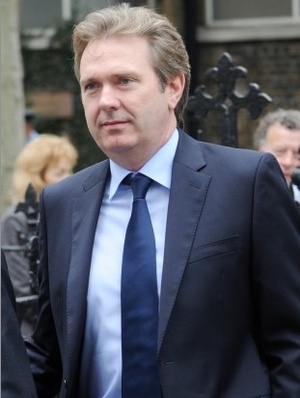
Independent TD Mick Wallace addressing Justice Minister Alan Shatter earlier today.
Mick Wallace: “Fine Gael used to pride itself as the party of law and order. How, in god’s name, can they still stand over that. You avoid using strong legislation, in order not to seek out the truth, not to reveal it. You don’t ask, you wouldn’t ask the [Garda] Commissioner [Martin Callinan] if he actually engaged in lawful surveillance, in case you might be told something that you had to stand over, you didn’t want the answer. You wouldn’t ask G2 the same question. You wouldn’t even ask him what did it do to check to see if there’s any rogue elements in their organisations that may have engaged in unlawful surveillance. You didn’t want the answers, minister. GSOC begged for the PULSE system, after the Boylan report and annual report, you refused to give it to them, you refused to give it to them in September. You gave it to them a few weeks ago under political pressure. You wouldn’t allow GSOC look at penalty points, but you allowed [section of Garda Síochána Act] 102 but not [section] 106 [which would have allowed GSOC to investigate practices, policies and procedures] of course, under political pressure. Minister, your prime motives are political survival, your prime motives have very little to do with the administration of justice, I’m sad to say. Now, there’s so many things that have gone on in this State, for a long time, that leave so much to be desired. And minister, it was happening long before your time but I am disappointed they is still no appetite for the truth.
Gemma O’Doherty lost her job in the [Irish] Independent because she had the audacity to challenge the Commissioner, the audacity. We got an email this morning, from a nephew of Fr Molloy’s, someone that Gemma O’Doherty has done a lot of research on. Here’s what he said in it. You mightn’t want to hear it, minister. He said: ‘For almost 30 year, people have hidden behind a wall of silence, deceit, corruption and cover-up. Time for the light of justice to shine on them and reveal them to the people for what they are. Many, many people have gone to their graves overshadowed by this heartache. Minister, if you are going to stay in power and the Commissioner is going to stay in place than I think this parliament is a sham. The people are right to be cynical about politics, they’re right to be cynical about politicians. This place is a joke. We play games in here. Well, you know what? Sometimes these games lead to the unfair distribution of justice or no justice being distributed. Sometimes these games lead to people losing their lives, they lead to murders, they lead to the families not getting any justice. And what do we see so often? When bad things raise their head? We see our police force circle the wagons. We see our politicians circle the wagons. Do what it takes to cover up what we don’t want to see. Do what it takes to hide the truth. Is there any appetite for doing things any different in this house? Minister, you look up here at us and you say ‘how dare those people with their long hair and raggy jeans have the audacity’ to challenge you. Well I want to tell you something. The people of Wexford that elected me to come in here, didn’t elect me to come in here and approve of your behaviour. They put me in here to challenge it. It’s time for you to go, minister. And bring the Commissioner with you.
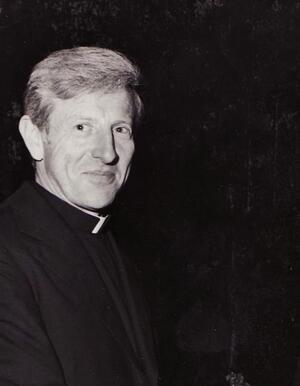
During the second stage debate of the Thirty-fourth Amendment to the Constitution (Judicial Appointments) Bill 2013 in the Dáil last Friday, Independent TD Mick Wallace spoke about unsolved murder of Fr Niall Molloy in 1986.
It follows last December’s appointment by Justice Minister Alan Shatter of Mr Dominic McGinn, Senior Counsel, to carry out an independent examination of the Report of the Garda Serious Crime Review Team relating to the death of Fr Molloy.
From around 1.50 on the video, above, Mr Wallace said:
A final example of what can go wrong when judicial appointments are political and when judges are too close to political parties is the case of Fr. Niall Molloy’s murder. Mr. Justice Frank Roe was appointed President of the Circuit Court just before Richard Flynn was tried for the manslaughter of Fr. Niall Molloy in 1986.
Judge Roe was a personal friend of Richard Flynn, the defendant. Despite this fact, he first decided to assign the case to himself, in an extreme abuse of the power that came with his role as President. He then withdrew the case from the jury after three and a half hours, without letting it consider any of the evidence and directed it to acquit. One eye witness reported that the then deputy leader of Fianna Fáil, Brian Lenihan Snr., was in the room which was the scene of the murder.
Although I welcome the eventual appointment of Dominic McGinn, senior counsel, to review the Garda investigation into the Fr. Niall Molloy murder and hope the facts and background to the case, to include its strongly political background, can finally be ascertained and that the family of Fr. Niall Molloy may gain some justice and peace, it is yet again a shame that this decision to review has only come after a delay of almost 30 years.
If the Minister, Deputy Alan Shatter, would only decide matters based on his ministerial responsibilities to justice rather than on political motivations and his own political survival, we might see more decisions based on transparency and accountability and fewer underhand tactics employed such as delay and confusion, dismissal of allegations, discrediting of real victims such as whistleblowers and the Garda Síochána Ombudsman Commission, GSOC, and misrepresentation of law and fact. These tactics never work on a permanent basis, as the Minister is now discovering to his peril. The truth generally comes out.
Ronan Bagnall, Cork Evening Echo; Chris Dunne, Cork Evening Echo; Maresa Fagan, Roscommon Herald; Anthony Hennigan, Western People; Fintan Lambe, The Gorey Guardian; Maria Pepper, Wexford People
Regional ‘Journalist of the Year’ 2013 nominations.
Around 60 to 70 people attended last night’s public meeting in Castlecoote Parish Hall, Co. Roscommon, regarding the unsolved murder of Fr Niall Molloy at the home of Richard and Therese Flynn, Kilcoursey House, in Clara, Co. Offaly in 1985.
Gemma O’Doherty, who was recently sacked from the Irish Independent addressed the meeting. Her work on the murder case led to the Gardaí reopening the case in 2010. The DPP recently decided not to pursue it any further.
During the meeting, Fianna Fáil Senator Terry Leyden told the meeting the late Brian Lenihan Snr and his wife Anne were not at the home of Richard and Therese Flynn on the night Fr Niall Molloy was murdered.
It also heard Fine Gael TD Frank Feighan tell members of the Molloy family that he would speak to Justice Minister Alan Shatter about the case.
(From top: Gemma O’Doherty addresses the meeting; Eamon Touhey, Fine Gael Roscommon County Councillor Dominic Connolly and Brian Sheridan; Seán O’Brien, John Wilson, Gemma O’Doherty, Fr. Arthur O’Neill and Senator John Kelly; Fianna Fáil Senator Terry Leyden; Kate, Barry and Liz Molloy; and Fine Gael TD Frank Feighan with Kate, Barry and Liz Molloy.)
“The file was stamped “top secret” but it’s content related to one of the most explosive criminal investigations and trials this century. The file was so important that garda authorities were willing to trade it for a convict’s release from high security prison.”
“Within the folder were two documents, letters from a Circuit Court judge to the office of the Director of Public Prosecutions. They gave the judge’s thinking on a death that has mystified Ireland for nine
years.”
“Fr. Niall Molloy died in a violent argument in the bedroom of Theresa and Richard Flynn in Co. Offaly in 1985. The following year, with official investigations apparently concluded, Richard Flynn stood in a circuit court dock charged with manslaughter and assault.”
“He was acquitted after Justice Frank Roe accepted expert evidence that the priest may have not have died from his injuries but from a heart attack. An inquest jury found the priest died from head injuries sustained in the fight, a difference of opinion that led to nine years of speculation, some of it aired publicly in the Dáil.”
“This week it is Judge Roe’s letters to the DPP that bring new questions to a mystifying case. The Sunday Independent has also learned that Fr. Molloy’s last will and testament, believed missing for nine years, is said to have been sent to his Diocesan headquarters, and may have made provisions for Mrs. Flynn.”
“Judge Roe’s letters are remarkable, both for their contents and for the method by which they were made public. The Garda file in which they were held was one of 145 stolen by the late Martin Cahill, Dublin’s infamous General, from Garda headquarters.”
“Cahill used the file about Fr. Molloy’s death to bargain with the authorities, effectively promising its return upon release from an English high-security prison of a close criminal associate. The man was transferred to an open prison and then finally back to Ireland.”
“The file was returned but not before the General had taken photocopies of its content for further use. He told associates he planned to make its contents public, but he had not decided on the nature and date of their release when he died. Cahill had, however made sure a colleague was kept fully aware of the file’s location, and of its content.”
“Last week the Sunday independent was shown the two letters. One is hand-written and, from other examples of his hand writing, the hand of Justice Frank Roe, can be identified.”
“The first hand-written letter dates from before charges were made against Richard Flynn, and is a communication from Mr Roe to Eamon Barnes, the Director of Public Prosecutions. The letter says Mr Roe knew Fr. Molloy and the Flynns.”
“The second letter was written after the trial and is an explanation – the word ‘explain” is actually used – of Judge Roe’s reason for the dismissal of the charges against Richard Flynn.”
“Mr. Roe last week refused to discuss the letters. “That case is dead and buried,” he said. “I have nothing to say.””
“He also refused to comment on why he sent the hand-written letter to the DPP, and would not elaborate on his associations with Fr Molloy and the Flynns.”
“They were lovely people all of them.” he said “God bless them all.”
An extract from a front-page article by Veronica Guerin, published by the Sunday Independent almost 19 years ago, on October 16, 1994.
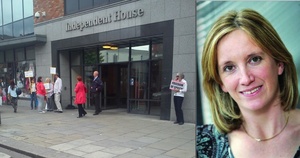
(Gemma O’Doherty and a protest outside the INM HQ in Talbot Street, Dublin following her sacking in the Summer)
So I repeat: why is the Rae story, like the story of the firing of Gemma O’Doherty before it, being ignored by the Irish media
The media exist to hold power to account. Given that the Indo is owned by the largest and most powerful media company in the Republic, Independent News & Media, it should be scrutinised by its rivals.
Journalists should police each other or the public they serve will think there is some kind of special treatment for the media élite. (The British phone-hacking saga was a case in point).
The absence of coverage in Ireland of the Rae story implies a cover-up.
Transparency International Ireland’s John Devitt addressed the European Parliament’s civil liberties, justice and home affairs (LIBE) committee on Monday.
Mr Devitt was invited to speak to the committee as it is investigating how states conduct surveillance on their citizens and how abuses by intelligence agencies might be prevented and exposed in the wake of the Edward Snowden NSA revelations.
From his address:
“We assume rightly that intelligence agencies are responsible for protecting us from attack and upholding democratic principles. But I believe that the anti-corruption community has largely underestimated the potential for abuse by members of the intelligence and security services.”
“This may be because we have seen comparatively few well-publicised cases involving whistleblowers from the intelligence community in the EU. You are no doubt familiar with the case of Frank Grevil (who blew the whistle on Denmark’s fabricated case for the invasion of Iraq); as well as Annie Machon and David Shayler’s cases in the UK. In Ireland, we have not had a public controversy surrounding intelligence services in more than 40 years – not since allegations of support for the IRA by Irish military intelligence surfaced in 1970.”
“That said, we have seen patterns of behaviour elsewhere in the public service that might be familiar to intelligence community whistleblowers.”
“In 2010, officials of the Irish Department of Social Welfare were found to be passing on personal data of Irish citizens to insurance companies and private investigators. Earlier this year, two police whistleblowers reported that Irish police were unlawfully manipulating and cancelling police traffic records for family members of police officers and other police officers.”
“We have noted how those same police whistleblowers have fallen victim to reprisal by their colleagues and management. We have also recently seen how a journalist, Gemma O’Doherty, was recently fired after she investigated reports that the Irish Chief of Police had his own traffic offence cancelled.”
“The message this sends to whistleblowers and journalists is that the reporting of abuse is worse than the abuse itself.”
Yesterday’s Dail debate on the report by the Comptroller & Auditor General concerning Garda management of the fixed charge notice system…
And the sacking of Irish Independent journalist Gemma O’Doherty.
Pádraig Mac Lochlainn: “Minister, as you know the Comptroller & Auditor General reported on his findings in relation to the fixed charge notice system and the outcome is absolutely shocking. What he has revealed is that because of clearly widespread maladministration and very poor procedures, 1 in 5 motorists facing fixed charge notices are getting off. 1 in 5.
“We’re talking here about 42,000 a year. Half of the summonses that were issued by the Courts in relation to these, half of them were not served. Now this is an absolute crisis. Minister, it’s not good enough to issue circulars, we need to see how the hell this happened.
“And Minister, you know that two Garda whistleblowers brought this wider issue into the public domain last year. You and the Garda Commissioner, I believe sought to undermine their credibility, talked down the numbers that were involved and now we see very clearly that they have been vindicated.
“So Minister, what are you going to do about this? This is a massive crisis of confidence for the public. The 71% of people who pay their fine, who take it on the chin, accept that they did break the speed limits or whatever they had done to break traffic laws. They need to know that the system applies to everybody.
“And Minister, will you now apologise to the two Garda whistleblowers for the attempts by yourself and the Garda Commissioner at that time to discredit them, to undermine the scope of what they were bringing into the public domain and acknowledge that they were right? There was a widespread problem with the system of penalty points in this State and it’s gonna be sorted out.”
Olivia Mitchell: “Deputy Higgins, two minutes.”
Joe Higgins:”Go raibh maith agat, a Cathaoirleach. Minister, the problem is is that there’s a huge contradiction between the report of the Comptroller & Auditor General and the report of the Gardai into the penalty points issue. The Comptroller found 600 repeat offenders with 3 or 4 terminations, the Garda report found a few. The Comptroller found 3,000 statute barred point cases, there was no mention in the Garda report.
“Thousands of fixed penalty notices went missing and were unaccounted for according to the Comptroller, there is no mention in the Garda report.
The Comptroller said that large volumes of notices were terminated by Gardai from outside their areas, the Garda report said three. The Comptroller said the thousands of notices cancelling contravened the rules and regulations and the Garda report said 600. And finally, the Comptroller said €1.2 million lost, the Garda report said a few thousand. Can you explain?
“Isn’t it the case that the whistleblowers are exonerated as truthful and honest in the light of this revelation and another member has left, another subject to sanctions. Will you see that justice now prevails here?
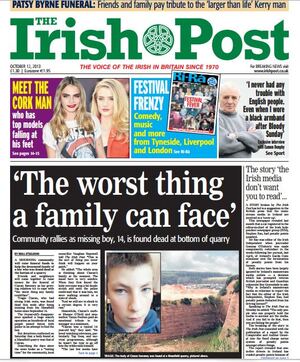
“Finally, another victim of the penalty points debacle, Gemma O’Doherty, a leading investigative journalist with Independent Newspapers was sacked because she uncovered a story that the Garda Commissioner was the beneficiary of cancellation of penalty points and according to the Irish Post, the editor of the Independent who sacked her was also a beneficiary of cancellation. Isn’t that outrageous and doesn’t it smack Minister of a grotesque abuse of power? Will you speak out against this also?”
Olivia Mitchell: “Thanks deputy. The Minister to respond. Four minutes, Minister.”
Minister Alan Shatter: “Let me respond to both deputies but on the last issue that the deputy who spoke raised, the last issue the deputy raised. I’m not privy to the background circumstances to anyone terminating their employment with Independent Newspapers and I’m certainly not going to comment in any way on that.
“I’m glad of the opportunity to comment on the findings of the Comptroller & Auditor General’s report on the Garda fixed charge processing system. I welcome these findings because they confirm what went wrong with the system and what needed to be fixed.
“Broadly speaking, the findings in fact, echo the findings of the examination of the same allegations which was carried out by Assistant Commissioner John O’Mahoney. I published Assistant Commissioner O’Mahoney’s report and also a related report by the Garda Professional Standards Unit earlier this year and referrred them to the Joint Oireachtas Committee on Justice, Defence and Equality.
“Perhaps the key point is that the O’Mahoney report broadly identified the same key issues of concern relating to the operation of the fixed charge processing system identified with the C&AG namely a failure to follow cancellation procedures in a significant number of cases, a lack of adequate record keeping and inconsistency, and in many cases a laxity in accepting justifications in speeding and other road traffic offences.
“Indeed, I previously have made reference to some of the explanations accepted as exotic. There’s absolutely no doubt the findings of the C&AG reinforce both the concerns identified by the O’Mahoney report about weaknesses in the fixed charge notice system and the case for corrective action and action has been taken. Disciplinary proceedings were taken against a number of members of An Garda Síochána.
“A number of others were advised of the absolute necessity to follow correct procedures. A new garda directive, cancellation of fixed charge notices was issued to the entire force on the 30th of August 2013 aimed at significantly tightening up on procedures for cancellation.
“The Garda Commissioner has accepted and will implement significant recommendations by the C&AG on improving the fixed charge notice system and how it interacts with the Courts Service and the driver licencing system. In addition as I previously indicate, I refer the two Garda reports to the Independent Garda Inspectorate for its advice on any further measures which may be required and expect to see a report from the Inspectorate in the near future.
“I welcome the action taken by the Commissioner and his committment to implement the further recommendations we’re addressing this evening. The result will be a fixed charge notice system which is more open and transparent and more robustly operated. This is essential in public confidence in the system in enforcement of road traffic laws being maintained.
“The Garda Siochana along with the Road Safety Authority and other stakeholders have done so much in recent years to improve road safety and reduce fatalities. Everything must be done to maintain that progress. The Garda Commissioner has my full support in the strong action he has taken.
“It is only fair to acknowledge that these reports and their findings and recommendations are a response to allegations of improper cancellation of fixed charge notices. Any fair assessment must conclude on the evidence available that a great many of the most serious allegations have been found to have been utterly without basis including allegations of avoidable road fatalities linked to speeding drivers being improperly let off fixed charge notices and allegations of hundreds of PULSE records being destroyed.
“Perhaps most significantly the members of An Garda Siochana making the allegations rejects all of the findings of the O’Mahoney report and continues to claim that there has been widespread corruption and criminality on the part of senior members of the Garda Siochana. These are exceptionally serious allegations which the O’Mahony report found no basis in fact. my department has written to the member concerned, urging him to come forward with any evidence that he may have to justify these allegations.
“And indeed, it’s open to the member concerned to make an appropriate presentation if he chooses to do so before the Joint Oireachtas Justice Committee but in fact that has not yet occurred. In conclusion, I welcome the finding of the Comptroller & Auditor General. The findings are in line with the findings of the report by Assistant Commissioner O’Mahoney published earlier this year.
“I fully support the Garda Commissioner and the decisive action he has taken on foot of them and I will do my best to ensure that any further co-ordination required between An Garda Siochana and the Courts Services to ensure the efficient enforcement of summonses in the area of traffic offences does take place and that issues should be promptly addressed when they come before the courts but of course that they become available to them, documentation that they require.
“It of course is not available to me, it would be highly inappropriate of me to in anyway interfere with the independent approach taken by the courts, or by particular District Judges in any individual cases that come before them with regard to any charges brought in relation to road traffic offences.”
Pádraig Mac Lochlainn: “Minister, I’m sure you will accept that the 71% of citizens who accepted the fine and took the penalty points on the chin will be appalled to know that you know that up to one in five managed to get away with this. And that is clearly down to the scale of it ye know you did talk down at one stage. the massive scale of it is clearly maladministration. But there are cases which will cause serious concern.
“There are allegations as ye know about judges repeatedly having points written off, serving Gardai, State Solicitors and recently we’ve been informed that senior journalists have had penalty points written off who work to hold Gardai to account. We have the allegation that the journalist Gemma O’Doherty and it is an allegation that she lost her job because of the work she was doing around all of this area. Are you concerned, Minister?
“Will you investigate the reason why at least two senior journalists in the publication mentioned in The Guardian newspaper, covered in the Irish Post newspaper that senior journalists in that newspaper, INM had penalty points written off, will you investigate those circumstances to see were they genuine and they may well have been genuine reasons but the public have a right to know because in the interests of democracy we need to know the answers.
“I’ll wrap up with this. Thank you, Chairman. Thank you for your appreciation of this. It is critical for public confidence to be restored that overall there was huge maladministration but clearly there were cases that people that were very powerful and connected had points written off because of who they knew, that is totally wrong. And you should undertake to investigate the circumstances where people would not hold Gardai to account by getting points written off. Examine that.”
Olivia Mitchell: “Deputy Higgins, you have a minute.”
Joe Higgins: “Minister, all is that demanded is that any of us who have incurred penalty points are treated in the same way whether you’re a public figure or a private citizen or anybody else. Now Minister you said that the conclusions of the Comptroller are in line with the findings of the report by the Assistant Commissioner O’Mahoney.
“Clearly that is not the case, Minister and that is easily documented. So I invite you to get your department to go through it with a fine toothcomb to revise your view on that.
“You do say it is only fair to acknowledge that these reports and the findings and recommendations are in response to allegations by whistleblowers, my word. Minister, I want you to go the extra mile. Be generous here. Okay, maybe they didn’t get everything absolutely right but the vast substance of what they said has proved to be absolutely honest and true and they have been victimised.
“And you have to stand up and champion the right of people in vulnerable positions to come out for the public good. So I’m asking you to do that today and to apologise for wrong comments you made yourself castigating these people.”
Olivia Mitchell: “Thanks Deputy. Minster to respond.”
Alan Shatter: “Can I firstly say to Deputy Higgins, no one has been victimised, no one has been victimised, Deputy. And there is no basis for alleging that anybody has been victimised. The allegations that were made were taken very seriously.
“The allegations that were made included allegations that a number of road fatalities in which people lost their lives were a consequence of fixed notice charges being cancelled. That was clearly, on a very detailed basis, established to be untrue.
“Such allegations could have caused a great deal of stress to families, already distressed, as a consequence of losing a loved one. Despite the very detailed addressing of those matters, in a report that’s before the Joint Oireachtas Justice committee, that Deputy Mac Lochlainn has access to, and others have access to this information, because I published it.
“Despite that, the individuals who raised these issues are adamantly insisting that they disagree with the contents of that report. The allegations alleged widespread corruption and conspiracy in An Garda Síochána. There’s absolutely no doubt there’s been administrative and bureaucratic failings.
“I’ve also no doubt that there’s been a number of fixed notice charges cancelled which based on the background circumstances, as detailed in the reports, were absolutely justified. And most of us, I think everyone would stand by them. And certainly there were some decisions that I, deliberately, described as exotic, that I would question.
“And indeed that is one of the reasons why the Garda Commissioner has changed the procedures and provided for oversight. And he made an initial statement on this when the original reports were published and a very detailed new guidelines were published which do amend the previous guidelines.
“As people, it was suggested earlier today in this house, that they’re just reproducing the same, the same guidelines all over again. They’re not. They address matters in a way to ensure there’s proper oversight and only decisions are made where appropriate and that there’s transparency and to ensure that everyone is treated equally.
“Because it is my view: It doesn’t matter who you are, you must be treated equally. And, in the context, indeed it could be said that people who are in prominent positions or members of this house, there’s, they’re going to be treated less than equally because there’s an additional level of, of..there’s a particular layer in the new guidelines which ensures that any applications made by them for cancellation are dealt at a higher level with An Garda Síochána. And there’s complete transparency, everything is monitored. And I’m very happy with that.
“So let me just say, that in conclusion, in so far as individuals who raised issues, are alleging that the Garda reports published are untrue, let them bring forward the chapter and verse and proof of that. I’m open to being convinced, but they haven’t done so. Indeed, having engaged with members of this House, and published material, they didn’t cooperate with the Garda investigations that took place.
“Now I don’t know why that is and there’s no question deputy, of anyone, of anyone being victimised. And could I conclude by saying, it is important to keep, and I’m saying this particularly to Deputy Mac Lochlainn, who raised the issue, to keep cancellations in perspective because both the Garda and C&AG reports are consistent in showing the level of cancellation of Fixed Charge Notices to be around 5%, meaning that 95% of Fixed Charge Notices have been processed correctly.
“And, indeed, within that 5%, 50% of those, there was absolutely irrefutable evidence, regarding 50% of those, there were indisputable reasons to cancel them: wrong people received Fixed Charge Notices; the registration number, for example, photographed, turned out to be different to the car owned by an individual.
“So whereas it’s true the C&AG report did identify some weaknesses in the process, particularly in enforcement notices, I’m glad that the Garda Commissioner is taking action in this area.
“And you can assume that I will continue to monitor, to ensure that matters are dealt with appropriately and I have no doubt, and I’m concluding finally Cathaoirleach, and thank you for your patience, I’ve no doubt that the Garda Inspectorate will keep oversight over this area so that everyone in this house is now satisfied the system is fair, is operating efficiently and appropriately.”
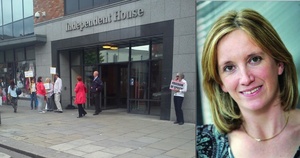
(Stephen Rae, editor-in-chief of the Irish Independent, Sunday Independent and Evening Herald and, above, Gemma O’Doherty and a protest outside INM ,Talbot Street, Dublin following her sacking)
Penalty points were wiped after they were accrued by a car registered to an Independent News and Media editor.
Stephen Rae was involved in the decision to make leading journalist Gemma O’Doherty redundant in the weeks after she approached the Garda commissioner to check if he had penalty points removed from his licence.
A vehicle registered to Rae, editor-in-chief of the Irish Independent and other INM titles, accrued penalty points at 6.37am on November 5, 2009 at the N11, Belfield, Dublin before the points were terminated.
….Her forcing out has brought condemnation from journalists at top British and international publications but has so far been ignored by Ireland’s leading newspapers and RTE.