
Tag Archives: Harry Warren

St. Michan’s church, Church Street, Dublin 7 and what lies beneath

The Mummies of St. Michan’s Crypt.

Harry writes:

There are many cultures around the world known for the preservation of the dead through mummification.

The most well-known are the Egyptians who preserved soft tissues by a deliberate action of embalming, preparing a body, they left the heart in place due to their spiritual beliefs, removed the rest of the internal organs, rinsed the body with wine, covered and packed the body with natron, a natural salt, leaving it to dry out for 40 days. The now shrivelled body was then plumped up with padding and perfumed, finally coated in hot resin and wrapped in a football fields length of linen strips.

The National Museum of Ireland in Dublin’s Kildare Street. has a petite but very interesting Egyptian room well worth a visit, with several mummies on view, including the mummy and coffin of the lady Tentdinebu dating from the first millennium.

Arguably the earliest practitioners of mummification occurred in what is now the north coast of Chile by the Chincheros, they mummified their dead as early as 5000 B.C. They also eviscerated the internal organs, treating them with salt and clay before returning them to the body. The dry arid climate did the rest for preservation.

Surprisingly, here in Dublin we have an excellent example of natural mummification and the macabre preserved remains can be viewed in St. Michan’s church vaults in Church Street, Dublin. Both the church and its burial vaults have a history to be told.

St. Michan’s is the oldest church on the north side of Dublin. Originally a Catholic Church founded by the Danes in 1095, it has been a Protestant Church since the Reformation. St. Michan’s has been renovated twice over the centuries, in 1685 and 1825. Its current incarnation is little changed since Victorian times.

The church itself is well worth viewing, it features an original wooden interior and a 1725 pipe organ with an original casing that is the oldest in Ireland. Reputedly it was on this organ that the composer Handel on a visit to Dublin first played The Messiah. There are some other unusual items displayed inside the church including a Stool of Repentance, where ‘open and notoriously naughty livers’ did public penance and a skull that purports to represent Oliver Cromwell.

It is what lies beneath the church in the crypt that is of most interest.

Inside the crypt the vaults contain the remains of some of Dublin’s most influential 17th, 18th and 19th century families.

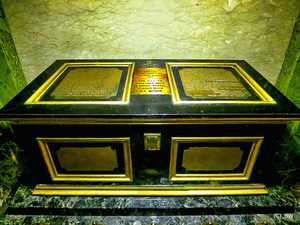
There are participants of the 1798 rebellion, the Sheares brothers, who met a gruesome end, they were executed by being partially hanged then drawn and quartered. What was left of them was brought to St. Michan’s. The mathematician William Rowan Hamilton rests here along with the Earls of Kenmare and there are highly decorated decaying coffins of the Earl’s of Leitrim on display. In the church graveyard are other notables, including Oliver Bond, who took part in the 1798 Rising.

But the most unusual remains are the mummified bodies on view.

Since Victorian times many visitors have descended the steps of the crypt to view the bodies. If you visit you will be in the footsteps of the author of Dracula, Bram Stoker. He may have gained inspiration for his masterpiece as he is believed to have visited the vaults in the company of his family.

The last time I visited in pre pandemic times, there were four dusty mummified bodies, in decayed open coffins to view. Their skin turned to a leather like parchment stretched across their skeleton. Some dried out internal organs could be viewed where the abdominal area had split on one of the bodies.

The legend is that these four comprised of, “The Unknown”, “The Thief”, “The Nun” and “The Crusader” dating from 800 years ago.

The “Unknown” is a female of which perhaps unsurprisingly, there is no information.”The Thief” has had his hands amputated, supposedly as a punishment for his robberies. There was a body of a “Nun” and most famously there was a body of a “Crusader” who because of his tall stature had his legs broken and crossed under him in order to fit into his coffin. Legend has it that if you stroke his leathery hand, it will bring you good luck. I did stroke his hand and it had a texture like polished leather but about the good luck, no lottery wins but happily I can’t complain.

These bodies have been preserved in the crypt of St Michan’s Church for centuries. The church was built in close proximity to what was then Oxmantown marsh, gases from the marsh, mainly methane coupled with the limestone brickwork of the vaults along with a dry atmosphere and an ambient temperature that rarely varies from 14 degrees has resulted in the remarkable preservation of the bodies.

There is some conjecture as to the actual age of the bodies on display with some arguing that they “only” date from the 17th century. But if they are of more recent vintage, they are still remarkably well preserved as normal bodily remains would have been reduced to skeletons or dust by now. Marshes and bogs are excellent at preserving bodies.

Very sadly in 2019 the crypt was broken into and desecrated. The body of the “Nun” was severely damaged and is now no longer on display. The “Crusader’s” head was torn off, stolen and was missing for some time. Outside of the vault in a normal atmosphere it was feared the remains would rapidly deteriorate. Fortunately, with local input and good investigative work by the Gardai it eventually led to the recovery of the “Crusader’s” head. After restoration work by the National Museum, it is now reunited with its original body.

So, for now, the vaults are currently closed due to the pandemic lockdown but when they reopen, for an interesting and macabre bit of Dublin history St Michan’s is well worth visiting.

All photos by Harry Warren

Harry’s Dublin appears here regularly, often on a Friday.

The Knockmaree Linkardstown Dolmen in Phoenix Park, known as the Devil’s Altar

The Knockmaree Dolmen.

Harry writes:

The Phoenix park in Dublin is always worth exploring and its nooks and crannies have some wonderful surprises. Here’s one you may enjoy.

Take a stroll along Chapelizod Village and enter the south western side of the Phoenix via the Park Lane entrance just off Chapelizod Road. Continue up along the pathway that brings you to Upper Glen Rd. As you cross the road you will see a small keepers cottage, Knockmary Lodge, on top of a hill. Adjacent to Knockmary Lodge in a very pretty woods at the top of Knockmaree Hill, you will find one of the oldest man-made creations in Dublin, the Knockmaree Linkardstown Dolmen.

Knockmaree is derived from the Irish name “Cnoc-Maraidhe” meaning the hill of the mariners. Perhaps the maritime name was associated the occupants of the tomb or with the nearby river Liffey The Knockmaree Linkardstown Dolmen or popularly known, perhaps with some justification, as the Devil’s Altar, dates from a time earlier than the pyramids of Giza. Dating from 3,500 to 3000 BC during the Neolithic period.

Linkardstown style cists, or burials, consist of an earthen mound, with a stone-built tomb at the centre. The remains found inside these tombs are usually adult males and may occasionally be accompanied by a child. The stones today at Knockmaree are all that is left of the original tomb, the earthen mound is long since gone. Archaeologists have identified centuries of water erosion on the dolmen’s capstone making it highly likely that the capstone was brought all the way up from the River Liffey to the tomb by our ancestors.

When the mound was excavated by archaeologists, they discovered the tomb was reused on several occasions. The tombs centre was found to contain the remains of two male inhumations (uncremated bodies) from the Neolithic age. Grave goods were also discovered, a flint blade, a bone toggle and a shell necklace. Later burials were cremations and burnt human remains were found in the tombs outer area. The remains were contained in four small sepulchral vases dating from the Bronze Age approx. four thousand years ago.

As the great megalithic tombs in the Boyne valley like Newgrange, Knowth and Dowth have shown us, many of these ancient burial sites like Knockmaree are astronomically aligned with an axial alignment towards the rising and setting of the Sun at the winter and summer solstices. As the burial mound that once covered the dolmen has been removed, I imagine the dolmen itself would have shifted somewhat over the centuries.

Next Solstice, perhaps a Broadsheet reader will visit with a compass and see if they can figure out any alignment, they won’t be disappointed as the sun shining through the woods is a reward in itself.

The alignments had a ritual significance and many sites were certainly ceremonial and spiritual in nature. The summits of prominent hills and mountains may have been symbolically important places to locate tombs and cairns.

There is archaeological evidence that Neolithic people believed in a multi-stage journey of the dead to the afterlife, the final leg of which took the deceased upwards through the roof of the burial chamber and mound (situated on a hill like Knockmaree Hill or a mountain summit) to the sky, where ‘the dead, now revived, joined the cyclic Sun, and very likely, a god or gods associated with it in the eternal rounds of cosmological life, death and rebirth’.

There is a timeless quality about these megalithic sites, even a modest one like Knockmaree, it gives them enormous power. They were here before us. They will be here long after we’re gone.

So, if you find yourself in the Phoenix Park, perhaps visit the tomb and take the opportunity to pay your respects to an ancient culture and some of Dublin’s earliest Dubliners.

All pics by Harry Warren

Harry’s Dublin appears here regularly, often on a Friday

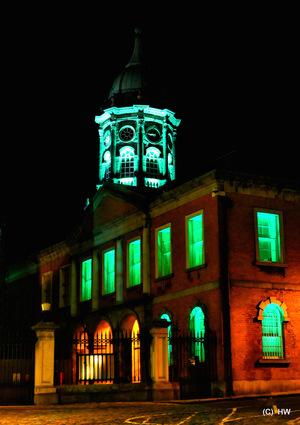
From top: Leinster House: Mansion House; City Hall; The Custom House; Bedford Tower, Dublin Castle and the Samuel Beckett Bridge

Harry Warren writes:

A selection of illuminated civic buildings in Dublin for St Patrick’s Day…

Meanwhile,

Harry adds:

 Temple Bar during the lockdown and pre lockdown…

All pics by Harry Warren

From top: King’s Inns and former tenement houses – including a museum at No. 14 (above), Henrietta Street, Dublin

Henrietta Street.

Harry writes:

The southside of Dublin has superb Georgian architecture in areas like Merrion square and Fitzwilliam square but the oldest and arguably the best designed Georgian street in Dublin is Henrietta Street on Dublin’s north side.

It has an elegant streetscape lined on both sides by fine Georgian mansions. The street itself is a cul-de-sac and it is capped at the top by the Honourable Society of King’s Inns buildings.

The King’s Inns were designed by James Gandon, construction began in 1795 and completed by his pupil Henry Aaron Baker in 1816. Henrietta Street has been featured many times as a location in TV shows and movies like Penny Dreadful, Foyle’s War, the Glenn Close movie Albert Nobb’s and John Huston’s The Dead to name but a few.

Number 12 has been used as a movie set and featured in over 40 different TV shows and films. Henrietta St is a favourite choice of period movie productions as it has the most intact collection of early to mid-18th century houses in Ireland.

Henrietta St was designed by Luke Gardiner. Work began on the street in the 1720s when mansions were built as homes for the upper tier of Dublin’s society. Gardiner a native of Dublin city, was an MP a treasury official and a wealthy speculative property developer.

In Henrietta St he designed a terrace of palatial townhouses facing each other across a broad street. It was once Dublin’s most exclusive residential address, being home to the country’s wealthiest and important figures from church, military and government.

Gardiner himself lived at number 10 in a house designed by Richard Cassels in 1730. Due to the Archbishop of Armagh owning a house on the street, the street became popularly known as Primate’s Hill. Later the bishop’s house along with two others was demolished to make way for the building of King’s Inns. The street was named for Henrietta, Duchess of Grafton whose husband was Lord Lieutenant of Ireland at the time.

The main rooms of the houses that were used for entertaining and living in was on the ground and first floors, these floors have the highest ceilings and highest windows. The servant’s rooms and the bedrooms were on the top floors.

All of the houses have a history to tell. The aristocrat Lady Kingsborough hired the proto feminist Mary Wollstonecraft, the mother of the author of Frankenstein, Mary Shelley, to be the governess of her daughters in Mitchelstown Castle, Co. Cork.

In February 1787 Wollstonecraft accompanied the Kingsboroughs to Dublin, living in 15 Henrietta Street. She later wrote in a letter home that the ‘wild Irish’ Kingsborough daughters, aged fourteen, twelve, and six, were ‘unformed and not very pleasing’, but she was pleased with her Dublin residence, “I have much more convenient apartments here,” she wrote. ‘A fine schoolroom and the use of one of the drawing rooms where the harpsichord is and a parlour to receive my male visitors in’.

Ten years later one of the daughters, Mary Kingsborough, scandalised Irish society by having an incestuous affair with her own uncle resulting in his murder by her father, the enraged Lord Kingsborough. At the time the supposedly malign influence of Wollstonecraft’s feminist teachings was widely blamed for Mary’s affair. The scandal inflamed Irish society and Lord Kingsborough was duly acquitted.

After the Acts of Union 1800 came into force in 1801 uniting the kingdoms of Great Britain and Ireland, Dublin lost its status as a capital, the country lost its own parliament and all power was transferred to London. Having lost its authority as a centre of legislation the upper echelon of Irish society now spent most of their time in Regency London and Georgian Dublin lost its grandeur.

During the 19th century the wealthy moved to the suburbs and their once elegant Georgian mansions were carved up by rapacious landlords and abandoned to the rent-paying poor.

Henrietta Street fell into disrepair.

For most of the 19th and 20th century it was a rundown tenement street. Each house was terribly overcrowded. Poor families and their malnourished children lived in squalid conditions resulting in rampant sickness with many children dying in infancy. Tuberculosis was a major disease. In Dublin alone, it killed more than 10,000 people a year, more than half of them children.

By 1901, Henerietta St. was home to 141 families, consisting of 897 people, on a street of only sixteen houses. In the mix were fish mongers, apprentice book binders, general labourers, corporation labourers, plumbers and housekeepers. By 1911, over 100 lived in one house.

At number 10, the Sisters of Charity ran a laundry housing more than 50 single women inside. Nineteen families comprising of 104 people resided in number 7. Among the 104 people who shared the house were ‘charwomen, domestic servants, labourers, porters, messengers, painters, carpenters, pensioners, a postman, a tailor, and a whole class of schoolchildren.’

Eventually in the latter days of the 20th century the residents of the tenements were rehoused and the dilapidated buildings were vacated.

Today some of the Henrietta Street buildings continue to need restoration but many houses have been restored. Their restoration is beyond the scope of this article but suffice to say the entrepreneurs, the voluntary and civic bodies involved should be supported.

When the pandemic restrictions are lifted, I would recommend a visit to Number 14 Henrietta St. It is an excellent museum that tells the story of the 300-hundred-year history of number 14 from its palatial Georgian origins to its time as a tenement, its occupants and of Henrietta St itself.

So, if you find yourself in that part of town reward yourself with a stroll up Henrietta St and in your mind’s eye you will find it very easy to be transported back to the vintage days of Georgian Dublin.

All pics by Harry Warren

Harry’s Dublin appears here regularly, often on a Friday.

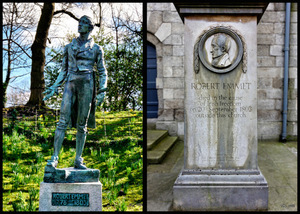
From top: St Catherine’s Church, Thomas Street, where Robert Emmet was executed and his head severed on a butcher’s block; Kilmainham Gaol

Dublin’s Public Executions sites.

Harry Warren writes:

Walking along a pandemically deserted Hammond Lane in Dublin late at night, a shiver passed up my spine. One of those odd feelings, I turned around to glance behind me to reassure myself that I was on my own. I then remembered that Hammond Lanes original name was Hangman’s Lane. Knowing its history is enough to give anyone the shivers.

It was a medieval route that the condemned walked heading to ‘Gibbets Mead’, (gibbet was an old name for the gallows and mead was a field) located in an area around Smithfield square then known as Oxmantown Green.

Executions were frequent in those days and over the years hundreds walked or were carted to their doom along this route. Dublin had many other locations over the centuries where public executions took place and here are just a few of them.

During the 18th century the majority of Dublin’s public executions were in the area of St. Stephen’s Green. Ever sit in the shade of a tree in the Green enjoying a summers sunshine? Be mindful of what tree you are under as you could be beneath a branch of a tree where an executed body dangled above you…

On the day of the execution a horse and cart would parade the condemned to the Hanging Tree, friends and families of the condemned would accompany the carriage. Whilst the condemned were still in the carriage the rope from the Hanging Tree would be noosed tight around their neck.

The cart would be moved on and the condemned would be left dangling experiencing an excruciating and lingering death from strangulation. The last hanging in Stephens Green was of Patrick Dougherty in January 1782, for the robbery of Thomas Moran.

Dougherty assisted by his partner in crime George Coffey, had mugged Moran and stole his watch, a seal, a key, a pen-knife, and a pair of silver shoe buckles. The stolen goods were worth £15 and Dougherty, found guilty, swung for the theft.

Not only did the condemned suffer capital punishment their executed remains often ended up in the hands of the anatomists in the Royal College of Surgeons or other Dublin medical schools for public dissection.

“Very often the corpse of a murderer was followed to the College gates by his weeping relatives or by a howling mob. A small portion of the anatomical theatre was set apart for persons who might desire to witness the dissections of malefactor’s bodies.”

The good anatomy professors loudly bemoaned that they were restricted to only six corpses a year of convicted murderers who were hanged for their crimes.

The area around Stephens Green began to be developed for buildings. As a result, public executions were relocated to the now demolished Newgate prison on Little Green now the present-day St. Michan’s Park near Smithfield.

Another concurrent location was Gallows Hill in what was then Kilmainham commons. Before Kilmainham Gaol was built on the site of Gallows Hill, the last hanging carried out there was on the double, two brothers named Connolly received the death sentence for the stealing of a cow and were duly hung.

Speaking of Kilmainham, most Dubliners would be aware of the heinous ‘executions’ of the leaders of the 1916 Rising inside Kilmainham Gaol in the Stonebreakers yard, but how about the public executions that took place just outside the entrance door?

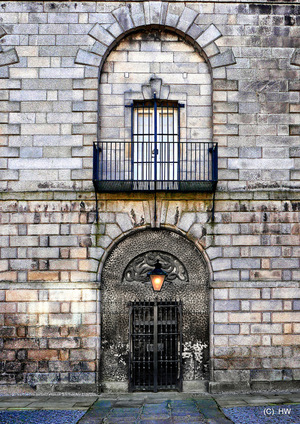
The condemned were publicly hanged on the gallows, now designed with a trap door for the condemned to drop through to snap their neck, above Kilmainham Gaol’s entrance doorway.

The new gallows worked so well that in 1798 a virtual copy was installed in Newgate Prison in the city centre. Enjoy the photograph of the Kilmainham Gaol entrance and note the sculptures above the door, the many-headed serpent represented the five worst crimes that resulted in capital punishment, murder, piracy, rape, theft and treason.

Watch out for the two small granite insets in the recess overhead that are visible in the entrance door photo. This is where the gallows used to be attached for public hangings. If a noteworthy or famous person was to be hung, thousands of spectators, men women and children, would visit Kilmainham on the day of execution.

Hawkers sold alcohol and food and the army and cavalry were at hand to control the milling throng. It was truly a ‘Gala Day’. The expression Gala Day is derived from the Anglo-Saxon gallows day when crowds would visit a public hanging. The last public execution in Kilmainham took place in 1865 when Patrick Kilkenny was hanged for the murder of Margaret Waugh.

The young revolutionary Robert Emmet had a particularly grisly end after he was accused and found guilty of high treason. Shortly after 1 o’clock on 20 September 1803, Emmet was publicly executed in front of St Catherine’s Church, Thomas Street, Dublin.

Emmet was hanged and then beheaded. It took thirty minutes for Emmet to die by hanging as there was no ‘long drop’ to snap the neck, he slowly died of strangulation being of light build. His executioner then clumsily severed his head with a large blade on a deal block borrowed from a local butcher.

Displaying the blood dripping head to the crowd the executioner exclaimed: ‘This is the head of a traitor, Robert Emmet’. According to eyewitness accounts his blood seeping into the gutter was hungrily lapped up by dogs.

‘The remains were brought to Kilmainham Gaol and left for some time in the court of the prison where the prisoners might view it from their cells’.

The blood-stained butchers block was displayed to the public for two days at Thomas Street after the execution.

The block itself has an interesting history. It came into the ownership of Sir Thornley Stoker, a leading surgeon and brother of Bram Stoker the author of Dracula. It was later sold at an auction to support the Volunteer Dependents Fund held at the Mansion House on 20–21 April 1917 and presented as a gift to Mrs Margaret Pearse, mother of the Pearse brothers. It is now to be found in the excellent Padraig Pearse Museum in St. Enda’s Rathfarnham.

There are many more locations in and around Dublin where public hangings and executions took place. So, the next time you are outdoors in Dublin, hopefully enjoying some nice weather, you may be relaxing at the site of a long but not forgotten gallows.

All pics by Harry Warren

Blessington Street Basin.

Harry Warren writes:

Dublin city has some lovely parks but not many parks would have contributed so much to so many Dubliners having sore heads after a night on the tiles as this charming little one. And not many of Dublin’s parks are at least eighty percent under water either.

Blessington Street Basin, “The City Basin” is a real secret garden, it is only a quarter of an hours walk from Upper O’Connell St and its history should be told.

During the latter half of the 18th Century the City Corporation utilised the completion of the Royal canal as a way of supplying drinking water from Lough Owel in County Westmeath to the city centre. In 1775 a spur of the Royal Canal was built to Broadstone along with the originally titled Royal George Reservoir, known to generations of Dubliners as, “The Basin”.

The installation of the reservoir began in 1803 and finished in 1810. The 15.1 million litre reservoir supplied water to northside homes until 1885. By 1869 as Dublin expanded the demand for water outgrew the Basin and the water supply was sourced elsewhere from outside of the city. Subsequently the Basin provided water, in a major act of conviviality, for both Powers distillery in Thomas Streeet and Jamesons distillery in Bow Lane right up to the 1970’s.

After that The Basin unfortunately fell into disrepair for many years until 1994 when the present park was beautifully restored and officially opened by President Mary Robinson.

To visit the park, walk past Parnell Square heading onwards up Frederick Street which merges into Blessington Street, and eventually you will reach the entrance. On the way enjoy some of Georgian Dublin’s architecture on the North side of the city. Many of the Georgian doorways to view on your route are original and are complete with elegant cobweb style fanlights above the door.

Enter the park via the fine wrought iron gates and enjoy the view of what was a city reservoir. Take a leisurely stroll around the rectangular pond surrounded by high stone walls and enjoy the flowers, trees and gaze a while at the artificial island created in the centre to encourage wildlife to flourish and flourish it does, as witnessed by the many ducks, swans, mallards and waterhens on view.

Along your walk you will find some fine sculptures of flora and fauna recessed into the northern boundary wall. By the way see if you can spot the bee hives. If you want to watch the world, go by there are plentiful park benches to relax on, they were donated by the ALONE charity to commemorate founder Willie Bermingham and his kindness for elderly Dubliners.

There is a nice walk along the Royal Canal Bank Linear Park if you exit at the rear of the Basin and turn right. The Royal Canal Bank linear park is the filled-in former Broadstone Canal spur linking to the main Royal Canal.

If you stay in the park there is a fine Basin Keeper’s mock-Tudor style lodge to view, built in 1811 and now lovingly restored. The original occupant of the lodge was William Ferguson and he had a colourful history.

To augment his Basin Keeper wages and despite the fact that the city in his time had 2,000 alehouses, 1,200 brandy shops and 300 taverns for a population of only 170,000, he opened a shebeen in the lodge. By all accounts it was a thriving business but his illegal activities soon came to the attention of the constabulary with the result that the City Corporation brought in a bye-law specifying that “in future none of the Basin Keepers be allowed sell Porter, Ale or Spirits, at any of the city Basins, nor permit any person to do so, under pain of dismissal”.

Today you will have to nip down the road for a coffee but you can sit outside the lodge at one of its many seats to enjoy the park and ponder awhile at one of Dublin cities original drinking water reservoirs.

All pics by Harry Warren

Harry’s Dublin appears here regularly, often on a Friday.

Dublin’s Diving Bell.

Harry Warren writes:

Strolling along Dublin’s Docklands today and being of a certain age you may notice that the city quays have changed so much over the years that it can be hard to recognise them. Old dilapidated once busy warehouses and depots are now modern apartments and office blocks.

Standing along the North Wall Quays and looking across the other side of the river Liffey, I often noticed what I incorrectly thought was the remains of an industrial chimney of some sort on Sir John Rogerson’s Quay. On closer inspection it is an amazing piece of Dublin’s industrial maritime heritage and its story should be told.

The orange painted Dublin Diving Bell was used in the building of Dublin Port and its quays and walls. It is a remarkable feat of Irish engineering. The bell was designed by a Victorian port engineer with the wonderful name of Bindon Blood Stoney and it was constructed by Grendon and Co. in Drogheda. It went into operation in 1871 and was used in the building and maintenance of Dublin Port and the Port’s quay walls right up until 1958.

Bindon Blood Stoney was a superb engineer, not only did he design the Diving Bell and its associated equipment, he also engineered the Boyne Viaduct in Drogheda, the renewal of Dublin’s O’Connell Bridge (then Carlisle bridge) and the quay walls including Sir John Rogerson’s Quay and North Wall Quay Extension.

Stoney became Chief Engineer at Dublin Port in 1867 and his engineering expertise transformed the port. Half the quays along the Liffey were converted into deep-water quays using his new and ground breaking method of underwater construction which he had first advocated in 1861.

Huge concrete blocks weighing an amazing 350 tons were constructed on a purpose-built block wharf and then positioned into place utilising a specially engineered crane, a “floating shears” designed by Stoney. Workers in Stoney’s Diving Bell had levelled the Liffey river bed readying it for the placement of the massive concrete blocks.

Stoney described his method in a paper, ‘On the construction of harbour and marine works with artificial blocks of large size’, delivered to the Institution of Civil Engineers in London in 1874, winning the Institution’s Telford Medal and Premium for that year.

Stoney also designed the largest in their day, hopper barges, for dredging the port to keep it free from silt which was collected and deposited out at sea. Unusually for the time he was also responsible for introducing a graduated pensions scheme for his workers.

Standing in front of the ninety-ton Diving Bell along Sir John Rogerson’s Quay you will see it is quite large. The height from the top of the access shaft to the base of the air-lock chamber is forty-four feet. The bell chamber where five men worked in very harsh conditions is twenty feet square in area and the access shaft with its airlock chamber is three feet in diameter.

The bell had six and a half feet of headroom inside. A steam powered barge with lifting gear and a horizontal air pump accompanied the Diving Bell, pumping compressed air into the bell chamber at 20lbs per square inch. Even though the surrounding water cooled the air going to the bell chamber, men working in the chamber found the air and temperature oppressively hot.

In later years the chamber had an electric light and a telephone connection and the men worked in five-hour shifts. They also had to take account of the tides, resulting in going down in the bell in the small hours of the morning or very late at night.

Working in such harsh conditions and such high pressure, many men suffered burst ear drums and bleeding from their nose and ears. The effects of the air pressure on men’s lungs were severe and coughing was very painful. As a result of working in the bell it was said one individual could whistle through his ear!

Despite the very harsh working conditions and throughout the history of the diving bell, there is no recorded instance of any serious accident or fatality. Not only was the Diving Bell used in Dublin Port it was also used in laying the foundations for the Bull Wall Lighthouse and laying concrete reinforcing blocks around the Poolbeg lighthouse.

Today, the Diving Bell sits atop a two-metre-high plinth. When it is again open to the public the plinth allows visitors to walk under the bell chamber and experience a sensory water feature that gives a hint of what it was like working in the chamber. There is also audio-visual information telling the story of the bell and the brave workers who built Dublin Port.

So, the next time you are in that part of the Quays enjoy a marvellous piece of Victorian engineering and give a nod to the hard-working Dubliners who courageously worked under the Liffey’s waters.

All pics by Harry Warren

Meanwhile…

Al writes:

Further to Harry’s article about the Diving Bell…please see this short documentary (above) The Coop produced for Dublin Port about same…

Whitefriar Street Church, Dublin, containing St. Valentine’s bodily remains

St Valentine and Dublin.

Harry Warren writes:

Ambling around Dublin during the pandemic lockdown there are not too many places opened to enjoy, but for the romantically inclined this weekend on the 14th of February, St Valentine’s Day, perhaps consider a visit to Whitefriar Street Church. It has an interesting history, as it is somewhat surprisingly the resting place of the man himself, St. Valentine.

Whitefriar Street Church in Dublin is located between Aungier Street and Wexford Street and is just a few minutes’ walk away from St. Patrick’s Cathedral and park. The church building has a rather dull exterior but the interior is quite beautiful.

It was built by George Papworth, a noted architect, and was consecrated by Dr. Murray on November 11, 1827. Built of stone and covered with Roman cement it measured 200 feet long, 34 feet wide and cost in those days a princely sum of £4,500. In 1950 a statue and shrine were built to honour St. Valentine and they were installed in the church.

Walk half way down the church on the right-hand side and you will find the statue and reliquary of the saint. The reliquary contains Valentine’s bodily remains and a plaque informs, “This shrine contains the sacred body of Saint Valentinus the Martyr, together with a small vessel tinged with his blood “.

Be mindful that on February 14, the Reliquary is removed from beneath the shrine and is placed before the high altar in the church and venerated at the Masses where there is a ceremony of the Blessing of Rings for couples hoping to be married.

Believer or unbeliever, you would have to be a hardened cynic not to be moved by the loving comments made by visitors in notebooks placed beside the saint’s altar.

Most commentators sign their surnames and note their country of origin, the visitors are from all over the globe. Heartfelt petitions are wrote invoking the saint to heal and bless their loved ones and for love, “For Paula and Ben to be in love forever”, “To love one another always like today”, “That she will accept my proposal on St. Valentine’s Day”.

But how did the remains of a Roman St Valentine come to rest in Whitefriar Street in Ireland?

Throughout the middle ages, the relics of Saint Valentine were kept in the Church and Catacombs of San Valentino in Rome, later they were relocated to the church of Santa Prassede during the pontificate of Nicholas IV.

During the nineteenth century a famous Whitefriar St Carmelite preacher was renowned for his oratory. Fr John Spratt was a native Dubliner who was born in Cork St. Dublin. He visited Rome in 1835 and because of his powers as a preacher he became known to Pope Gregory XVI who gifted his Church St Valentine’s relics.

The bodily remains of Valentine contained in a casket were brought to Whitefriar Street Church in 1836, and since then have been venerated especially around the Feast Day of St. Valentine on February 14th. The flower-crowned skull of Saint Valentine remained in Rome and it is on display in the Basilica of Santa Maria in Cosmedin, Rome.

There are many legends associated with St Valentine and how Valentine became associated with lovers and here are a few. Like many Christian saints we have to go back to the Roman era. In Roman culture polygamy was popular but the church’s teaching promoted monogamy, a marriage between one woman and one man.

St Valentine was a priest during the reign of the Roman Emperor Claudias II, who persecuted the church during that time. Claudias II, wanting to strengthen his army, passed an edict that forbade the marriage of his young soldiers based on the idea that unmarried soldiers fought more fiercely than married soldiers, surmising that married soldiers would fight less fiercely being afraid of what might happen to their wives or families if they died.

Against the Emperor’s wishes Valentine encouraged couples to marry and he secretly married them in direct contradiction of the edict. According to legend, in order “to remind these men of their vows and God’s love, Saint Valentine is said to have cut hearts from parchment”, giving them to these soldiers, a possible origin of the widespread use of hearts on St. Valentine’s Day.

For performing such marriages Valentine was imprisoned and tortured and put on trial. One of the men who was to judge him under Roman law was a man named Asterius, he had a daughter who was blind. Valentine was supposed to have prayed with and healed the young girl’s blindness. As a result of this, Asterius converted and became a Christian.

In the year 269 AD, Valentine was found guilty and condemned to a three-part execution of a beating, a stoning, and finally decapitation because of disobeying and denying the edict of Emperor Claudias II. The legend tells that the last words that the soon to be martyred Valentine wrote were in a note to Asterius’ daughter. He inspired today’s romantic missives by signing it, “from your Valentine“.

So, if you are lucky to have a significant other, keep the tenderness of a good heart, share your love and squeeze their hand a little tighter this Valentine’s Day.

All pics by Harry Warren

Ranelagh Gardens Park, Dublin 6.

Harry Warren writes:

If you are passing through Ranelagh in Dublin, I would heartily recommend a stroll through Ranelagh Gardens Park. It is a delightful small park somewhat hidden in plain sight making it easy to bypass.

The main entrance to the park is via a fine granite archway underneath the Luas line. It also has a few little-known entrances around the side roads of Ranelagh that are mainly familiar to locals. The gardens consist of an ornamental pond surrounded by green space and mature trees with plenty of wildlife, swans, ducks, Leisler bats and fish whose stock was depleted on the day I visited by a hungry heron.

At the Chelmsford Ave end of the park there is a commemorative statue of Richard Crosbie. The park is well worth a visit and it has a very interesting aeronautical history whose story should be told.

Originally the site of the 18th century Willsbrook House, the house and its gardens were bought by the entrepreneur, William Hollister, who created a five-hectare pleasure garden and opened them in 1769 for the enjoyment of Dublin’s gentry, featuring carnivals, balls and such like pleasures.

Hollister named the gardens after Lord Ranelagh from Co Wicklow who owned similar gardens by the Thames in London. He was a canny businessman always on the lookout for new attractions and publicity, hitting gold when he allowed Richard Crosbie to attempt the first balloon ascent in Ireland from his gardens on January 19th, 1785. Crosbie was a pioneering aeronaut and was born at Crosbie Park, Co. Wicklow, in 1755.

Richard Crosbie has an interesting history. When he was a student at Trinity college, he was the leader of the notorious Pinking Dindies, one of the many armed gangs in Dublin at the time along with the Bucks and the Cherokees. Their members were from the upper echelons of society and they terrorised “single men and citizens who neither wore fine clothes nor swords” also extorting money from brothel madams and their customers whilst still finding time to engage in duels and fights with their gang rivals.

The “Pinks” were armed with short swords from which they derived their name, they also carried knives, falchion and shillelaghs. When they weren’t fighting one another, they had vicious battles with members of the city’s Night Watch.

“They were of imposing appearance, being handsome and well made in general; so that, individually, you could not suspect them: it was by their acts only you could convict them, and they commonly pursued their schemes in parties, and by night; and they were so well prepared for battle that the ancient and quiet watchmen, the only protectors of the citizens of Dublin at that period, were worsted in almost every attempt made to subdue them…”

Outside of being a leader of the Pinking Dindies, Crosbie was described as being:

“…beyond all comparison the most ingenious mechanic I ever knew. He had a smattering of all sciences and there was scarcely an art or trade of which he had not some practical knowledge … he was very good tempered, exceedingly strong and as brave as a lion – but as dogged as a mule. Nothing could change a resolution of his when once made and nothing could check or resist his perseverance to carry it into execution’”

Inspired by the first ever hot air balloon ascent by the Montgolfier brothers in France in 1783, Crosbie constructed a balloon his own “Aeronautical Chariot”. Displaying his scientific knowledge, he chose hydrogen gas rather than hot air to create lift in his balloons. His ascent was to take place in Ranelagh.

Prior to his manned flight he tested his balloons. To entertain his audience and to drum up publicity, he used a tethered balloon to send up various animals culminating in a free flight with a cat on board. The balloon floated away and was reported being visible off the coast of Scotland. Carried by the wind it eventually descended into the Irish Sea near the Isle of Man. Fortunately the cat, presumably having lost one of its nine lives, survived its adventure and both the cat and balloon were recovered by a passing ship.

On the 19 January 1785 thirty-year-old Richard Crosbie; wearing an extravagant outfit of a long robe of oiled silk, lined with white fur coupled with a waistcoat and breeches of white quilted satin, red Morocco boots and a Montero cap of leopard skin climbed into the gondola of his balloon in Ranelagh Gardens.

The balloon flamboyantly decorated with the Arms of Ireland and images of Minerva and Mercury soared aloft. A huge audience for its time, over 30,000 spectators witnessed Crosbie’s ascent, the first successful human flight in Ireland. He had set himself the task of flying across the Irish Sea but he got no further than making a safe landing in Clontarf. His flight was a great success and it was a truly remarkable feat coming only 14 months after the first-ever manned balloon flight by the Montgolfier Brothers in November 21, 1783.

Crosbie now an established aeronaut, made several other flights in Ireland and America. In July 1785 he again attempted an Irish Sea crossing but inclement weather forced him to land in the sea just off the Welsh coast. Crosbie became famous in Ireland and abroad for his aeronautical exploits.

A few years later in 1787 the new Rotunda Gardens opened on the North side of Dublin and they began to draw the fashionable set, Hollister losing business decided to sell the gardens. They were soon reopened by another entrepreneur but the gardens gradually became less successful over time.

In 1788, Ranelagh Gardens were sold off to a community of Carmelite nuns who moved into Willsbrook House. It was an enclosed order resulting in Ranelagh Gardens being closed to the public for close on 200 years. After the Carmelites left Ranelagh for pastures new, various portions of the gardens were sold off to developers and what was left of the gardens, now shrunk to 1 hectare were taken over by Dublin City Council who now maintain them today.

So, if you find yourself in the gardens pause for a moment and spare a thought for the remarkable aeronautical pioneer Richard Crosbie who made the first successful human flight in Ireland.

All pics by Harry Warren

Sunlight Chambers.

Harry Warren writes:

Walking along Wood Quay towards the city centre on a miserable rainy January day, I couldn’t help but glance through the grey drizzle at the architectural monstrosities of Dublin Civic Offices.

They were erected in one of the greatest acts of cultural vandalism in Dublin’s history. The most historically significant area of Viking Dublin was literally destroyed by the then Dublin City Corporation in the name of progress during the late 1970s and early 80s.

The offices, visually having as much merit as some hideous wartime command bunkers, were dumped upon and destroyed one of the greatest and best-preserved Viking settlements anywhere in Europe.

My mood dampened. Ironically a parked cars radio was playing Morrisey’s “Every Day is like Sunday” with the classic lines “In the seaside town, That they forgot to bomb, Come, come, come, nuclear bomb”. Never a more appropriate sentiment I thought.

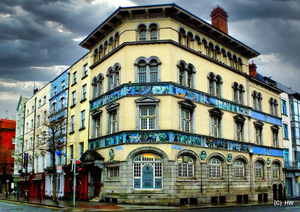
My spirits lifted when I reached Capel St Bridge (Grattan Bridge). The delightful Florentine style Sunlight Chambers building came into view on the corner of Parliament Street and Essex Quay.

Originally it was the Irish headquarters of Lever Brothers and it was elegantly designed by Edward Ould of Liverpool in 1899. The building was named after their most successful product Sunlight soap. It was one of the first soaps to be made on an industrial scale and brought the company huge success. It is still on sale today in Europe. Levers later merged with a Dutch manufacturer and became Unilever. Today you probably buy their supermarket products like Domestos, Surf, Persil, etc.
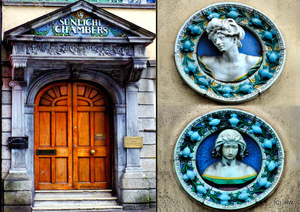
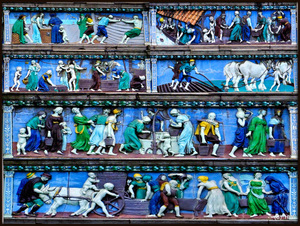
Sunlight Chambers was built to impress being Lever’s Dublin headquarters, with its renaissance stye windows on the upper floors, a red terracotta roof with wonderfully sculpted glazed terracotta faience’s or friezes on two levels. They depict animated scenes of agriculture and industry and the making of soap, along with some delightfully sculpted ladies doing washing. Sexist? perhaps by today’s standards but it is of its time and the detail and colours of the friezes are wonderful.

The sculptor, Conrad Dressler, designed and crafted the series of four roundels and twelve panels around the three faces of the building. The glazed ceramic friezes were made in 1902 in Dressler’s pottery works in Buckinghamshire. They were commissioned to fit in with W. H. Lever’s philosophy that “good art should enrich everyday life“.

So, the next time you are in that part of Dublin City, look up and reward yourself with a bit of time to enjoy the beauty of the sculptures and the story they tell.

All pics by Harry Warren