The Emily-assisted, Joe Caslin-installation on Achill Island, Co Mayo.
Emily tweetz:
Nice little piece in the @IrishTimes about the project we did at the weekend.
Previously: Man of Achill



The Emily-assisted, Joe Caslin-installation on Achill Island, Co Mayo.
Emily tweetz:
Nice little piece in the @IrishTimes about the project we did at the weekend.
Previously: Man of Achill

David Connolly writes:
I can’t be the only one who finds the Vodafone ad animation currently on the Irish Times homepage hugely amusing…

 Solicitor Simon McGarr (above) appeared on Today with Sean O’Rourke on RTÉ R1 this morning too discuss the Irish Times’ ‘first abortion‘ story and the paper’s handling of the subsequent fallout (above).
Update: “A spokesperson for ‘The Irish Times’ editor Mr O’ Sullivan said he would be making no further comment beyond the correction and apology which was printed in Saturday’s edition.” (Editor under pressure to explain article on abortion, Eilish O’Regan, Independent.ie). .
Sean O’Rourke: ” On page 7 of ‘The Irish Times’ last Saturday, a very small correction was carried. It said, ‘On August 23rd, last, under a story headlined, “First Abortion Carried Out Under New Legislation”, we, that’s ‘The Irish Times’, reported on a purported clinical case at The National Maternity Hospital. The Hospital has pointed out that the case described in the article, did not happen, and ‘The Irish Times’ accepts this, and apologises unreservedly to The Hospital for the distress caused.’
The apology now seems to have raised as may questions as it hoped to answer. Did the case ever happen, if it never happened, where did the story come from in the first place and what about the readers who paid their two euro for their paper that day, were they not misled by the lead story? On the line now, solicitor, Simon McGarr, who believes that ‘The Irish Times’ has a lot more to explain. Why so, Simon McGarr?
Simon McGarr: “Thank you for asking me on…”
O’Rourke: “…Sorry, you might just start by bringing us back to the original story, for those of us who haven’t read it.”
McGarr: “Certainly, the original story was quite a dramatic one. It described a medical crisis in a woman’s pregnancy which resulted in termination of the pregnancy to save her life. It gave a lot more detail than that, and indeed it gave so much detail that it would not have been difficult to identify the person, if you knew her. And originally the argument was that the justification for putting some-one’s personal medical details on the front page of ‘The Irish Times’ was that there had been a balancing done inside the newspaper, to decide that this was in the public’s interest that they should know it because it was the first termination under the aegis of the new “Protection of Life During Pregnancy Act’.”
O’Rourke: “It quickly turned out that this wasn’t the case, as the law hadn’t kicked in yet..”
McGarr: “That’s right, by the afternoon, it was clear that that wasn’t the case. Now, if that was the public interest defence, that public interest had gone, obviously and then the question was, well, therefore, we have a situation where ‘The Times’ had published, apparently, medical details of a private citizen on the front page, and I felt that wasn’t very good, at the time.”
O’Rourke: “…Because the commencement order hadn’t been signed and nonetheless, internationally, the press repeated what they had read from ‘The Irish Times’. There was a very vigorous, if not to say a very angry, furious response on ‘Morning Ireland’ from the former Master of Holles Street, coming on air, Peter Boylan, that was of course, describing the leak of patient’s details in the article as unacceptable and unethical, patient confidentiality being absolutely critical. But that almost seemed to confirm that it was a story that had been leaked.”
McGarr: “Well, there’s an awful lot of mystery around this, this is one of the issues that really, I’m concerned about. Was there really ever such event, I don’t know. The wording of the apology, I have to say is slightly cryptic, it says, in that the case described in the article, did not happen, and those words can be unpacked to be, to mean anything you want them to mean, really, at this stage. What I’m concerned about, really, what’s the the response of the newspaper, I’m concerned with this, as a reader, what’s the response of the newspaper, if there has been a problem? Like, if there has been a mistake made, what is the editorial judgment about, how do we deal with a mistake of this sort?
O’Rourke: “They’ve withdrawn the story and they’ve apologised!”
McGarr: “Well, eight days later, a two paragraph, rather cryptic apology on page 7 doesn’t fall within the spirit of the code of practice of the Press Council of Ireland, now, these aren’t my standards, I mean, I might have my own opinion as to whether, or not a story that ran globally is sufficient to correct it, eight days later in the inside pages. These are the standards of The Press Council.”
O’Rourke: “Going right back to the days of [Irish Times editor] Douglas Gageby, almost half a century ago, ‘The Irish Times’ has a very fine track record of calling people to account in public life, and transparency. Is it time that they practiced some of what they preach?”
McGarr: “Well, ever since the apology has been published, the Editor has simply refused to comment. It hasn’t been, as far as I know, for want of people asking for comment. Initially, the apology suggested, Holles Street wouldn’t make any further comment, which is fair enough.”
O’Rourke: “They accepted as well, that the article had been published in good faith.”
McGarr: “Holles Street did, that’s Holles Street’s position, and indeed I’m not saying the article wasn’t published in good faith, I’m saying, how does an article get on the front page, go all around the world, the story was re-printed in India, The United States, the UK, it had considerable international interest, it has thousands of social media re-shares, it generated as you say, ‘Morning Ireland’ interviews, there were interviews on other radio stations, as well. There is no question but, that the story made a splash. If a story makes a splash, and then, it is just wrong, I mean it is just wrong, it is incumbent on the newspaper to do the right thing and say, how did this happen, what have we learned from it and to make sure that the correction makes it (the apology) has due prominence, that’s the phrase that The Press Council uses, in other words, you try and reach the people you originally reached with the story, with the correction as well.”
Listen here
Previously: Apology Times 2
‘The hospital has pointed out that the case described in the article did not happen.’ @irishtimes apology. pic.twitter.com/3hSEQr22H8
— Brian Nolan (@BrianNolan1974) August 31, 2013
That page 1 story.
Now a page 7 apology.
Previously: Decision To Print
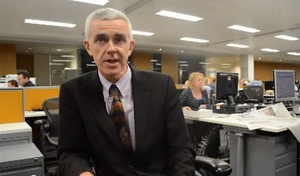
Aingeala Flannery, sitting in for Matt Cooper on Today FM’s Last Word last night, spoke with Paul Cullen, above, Health Correspondent for the Irish Times about criticism of his paper’s report on the the ‘first abortion’ under the new Protection of Pregnancy During Life legislation.
Aingeala Flannery: “Now, the Department of Health has said a termination of pregnancy carried out at the National Maternity Hospital in Holles Street did not take place under the protection of the ‘Life During Pregancy Act’, as the act has not commenced yet. It was reported in the ‘Irish Times’ today that a procedure carried out a number of weeks ago was the first to be carried out under the Act. Dr. Peter Boylan, the Clinical Director of Holles Street, is extremely unhappy about the newspaper report and says that patient confidentiality has been breached. I’m joined now by Paul Cullen, the ‘Irish Times’ health correspondent, and by Simon Mills, barrister and doctor. Paul, if I could go to you first. You wrote this report in the ‘Irish Times.’ What are the circumstances of the patient who had the termination?”
Paul Cullen: “Well, this my the report in the paper this morning. This concerned a termination which took place at the National Maternity Hospital in Holles Street recently and involved a woman who was in the second trimester and whose membranes had ruptured and there was a threat to her life. And the pregnancy was considered unviable. And after discussions involving the woman and a number of obstetricians and other medics in the hospital, a termination was carried out.”
Flannery: “Now, the Clinical Director of Holles Street, Dr. Peter Boylan, is extremely unhappy about this. He says patient confidentiality has been compromised.”
Cullen: “Yes, I heard that interview this morning. I can hear where people are coming from, when they refer to issues around patient confidentiality. I would say that, while there are rights to patient confidentiality, there are also rights for the public to know what is happening. And in this case – and in all the reporting by ‘The Irish Times’ on this issue, over the last year and before – we’ve been trying to put out there what is in the public interest. And I think it would be acknowledged by everyone that this new leglislation and the issues around it and the medical practices within hospitals are of huge public interest, and it would be also of intense interest to see how the new legislation fares, and whether it does bring the clarity it means to bring.”
Flannery: “But Paul, the Department of Health is saying it has nothing to do with the new legislation, that it didn’t take place under the ‘Protection of Life During Pregnancy Act.’
Cullen: “Well, certainly the case is the first to come to light since the legislation went through the Dail, and I think there was a wide-spread belief… which the department has surprised a lot of people today by pointing out correctly that the legislation has not yet been commenced – somewhat surprisingly. But certainly cases like this would come under the provisions of the Act, particularly section 7, which relate to medical cases, physical threats to a woman’s health. So I think it’s justified on the basis of public interest.”
Flannery: “Okay, Paul, rather than get tied up on whether the act has come into force or not: you say that you believe that this in the public interest. Why is it in the public interest?”
Cullen: Well, because I think people… obviously, this debate about abortion has raged in this country for many decades. I think that there are very strongly-held views on both sides. As a reporter, I’m trying to relay facts to give as comprehensive a picture as I can, and that’s what I tried to do in this article today. I would point out, for example, that our newspaper was the first to report on Savita Halappanavar.
Flannery: “Paul, this is a different case and I’m wondering do you see that this could be distressing for the woman involved, that she may not have wanted her medical details to be splashed across the front page of a national newspaper?”
Cullen: “Yes, I understand, and I have received mail today, for example, from people who are concerned about the report. I understand that entirely. What I was trying to say was that I have to try and balance in my work, and all journalists have to, the right to confidentiality with the right to public disclosure of information which is in the public’s interest. In preparation of this story, we did leave out other details because of that concern. We also went through legal checks for the article, before a decision to print.”
Listen here
Previously: Holles Confidential
Further to the report in this morning’s Irish Times about the first abortion performed under the new Protection of Life During Pregnancy law at Holles Street.
In a statement, the Department of Health said that the Protection of Life during Pregnancy Act was signed into law on 30 July, but that it has not yet commenced.
The department said there are operational issues that need to be addressed before it can commence, but added it will be begin as soon as is practicable.
“These include the establishment of a panel of medical practitioners for the purpose of the formal medical review provisions and administrative facilities to enable the review committee, drawn from the review panel, to perform its functions.”
Hospital to Investigate Breach of Confidentiality (RTE)
NotTheBogeyMan writes:
Has no one copped on that the Act has been in place since July, that the Dept of Health is working outside of it, or that the legislation they so enthusiastically supported is being ignored.
The Irish Times is getting a good old slagging for publishing confidential information that’s actually in the public interest.
Earlier: The Floodgates
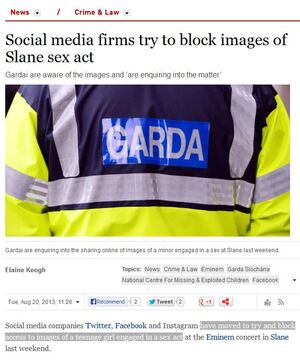
The @irishtimes reports that, somehow, only one person engaged in a two-person “sex act”. Surprise! It’s the girl! http://t.co/IY3Upe5igN
— Ben Walsh (@bwalsh) August 20, 2013
 Today’s Irish Times.
Pierce writes:
I don’t wish to start yet another FIGHT! but Fintan O’Toole’s excellent column in the Irish Times this morning asks an important question: Who Will Be The Last To Suffer For The Mistake of Austerity?
To help him answer can I suggest he has a look around his newsroom. The Irish Times has gently urged us to embrace austerity since this fiasco began and, like the property boom, will be the very last to shout ‘stop’. And no one will ‘suffer’.
FIGHT!
Woman in Ireland refused abortion dies in taxi on way from UK clinic- lays bare deficiency of new law http://t.co/PH60GpQSuc #anotherdeath
— Jamie Smyth (@JamieSmythF) July 22, 2013
@JamieSmythF @carlobrien Lack of abortion = @IrishTimes PR formula for cases of death in pregnancy which appear due to medical negligence?
— Caroline Simons (@carolinesimons) July 22, 2013
Woman’s tragic death after abortion in UK (Abortion Rights Campaign)
Previously: ‘A Message From Caroline Simons At This Important Time’