



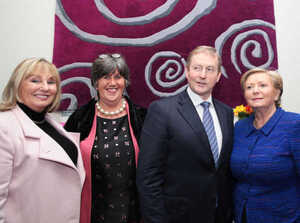

From top: Chairperson of Dublin Rape Crisis Centre (DRCC) Ann Marie Gill, CEO of the Dublin Rape Crisis Centre, Ellen O’Malley-Dunlop, Taoiseach, Enda Kenny and Minister for Justice Frances Fitzgerald at a DRCC event last year; Dr Julien Mercille
Is Enda Kenny a feminist?
Dr Julien Mercille writes:
Enda Kenny’s speechwriter wrote a piece in yesterday’s Sunday Independent declaring her boss a “feminist intellectual” and that he “went the extra mile to help women and do them justice”.
The article is so poorly written that it offers one more clue as to why Fine Gael did so badly in the election.
The speechwriter, Miriam O’Callaghan (not RTÉ’s Miriam O’Callaghan) “admire[s] his compassion, his insight, his ordinariness, his warmth, his feminism and huge intellect”.
Is Enda Kenny a feminist? And what is a feminist anyway? I’ll define it for this piece simply as someone who is in favour of improving conditions for women as a matter of principle.
Therefore, a feminist can be a man or a woman (that will be obvious to feminists, but it’s still misunderstood in public debate). Conversely, anti-feminists can also be either men or women.
So is Enda Kenny as feminist? Well, no he’s not. It’s easy to see that he hasn’t done much at all to improve conditions for women in this country. Let’s look at a few examples (there are many more, of course).
First, abortion rights are still a scandal Abortion is criminalised even in cases of rape, incest and fatal foetal impairment, as Amnesty International explains . T
he 2013 Protection of Life During Pregnancy Act leaves this restrictive legal framework largely intact. As a result, Ireland is still an outlier—an island of conservatism within a European sea of liberalism.
Second, a number of austerity cuts have affected women negatively. Cuts to the lone parents’ payments implemented by Joan Burton’s department hit women disproportionately.
Another cut that I think represents very well the way in which this government has mistreated women is the overall 21% cut to the Rape Crisis Centres between 2008 and 2014. That’s called a direct attack on women.
In Ireland, 87% of victims of rape or sexual violence are women or girls. If you’re not a feminist yet, that statistic alone should make you one. And what about the perpetrators of those crimes? 98% are men.
But few care: try to find a single story in the media documenting in detail the cuts to the Rape Crisis Centres. The only ones I’m aware of are my own, published on Broadsheet and in the Irish Times. To this day, I have not received a single request for a media appearance or interview to talk about those things.
Third, there are fundamental issues, such as the fact that in Ireland, the gender “pay gap” is 14%. This means that on average, for one hour of work, women in Ireland are paid 14% less than men (the data is based on surveys of employees at companies with 10 or more employees—so it doesn’t include women who don’t work).
Those who think that it’s not too bad should consider that this means that women work on average seven weeks per year “for free” compared to men. And according to the available data, the gender pay gap has been widening over the last few years of austerity.
Moreover, if we look at the “earnings gap” faced by women, it is 35% (this compares the annual earnings of men and women, and so considers the fact that women on average work fewer hours and have a lower employment rate, for example because they interrupt their career to take care of children).
There are many causes for this pay gap. According to the European Commission, they include: “Management and supervisory positions are overwhelmingly held by men”; “men are more often promoted than women, and paid better as a consequence”; “less than 4% of CEOs are women”; “women spend more time than men on important unpaid tasks, such as household work and caring for children or relatives”; “pay discrimination, while illegal, continues to contribute to the gender pay gap”.
To my knowledge, the gender pay gap was not exactly a big issue on the government’s agenda.
A real feminist government would focus on issues like those just mentioned, and on a range of others.
Julien Mercille is a lecturer at University College Dublin. Follow Julien on Twitter: @JulienMercille
Rollingnews