
Tag Archives: Mercille on Monday

john-callan-tony-maloneGREECE-FINANCE-ECONOMY-JOBS-PROTEST

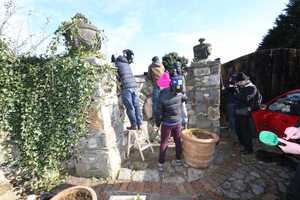
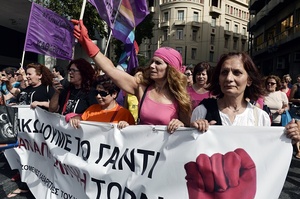
Tony Malone (top right with his Mandate union rep John Callan), who was sacked by Dunnes in Dundalk after he went on strike, and (above) laid-off cleaning staff from the Ministry of Finance protesting in Athens, Greece in 2013

What connects The Dunnes Stores workers and the 600 women cleaners who were employed by the Ministry of Finance in Greece but fired in 2013 due to austerity?

International solidarity.

Julien Mercille writes:

The sanction has been swift. Immediately after the one-day strike at Dunnes, Margaret Heffernan [Dunnes Stores CEO] targeted a number of workers “from all over the country” to punish them for participating in the strike.

One striker, Tony Malone, was fired the day after the work stoppage took place. Reports indicate that he’s not the only one and that many others have had their hours cut or their position changed. Mandate, the workers’ union, is now seeking legal advice on how to go about rectifying the situation.

When their privileges are challenged, the powerful retaliate swiftly and forcefully to send a message to people elsewhere who could get similar ideas. The Arab Spring and the Occupy Wall Street movement show that progressive ideas can spread rapidly.

This is one reason why Greece under Syriza is so demonized by the troika. Elites know very well that similar challenges are growing in other countries, most notably Spain, but also here, through movements like the water charges protests.

Related, we often hear that the European economic crisis is a result of Germany oppressing weaker countries like Ireland and Greece to teach them a lesson for others to see. There is truth in that, but it is misleading to pitch “the Germans” against “the Irish,” because every country is divided into a minority of elites and a majority of ordinary people.

It is more accurate to say that all elites – German, Irish, Spanish, etc.—share very similar goals against ordinary Europeans. That’s why the Irish government has been as happy as the German one and the troika to implement austerity here. It is also why when Syriza came to power, Greek, German, Spanish and Irish elites were all very upset, and still are.

We thus find struggles by ordinary people against austerity throughout Europe that are very similar to that of the Dunnes workers. For example, in Greece, there is the well-known case of the 600 women cleaners employed by the Ministry of Finance who were fired in 2013 due to austerity policies. Syriza promised to re-hire them if elected and the negotiation process is ongoing in order to establish the terms under which they would be given their jobs back.

After learning they had been fired, the women held regular peaceful protests in Athens, chanting slogans at the gates of Finance Ministry. The police was sent to deal with them. Amnesty International reported that they were left “beaten and bruised” by riot police.

The police hit the women with their shields and kicked them and some had to be taken to the hospital. One woman reportedly had her leg fractured. Amnesty International said that “the culture of impunity among the ranks of the Greek police is so deeply ingrained that officers believe they can get away with such flagrant human rights violations—and they often do.”

The media won’t highlight those similarities as obvious grounds for cross-border solidarity. Rather, they will play up nationalist feelings to try to rally people behind their own governments and elites. And they will, of course, repeat ad nauseam that austerity is a great thing and that There Is No Alternative, as I have shown in my recent book on the subject.

Actually, Pat Leahy, the Deputy Editor of the Sunday Business Post, seems to agree with my conclusion about the media’s coverage of austerity. In a column published yesterday on the subject of media bias, he states that his view is that the Irish “media’s attitude to austerity has been to favour it in general terms,” although opposition to particular policies often appears. Exactly what my book says.

Some in the media have tried to defend Dunnes Stores against its workers. Richard Curran wrote in the pages of the Irish Independent an article entitled “Businesses Should not be Vilified over Workers’ Casual Contracts.”

He says that “the easy narrative is that companies are increasingly exploiting workers in order to make ever-larger profits,” but according to him, the “reality isn’t that simple.” This is because some workers at Dunnes are happy with the hours they have, and after all, “there is nothing unfair in these [zero-hour] contracts,” as “it is how they are applied that causes problems.” Also, in the age of globalisation, “many companies themselves are in a less secure and more precarious position” and they could “find their entire business model undermined by competition.”

This is throwing ifs and buts out there to confuse a situation that is crystal clear: Dunnes workers are not treated fairly, and their employer is responsible. Splitting hairs until issues are blurred is a standard mass media tactic. And yes, there is international competition that leads businesses to cut labour costs—but that’s the problem, not an excuse for what is happening.

To cut through the spin, just look at this recent survey of 1,200 Dunnes workers that revealed that:

98% of workers want more stable hours
85% say insecurity of hours and rostering is used as a method of control
88% believe hours are unfairly distributed
88% believe they are not treated with dignity and respect

International solidarity would help those workers as much as it would help the Greek cleaning women. But solidarity is arguably even more important within Ireland. Irish trade unions should cooperate to a greater extent to support workers facing difficulties in various economic sectors, public or private.

In other words, unions should be about social change, not just about the relatively narrow issue of salaries for their own members. Moreover, as many of us as possible should support Dunnes workers, because ultimately we all win when work norms are improved in any given economic sector.

Perhaps a slogan could be: People of Ireland, unite. You have nothing to lose but Margaret Heffernan.

@JulienMercille is lecturer at UCD and the author of The Political Economy and Media Coverage of the European Economic Crisis: The Case of Ireland (2015, Routledge). His new book, Europe’s Treasure Ireland, will be out in July 2015.

Previously: Mercille On Monday

Pics: Talk Of The Town, via Irish Times and Getty
00146005irl_bus_330

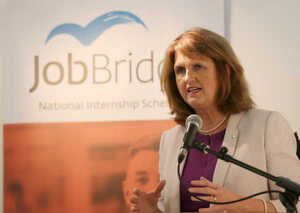
Above: Joan Burton and Margaret Heffernen

Low hour contracts and useless internships.

How Dunnes Stores and the Labour Party devalued work.

Julien Mercile writes;

We live in a world of smoke and mirrors where words are turned upside down to hide the simple fact that ordinary people are being exploited by elites. For example, if words reflected reality, the “Labour Party” would be renamed the “Employers Party”, and Joan Burton, the “Minister for Social Protection”, would be renamed “Minister for Social Dismantlement”.

Last week, more than 6,000 Dunnes workers throughout the country staged a one-day strike. The problem is their zero-hour or low-hour contracts. These require that the workers be available to work, but they don’t guarantee a decent number of hours of work per week. Therefore employees never know how much income they will receive every week. The time of their shifts also changes, so they can’t plan childcare, leisure, or anything.

The Dunnes workers want guaranteed hours of work to ensure they’re not shuffled around as Dunnes’ owners see fit. This is not a revolutionary or radical request: others do guarantee hours, including Tesco, Arnotts, Marks & Spencers, to name a few.

Of course, this is a way for employers to control labour. Employees who make too many requests for better conditions or want to organise can see their hours cut or their shifts moved to hours which they can’t attend. That’s why 85% of Dunnes workers said that one method of control on the part of management is to preserve the system of insecure hours of work.

Actually, work conditions at Dunnes are so bad that Dunnes is the company that hires the most workers who depend on social welfare in the country. More than 1,200 of their employees depend on social welfare to top up their irregular Dunnes income.

Meanwhile, the chief of Dunnes Stores, Margaret Heffernan, is very comfortable. Her net worth is estimated at €600 million. She has a luxury home in Barbados. She has another luxury home in Stillorgan in south Dublin which she is currently remodeling by joining three other houses with an extension including a cinema and an indoor swimming pool.

It is telling that when Margaret Heffernan took over the company in 1993, about 80% of Dunnes Stores workers were full-time. Conversely, today, 80% of staff is on part-time contracts that guarantee only 15 hours a week. Most staff are young and female.

The situation has created enough of a stir for Joan Burton to make a public relations appearance for a few minutes standing next to the workers on strike in front of the cameras.

But the Labour Party has contributed to the casualisation of labour, unemployment, and bad work conditions over the last few years. This has been done in three main ways.

1) Austerity: Support for austerity has deepened economic problems, increased unemployment, and prevented the economy from recovering. That’s the fundamental issue on which the current government should be judged—and kicked out of power.

2) Labour “reform” (another word that’s supposed to make us think it’s a great thing) for those lucky enough to still have a job: The workforce in the public sector has been reduced by 32,000 since 2008, at a time when the population has been growing and demand on public services is increasing. That’s on top of pay cuts and other schemes to increase management’s control over workers, even when management itself is incompetent.

3) Degrading work conditions by compelling the unemployed to reintegrate the workforce under bad conditions: The best known example of this is JobBridge, but there are many other similar programmes. JobBridge is a national internship scheme that provides work experience placements for interns who are paid only €50 per week on top of their existing social welfare entitlement, which equates to an hourly wage of €3.65 for a 40-hour week.

This amounts to a huge subsidy to the private sector, which accounts for approximately two thirds of internships. Effectively, the rise of internships has replaced a range of full-time employment opportunities that would likely have been made available anyway in the absence of the programme. There is little doubt that businesses have been using the scheme to replace paid work and the difference is going directly to the bottom line.

To take one example, Tesco has been using JobBridge to advertise for positions such as filling shelves according to merchandising plans and ensuring that customers do not have to queue while other companies such as fast food chain Sbarro have used it for finding pizza chefs.

Despite the abuse of the programme, the minister responsible for it—Joan Burton—has defended it explaining that it has been much praised “particularly by the employers” which is hardly surprising given that they are the main beneficiaries.

Democracy is not just about voting once every four years for a short menu of parties that essentially all care about elites, not ordinary people. Real democracy involves people having a say over matters that affect their lives.

A crucial part of this is economic democracy, which means workers having a say over their work conditions and the business they work in. After all, we spend one third of our waking life at work, so that’s an important chunk of time. That’s what the Dunnes workers are attempting to do.

Economic democracy is also about citizens having a say in how the government taxes them and the corporate sector and how it spends those taxes. That’s what water charge protestors are trying to influence, just like many progressive groups around the country.

They face opposition from the established parties, who know very well that the success of those campaigns will translate automatically into a loss of power for elites and into a redistribution of power and income toward ordinary people. No wonder they’re scared and react hysterically to mild media reports that even dare mentioning the protests.

@JulienMercille is lecturer at UCD and the author of The Political Economy and Media Coverage of the European Economic Crisis: The Case of Ireland (2015, Routledge). His new book, Europe’s Treasure Ireland, will be out in July 2015.

(Photocall Ireland)

gkoregandan

Mercille From top: Geraldine Kennedy; Gerry O’Regan; Dan O’Brien; Julien Mercille

An inevitable thing happened at the banking inquiry.

Dr Mercille Writes:

Last week, the Banking Inquiry forced some members of the media to undergo questioning about their poor performance during the housing bubble years. They didn’t enjoy it.

The Inquiry’s media deliberations started with myself and [Dublin Institute of Technology journalism lecturer] Harry Browne, who provided a critical look at the media.

Then, a string of media individuals were called in to reassure everybody that what we said was garbage.

The media’s defence mostly has revolved around personal attacks and flimsy arguments. I don’t want to delve too much into the personal diatribes because it distracts from the important issues, but many are funny, so here is a short list of what I’ve been called:

-A “messiah” and “self-appointed guru”, and also “an obscure academic” (Gerry O’Regan, ex-editor of the Irish Independent).

-“The finest conspiracy theorist I have heard in a long time” (Geraldine Kennedy, ex-editor of the Irish Times).

-A “man of the hard left” (Dan O’Brien, a hard right-wing journalist)

-“I attach no credence whatsoever to Dr. Mercille and his views regarding the Irish Examiner. They are from a planet I neither recognise nor inhabit and they do not apply to the Irish Examiner” (Tim Vaughan, Irish Examiner editor).

-“Far left”, “not a media academic”, and has “never worked in the Irish media” (Michael Clifford, Irish Examiner journalist).

The real issues, however, are this: the Irish media has a record of failure over the last 15 years on reporting economic issues of the highest national significance.

It’s easy to see: news organisations missed the housing bubble in 2000-2007, and then from 2008 onwards, have argued that austerity is the best strategy out of the downturn, even though it actually worsens economic performance.

Therefore, if accountability was a value espoused by our media, a lot of journalists and editors should by now have been fired for incompetence.

A few responses to the (false) claims that have been made at the Inquiry and since then will clarify the role of the mass media during the housing bubble and since then.

-“Saying that the media conveys elite views is a conspiracy theory.”

A conspiracy happens when a few people plot in secret outside the normal institutional channels to accomplish something from which they benefit personally. This has nothing to do with my analysis of the media, which is an institutional one: the media give us the views of the elites because they’re owned and funded by elites. Nothing surprising in this.

-“Journalists just reported what the ‘experts’ said so they shouldn’t be blamed for missing the housing bubble.”

This is very interesting and is often heard from journalists attempting to absolve themselves of any blame. When you think about it, it is actually a very harsh indictment of the media.

Indeed, it implies that journalists don’t think and are not critical of anything: they only report what others say, like robots.

I recall a senior RTE journalist who said to me that he wasn’t to blame for missing the housing bubble because he wrote his articles in this way: “When I come back from lunch, I check my smartphone, and I’ve usually received about 12 press releases from companies and the government. I just copy them and that’s my article!” Great. Journalists are supposed to think and challenge viewpoints, not report them without question. Thankfully, some journalists still believe in those principles and apply them.

-“We really tried to find out but all the experts were telling us the economy was fine.”

For example, at the Inquiry, former Irish Independent editor Gerry O’Regan claimed that the Irish media had missed the boat on the banking crisis, but that “it was not for want of trying,” and that the state of the banking sector was “hidden from the view of everybody” at the time.

Really? In 2007, when Morgan Kelly wrote his newspaper article essentially predicting that the Irish banks would collapse, he first sent it to the Irish Independent, whose editor was Gerry O’Regan. What happened? The editor wrote to Kelly and told him his article was “offensive” and that he wouldn’t publish it.

-“Commercial interests don’t affect news content.”

Advertising revenues are crucial to today’s news industry. For example, at the height of the boom, 17% of the Irish Times’ revenues came from property advertising only, which means nearly €100 million over the period 2002-2006.

In any case, some journalists have already revealed in published academic research that they faced pressures not to attack the banking and property sectors during the housing bubble.

-Some, like Irish Examiner journalist Michael Clifford, say that “The notion of ‘the media’ as some homogenous beast that takes a line and follows it like a political party, for instance, is complete garbage.”

Yes, and that’s why nobody is saying that. The media reflect the range of opinion among elites. So there is diversity in the news, but it is relatively narrow.

-“If you can’t give examples of journalists who have been prevented from their editors or owners from challenging those in power, then you can’t say the media represses contrarian viewpoints.”

First, we have academic research that has reported on journalists who said they were leaned on not to criticise the housing bubble. But more broadly, the point is that those who work in the media, journalists and editors included, mostly agree with the values and principles of the organization they work for.

It’s the same in any institution: for example, if you’ve been a military officer for years, you probably believe in armed operations in world affairs, or at least you’re not too strongly opposed to that. Those who don’t assimilate their organisation’s values will most likely leave it or be forced to leave.

So most journalists won’t question or challenge elites, because they largely agree with them on the basics of policy. Sure, policy will be questioned in the details, but not fundamentally.

Therefore, when editors claim that they never came under pressure on the part of commercial interests or owners, in a sense, that’s probably true, because no pressure is needed to make them toe the line, with which they agree. (Of course, some journalists are very much aware of the pressures they face, so there are always exceptions).

-In his Sunday Independent article yesterday, Dan O’Brien [former Irish Times Economics Editor] insinuates that I overlooked a clear warning he supposedly gave to the nation on Prime Time in April 2006 about the housing bubble.

This is not at all true, and would mean that Dan O’Brien counts himself, together with David McWilliams and Morgan Kelly, as having warned us all about the bubble. But you don’t need to do any research to find out that O’Brien is wrong. In the same article, he says himself that he didn’t have a clue about the housing bubble until 2008:

“I did not see the size of the risks building up in the financial sector in Ireland and across the western world before 2008. I accept this was a failing and do not seek to distract from my culpability.”

But then he complains that I should have classified him as one of those who warned us about the impending crisis. Go figure. This is indeed reasoning from another planet.

@JulienMercille is lecturer at UCD and the author of The Political Economy and Media Coverage of the European Economic Crisis: The Case of Ireland (2015, Routledge). His new book, Europe’s Treasure Ireland, will be out in a few months.

Yesterday: Don’t Hate Him Because He’s Beautiful

renua:it
t4_-371666110-226x300Lucinda Creighton and Harry McGee of The irish Times (top) and Julien Mercille

How do you sell another right-wing party like Renua?

With a little help from the people behind Mr Tayto and the man from the Irish Times.

Julien Mercille writes:

What’s the link between Renua, Tayto crisps, Diageo and Baileys? Answer: they’re all sold to us by the same marketing firm and consultants.

To come up with its name and image, Renua hired Noel Toolan, a marketing consultant with extensive experience in promoting alcohol products, in particular for Diageo with whom he worked for many years, while serving as Head of worldwide marketing for Baileys.

Renua also worked with a brand-design firm called Dynamo, which has been doing the branding work for Tayto crisps among others. They state on their website that “We have been associated with everything Tayto for over a decade… from the much talked about Tayto Chocolate bar to product innovation with Tayto Nuts Tubs and Tayto Popcorners.” They also work to promote alcohol products like Bulmers “to grow the brand from Irish market to the rest of the world,” of which they “are massively proud.”

This is what politics has become today. Politicians hire marketing agencies to promote them the way crisps and beer are promoted. Of course, that doesn’t exactly lead to meaningful public debate.

But from the viewpoint of those in power, it’s a pretty good strategy. The electorate is now disillusioned with the political establishment due to the harsh austerity of the last few years. There is thus space for new parties to come into being and gain in prominence.

Who knows, maybe Lucinda Creighton is a better manager than Enda Kenny to implement right-wing policies. Maybe a new face will reduce popular protests for a while. A segment of the establishment may thus want to put its weight behind Renua, thinking that it will better serve its interests.

It’s almost impossible for Renua, however, to distinguish itself through its policies, because they’re essentially the same as those of the other main parties. So they need to focus on empty statements, on coming up with a new logo, with new colors, a new slogan, new faces, etc. Anything that means nothing but looks good will do. And on those grounds, Renua may not have done so poorly.

Especially since the new party has received a big promotional boost from the media. There are many examples, but let’s stick to Ireland’s newspaper of record, the Irish Times, and in particular Harry McGee, its political correspondent.

McGee praised Renua as “well organised, highly-motivated and focused” as well as “ambitious.” There is also “little doubt” about Lucinda’s “abilities as a politician.”

In an article that pretends to be investigative journalism, entitled “Renua: The Making of a Political Party”, he went out of his way to present the party in a positive light, with the Irish Times in effect acting as an advertising agency.

The Times even made a 12-minute video about how Renua came into being, interviewing its leaders, advisors and ordinary people telling us how great and trustworthy the party is. Watch it and read the article, and see if you laugh or cry:

The article shows that the Irish Times is not in the business of challenging power but rather on a mission to glorify it. In the video, Harry McGee has tea with Creighton, asking her soft, irrelevant questions that make her look good while the cameraman is busy capturing her smiling in just about every possible angle.

The camera then follows Creighton everywhere, showing her as dynamic, decisive, caring and likeable. McGee also talks to people at Dynamo and he tells us about the artistic process to conceive the logo and all the details involved.

But beyond that, what do we know about Renua? It’s yet another right-wing party in the country and it labels itself as pro-business and pro-entrepreneurialism. Looking at its website and that of Lucinda Creighton, its leader, a few things are clear:

– Renua is empty: it’s striking how the whole project is based on vague and meaningless statements. One of the party’s “core beliefs” is that “There is no greater moral and political issue than securing the future of children.” Every policy point and strategy is about as imprecise as that.

– Renua has no understanding of economics: Creighton’s website states that “The current Government did a good job of stabilising the economy after it was destroyed by Fianna Fáil.” She was also once quoted as saying that “austerity and growth were not incompatible.” It would be hard to come up with more incorrect claims. In fact, the current government crashed the economy by implementing austerity, which by now should be clear to all.

– Renua has hyper pro-business values: its website states that “RENUA Ireland believes in a society that encourages families, communities and businesses to embrace an ethic of enterprise and improvement.” A family based around an “ethic of enterprise”? Wow. Is that when family members have to bill each other for favours?

– Renua is full of contradictions: a lot of statements are designed only to appeal to the electorate, like saying they believe in “real family values”, children, communities, etc. But those have been attacked continuously under austerity. Not so long ago, Creighton said that she supported government spending cuts because “the Government has no choice. We have no option but to proceed and implement the decisions that were announced in the Budget.” “We have to face up to the difficult decisions that have to be made,” she said. “That’s what we came into government for. It’s obviously not going to make us popular, but we have to do it.”

On top of that, Renua will keep water charges. That obviously doesn’t help families, children and communities. But maybe some people can be convinced otherwise, if Harry McGee and the Irish Times keep working hard on it.

@JulienMercille will appear at the Banking Inquiry this Wednesday to talk about the role of the media in the economy. He is lecturer at UCD and the author of The Political Economy and Media Coverage of the European Economic Crisis: The Case of Ireland.

00158967
t4_-371666110-226x300Michael Noonan (top) and Julien Mercille

Why is Michael Noonan courting property developers and vulture fund managers?

Has he learned nothing?

Julien Mercille write:

Our Minister of Finance, Michael Noonan, is cosying up again to the same developers and banks who crashed the country. A few days ago he met with them to explore ways of financing new construction.

Celtic Tiger developers Johnny Ronan and Michael O’Flynn and others were present at the “low-key”, “behind-closed-doors” meeting in the luxury Marker Hotel in Dublin’s Dockland. They said it’s “good to see” the key players in construction in the “same room again”.

The Irish Independent conveyed Noonan’s thoughts without challenge with the headline “It’s Time for us to Stop Scapegoating Property Developers—Noonan”. A tough press challenging the government indeed.

The Sunday Times went further and backed the strategy while defending the developers. The editors were explicit: “It’s Time to Bring Developers in from the Cold”, they said. They stated that Noonan’s comments about scapegoating were “right on the money”. Then followed a pathetic defense of those directly responsible for the crisis as the editors asserted that:

-Since the crash, “much time and energy has been expended in scapegoating” bankers, developers and politicians, which is harsh because “most of the culprits have been punished in one way or another”.

-And “if we keep obsessing about the mistakes and injustices of the past we are in danger of losing the capacity to move forward”, and that’s why “Noonan’s comments make perfect sense”.

-If we don’t bring developers back, we won’t be able to build the houses we need because those developers “have experience of dealing with the myriad issues involved in turning an empty field into family homes”.

-We shouldn’t forget that the only thing most developers did “was borrow too much money from banks”, something we all did anyway because we were all partying.

Oh wow. Reality turned on its head.

In fact, bankers and developers haven’t been scapegoated at all, otherwise they’d be in jail or would have been forced to do community work for years to compensate for the mess they’ve caused. Second, if we forget about the mistakes of the past, well, we’ll make them again.

Third, the way to build the social housing units needed is to involve the government more in this task, not discredited developers. Rory Hearne provides a lot of progressive ways on how this could be done here.

Last, we didn’t all party. The truth is that a small minority of VIP’s partied, and everybody else then cleaned up their mess.

Indeed, good reporting from yesterday’s Sunday Business Post revealed that in 2008, a mere 22 Celtic Tiger developers were responsible for a staggering €26 billion of debts to banks. Compare that to the €64 billion that taxpayers injected in banks to recapitalize them.

Michael O’Flynn had total borrowings of €1.8 billion primarily owed to Anglo Irish. Johnny Ronan was one of the “most ambitious developers of the boom” and owed €1.6 billion mostly to Anglo Irish. Denis O’Brien owed €1 billion primarily to Anglo Irish. Bernard McNamara owed €1.7 billion, mostly to Anglo Irish. Sean Quinn owed €2.9 billion, almost all of it, you guessed it, to Anglo Irish.

But Noonan has been meeting up with other characters as well: foreign vulture funds, many from the United States, that have been buying up Irish property by the ton.

Again, the Sunday Business Post has done very good reporting on this, with journalists Ian Kehoe, Emma Kennedy and Roisin Burke in particular spelling it out as it should be in articles entitled “Who Owns Ireland and Who Wants to Buy it”, “Vulture Funds Turn Screw on Apartment Renters” and “Why Vulnerable Mortgage Holders Are in the Line of Fire”.

They show how foreign interests are capturing large chunks of the country’s stock of property, and warn that they are most likely to leave in the short term, once the assets have gone up in value, at which point they’ll sell them back to… Irish people.

This highlights an important point about the mass media. Of course, there’s a lot of regurgitation of government propaganda.

You can find that in editorials, opinion and news sections. Uncritical reporting is definitely one way to make a long and rewarding career in Irish journalism. If you establish good contacts with influential politicians and report descriptively on whatever they say with no questions asked, you’ll get a secure job. If you defend them when they’re attacked, you’ll be praised beyond retirement.

But there’s also excellent information in the press. The reason is that the business press caters to, well, business people, and decision makers. Those people need good information, otherwise it would be hard for them to make any decisions. So there is good analysis in the business press, albeit presented from the point of view of someone in business. It’s also often buried in the back pages, but it’s there.

@JulienMercille is lecturer at UCD and the author of The Political Economy and Media Coverage of the European Economic Crisis: The Case of Ireland. He will provide evidence to the Banking Inquiry later this month on the role of the media during the housing bubble years.

90372561
t4_-371666110Gorse Hill, Killiney, last week (top) and Dr Julien Mercille (above)


Dr Julien Mercille writes:

Since 2009, there have been 3,865 home repossessions in Ireland (1,114 were ordered by courts and 2,751 were voluntarily surrendered or abandoned).

Also, the Central Bank has just released new figures showing that there are still more than 100,000 homes in arrears, or 15% of mortgage accounts. The evidence suggests that banks will seize even more homes in the near future.

If an opinion poll was taken today asking Irish people, ‘Can you name one of those repossession cases?’, probably 95% would answer ‘the rich guy in Killiney whose Gorse Hill mansion Vincent Browne showed us on television… the one with a tennis court, swimming pool, stone lions, and a nice view on the Bay’.

The ‘rich guy’ is Brian O’Donnell, a solicitor and developer who not so long ago controlled a €1 billion property empire but went bankrupt in 2013.

When Bank of Ireland moved to seize his €7 million palatial house over an unpaid debt of €71.5 million, a group calling itself the New Land League tried to block the repossession.

It just so happens that the New Land League, set up in 2013, is led by Jerry Beades, who is also a developer and a former member of Fianna Fail’s National Executive who collaborated closely with Bertie Ahern in the not so distant past.

According to press reports, he also accumulated multi-million euro bank debts over which he has been in legal battles with the banks.

The media has paid so much attention to that story that by now we know a lot about the intricate details of the lives of the O’Donnells, Jerry Beades, Gorse Hill itself and the New Land League. Yesterday, in a long Sunday Independent front-page ‘Exclusive’, ‘first-ever’ interview, the children of the O’Donnells told their stories. And that passes for investigative journalism.

One issue is, why is the media so focused on this case, but not on the thousands of others who have or are at risk of losing their house?

For example, just as the Gorse Hill soap opera is unfolding, a Limerick father called Ger Lonergan who is undergoing treatment for cancer risks losing his home due to a mortgage debt of €32,000.

He became unable to make payments due to illness and was diagnosed a few months ago with cancer. Permanent TSB has asked for a possession order to seize the house in which he lives with his wife and two daughters. Mr Lonergan says he gets a disability payment of €78 a week.

Whatever the details of this specific case, it’s not hard to imagine many other similar ones in the country. And ‘imagine’ is the right word, since we haven’t heard much about them.

The reason is that our mass media is not representative of popular interests. It cares about those of the better off and the stories that concern them, but not so much about the conditions faced by ordinary people.

That’s why all newspapers have ‘Business’ and ‘Money’ sections, but no ‘Poverty’ or ‘Human rights’ or ‘Deprivation’ sections. There are ‘Sports’ and ‘Lifestyle’ or ‘Living’ sections, but those don’t challenge Ireland’s power structure or injustice (they’re just about shopping and entertainment), so they may be printed.

The same goes for sensationalist stories like Gorse Hill. Narrowing down the discussion to the swimming pool and the paintings in the house, while not making links or comparisons with ordinary people at risk of losing their homes saves the government and bankers some embarrassment over kicking out ordinary and sick people out of their homes.

Another effect is that whenever the important issues of repossessions, evictions and mortgage arrears are brought up in public discourse, the picture conveyed is one of arrogant rich people living in mansions and too stubborn to vacate their house that they bought thanks to property speculation during the housing bubble years.

Many of us will have little sympathy for such individuals and might even secretly cheer for the courts and banks to kick them out of their house.

The result is that issues of repossession and arrears are misrepresented and turned upside down, and thousands of people whose lives are directly affected by them will not receive the attention they deserve.

@JulienMercille is lecturer at UCD and the author of The Political Economy and Media Coverage of the European Economic Crisis: The Case of Ireland. He will provide evidence to the Banking Inquiry on the role of the media during the housing bubble years.

Related: Banks attempt to repossess 7,000-plus homes (irish Times)