
Tag Archives: Noirin O’Sullivan

Screen Shot 2016-06-02 at 15.14.49Screen Shot 2016-06-02 at 15.16.12

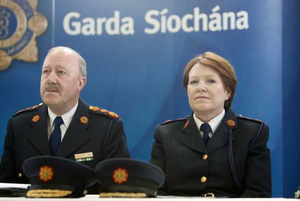
From top: Paul Reynolds, of RTÉ; Garda Commissioner Nóirín O’Sullivan speaking to journalists at Phoenix Park this morning

Earlier today.

Paul Reynolds interviewed Garda Commissioner Nóirín O’Sullivan.

It’s the first time Ms O’Sullivan has spoken publicly about the O’Higgins Commission of Investigation.

Mr Reynolds reported on RTÉ’s News At One’s news headlines:

“The Garda Commissioner was anxious today to reassure the public that changes that are badly needed in An Garda Siochana will be implemented including changes in training, supervision, incident management and how victims of crime are dealt with.”

“She says it took some time to make the case for investment so that the gardaí could receive the resources necessary to make these changes happen.”

“In relation to allegations that some officers may have been preparing to give testimony against Sgt Maurice McCabe, at the O’Higgins Commission, which contradicted his, at a meeting in Mullingar, the Commissioner said she took action as soon as she became aware of the public commentary that gave this impression.”

“She said that she cannot comment further because the matter is being investigated by GSOC. She also said that the Garda needs to change its approach to whistleblowers but it’s already taken steps in that regard.”

Listen to Mr Reynolds’ interview with Ms O’Sullivan in full here (go to 10.20)

O’Sullivan acted ‘as soon as possible’ over allegations (RTE)

UPDATE: A transcript of the interview…

Paul Reynolds: “Commissioner, you mentioned there were recurring faults. What do you say to criticism from people like Mick Wallace and Clare Daly, elected representatives, who say that you were a part of the senior management who didn’t implement those changes when they should have been implemented because the faults kept occurring?”

Noirin O’Sullivan: “Well I don’t think that there’s either time or space to go into it here but that’s something we can explore further with the authority and that’s why we were very anxious that the authority would bring forward a public session because I think it’s very important that the public are reassured that there are lessons have been learned and I think also that…”

Reynolds: “But why were they recurring?”

O’Sullivan: “That the public can be reassured that there is now adequate levels of investment, to allow us to start implementing some of those changes that are very badly needed. So for example, if you look at some of the criticisms, quite right criticisms, in the O’Higgins Commission particularly, we had incident management and  supervisory management about insuring that Gardaí are properly trained. That there are supervisory management practices in place to ensure that people are actually being supervised properly and they have been supported in doing the job that they have to do and providing the appropriate level of service. Particularly to victims in crime, we now have the opportunity to put those measures in place because we now do have the investment.”

Reynolds: “You’ve been criticised in relation to, following the publication of the report, in relation to the actions of some senior officers. Now, I know that allegations were made, they’re unfounded, and this has been sent to GSOC for investigation, but the questions in relation to you have been: what did you know about this? When did you know it? And why didn’t you act before the GSOC investigation was set up?”

O’Sullivan: “Well I think there are a couple of very important points that need to be made. Firstly, Mr Justice O’Higgins conducted a Commission of Investigation, of which we was the sole member. He had the opportunity to hear all of the evidence, from all of the parties and all of the submissions on behalf of all of the legal parties. And Mr O’Higgins’ report speaks for itself, having weighed up all of those submissions, all of the evidence given by all parties. When we received the O’Higgins Commission report, and some of the public commentary attributing, misplaced or otherwise, belief that senior officers had done something which was improper and inappropriate to do, then it was immediately required to the Garda Siochana Ombudsman Commission and that investigation, I’m not allowed, I can’t comment any further but it is being investigated by the Garda Siochana Ombudsman Commission.”

Reynolds: “But can you not say why you didn’t take action when you became aware of it?”

O’Sullivan: “Well you know, I’m sure Justice O’Higgins would have a view, if I were to go into the middle of his commission. But, as soon as I became aware of the public commentary which gave this impression, it was required to the Ombudsman.”

Reynolds: “You gave evidence to the Commission, didn’t you?”

O’Sullivan: “Well I think anybody that looks at the report, there’s an appendice of witnesses to the report. Obviously, the Commission was a private sitting and it was a matter for anybody that was before the Commission to request it to be in public but it is a matter of record, in the report, that I appeared as a witness.”

Reynolds: “But what about your handling of Sgt Maurice McCabe? The criticisms in relation to instructions to your lawyers, in relation to testing his credibility, his motivation and his integrity?”

O’Sullivan: “Well, you know, again, I’m on record as saying that An Garda Siochana have lots of things to change. One of them is our approach to people who want to have a different voice and who have a different voice and want to bring things to our attention. And very, very clearly, from day one, I’ve said that dissent is not disloyalty, we have taken a number of steps to ensuring that people can bring forward issues of which they want to raise. Some of those people just want to raise their issues and they want to have them dealt with and they have that right. In order for people to be able to come forward and people that want to, under the Protective Disclosures Act, bring forward disclosures. We have put systems into place to ensure that people can do that, that there will be a safe environment in which they can do it. And we are working with bodies, such as Transparency Ireland, to ensure that the proper environment is there so that people can do that. We’ve also appointed a Protective Disclosures Manager and we will have appropriately trained staff to deal with that.”

Reynolds: “Ok but why did you, why did you test his credibility and motivation… no, sorry, why did you test his credibility and motivation?”

O’Sullivan: “Well, I think, refer it back to the statement, you know, I’m very restricted in what I can say in relation to what happened at the Commission but I think a previous statement makes it clear what the approach was.”

Previously: Clarifying Matters
Screen Shot 2016-05-30 at 19.31.15
Former Garda Commissioner Martin Callinan and Garda Commissioner Nóirín O’Sullivan

Commissioner O’Sullivan was not aware of any private meeting between former Commissioner Callinan and Deputy McGuinness as outlined by Deputy McGuinness in the Dáil.

In relation to whistleblowers, Commissioner O’Sullivan has consistently stated that dissent is not disloyalty and as a service we are determined to learn from our experiences. An Garda Síochána agrees that whistleblowers are part of the solution to the problems facing the service.

The Commissioner has recently appointed a Protected Disclosures Manager and an appropriately trained dedicated team will be established to oversee all matters related to whistleblowers.

Transparency Ireland has agreed to work with An Garda Síochána to help ensure protected disclosures and people making them are welcomed and protected in An Garda Síochána.

Garda Commissioner Nóirín O’Sullivan in a statement released this evening.

Meanwhile…

56df37279f83c1af81fa6c9177fad079_400x400

Lorcan Roche Kelly

You may recall the murder of Sylvia Roche Kelly.

The mother of two, from Sixmilebridge, Co Clare, was murdered by Gerry McGrath, from Knockavilla, Co. Tipperary, at The Clarion Hotel in Limerick on December 8, 2007.

McGrath was out on bail –  for attempting to abduct a child, on October 9, 2007 – when he killed Sylvia.

He was also out on bail for assaulting taxi driver Mary Lynch in Virginia, Cavan on April 30, 2007.

Further to this…

Sylvia’s husband and journalist Lorcan Roche Kelly spoke to Seán O’Rourke this morning about An Garda Síochána and his trust in the same.

Lorcan Roche Kelly: “I think the problem with Noirin O’Sullivan – this is nothing personal against Noirin at all, I’m sure she’s a perfectly good Garda – is that she is a commissioner that was appointed internally. She came up through the system that exists within the gardaí for the last however many years and it’s that system that has been the problem. So, to get that system reformed, I don’t think Noirin O’Sullivan should have the public’s confidence in being able to reform it because she is of that system. Like I think if you look over the border, what we saw in 2001 with the Royal Ulster Constabulary being completely transformed into the Police Service of Northern Ireland, it’s, I’m not saying we need to change the name of the Gardaí but it’s that level of reform that the Gardaí now need because they have resisted reform for so long that the reform, I suppose, the actions needed have built up to such an extent that we’re nearly at a root and branch level of reform.”

Seán O’Rourke: “Yeah but again that is very central to her whole approach and that’s what’s being seen now by the new Policing Authority. Was it not a good starting point in itself? I suppose it’s precious little consolation to people like yourself and the [Shane] O’Farrell family, for instance. The Commissioner did say, ‘we are sorry the victims did not get the service they were entitled to’.”

Roche Kelly: “Isn’t that the most mealy-mouthed apology. It’s like: I’m sorry your coffee wasn’t as hot as you wanted it to be. Like this is much more serious..”

O’Rourke: “Ah is it not a bit, and I accept now that nobody knows apart from you and your family the grief that you’ve had to endure but would you not give her a bit more credit it than that?”

Roche Kelly: “To be honest, after nine years and after the, I suppose, the stonewalling we’ve received over the years, it’s very hard for me to look at a guard and say, ‘ok, I trust your bona fides in this’. Like this apology came after the O’Higgins Commission, the apology, when the writing was so clearly on the wall that then, ok, now, an apology was necessary. So rather than making a fulsome apology, the apology was made as a press release, that I didn’t receive, I’d to go on Twitter and ask, ‘does any journalist have this press release so at least I can see it’.”

O’Rourke: “Have you had any direct personal apology yourself, from the gardaí?”

Roche Kelly: “Last week I had a meeting with some gardaí in Dublin with the idea of them outlining the reforms they’re bringing in. So it was, the idea of the meeting was to show what reforms they’re bringing in to show this won’t happen again, I think is where we are.”

O’Rourke:“And they clearly would have been senior. How senior gardaí were they? Was there an assistant commissioner or deputy commissioner among them?”

Roche Kelly: “No.”

O’Rourke: “And were you persuaded by what you heard?”

Roche Kelly: “Again, I’m probably the least persuadable person when it comes to Gardaií reform but no it was..no, I think it’s as simple as that, to be fair.”

O’Rourke: “And what would persuade you, Lorcan?”

Roche Kelly: “I think, in order for a reformed process to have credibility, the first thing you need to say is, ‘ok, the people that need to be reformed shouldn’t be the people that do the reforming’. Like, again, nothing personal against Noirin O’Sullivan, I’m sure she’s a fantastic person and she’s a very good guard, but in order to reform an organisation, you need to bring in an outsider. Like, say, in the corporate world, if you want to change a company, you appoint a new CEO from outside because you can’t appoint an internal appointment because, you’ll say, well that’s just going to be more of the same in the Gardaí. So the Gardaí, as an organisation, have to be beyond reproach and we have spent, I have spent nine years, the Irish media have spent the last month and a half reproaching the Gardaí, saying, ‘look this is where the problems are, what are you going to do to address these problems?’, ‘how are you going to address these problems?’. It’s a constant drumbeat of a question that is landing at the Gardaí’s desk and, in order to address those problems, they need to have an outsider come in. And again, to look at what we saw what was done over the border 15 years ago, so it is not an impossible task but there has to be willingness to do it.”

O’Rourke: “To what extant, Lorcan, are your views informed by that experience, that nine years as you say, in the course of which you took a legal action which, I think, you knew would fail, seeking to get fuller information. And then you had the dealings with GSOC and you’re still not satisfied that there is sufficient accountability there clearly.”

Roche Kelly: “When I was doing the research, one of the interesting statistics from GSOC that I found out and you mentioned this yourself with the exoneration of the gardaí in Cavan-Monaghan at a previous report in 2011 was that the way GSOC works is that they can make recommendations for disciplinary action against a guard but they have no power themselves to implement disciplinary commission, that goes to a senior guard. And in 2012, the year my complaint came up, there was 5,600 complaints against gardaí. Over 1,000, I think it was 1,017 of them were put forward for disciplinary action. Of those 1,017, 69 resulted in some disciplinary action. So, if you’re a garda and a complaint is made against you there is a less than 1% chance of you facing any disciplinary action at all. Which, some people could say a lot of the complaints against gardaí may be spurious but I doubt 99% of them are. It’s the culture, and that needs to be highlighted, because it’s a cultural problem, rather than admit there are problems, let’s ignore the problem and move on as an organisation and to move on within the gardaí seems to me to mean, ‘let’s pretend none of this happened’.”

Later

Roche Kelly: “When my wife was murdered, our daughter was in junior infants in primary school, she’s now in first year in secondary school. So her entire primary school life has been based on: where is the answer to these questions? And I haven’t found them. And the only reason that I haven’t found the answers to these questions is because I have been stonewalled by the gardaí. This entire, my entire thing could have been sorted out with two phone calls and a letter eight years ago.”

O’Rourke: “Did you get the answers in the O’Higgins report?”

Roche Kelly: “I got the answers, the factual play that I had known all along. It was, why had the gardaí not admitted that they had made a mistake here; why have they not come out and said, ‘ok, if we had done our job right, Sylvia would still be alive’ and here’s what we’ve done to address it. And like the O’Higgins report, again, ended with a kind of a thing that happens a lot in Ireland where there are systematic problems where many things failed, therefore no one should be individually held responsible. And if that’s the response of the O’Higgins commission, then the book for that has to go to the top of the organisation. And again, I’m not saying Noirin O’Sullivan is anyway incompetent or had any hand, act or part in this but if the organisation is fundamentally rotten or, I won’t say corrupt, but is damaged then it needs to be changed from the top down.”

O’Rourke: “And what about the fact that there was an open, international competition for the Commissioner appointment, after Martin Callinan resigned or was retired, whatever way you want to phrase it, and she came through that competition?”

Roche Kelly: “Again, I don’t think it’s the fact that the competition existed, I would understand that wanted a challenging position would look at the garda, the job of the head of the garda, and say that might be a bridge too far for me, to reform an organisation like that. But if there is an open competition then have an external candidate so internal candidates cannot apply for it because it is a situation where you need an external candidate.”

Listen back in full here

Commissioner ‘not aware’ of Callinan’s car park meeting (Today FM)

Previously: Better Late Than Never

Screen Shot 2016-05-25 at 14.28.56Screen Shot 2016-05-25 at 14.32.50

From top: Garda Commissioner Nóirín O’Sullivan and Justice Minister Frances Fitzgerald at the launch of ‘joint agency response to crime’ strategy last November; Clare Daly

Independents 4 Change TD Clare Daly spoke to Audrey Carville on RTÉ’s News At One this lunchtime.

The interview came after Garda Commissioner Nóirín O’Sullivan released a statement at midday, saying, “I can confirm that An Garda Síochána’s legal team was not at any stage instructed to impugn the integrity of Sergeant Maurice McCabe or to make a case that he was acting maliciously.”

Grab a tay…

Audrey Carville: “Just to repeat, Nóirín O’Sullivan states, ‘I can confirm that An Garda Siochana’s legal team was not, at any stage, instructed to impugn the integrity of Sergeant Maurice McCabe or to make a case that he was acting maliciously. We’re joined now by Independent socialist TD Clare Daly. Clare Daly, thanks for joining us, do you believe the Commissioner when she says that?”

Clare Daly: “I think she’s saying very little. I think, if you read it carefully, her statement is very well put together. She’s selecting the word, ‘integrity’ which of course, we know from the leaked transcript, was exactly the expression used by her senior counsel Colm Smyth in November [2015] when he said the integrity bit was his words but she’s very silent on the allegations which were upheld that they were instructed to question the credibility and motivation of Maurice McCabe. And I think while she says and we can take it maybe, in some sense, they had to cross examine the evidence of everybody including Maurice McCabe, and I think everybody would accept that but this wasn’t about cross examining the evidence, this was about questioning his motivation, his credibility and having two senior officers prepared to give false testimony to back that up. And those allegations are still unanswered.”

Carville: “But isn’t she right though? In relation to the documents that have been leaked, she calls it the selected information purporting to relate to these proceedings out into the public domain, the transcripts of no more than three minutes of what happened at a Commission which ran for 34 10-hour days.”

Daly: “I think it’s interesting that she did choose to focus on that and says they’re selective but she doesn’t say they’re not true and they’re very comprehensive in their entirety of what they’re claiming and the claim hasn’t been denied anywhere – that Garda authorities instructed their legal team to basically go in and give false testimony to mislead the Commission as regards the credibility and motivation of Maurice McCabe…”

Carville: “How do you know that though? You can’t say that for certain.”

Daly: “I can say that for certain. And nobody disputed it any where, including the Garda Commissioner. To say that the evidence that was leaked is not valid or that it’s only part of the story – that’s not the case. It’s a very comprehensive transcript which stands up in its own ground and that added to other testimony that I’m absolutely aware of that the Garda legal team adopted an incredibly adversarial approach to Maurice McCabe where it was repeatedly stated at the Commission that he was, in effect, being put on trial – that treatment was not given to anybody else. I think it’s interesting that the Commissioner says she’s now asked the minister to investigate the matter of the two senior officers but the reality is is that this claim, with these two officers, was made over a year ago and it was only withdrawn last November – just before, on the eve if you like, of Noirin O’Sullivan herself giving evidence to the Commission. But if that information was out there, which it was, why hasn’t she, as the Garda Commissioner, already investigated that matter and why is she doing it now that it’s in the public domain because she’s aware of it.”

Carville: “Do you welcome though that it has gone to GSOC to investigate?”

Daly: “I think sadly GSOC are not equipped to deal with these matters adequately, it’s interesting that she talks again about dissent not being disloyalty for the current Garda whistleblowers whose cases are before GSOC. They haven’t been able to get a proper hearing and dissent is very much disloyalty under Noirin O’Sullivan’s watch as far as they’re concerned. So I don’t think GSOC are adequately equipped to deal with this. I’m glad somebody is investigating but to be honest with you, the real answers have to come from the Minister for Justice [Frances Fitzgerald] who, in legislation, ultimately is accountable for the behaviour of the Commissioner and I don’t think she’s accounted for her actions adequately. I think this is a longer statement basically saying what she did the last time and hiding behind confidentiality and legal points which have not been validated by any independent source again talking about Section 11 of the Commission of Investigation which is factually incorrect because that simply deals with evidence and the information here is not evidence, it’s a legal position being put forward.”

Carville: “But if there was a position, if there is an implicit admission in this statement that perhaps Sgt McCabe’s motivation and credibility were to be challenged, before the Commission, isn’t that fair enough because, as she says, the Gardai were being subjected to the most serious of allegations, from Maurice McCabe. So, in any court, isn’t the person making the allegations cross examined to the fullest?”

Daly: “I’d be fully in favour of evidence being cross examined and indeed motivation can be but that’s entirely different to senior garda officers, in order to substantiate that, being prepared to give false evidence to the Commission. And that big, giant elephant is still in the room because that is a fact that has been undisputed and we need answers on that because that evidence was apparent to the Commissioner as late as a year ago and nothing has been done on it. Now we’re being told she is going to do something on it, or asked the minister, that’s not good enough for the head of An Garda Siochana. We’re talking about, in essence, perjury to a sworn commission. It’s highly serious.”

Carville: “But we don’t know exactly what those two senior Garda were prepared to do because it hasn’t made it in to the final report. And it’s not really dealt with in any of the leaked documents either.”

Daly: “And it is very much out there in the public domain, that the Garda Commissioner’s statement hasn’t answered it, and we need very clear answers on it, I mean I’d like to know, for example, why is Noirin O’Sullivan only acting on it now?”

Carville: “But it’s only a suspicion, Clare Daly, about what the two senior officers did. And she is now referring it to GSOC to be investigated.”

Daly: “The people who were at the Commission are very clear on what the two officers said, very, very clear and there were quite a number of people at that Commission and I honestly believe the truth will out and I’m perfectly satisfied and safe, if you like, in saying that they were prepared to give evidence to mislead and only withdrew that when taped evidence was produced by Maurice McCabe to say what they had said was not true. That was the trigger that led to it being withdrawn. This man could have been ruined had be not had that tape recording.”

Carville: “Yeah, well, the matter is gone now to GSOC to investigate that and, as I say, it’s not fully clear from Mr O’Higgins’ commission that was indeed the case. Some people have said that it is time to draw a line under this. That nothing good can come from repeatedly going over this same situation in relation to Maurice McCabe, what do you say to that?”

Daly: “I think we can’t move forward until we honestly deal with what has happened. And I think we have repeatedly made the point that since the exit of Commissioner [Martin] Callinan and Minister [for Justice, Alan] Shatter, unfortunately, under the watch of Noirin O’Sullivan, and Frances Fitzgerald, the same very bad practice regarding the vilification of whistleblowers has continued and there’s nothing new in that and we know that from the treatment of Keith Harrison and Nick Keogh, current Garda whistleblowers, whose dissent has been very much treated as disloyalty. These people are out of work sick, they’ve been vilified, demonised, their life has been made an absolute hell – all on Noirin O’Sullivan’s watch…”

Later

Carville: “Thank you very much indeed, Independent socialist TD Clare Daly. And just to reiterate that no allegations have been proven against two senior gardai, that they deliberately misled the O’Higgins commission.”

Listen back in full here

Previously: Nóirín Speaks

Rollingnews

Screen Shot 2016-05-19 at 09.18.51Screen Shot 2016-05-19 at 09.21.29

From top: Sgt Maurice McCabe; Former Garda Commissioner Martin Callinan and Garda Commissioner Nóirín O’Sullivan

I’ve spoken to several people who were in attendance throughout, if not the entirety, most of the days that the Commission took evidence and they say that it was if Sgt McCabe was on trial. He said as much when he was under cross examination on several occasions and a serving member of the Gardai – that I’ve spoken to – who was present at several days of proceedings has told me:

‘They tried to blame Maurice for everything and it was bullshit.’

The ‘they’ in this case is the Garda HQ, and what that member of the force was referring to was either individual Gardaí or An Garda Siochana corporately claiming that Sgt McCabe was actually the person at fault in each of the cases that he blew the malpractice whistle on. When of course the judge found out that he wasn’t blamed at all.

You’re not going to find much reference to this in the completed report. Much of the process, the business of the commission revolved around Maurice McCabe having to prove that he wasn’t guilty of the very malpractices that he had highlighted in the first place by bringing them to the attention of the Confidential Recipient [Oliver Connolly] and to [Fianna Fáil leader] Micheál Martin.

In one case, to give example, he was accused by gardai of having given an instruction that was central to one of the cases of malpractice but, after scrutinising his diary from many, many years earlier, McCabe was actually able to offer the watertight alibi that he wasn’t on duty that particular day that he was accused of having done something because he was actually present at the birth of one of his children.

…Commissioner Nóirín O’Sullivan and many of the individual senior officers – be they retired or serving – were all represented by the Chief State Solicitor’s Office and acted for, at the commission, by Colm Smyth, senior counsel. So the legal strategy was, in most cases, centralised. The line of attack on McCabe was organised.

RTÉ’s Philip Boucher Hayes speaking on Drivetime last night.

Listen back to his report in full here

Earlier: Who is Misleading Whom

Previously: ‘Something For Everyone’

Clarifying Matters

Rollingnews

Screen Shot 2016-05-18 at 11.35.48

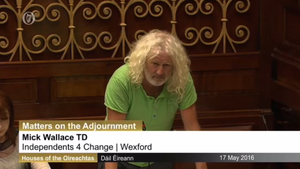
Last night in the Dáil, during the Adjournment Debate, Independents 4 Change TDs Clare Daly and Mick Wallace addressed Tánaiste and Justice Minister Frances Fitzgerald.

They were speaking about Garda Commissioner Nóirín O’Sullivan’s representation at the O’Higgins Commission of Investigation in respect of Sgt Maurice McCabe.

Ms Daly and Mr Wallace spoke in the Dáil before transcripts of Ms O’Sullivan’s legal counsel Colm Smyth SC speaking before Judge O’Higgins were revealed on RTÉ’s Prime Time last night.

The transcripts revealed that Mr Smyth initially told Mr O’Higgins: “My instructions are to challenge the integrity of Sgt McCabe and his motivation.”

The two men then had the following exchange:

O’Higgins: “…An attack on somebody’s credibility and his motivation or integrity is something that really doesn’t form part of this inquiry. It would be necessary for you to go further and say that the complaints and the actions of Sgt McCabe were motivated by… that is motivation was dishonest or wrong…In other words that he made these allegations not in good faith but because he was motivated by malice, by some such motive and that impinges on his integrity. If those are your instructions from the Commissioner, so be it.”

Smyth: “So be it. That is the position judge.”

O’Higgins: “Those are your…”

Smyth: “Yes. As the evidence will demonstrate judge…[later] this isn’t something I’m pulling out of the sky, judge, I mean I can only act on instructions.”

Later, in November – after Sgt McCabe produced a transcript of his meeting in Mullingar with two gardaí – Mr Smyth told Justice O’Higgins that, in fact, he, on behalf of Ms O’Sullivan, was not challenging Sgt McCabe’s integrity but just his credibility and motivation.

Mr Smyth said he erred earlier when he said ‘integrity’.

Further to this…

Clare Daly: “I listened to the Tánaiste during Leaders’ Questions with a mixture of disbelief and awe. Does she really believe that the questions about the conduct of the Garda Commissioner are going to go away? Does she really believe that, by saying that the Commissioner made it clear that she supported Maurice McCabe, it is the end of the matter?”

“What the Commissioner’s statement actually said was that she had never regarded Maurice McCabe as malicious. Fair play to her, that is very nice, but it is not the issue at hand. The issue in front of the public is that the Garda Commissioner’s legal team, allegedly on her instruction, attempted to mislead the commission deliberately by entering false information in order to challenge the motivation and credibility of Maurice McCabe.”

“The fact that legal counsel has stated that the attempt to challenge his integrity was its idea and not the Commissioner’s does not make any difference. It is reminiscent of the former Minister, Alan Shatter, throwing Oliver Connolly under the bus.”

“The commission was told that two senior gardaí would give direct evidence to the effect that Maurice McCabe was present at a meeting and stated that he operated under malice. It was only when irrefutable evidence was presented showing it to be false that the allegation was withdrawn.”

“If the Tánaiste does not have a problem with this, we are in even bigger trouble than I believed. There is an immediate crisis of trust and confidence in the Commissioner. Public statements uttered by her in support of whistleblowers have been contradicted by her actions behind the scenes.”

“The Tánaiste should not be surprised about that because we are not. Eighteen times since the Tánaiste became Minister, Deputy Wallace and I have tabled the issue of Commissioner O’Sullivan’s treatment of the whistleblowers Mr. Keith Harrison and Mr. Nick Kehoe.”

“The Tánaiste has done nothing. Will she launch a full investigation into the Commissioner’s actions in accordance with the Garda Síochána (Policing Authority and Miscellaneous Provisions) Act, under which she can investigate and remove the Commissioner for actions that discredit her office?”

“Will she commission the Garda Síochána Ombudsman Office, GSOC, to launch an investigation? If not, why not?

I am reminded of a memorable contribution by Deputy Wallace in the Dáil when he told the former Minister that it was time for the latter to go and to take the then Commissioner with him. It is obvious that it is time for the current Commissioner to go. Unless the Tánaiste acts, the Commissioner will take her with her.”

Mick Wallace: “If Maurice McCabe had not made a recording, the judge would have been compelled to believe the two officers and Maurice McCabe would have been destroyed. This development was not even mentioned in the O’Higgins report. Surely, that undermines the report’s integrity.”

“We still do not know whether Ms Nóirín O’Sullivan’s legal team, under her direction, handed documents to the commission that contained a false statement. That is supposedly a criminal offence. This is a serious matter.”

“I find it difficult to believe that, when there is so much discussion about doing things differently in all aspects of politics, Fianna Fáil does not want to know about this situation. It just wants the issue to go away as well. This is shocking.”

“What the Commissioner says in public is different to what is happening on the ground. Keith Harrison and Nick Kehoe have been treated abysmally for two years. Both are out sick now. One gets less than €300 per week and the other gets nothing. Every effort has been made to hound them out of their jobs.”

“It is two years since Mr. Harrison tried to get a proper hearing and he has only had one proper meeting with GSOC. GSOC requested Mr. Kehoe’s file after a poor internal Garda investigation. The Garda was given 30 days to deliver it but still has not done so.”

“Ms Nóirín O’Sullivan asserts that dissent is not disloyalty, but that is not true. Now it is being claimed that the question of integrity was not raised and the senior counsel is being thrown under the bus or is taking one for the team.”

“The Commissioner is not even rowing back on how she questioned Maurice McCabe’s motivation. She has not rowed back on the fact that she was questioning his character. Who in God’s name would be a whistleblower? She is not fit to be the Commissioner.”

“Nothing has changed. It is as it was. We will not improve or change how we do policing in Ireland until we change the hierarchy and start from scratch.”

Transcript via Oireachtas.ie

Screen Shot 2016-05-17 at 22.14.07

RTÉ crime correspondent Paul Reynolds on RTÉ’s Six One earlier this evening

Earlier this evening.

RTÉ crime correspondent Paul Reynolds reported that he obtained new documents in relation to the exchanges between Garda Commissioner’s senior counsel Colm Smyth and Judge Kevin O’Higgins during the Commission of Investigation into Sgt Maurice McCabe’s complaints.

Mr Reynolds reported that the documents show Mr Smyth told the judge he was instructed, by the Commissioner, to challenge the ‘motivation and credibility’ of Sgt Maurice McCabe.

This, Mr Reynolds reported, was because Ms O’Sullivan had to consider the welfare of all of the gardai not just Sgt McCabe.

Grab a tay.

Mary Wilson: “Paul Reynolds, what’s going on?”

Paul Reynolds: “Well. OK. This controversy began last week when it was reported that the Garda Commissioner’s legal team was going to claim that Sgt Maurice McCabe was motivated by malice. This was in marked contrast to the Commissioner’s public statements in support of the Garda whistleblower.”

“Now we have seen documents today which show that, early in the Commission’s hearings, the Commissioner’s senior counsel said that, quote, his instructions from the Commissioner were to challenge the integrity of Sgt Maurice McCabe. Now the judge put that issue to one side, so if you can think of that as an earlier hearing.”

Wilson: “OK.”

Reynolds: “And that was brought up later in the proceedings in the hearings of the Commission. In fact, just before the Garda Commissioner was due to give evidence. Now. The Garda Commissioner came in to give evidence and the judge sought clarification on this issue.”

“Now the Commissioner’s senior counsel then told Mr Justice Kevin O’Higgins that, quote, my instructions at all times were to challenge the motivation and credibility of Sgt Maurice McCabe.”

“Senior counsel Colm Smyth also said that it was on an error on my part when he said, earlier, that his instructions had been to challenge the integrity of Sgt McCabe.

“So he said that he made a mistake at the earlier hearing when he said he was challenging his integrity. But he said they were going to challenge Sgt McCabe’s motivation and credibility.”

“But, specifically, they were going to challenge his motivation and credibility in relation to his allegations of corruption and malpractice. Now you know that, sorry, we know that Sgt McCabe made serious allegations of corruption against five senior officers including the former Garda Commissioner Martin Callinan.”

“So, the Garda Commissioner’s legal team was going to challenge his motivation and credibility in relation to this. Senior counsel for the Garda Commissioner told the judge that Sgt McCabe had, quote, alleged corruption on the grand scale against the five senior officers and that he had been invited to withdraw the allegations of corruption against Martin Callinan but he had refused to do so.”

“Now, as we know, the commission’s report came out last week and found there was no evidence to substantiate any of the allegations of corruption against any of the gardaí and not a scintilla of evidence to support Sgt McCabe’s allegations of corruption against the Commissioner.”

“So the Garda Commissioner’s senior counsel also pointed out the reason why he was challenging the motivation and credibility of Sgt McCabe on these points, he said he was doing this on behalf of Nóirín O’Sullivan because she had to consider the welfare of all of the gardai not just Sgt McCabe. She had a concern for his welfare and his concerns, but she also had a concern for the other officers, the other officers against whom the allegations were made. They were also under her control and, quote, that she had to hold the balance.”

Wilson: “Ok, a lot of detail there, Paul, if we pick our way through it, I take it you’ve had sight of certain material. We know that other material that other reporters had sight of has made its way into the newspapers.”

“At this stage, without challenging the rights and wrongs of either sets of documents that you’ve all seen and what they say or don’t say, how is this going to be all cleared up, once and for all? Does it require the commission chairman to come out and make a clear statement?”

“Because we’re talking here, not about the evidence, if I’m correct, but about the case that’s being set out by the lawyers. A lawyer would come into a courtroom or before a commission and say, the case I’m going to make is this, they set out their stall.”

“So does it require the commission chairman to make a statement, to clarify it for once and for all, or does it require the lawyers to come out and clarify for once and for all about what went on?”

Reynolds: “Well, these documents are essentially clarification documents and they do tend to clarify it because if you look, just to go further, in relation to that allegation of malice – and that’s the one that’s been subsuming people and politicians over the last week – Colm Smyth, the senior counsel for the Garda Commissioner told the judge that the Commissioner never claimed that Sgt McCabe was motivated by malice and he said, ‘I never used the words mala fides’. He said, ‘those were the words that in the first instance came from Mr McDowell’, that’s Michael McDowell, senior counsel who was representing Maurice McCabe, his legal representative.”

“He also said that the word ‘malice’ was introduced, or the words mala fides were introduced by yourself, the judge, in interpreting what my instructions were. So he said that the Garda, that he never used the word malice or mala fides and neither did…he never used them on behalf of the Commissioner, the words were used by the judge and by Michael McDowell, who was representing Maurice McCabe.”

Wilson: “But then, sorry, Paul, just to be clear. Colm Smyth we’re talking about here, the senior counsel, what was he going in to clarify when he went back before the commission then?”

Reynolds: “You see what happened was, at this later hearing, the judge read a transcript to Colm Smyth from the earlier hearing. And at the earlier hearing the word ‘malice’ was used twice by the judge when he put the transcript, the earlier transcript to the senior counsel, and the senior counsel.”

“And the senior counsel in the transcript of the earlier hearing replied, ‘so be it, that is the position judge’. However the issue had been left to one side so this later hearing clarifies that when the judge reads the transcript back to Colm Smyth and he says, the senior counsel on behalf of the Garda Commissioner, he clarifies this by saying, ‘I never used the words mala fides’ and after he clarifies it, the senior counsel for the Commission, Sean Gillane stands up and says, ‘let me clarify this’ and he says, quote, “no case was being made that Sgt McCabe either lacks integrity or acted mala fides in bringing his complaints”.”

Wilson: “OK”

Reynolds: “So he clarifies it and the judge accepts this and he says, oh, this clarifies the position, and the judge’s final word in the exchange is, ‘good, well that is clarified’ so the judge accepts the bona fides of Colm Smyth acting on behalf of the Garda Commissioner and accepts the clarification and Noirin O’Sullivan then gives her evidence.”

Right so.

Listen back in full here

Previously: No Absence Of Malice

UPDATE:

Screen Shot 2016-05-17 at 23.28.20

Katie Hannon and David McCullagh on RTÉ’s Prime Time tonight

Meanwhile, also earlier tonight, journalist Katie Hannon revealed sections of transcripts from the O’Higgins Commission of Investigation in May and November, on RTÉ’s Prime Time.

The following are the sections reported by Ms Hannon:

Colm Smyth SC: “I have instructions from the Commissioner, Judge. This is an inquiry dealing with allegations of malpractice and corruption on a grand scale by members of An Garda Siochana.”

Judge Kevin O’Higgins: “No. This part of the inquiry…”

Smyth: “I appreciate that but my instructions are to challenge the integrity of Sgt McCabe and his motivation.”

O’Higgins: “The integrity?”

Smyth: “His motivation and his credibility in mounting these allegations of corruption and malpractice.”

O’Higgins: “…An attack on somebody’s credibility and his motivation or integrity is something that really doesn’t form part of this inquiry. It would be necessary for you to go further and say that the complaints and the actions of Sgt McCabe were motivated by… that is motivation was dishonest or wrong.”

O’Higgins: “…In other words that he made these allegations not in good faith but because he was motivated by malice, by some such motive and that impinges on his integrity. If those are your instructions from the Commissioner, so be it.”

Smyth: “So be it. That is the position judge.”

O’Higgins: “Those are your…”

Smyth: “Yes. As the evidence will demonstrate judge…[later] this isn’t something I’m pulling out of the sky, judge, I mean I can only acting on instructions.

Later

O’Higgins: “But you are attacking his motivation and you are attacking his integrity?”

Smyth: “Right the way through.”

O’Higgins: “Full stop.”

Smyth: “Yes. Full stop.”

Later

Smyth: “My instructions are reconfirmed.”

O’Higgins: “Very good. Your instructions as I understand them are that Sgt McCabe acted as he did for improper motives.”

Smyth: “Yeah.”

O’Higgins: “Okay and that his integrity is being challenged in that respect.”

Smyth: “In that respect.”

O’Higgins: “Okay, fine. So be it.”

Later in November, on the day Garda Commissioner Noirin O’Sullivan is due to give evidence – by which time Sgt McCabe had produced a transcript of his meeting in Mullingar with two gardaí

Smyth: “As far as the Commissioner was concerned at all stages I had instructions to challenge Sgt McCabe in relation to motivation and credibility.”

O’Higgins: “And integrity?”

Smyth: “No. There was no mention of integrity.”

Later

Smyth: “…that is an error on my part.”

O’Higgins: “Well that is the clarification I sought. So the position now is that his motive is under attack, credibility is under attack from the Commissioner. But not his integrity.”

Smyth: “Just to be clear about it. The credibility in so far as he made these allegations of corruption and malpractice. There is no question about that.”

Later

Smyth: “Judge, the Commissioner has a duty of care to all members. She wasn’t acquiescing. She has to hold the balance between, on the one part she has Sgt McCabe who she has a concern for and his welfare and on the other hand she has a concern for the Superintendents who are under her control. She has to hold the balance. She cannot come down on the side of Sgt McCabe and say I agree with everything he says without challenge.”

Watch Prime Time back in full here

Screen Shot 2016-05-17 at 15.35.29

From top: Mary Lynch on Claire Byrne Live last night and Justice Minister Frances Fitzgerald in the Dáil this afternoon

This afternoon.

Tánaiste and Justice Minister Frances Fitzgerald fielded questions from Sinn Féin TD Jonathan O’Brien further to the reports that Garda Commissioner Noirin O’Sullivan’s senior counsel told the O’Higgins Commission of Investigation into Sgt Maurice McCabe’s complaints – that McCabe told two officers he was acting out of malice.

The allegation was proven to be false after Sgt McCabe produced a recording of his conversation with the two Gardai – and the matter wasn’t included in the final report.

Before Ms Fitzgerald took questions from Mr O’Brien, she mentioned the victims whose experiences were looked at by the O’Higgins commission – including that of taxi driver Mary Lynch who appeared on last night’s Claire Byrne Live on RTE One.

However, Ms Fitzgerald called her by the wrong name.

Ms Lynch was viciously assaulted by Jerry McGrath who was released on bail before Ms Lynch had made a statement. McGrath went on to attempt to abduct a five-year-old girl and received bail again. He then went on to kill Sylvia Roche Kelly.

Ms Fitzgerald said:

“It is disheartening to read of the experiences of victims. We saw Mary Lyons [sic] last night on RTE and we can see the horror that was visited upon her and indeed other victims.”

Following questions from Mr O’Brien, Ms Fitzgerald said:

Frances Fitzgerald: “I believe we shouldn’t lose sight of the central fact that at the heart of the report are the victims who were let down. I think that’s a very key point for all of us to note. And I think our central focus should be on doing everything possible to make sure what is outlined in those investigations doesn’t happen again.”

“There are severe constraints on what I can say about claims that have appeared in the media, under the Commission of Investigation Act of 2004, which formed the legal basis for putting the commission in place.”

“And I have a duty to respect the law and that duty is not diminished by the fact that some media reports have appeared, you know, purporting to set out a small part of what may or may not have been said.”

“I would obviously refer to the statement from Garda Commission Noirin O’Sullivan where she comments on her response to the report and says that she accepts it in full and has put as much information into the public domain as she can do – saying that she’s legally precluded under Section 11, saying any further and I would just reiterate what she said in relation to Sgt Maurice McCabe’s contribution – that it is valued and that the service is changed for the better in response to the points and the issues about which he complained.”

Jonathan O’Brien: “Thank you, minister. Minister the statement last night of clarity actually clarifies nothing in my opinion. And I think there is an issue here which needs to be clarified. Because we have a situation where we have media reports stating that they’ve seen documentation which alleges that the Garda Commissioner instructed her legal team to insinuate malice on behalf of Sgt McCabe. Now if that is the case then somebody, in my opinion, calls into question her credibility. Because is she saying one thing in public and another thing in private to her legal team, then there’s an issue. Now, the other scenario is that this documentation may not be legitimate and if that’s the case then you have a situation where somebody close to the Commission, more than likely close to the Commission has passed on documentation knowingly that is not factual and one can only presume that somebody would do that to undermine the Garda Commissioner herself…”

Meanwhile, from RTÉ’s Claire Byrne Live last night – after Ms Lynch recalled how she was attacked and how the gardaí handled her case…

Claire Byrne: “Has anyone contacted you – this Garda Commissioner, Noirin O’Sullivan? The previous Garda Commissioner Callinan?”

Mary Lynch: “No.”

Byrne: “This minister for justice, Frances Fitzgerald?”

Lynch: “No. Nobody.”

Byrne: “Minister Shatter before her?”

Lynch: “No, and I’d love to talk to some of them. I would love to talk to both of them actually. I’d like to know why nobody has been made accountable for what happened. Nobody like. Everybody walks away with their hands clean.”

Watch Claire Byrne Live back in full here

Screen Shot 2016-05-17 at 10.24.24
Screen Shot 2016-05-17 at 10.06.08

From top: Michael Clifford, Colette Sexton and Gavan Reilly; Vincent Browne

Further to the statement Garda Commissioner Nóirín O’Sullivan released last night – in which she stated:

“I want to make it clear that I do not – and have never, regarded Sergeant McCabe as malicious.”

Vincent Browne discussed the matter with his panel on TV3’s Tonight With Vincent Browne last night.

The panel included Irish Examiner journalist Michael Clifford, who last week reported that Ms O’Sullivan’s senior counsel Colm Smyth told Justice Kevin O’Higgins – during his Commission of Investigation into Sgt Maurice McCabe’s complaints – that McCabe told two officers he was acting out of malice.

The allegation was proven to be false after Sgt McCabe produced a recording of his conversation with the two Gardai – and the episode wasn’t included in the final report.

Mr Clifford reported:

The documents show that, at the commission, Mr O’Higgins asked the commissioner’s lawyer whether “you are attacking his [McCabe’s] motivation and attacking his character”.

The reply from Colm Smyth, SC, was: “Right the way through.”

He told the judge that he was acting on instructions.

This morning, Mr Clifford reported that after he received a draft of the O’Higgins report, he threatened to get an injunction against the publication of the report – because the episode wasn’t included.

Colette Sexton, of the Sunday Business Post and Gavan Reilly, of Today FM were also on the panel.

Grab a tay…

Gavan Reilly: “On the question of who was acting on whose instructions, by the way, Vincent, it’s worth bearing in mind that the senior counsel involved in this particular exchanged that formed Mick’s story on Friday. Not only were they hired and instructed by the Chief State Solicitor but they were the same legal team that represented not only Noirin O’Sullivan but the two former commissioners Fachtna Murphy and Martin Callinan and all the other members of the Gardai who were implicated by Maurice McCabe’s allegations the whole way down so…”

Talk over each other

Vincent Browne: “That makes it even more confused because it could have been somebody else that…”

Michael Clifford: “No, the counsel was specific on whose instructions he was representing.”

Browne: “On what basis are you saying, are you asserting this?”

Clifford: “I’m asserting… it was in the story on Friday. He was asked was it the Commissioner that wanted to follow this line and he said, he was operating on instructions.”

Browne: “I know but where do you get this from?”

Clifford: “It fell off the back of a lorry, I mean what do you expect me to say to that?”

Browne: “Have you two…have you, I assume that it fell, let’s assume it fell off the back of a lorry. But then did you, did you independently confirm that what fell off the back of the lorry was true?”

Clifford: “I am 100% secure and confident in the veracity of that story that was published.”

Browne: “All right, tell us about this story that you have in the Examiner tomorrow, the ‘McCabe threat to injunct inquiry report’. What’s that?”

Clifford: “This is, when the draft report, as I understand it, was released, Sgt McCabe was, as I understand it, very perturbed because he felt that it was entirely imbalanced and that one of his main issues with that was the fact that this matter was not included, at all, in the draft report. As a result of that he was minded to take a legal action, to injunct the report. We saw something similar in the Moriarty draft report, where there was a similar scenario. Now, ultimately, they didn’t do that because the costs would have been so prohibitive. But I think it just demonstrates how perturbed he was that this matter in particular, I think there may have been a few others but this was one of the main reasons…”

Browne: “Which matter are you talking about?”

Clifford: “The matter about the….”

Browne: “The malice issue, yeah.”

Clifford: “The attempt to impugn his character that this hadn’t been included in the report and I have to say, just looking at it, there’s a question there for Kevin O’Higgins. Let’s for example assume that he had, Sgt McCabe didn’t have a tape recording of that and that officers came in and said he had expressed malice, would that have been in the final report? Would it have…we’d have had a very different report, remember, completely. You’d have had a report that suggested that McCabe had brought forward these allegations on the basis of malice and therefore they had to be treated on that basis and seen in that light. That’s the kind of report you’d have had if hadn’t protected himself with a tape recording. And would have that have been included? And if so, why was it not included as it emerged here.”

Reilly: “It does raise the other question though as to whether the inquiry would have been allowed to include that, if, as you mentioned, that if it was included on the basis of arguments by lawyers and not by evidence from witnesses. That if this was something that was brought to the tribunal only by lawyers chatting among themselves really..”

Clifford: “Oh yeah but surely…”

Talk over each other

Clifford: “There’s an indication that there’s going to be evidence to that effect, and then the tape recording was produced, surely it was still incumbent to hear the evidence to see what was going to be said…”

Browne: “OK, we gotta take a break but I think, just before we go to a break, it’s fair to say that yes, questions arise, further questions arise that the Garda Commissioner has got to address but I think it’s fair to say that, given her record and given her stature and known integrity, that it’s very unlikely that she is telling a lie about a matter as central as this to the whole O’Higgins’ report.”

Watch back in full here

Previously: ‘I Have Never Regarded Sgt McCabe As Malicious’

Nóirín’s Disgust

toinettecunningham

Noirin-OSullivan

President of the Association of the Garda Sergeants and Inspector Antoinette Cunningham; and with Garda Commissioner Noirin O’Sullivan

The new president of the Association of the Garda Sergeants and Inspector Antoinette Cunningham spoke to Seán O’Rourke on RTÉ Radio One this morning.

They discussed the AGSI members’ plans to protest next week over pay and their willingness to take industrial action if needs be.

They also talked about the O’Higgins’ report, Sgt Maurice McCabe’s allegations and Garda Commissioner Noirín O’Sullivan’s allegation to the inquiry that McCabe told two officers he was acting out of malice.

The allegation was proven to be false after Sgt McCabe produced a recording of his conversation with the two Gardai.

From their discussion…

Antoinette Cunningham: “I can tell you Seán, from our conference and our mood on the ground, I can tell you that we are prepared to go as far as we have to go. Next week we have a march, we will picket the Dáil next week, as a national executive from AGSI.”

“The week after that we will move on to picket the Office of the Minister for Justice and the Taoiseach. We will do whatever it takes for us to highlight our cause around pay. It’s not a desirable position, it’s not what we want to do but I would like members of the public to understand, we don’t want to try and affect services to the public but we have to try and highlight our cause in some form and sadly this is the last one that’s left.”

Later

Seán O’Rourke: “The O’Higgins’ report published last week, looking into claims of corruption and malpractice made by your colleague, Sgt Maurice McCabe. One of the things the report did was highlighted the ill treatment he received in the force after he spoke out. Now, do you think, or do you agree with the suggestion that An Garda Siochana is a cold house for whistleblowers?”

Cunningham: “Well, first of all, I’m not going to comment on any individual, Seán. But I will comment on a general basis in relation to whistleblowing. And I think, look, organisations like An Garda Siochana, have a responsibility to ensure that people who do want to make disclosures within the organisation have a safe environment to do that. I know that the Protected Disclosures Act of 2014 brings in the guards within that and I think, you know, there shouldn’t be any fear or repercussions made by anyone who wants to report corruption or malpractice in any organisation, including An Garda Siochana.”

O’Rourke: “There was one thing which I think a lot of people were disturbed by. Now, in a sense, it’s difficult for people, particularly like the Garda Commissioner to comment because there is a restriction on what can be said or revealed about what emerges and exchanges add something to like a Commission. But nonetheless, it has emerged into the public arena that senior counsel for both the Commissioner and indeed members of the force suggested that Sgt McCabe had been acting with malice and that evidence would be brought to that effect. But then when it transpired that Sgt McCAbe had had a recording of the exchanges in which this malpractice was alleged to have been given voice to by him, that just vanished. Now does that concern you?”

Cunningham: “Well, I think, look Sean, the Commissioner has, at this stage, not commented on that so it would be remiss of me to try in any way to comment on that matter. What I would like to talk about in relation to…”

O’Rourke: “No but do you think we should know more? Or is it good enough that, and I wouldn’t accuse the Minister or the Commissioner of hiding behind a law, which is her duty to uphold, but nonetheless, would you accept that there should be some forum for clearing the air about this?”

Cunningham: “Well I think that’s a matter for the Garda Commissioner, Sean. I don’t think it’s, it would be appropriate for me to comment in relation to that.”

O’Rourke: “Is it not a matter for every citizen in this state? And you, as president of the AGSI, that such murky dealings appear to have been going on. At least that’s the suggestion, and we have to enter all sorts of caveats about this, it’s selective and we don’t know what the context is, but there appears to be a record which is the basis for this report by Michael Clifford last week in the Examiner.”

Cunningham: “Well I think if there is a murkiness or anything attached to it, Seán, that needs clarity, then it’s not for me to provide that clarity, it’s a matter for the Garda Commissioner.”

O’Rourke: “Well you could call for it thought?”

Cunningham: “Well I don’t know if it’s appropriate for an association to call for it, I think if  members of the public want to call for it, or if indeed anyone else wants to call for it, I don’t think it’s a matter for a Garda association…”

Listen back in full here

Pic: AGSI

Screen Shot 2016-05-13 at 11.03.57

Former Garda Commissioner and then Assistant Garda Commissioner Noirín O’Sullivan speaking at Public Accounts Committee in January 2014

You may recall former Garda Commissioner Martin Callinan speaking at a meeting of the Joint Oireachtas Committee of Public Accounts on January 23, 2014.

Mr Callinan made that ‘disgusting’ remark in relation to the Garda whistleblowers Sgt Maurice McCabe and John Wilson during the meeting.

Mr Callinan, who was sitting next to the then assistant Garda Commissioner Noirín O’Sullivan at the time, said:

“My position is very clear, anyone that makes any report of wrongdoing to me, I will deal with it very, very seriously indeed. And I’m sure I speak for my officers here beside me, and beyond, when I say that is the case. And we will not be isolating anybody who makes a complaint of wrongdoing against another member of the force.”

“…I will not allow anybody to be bullied or harassed or anything of that nature, intimidate, any adverb, any adjective you choose to use, that will not happen on my watch, as far as I’m concerned, if people are reporting wrongdoing. But there is a mechanism and a procedure for doing it and that shouldn’t be going off to a third party with a whole raft of very, very serious allegations, criminal and otherwise and producing those elsewhere.”

“…There isn’t a whisper anywhere else, from any other member of An Garda Siochana about this corruption, this malpractice and all of those things that are levelled against their fellow officers. I, frankly, I think it’s quite disgusting. On a personal level, I think it’s quite disgusting.”

Further to this, and this week’s publication of the O’Higgins report into allegations made by Sgt Maurice McCabe….

In today’s Irish Examiner, Michael Clifford reports that claims made by Noirín O’Sullivan’s senior counsel to the O’Higgins Commission of Investigation – that Garda whistleblower Sgt Maurice McCabe was acting out of malice – were proven to be untrue.

Yet they weren’t included in Justice O’Higgins’ findings.

Ms O’Sullivan was represented by Colm Smyth, SC, while Sgt McCabe was represented by Michael McDowell, SC, now a Senator.

Mr Clifford reports:

At the very early stages, the inquiry was told by senior counsel for Ms O’Sullivan that evidence would be produced to show that Sgt McCabe had told two other officers that he was making his complaints because of malice he harboured towards a senior officer.

The inquiry was informed that the two officers had taken notes at the meeting in question and prepared a report which was forwarded to a senior officer.

However, a few days after the submission, Sgt McCabe informed Mr O’Higgins he had a tape recording of the meeting in question.

Mr O’Higgins indicated that the transcript coincided precisely with Sgt McCabe’s version of events and was in conflict with the allegation that he had told the two officers he was motivated by malice.

…At the inquiry, the commissioner was represented by the same counsel as two of the officers against whom Sgt McCabe had made allegations.

A Garda spokesperson said the commissioner was barred by statute from commenting on the commission.

Garda Commissioner claimed Maurice McCabe was motivated by ‘malice’ (Irish Examiner)