

Tag Archives: performance

moores-law-for-apple-1 Chip-Speeds
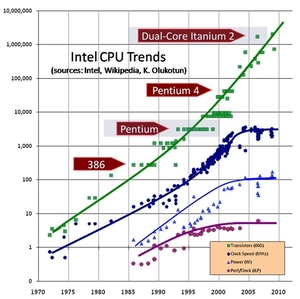
From the first of a series of articles by Memeburn’s Graeme Lipschitz explaining why Moore’s Law (which states that the performance of semiconductor chips doubles every two years) – tied in with Kryder’s Law (which states that storage space doubles and its cost halves every 14 months) – no longer applies.

The improvement in chip speed, storage space and even pixel size in digital cameras has left an indelible effect on the global economy. Well, apparently, that’s all going to end: we’re hitting the limit of the number of electrons that can fit in a certain area.

It’s all down to May’s Law, apparently.

But you knew that.

The End Of Moore’s Law: A Brief History (Graeme Lipschitz, Memeburn)

Theoretical physicist and Jedi master Michio Kaku explains it all rather well.

(Hat tip: John Gallen)


Behold: the government’s proposed new performance-measuring points system for civil service managers who, according to an internal review, fail to manage (and erroneously promote or reward) sub-standard staff.

You at the back. Pay attention there:

The system involves a sliding five-point scale. Five points is “outstanding”, four points “exceeds the required standard”, three points is “fully acceptable”, two points “needs improvement”, while one point is “unacceptable”.

The expert group that drew up the scale anticipated that – based on other organisations – up to 10 per cent of staff would score a single point, while up to 20 per cent would score two points.

However, an internal review of the system found a majority of civil servants – 65 per cent – were awarded between four and five points by their managers during 2010.

In contrast, just 1 per cent of staff were assessed at between one and two points.

Meanwhile, eh, only yesterday.

Senior civil servants to face sanction for failing to manage staff (Irish Times)

pic