Tag Archives: refugees

CZkCfoxWcAAQ_CY CZkLDNkWQAEdrkp

This morning.

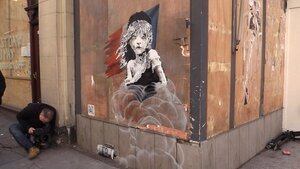
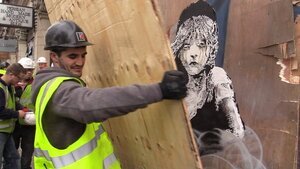
A new Banksy outside the French embassy in London – depicting the tear gassing of refugees at the so-called ‘Jungle’ in Calais – being covered up.

Banksy’s artwork included, for the first time, a QR code beneath it – allowing viewers to link to and watch an online video of a raid on the camp by police on January 5.

Related: Banksy’s new artwork criticises use of teargas in Calais refugee camp (The Guardian)

Previously: ‘We’d Settle For Animal Rights’

Via Jon Scammell

Screen Shot 2016-01-21 at 18.48.36


Passport Control at Dublin Airport

Last month, on December 15, the Minister for Justice Francis Fitzgerald told the Dáil the following number of people, of certain nationalities, were refused permission to enter Ireland last year – and subsequently deported: Syrian 59; Afghan 139; Eritrean 11; and Iranian 44.

In addition, Ms Fitzgerald stated:

“I would advise the Deputy [Padraig Mac Lochlainn] that persons refused leave to land and who are subsequently removed from the State are returned to their point of embarkation, which in most cases is within the EU. I would point out in relation to the countries concerned that no commercial direct flights to Ireland are available from these countries.”

Further to this, the CEO of the Irish Refugee Council Sue Conlan has released a statement this evening, saying:

“It is unfortunate that the State refuses leave to land to nationals of these countries during the greatest refugee crisis since World War II. According to the United Nations High Commissioner on Refugees, 75% of Syrians and Eritreans require international protection, which suggests that the State potentially turned away some 50 refugees from its borders last year. Nationals of Afghanistan and Iran are also likely to be fleeing persecution. We regret that they were refused leave to land and not admitted to the State to have their protection needs assessed.”

People are refused leave to land in closed rooms in airports. They are refused leave to land in circumstances where they have no access to lawyers or legal information, no clarity around their rights. An estimated 3,000 people [in total] were refused leave to land in Ireland last year, about the same number who applied for asylum. The Irish Refugee Council spoke with a very small number of those. What we heard concerns us. We call on the Minister to release the full details of refusals of leave to land not only of these nationalities but of all nationalities and to provide greater clarity around the process.”

Refusals of leave to land are alarming, says Irish Refugee Council (IRC)

Previously: Pawns In The Game

Choice Would Be A Fine Thing

Mark Stedman/Rollingnews

Screen Shot 2016-01-19 at 12.17.32

Front page of today’s Irish Times

The EU’s refugee relocation programme – which was to relocate 160,000 asylum seekers from Greece and Italy in two years from September 2015 – is moving at a glacial pace.

The Irish Times today reports on Ireland’s involvement in the scheme.

A front page report  headlined, “‘Very low’ take-up of EU refugee programme in Ireland – Only 20 asylum seekers have applied to Ireland so far as part of relocation plan’ may imply that asylum seekers currently waiting in Greece and Italy are able to choose the country in which they would like to live.

Like picking a holiday location.

However…

CZDSI_wWEAEsBWb

According to  the European Asylum Support Office states (above) in a brochure for asylum seekers :

“It is not possible to choose the country to which you are relocated.”

Further to this:

Screen Shot 2016-01-19 at 12.49.10Screen Shot 2016-01-19 at 12.53.37

Previously: Pawns In The Game

Thanks Subpri.me

UPDATE:

The Irish Times has updated its headline…

Screen Shot 2016-01-19 at 16.19.01

Screen Shot 2016-01-18 at 11.41.54

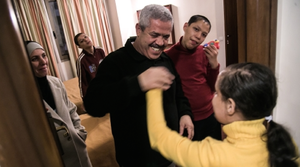
Mahmoud Khelife with his wife and children in Athens, Greece

Last September, the EU announced that it would relocate 160,000 refugees from Greece and Italy to other countries in the EU over the following two years.

But just 272 people have been relocated in the past four months.

Further to this, journalist Andrew Connelly, currently in Athens, Greece, writes:

Austria has suspended its participation in the relocation scheme, hardliners Hungary and Slovakia are challenging the numbers they are supposed to receive in court, and Denmark and the UK opted out from the beginning. Overwhelmed Sweden has reversed its involvement, asking to be a sending rather than a receiving country.

Refugees themselves have been ambivalent about the scheme or simply don’t know about it. Only six nationalities are eligible: Syrians, Iraqis, Eritreans, Yemenis, Bahrainis, and Swazis – based on the high percentage of asylum seekers from those countries who receive refugee status in the EU. Afghans, who represented around 20 percent of Europe’s refugee arrivals in 2015, are notably absent from the list as their likelihood of getting refugee status is well below the 75-percent threshold required for the programme.

[An Iraqi-Kurdish journalist and former producer for Sky News Arabic who fled Iraq] Aral Kakl says those who do qualify for relocation often wait for weeks, only to be told they will be sent to, for example, Cyprus or Bulgaria – countries they know nothing about. Many subsequently opt to leave the hotel and make their own way to a country of their choice.

Mahmoud Khelife – a 53-year-old electrical engineer from Aleppo – and his wife have three teenage children who all have severe learning difficulties. Abdul Malik, 16, Aya, 18, and Mohammed, 19, bounce around the confines of the family’s hotel room. After 47 days, they are still waiting to be accepted by a country for relocation.

My dream is to go to Ireland,” says Khelife. “I hear the doctors are good there, and they speak English. But no problem – I just need an answer from any country soon. I’m an old man. It doesn’t matter about me. It’s all about my children. Where will they go? They need special treatment.”

Failed EU relocation plan leaves refugees in limbo (IRIN, Andrew Connelly)

Pic: Nicola Zolin

Earlier: Sex Crimes And Refugees

CX-h0LEWEAAZjEr

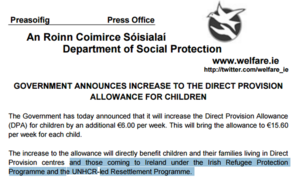
A press release published by the Department of Social Protection last night and a tweet by the Irish Refugee Council

Last night the Department of Social Protection officially announced – and published a press release – that the weekly allowance for children seeking asylum is to be raised by €6 from €9.60 to €15.60.

This has already been reported.

However, in addition to the increase benefitting young asylees – who are in the process of seeking refugee protection – the department also said that the increase will also benefit “those coming to Ireland under the Irish Refugee Protection Programme and the UNHCR-led Resettlement Programme.”

It’s understood that the people who are being relocated to Ireland under this programme – such as the group of Syrians who were brought to Clonea Strand Hotel near Dungarvan before Christmas –  have been predetermined as refugees by the UNHCR.

And once a person is recognised as a refugee in Ireland, they are entitled to apply for social welfare payments on the same basis as an Irish citizen.

Anyone?

Government announces increase to the direct provision allowance for children (Welfare.ie)

Previously: Institutionalised

A Wintry Welcome

The Institutionalisation Of 1,818 Children

Thanks Subpri.me

UPDATE:

In response to the increase…

Tanya Ward, Chief Executive of the Children’s Rights Alliance and member of the Working Group on the Protection Process, says: “As a member of the Working Group, I was deeply upset to witness first-hand the poverty that children in direct provision must endure. This increase – which will barely cover the cost of a bottle of Calpol – can only be seen as a gesture of goodwill. Our welcome is given with a strict proviso that the full increase to their payment be secured in the short-term.”

June Tinsley, Head of Advocacy at Barnardos, says, “While any increase is a move in the right direction, it is difficult to see the justification for such a paltry increase – less than a third of what the working group recommended and still far short of what they need. The direct provision system is no place for children and this increase will do precious little to change that. It must be abolished.”

Grainia Long, CEO of ISPCC, says, “ISPCC staff have worked with families in Direct Provision and seen the hardship caused by the inadequate level of financial support. We’ve heard from mothers trying to save an extra egg to bake a birthday cake for a child, and from children who have never known anything other than basic conditions in institutional settings. The modest increase from ministers is welcome, but it falls short of what children need, and will ultimately mean that children in Direct Provision remain woefully unsupported by the Irish state in 2016.”

Screen Shot 2016-01-04 at 01.58.19Screen Shot 2016-01-04 at 01.39.41

Hundreds of thousands of lifejackets in a makeshift dump outside Eftalou, northern Lesbos in early December; and former chair of Goldman Sachs International and UN Special Representative for Migration, Peter Sutherland

Just before Christmas, Ireland’s former Attorney General and the current United Nations Special Representative for International Migration Peter Sutherland criticised the European Union for its response to the refugees and migrant crisis

During a speech, entitled ‘Migration – The Global Challenge Of Our Times’, at the Michael Littleton Memorial Lecture at the RTÉ Radio Centre on December 17, Mr Sutherland, said: “Ruinously selfish behaviour by some member states has brought the EU to its knees.”

In addition, the Irish Times reported:

‘On the way forward, Mr Sutherland said EU member states would be wise to take a “bold step” towards a single European border agency and, eventually, a single European asylum agency. Europe had to properly fund organisations such as the [UN’s] World Food Programme, which was feeding refugees in sprawling camps in Jordan, Lebanon and Turkey. He said it was immoral that the only pathway Europe offered to desperate refugees to access protection was to cross the perilous Mediterranean at great cost and risk of death.’

Indeed.

There are 2.2 million Syrian refugees registered in Turkey – 250,000 to 350,000 of whom are living in Government-run refugee camps, with the remaining Syrian refugees living in Turkey left to fend for themselves without access to legal employment.

In 2014, Amnesty International reported:

“According to Turkish government sources, only 15 per cent of Syrian refugees outside official camps receive assistance from humanitarian agencies and organisations. The need to provide basic food and shelter means that families resort to desperate measures to try and make ends meet – even putting their children to work.”

There are also approximately 230,000 asylum-seekers from other countries in Turkey while Lebanon and Jordan are hosting 1.1 million and 633,000 Syrian refugees respectively.

The UN World Food Programme (WFP) – referred to by Mr Sutherland in his speech – is described as the ‘food assistance branch of the United Nations and the world’s largest humanitarian organisation addressing hunger and promoting food security’.

In September of last year, the Guardian reported that the UN’s humanitarian agencies were “on the verge of bankruptcy and unable to meet the basic needs of millions of people because of the size of the refugee crisis in the Middle East, Africa and Europe”.

It reported:

The deteriorating conditions in Lebanon and Jordan, particularly the lack of food and healthcare, have become intolerable for many of the 4 million people who have fled Syria, driving fresh waves of refugees north-west towards Europe and aggravating the current crisis.”

“This year the World Food Programme cut rations to 1.6 million Syrian refugees. The most vulnerable living in Lebanon now only have $13 to spend on food each month, a figure that the WFP warned would leave refugees vulnerable to recruitment by extremist groups. “

In the same Guardian article, it was reported that the UN only received $0.9 billion of the $2.89 billion it requested for its Syria Regional Response Plan.

It explained:

“The majority of the UN’s humanitarian work is funded entirely by voluntary donations from individual governments and private donors, with agencies such as the UNHCR and Unicef receiving none of the regular budget that member states pay into the UN’s central coffers.”

[UN high commissioner for refugees, António] Guterres is leading calls from within the UN to change this system and ask member states to make more regular payments to the main agencies.”

More recently in a TED talk, Mr Guterres said the sharp increase in refugees arriving in Europe in 2015 was largely prompted by the dire conditions facing refugees – particularly in Lebanon and Jordan – which were, in turn, largely due to lack of UN funding.

He said:

“The living conditions of the Syrians in the neighboring countries have been deteriorating. We just had research with the World Bank, and 87 percent of the Syrians in Jordan and 93 percent of the Syrians in Lebanon live below the national poverty lines. Only half of the children go to school, which means that people are living very badly. Not only are they refugees, out of home, not only have they suffered what they have suffered, but they are living in very, very dramatic conditions.”

“And then the trigger was when all of a sudden, international aid decreased. The [UN] World Food Programme was forced, for lack of resources, to cut by 30 percent food support to the Syrian refugees. They’re not allowed to work, so they are totally dependent on international support, and they felt, “The world is abandoning us.” And that, in my opinion, was the trigger. All of a sudden, there was a rush, and people started to move in large numbers and, to be absolutely honest, if I had been in the same situation and I would have been brave enough to do it, I think I would have done the same.”

Such cuts in funding could explain the following.

Between January 1, 2015 and November 14, 2015, an estimated 387,340 people had arrived on Lesbos via rubber dinghies – with the vast majority of these people arriving on the north of the island and spending a night there, in ill-equipped transit camps, until travelling down to Mytilene in the south for registration the following day.

Since November 29 – when the €3billion EU/Turkey deal was struck – the majority of boats arriving on Lesbos have been arriving on the south of the island.

When people arrive off boats they are generally soaked, very cold and their few possessions are either also soaked, and therefore abandoned, or were lost at sea. Some arrivals say they haven’t eaten for days.

According to figures obtained from the UNHCR, as of November 13, 2015 – when there were four “roving” UNHCR staff working in northern Lesbos – the UNHCR had provided the following by way of food, blankets and clothes in the area:

50,400 high-energy or sesame bars. These included 19,600 high-energy bars in Skala Sikaminias; 12,300 high-energy bars and 3,600 sesame bars in Molyvos; and 14,900 high-energy bars in Mantamados. They were distributed via their partner groups Starfish, MsF, Eurorelief, Samaritan’s Purse and the International Rescue Committee.

16,390 blankets. These included the distribution of 2,810 blankets in Mantamados, 3,605 in Skala Sikaminias and 9,975 in Molyvos.

1,913 raincoats. These were distributed in Molyvos.

The UNHCR spokeswoman said:

“UNHCR has significantly ramped up its presence in Lesvos and UNHCR staffing is being increased. Thirteen additional staff have been deployed, many speaking the language of the refugees, and bringing the total staff on Lesvos to 30. As you are aware, the situation is very challenging in all areas. At the North, new arrivals neither stay nor get registered by the Greek authorities. Thus, it is important for us to also focus in providing them protection and assistance the accommodation/registration sites near Mytilene, where people stay for a longer time than in the north.”

“UNHCR staff engage in a range of activities. Among others, they provide information to the new arrivals as regards the situation on the island, the processes that they have to go through, their rights and responsibilities…”

Alessandra Morelli, regional operations chief for the United Nations High Commissioner for Refugees, recently spoke of her appreciation of the efforts of volunteers on the island of Lesbos, telling the Wall Street Journal: “Everyone recognises [the volunteer efforts]. But “now it’s time to bring professionals.”

Further to this.

In an open letter to the former chairman of Goldman Sachs International, Mr Sutherland – that has been circulating on social media and Reddit in recent days – a man called Patrick Holland writes:

“This refugee problem was brought about by the so called policy of ‘regime change’ favoured by some members of the US government and their lobbyists and the military-industrial business people, banking and big oil interests, including the neo conservatives…”

“Massive amounts of money are being made from these wars, supplying all sides of the conflict. Many newspapers report increased revenues and profits for military industrial interests and large banking interests which are involved in these conflicts in the Middle East. Several of these neo conservatives, lobbyists and military-industrial business people, banking and oil interests, are personal friends of yours, Mr Sutherland, you have met them in Bilderberg meetings, Trilateral Commission meetings, European Roundtable meetings, Goldman Sachs meetings, BP meetings, and WTO meetings.”

“You should get these people to stop their wars, stop their game playing in the Middle East. Use your influence, your power, your position, the press and media, your political connections, and your Goldman Sachs, Bilderberg and Trilateral connections to do this. This would help end the refugee problem…”

Selfishness on refugees has brought EU ‘to its knees’ (Irish Times)

Related: The Syrian opposition: who’s doing the talking?Charlie Skelton (The Guardian, July 12, 2012)

Previously: In Their Backyard

Sam Boal/Rollingnews.ie

clonea-strand-hotel

Clonea Strand Hotel outside Dungarvan, Co. Waterford

Last night, RTÉ reporter Frances Shanahan, on Drivetime, broadcast a piece on the 32 Syrian refugees who are now living in Clonea Strand Hotel near Dungarvan, Co. Waterford – where they’re expected to reside for six to eight weeks.

The hotel had been closed for some time but was reopened for the Syrian families and their children, after the Department of Justice did a deal with the hotel’s owners.

The Syrians arrived in Ireland last Thursday, after travelling from UN camps in Lebanon.

Ms Shanahan spoke with several people from the area, including local [Independent] councillor Seamus O’Domnhaill – who felt Clonea Strand Hotel is too isolated a location for the families.

Cllr Seamus O’Domnhaill: “Clonea is four miles from Dungarvan town. It’s a seaside place. Step out from the hotel and you’re on the beach.”

Frances Shanahan: “A lovely place to be in the summer, a gorgeous place for holidays but in the middle of winter with the rain pouring down, is this a suitable location for refugees?”

Cllr O’Domnhaill: “No it’s not a suitable location. Now, I’m not against the refugees. The problem with the refugees is we have no shops here, in Clonea. There’s no transport out of Clonea and what I’m worried about is how will they get around from A to B. That is my problem.”

Shanahan: “You think they’re very isolated here?”

Cllr O’Domnhaill: “Very isolated. I’m kind of surprised that they’re coming in there at all actually and that the Government would allow them to be there…”

Shanahan: “Well they’re staying in a hotel which, you know, was closed. So it’s good business for the hotel.”

Cllr O’Domnhaill: “Well I suppose it’s business for the hotel but in my view it wouldn’t be for the local people, it wouldn’t be good business for them because we have a huge caravan site just here, at the back, I’m afraid he’s going to be affected in a very big way with these refugees. It will effect tourism coming in as well. Now I’ve spoken to quite a number of people and they say that the refugees in Clonea, that they will not be coming in there.”

 Shanahan: “Is there no welcome for the refugees in Co. Waterford?”

Cllr O’Domnhaill: “Well, in my view, we don’t know anything at all about them. And I’d be worried about that part.”

Shanahan: “And is there any way of finding out about them? Or making contact and extending a welcome to them? To help them in some way to integrate?”

Cllr O’Domnhaill: “I do not know because it’s quite a bit out from Dungarvan and they have no English, I suppose, and they’ve no bit of Irish, they’ve nothing. I believe they have chefs laid on for them here in the hotel and they have interpreters and they have psychologists and so on but that’s not much good to them either, is it?”

Shanahan: There’s nobody to liaise with  the local community, or introduce them?”

Cllr O’Domnhaill: “No, there’s nobody around here who’d be able for the like of that.”

Good times.

Listen back in full here

CV2u4YkWoAAh2y7

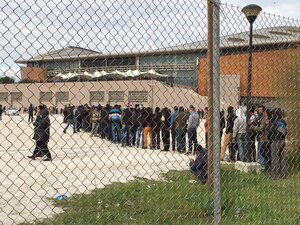
Refugees, who were forcibly returned from Idomeni at the Greek/Macedonia border to Athens on Wednesday night, queue for food outside Tae-Kwon-Do Stadium in Athens on Thursday morning

After spending Autumn working with refugees arriving in Lesbos Broadsheet’s Olga Cronin returned to the Greek island this week.

Olga writes:

On Sunday, November 29, the EU struck a deal with Turkey. In return for €3billion, visa-free access to Schengen zone countries for the citizens of Turkey and a speeding up of the process of allowing Turkey into the EU, Turkey promised to stem the flow of refugees travelling from Turkey to the Greek islands.

The agreement was made as high numbers of people seeking refugee protection – the majority of whom are from Syria and Afghanistan – continue to travel from Turkey to Greece on inflatable rubber dinghies.

The number of people who have died this year while trying to cross the Aegean Sea is unknown while, according to the UNHCR, more than 3,440 people have died trying to make the journey across the Mediterranean.

After the EU/Turkey deal was struck, the chancellor of Germany Angela Merkel – named this week as Person Of The Year by Time magazine – said the agreement would help “keep people in the region” and out of Europe.

According to the latest figures from the UNHCR, 768,916 people in total travelled across the sea to Greece between January and December 8 of this year – 58 per cent men, 26 per cent children and 16 per cent women.

A total of 447,958 – or 58 per cent – landed on Lesbos alone.

Chios and Samos islands have seen the second and third highest number of arrivals with 105,691 and 91,243 landing on its shores respectively during the same time period.

Although it’s less than two weeks since the EU/Turkey deal, and fluctuations in the number of people arriving are common – with numbers commonly dropping in tandem with political events such as a visit of a politician or dignitary to an island or Turkey’s recent general election – the UNHCR figures indicate the smugglers, perhaps inevitably, may be changing the route upon which they send people.

The winter weather is also likely to be a factor, but smugglers offer those travelling in bad weather a discount.

The daily number of people arriving on Lesbos island decreased dramatically in just a matter of days, from 2,462 on Sunday, November 29 to 1,337 on Friday, December 4.

Boats are very much still arriving on Lesbos, with the figure rising to 3,231 on Monday, December 7, but the location of where the majority of boats are arriving has changed dramatically from the north of the island – where the Turkish coastguard activity has been most visible to date – to the south.

The coastline of northern Lesbos – just six kilometres from Turkey – is unrecognisable from how it looked just a few weeks ago and volunteers and rescue teams present in northern Lesbos now feel it’s a waiting game in regards to deciding where they should place their efforts.

Gone is the necklace of washed-up bright orange lifejackets along the northern coastline, due to a substantial clean-up operation – with a mountain of thousands upon thousands of lifejackets piled high in a dump outside Eftalou – while the unofficial camps outside Skala Sikaminias and in the car park of nightclub Oxy, outside Molyvos, no longer have the swarms of people huddled outside trying to sleep on cold, muddy ground, often without any shelter or blankets.

The south of the island is receiving more and more boats every day, prompting volunteer and rescue groups to send teams to the south, and volunteer groups to increase their night-time operations in Camp Moria where, as of the weekend, all nationalities must register and where those not from Syria must sleep – often outside, in mud or on a section of pavement, without blankets.

Sadly, the change has come at a time when the north has seen a substantial increase in both volunteers and returnee volunteers arriving.

New infrastructure and provisions have also been put in place.

The International Rescue Committee has built a camp on the so-called dirt road between Eftalou and Skala Sikaminias, equipped with enough tents to provide shelter for 1,500 people and is scheduled to open in a matter of days, while Médecins Sans Frontières and Greenpeace have launched three rigid hulled inflatable boats (RHIBs) – strengthening the huge rescue efforts of the Spanish Pro-Activa Open Arms lifeguard volunteers who have been present on the island since September.

Much like the south of Lesbos, the other Greek islands have also experienced significant change. Chios, which lies south of Lesbos, saw a sudden spike in arrivals from Turkey with the figure jumping from zero on November 28 to 2,139 on November 29 – placing tremendous pressure on the locals who have led the effort to provide for those arriving, along with the skeletal number of volunteers who were present at the time.

Those working at Tabakika in Chios – a freezing cold and rundown former factory building which serves as a Frontex hotspot and where smoking area-type heaters heat the area officers register arrivals while those waiting to register go without – are currently trying to work out how to provide food to those arriving as the prospect of opening a food station has prompted fears of attracting rats.

Refugees waiting to register may leave the camp to buy food in local stores but, for those who don’t have any money, they could face remaining in their wet clothes and living off of water and crackers provided by the UNHCR for up to three days.

A clothes distribution hut is in place in the camp but it is only opened when there are three volunteers present. If there are fewer than three present, as is often the case, men, women and children sitting in wet clothes must remain in them.

Those helping people off boats try to offset this by hurriedly trying to provide dry clothes – mostly donated – from the back of their cars as soon as refugees reach the shores.

Depending on the number of volunteers present at a given time, and what they have in their car at the time a boat arrives, this can amount to just a pair of socks with a small plastic bag in lieu of dry shoes.

In an effort to prevent – in children especially – hypothermia, volunteers hand these little bundles out, telling people to take their wet shoes and socks off, to place the dry socks on, followed by the plastic bag, and to then put their feet back into the wet shoes.

A bus system is in place in Chios whereby, once a boat arrives, volunteers can call for a  bus – which is organised by the local authorities – to come and collect people and take them to Tabakika. The police running the buses charge €3 per adult while children on the near 60-seater coaches can travel the 10-minute or so journey for free.

After registering, refugees can go to a makeshift camp set up in the shadow of the Castle Of Chios, called Souda, to sleep. Just a few minutes’ walk from Tabakika it is equipped with two 250-capacity tents and multiple IKEA shelters. Souda is cleaned daily.

On Samos, between November 28 to 30, the number of arrivals rose from zero to 517 while Kos saw the number of arrivals rise from less than 50 on November 29 to 229 on November 30, rising again to 378 on December 7.

Leros also saw the number of arrivals rise from zero on November 28 and 29 to 264 on November 30.

In the meantime, as the number of arrivals from Cesme in Turkey to the shores of Chios rises, so does the death toll.

On Tuesday, it was reported that six children, including a baby, died when a dinghy – believed to have been bound for Chios – capsized off Cesme.

Separately, it was reported Wednesday that at least 11 people, including five children, drowned and 10 are missing after a boat sank off Farmakonisi island.

But change isn’t only afoot on the Greek islands.

On Wednesday night – the eve of the 67th anniversary of the United Nations General Assembly adopting the Universal Declaration of Human Rights which states that “everyone has the right to seek and enjoy in other countries asylum from persecution” – approximately 2,400 refugees were rounded up and forcibly put on buses in Idomeni, at the border between Greece and Macedonia, and sent to Tae-Kwon-Do Stadium in Athens.

The move followed several weeks of authorities only allowing the citizens of Syria, Afghanistan and Iraq to pass through the border, putting a blanket ban on those from other countries and prompting smugglers to offer those stranded other methods of getting further into Europe.

The ban disallowing those not from Syria, Afghanistan and Iraq to pass forced them to camp out in squalid conditions while some sewed their lips shut in protest. Last week a Moroccan died after he was electrocuted. It’s been reported he had climbed on top of a train carriage when he came in contact with electric cables.

It’s also been reported that, prior to these people being put on the buses, journalists were removed from the area to a place two kilometres away and that some were asked to delete photographs. Volunteers were also removed.

Following the eviction of those at the camp a volunteer in Idomeni wrote on the Facebook page, Forgotten In Idomeni:

“When the camp was re-opened, it was clear that people didn’t have time or weren’t given the opportunity to gather possessions. Refugees reported from inside the camp that people were dragged from tents and some were beaten. Others gave up and left peacefully. All hope lost.”

After refugees register on the Greek islands, Syrians are given a document which allows them to stay in Greece for six months while all other nationalities are given a document which orders them to leave Greece, or return home, within 30 days.

Many of those who had been in Idomeni were there for three weeks meaning their deadline to move is fast approaching.

Different treatment for different nationalities isn’t uncommon in Greece.

In Lesbos, only Syrian families can sleep in a camp near Mytilene called Kara Tepe – which has facilities much more favourable to those provided at the barbed wire-fringed former prison that is Camp Moria, just two miles from Kara Tepe.

As thousands of refugees continue their journey from the Greek islands, via ferries, to Athens and more and more buses return from the border with Macedonia to the Greek capital, many long-term volunteers and solidarity groups on the islands – who are largely dependent on the testimonies of other volunteers via Twitter and Facebook for details of events on the ground – are starting to feel that perhaps Athens will be their next stop.

It’s likely smugglers feel the same.

Previously: A Drop In The Aegean

Don’t Look Away

Letter From Lesbos

Pic: Daphne Tolis

Related: Smugglers are least bad option for border returnees (IRIN, Andrew Connolly)

Screen Shot 2015-10-12 at 14.48.34

Human rights activist Bairbre Flood, from Cork, is just back from the refugee camp in Calais, France.

She writes:

The French are out walking their dogs every evening. We see them on the streets minding their dogs while, some miles down the road, people are living and dying in the camp. Will they say they didn’t know what was going on when their children ask them? Will we say we didn’t know what was going on when our children ask?

Driving through Calais on the first night, groups of men walked through the shuttered town on their desperate mission to jump the train and find refuge in England. Ghost-like, from another world, their faces exhausted and determined. Many of these people will fall off the trains, sucked up into the tunnel and forgotten by all but their friends and family who see this happening and still have to go on. Why would someone risk life and limb to get to England?

A man from Afghanistan showed me a scar from his wrist to his elbow which he’d gotten trying to jump the train. ‘I’m not trying anymore. I will stay here for now. I’m here 6 months, but I can’t go home. The Taliban will kill me, it’s too dangerous to go home.’

He was clearing an area to set up a café on the camp. Whenever we passed that day he was clearing rubbish, filling in soil. He told us the Irish could eat there anytime, for helping him clean up the space. ‘I have to do something or I’ll go crazy.’ He had soft eyes, a warm face. His friend started talking to us.

‘When I was 12 my father sold our land so we could escape. When he was coming back he was robbed and murdered. Since then I’ve been wandering. I got to England and worked there, but they arrested me one day and deported me back to Afghanistan.

‘I came all the way back here, walking for months. In Hungary they beat me and put me in jail, but I know how to get around.’

He took a drag from his cigarette and grimaced. He must have had some creativity and strength to survive even this long. I thought back to when I was 12 and what I would have done. I don’t think I’d have lasted a year with all that’s stacked against ‘migrants’ in this Dickensian parallel universe.

We heard many stories of horrendous boat journeys, months walking across Europe – detained in each country, sometimes jailed or beaten by police. And then arriving in Calais to absolute neglect.

Apart from citizen aid, they would have nothing at all. As it is, there are few toilets (overflowing), E.coli in the couple of water taps, rubbish piling up and sporadic food/clothes distributions. There’s also incredible people who’ve built a library, a church/community centre, cafés, shops and restaurants – again, the creativity and strength of the people living here is mind blowing.

Suzanne’s café is a little oasis.

‘I want it to be somewhere people feel safe and can relax,’ Suzanne’s husband tells us. ‘We came by boat from Libya. It cost thousands for the boat trip, but we had to do it. We couldn’t stay.’

They brought out sweet coffee and tea while we were talking. Everywhere we went, people offered us water, tea, coffee, food, whatever they had – which was often almost nothing.

This generosity and welcome is in stark contrast to how the French authorities treat them. On the first day there, some of our team came across the police pepper-spraying women crossing a bridge. They leaned out of the squad car and sprayed right into their faces, just as these women were walking. You can see in the video, above, it was a completely unprovoked attack.

We also heard first-hand stories of beatings by the police, dogs being set upon them and detention and torture in cells.

‘We’re in the 21st century, but David Cameron is in another age.’ one Sudanese man said to us, ‘Why does he do what he does? He’s a donkey. Every night I go to the train. They took the muzzle off the dog, they beat us. Our sisters fall, they’re electrocuted, we are being killed.’

His friends stand around and shake their heads, they all ask us why we don’t want them.

We came back to Ireland after just four days on camp. None of us wanted to leave. It’s hard to describe the feeling of leaving people to this existence, of knowing what’s going on right in the heart of our so-called democratic continent. The trucks continue their journeys safely and people are trapped or attempting dangerous escapes.

‘We don’t even want human rights at this stage,’ one guy told us, ‘We’d settle for animal rights. The way you treat your dogs, we’d be happy with that.’

Ireland Calais Refugee Solidarity

Bairbre Flood

Meanwhile, free Thursday night?

CRH8BcjWgAAnQVi

You can buy tickets online for €10 here

Thanks Sarah Peters