
Tag Archives: RTE

Hawkes
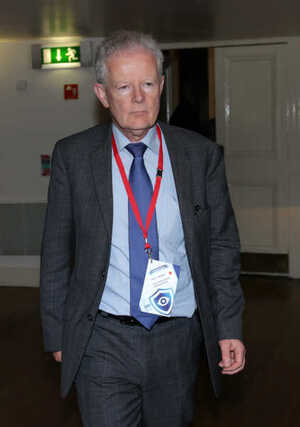
[Data Protection Commissioner Billy Hawkes at the Institute of International European Affairs’ Cybersecurity conference at the Manison House in Dublin last November]

Data Protection Commissioner Billy Hawkes spoke to Richard Crowley on RTÉ News at One, following the publication of his office’s audit of data protection in An Garda Síochána from 2011 to October 2013.

Specifically, Mr Hawkes told how, during his investigation, he found incidences whereby members of Gardaí – not the whistleblowers Sgt Maurice McCabe and former Garda John Wilson – accessed the Garda profiles of certain ‘RTÉ celebrities’, passed on information to private investigators and also accessed information in the Department of Social Protection.

Richard Crowley: “This report has just been published, it’s rather long. We haven’t even seen the executive summary, so maybe you could do the job for us and tell us what are your main findings?”

Billy Hawkes: “Well the main findings are that An Gardaí are treating personal data as you would expect a professional police force to do so. They have responded to points, weaknesses we pointed out, particularly inappropriate access by members of the force to data and, even worse, disclosure of it, outside of the force. But it’s quite a comprehensive report, it goes through things like how they deal with CCTV, how they deal with suspects, the system of Garda vetting, how that works, so it’s essentially a comprehensive look at all aspects of how An Garda Síochána carry out their duties because, again, obviously personal data is the lifeblood of An Garda Síochána but it’s particularly important that how they handle it respects all of our rights in relation to the data that they hold, so that was a particular focus of it – that basically that we should be satisfied and everybody else should be satisfied that when they give information to An Garda Síochána, whether voluntarily or compulsory, that we should all be satisfied it would be guarded carefully. Only those who have needed to do so would have access to it and particularly won’t be disclosed outside the force.”

Crowley: “But how many members of the force were abusing the system?”

Hawkes: “Again, that’s, we discovered quite a number of incidences, because we did sample tests where people could not justify why they were accessing the records of certain people, including by the way, personalities within RTÉ, so basically there was a need for action there. We’re also, separately, in a separate investigation, we’re also dealing with under our own powers as data protection, we’re dealing with evidence of more active, as it were, disclosure of information from An Garda Síochána to people who have no right to receive it. But that’s a separate issue.

Crowley: “Ok, are you talking about the two whistleblowers? Those that we call the whistleblowers?”

Hawkes: “No I’m not, I’m talking about something entirely different about disclosure from within An Garda Síochána, not in relation to whistleblowers, it’s people who had basis at all for disclosing information to third parties. So..”

Crowley: “Who? What third parties?”

Hawkins: “No, it would be people like private investigators who try to get information from Garda systems.”

Crowley: “And who tried to, or who did?”

Hawkins: “Succeeded.”

Crowley: “On how many occasions?”

Hawkins: “Again, again, all we can do is based on a sample of what we’re dealing with, of complaints we’re dealing with. There have been such instances but the important point in this…”

Crowley: “But how many?”

Hawkins: “No, again, cause I mean, all I can deal with is the ones we know about.”

Crowley: “Ok, well, how many do you know about?”

Hawkins: “We know, I suppose all we know about would be a handful of those cases because we’re carrying out a detailed investigation into private investigators and their actions at present.”

Crowley: “But you know that, in all of those cases, the information went to specific private investigators and you know who those private investigators are..”

Hawkins: “Yeah at we’re..that particular investigation is in fact continuing. We have by no means reached the end of our investigation because it’s not only access to the Garda data it’s also access to data for example in the Department of Social Protection, so it’s more, it’s part of a broader sweep in terms of inappropriate access.”

Crowley:Can we go back to PULSE. Are guards giving information to the media?”

Hawkins: “Well we don’t…know they do but we’re not talking about that.”

Crowley: “No, I mean from PULSE now. Are they passing information from PULSE onto the media?”

Hawkins: “No, again, that was not the focus of our investigation.”

Crowley: “Well I know it wasn’t the focus but did you come across it?”

Hawkins:I suspect that there were incidences, and I’d be careful of what I’m saying, where that might have been happening. But, again, since I’m speaking to a journalist, I’m not going to elaborate.”

Crowley: “Now the question we’ve asked, a couple of minutes ago was how many members of An Garda Síochána have abused the system?”

Hawkins: “I don’t know that answer to that because all we could do is sample it because we did find enough for An Garda to acknowledge they had an issue here which they have addressed. They have taken disciplinary action against a number of members of the force and they have also issued clearer guidelines. They are now carrying out proactive audits which they were required to do under a code of practice which we approved for An Garda Síochána a few years back so basically we’re recording broad satisfaction with the actions they’re taking but we are going to follow up on an action plan which An Garda Síochána are putting in place to make sure that the recommendations we’ve made, to which they’re committed to, are actually carried out.”

Crowley: “But each time a guard signs on to the PULSE system and accesses specific information about a particular individual does that leave a footprint, do we know that he or she has been there?”

Hawkins: “Yes we do and that’s greatly to the credit of An Garda Síochána, they do have proper auditory rules, so you can know which member has accessed the particular record and…”

Crowley: “So then you should be able to tell me how many gardaí have abused the system surely?”

Hawkins: “No because again the people may have a, obviously the gardaí needs access to the records of people on a daily basis and it’s a question of, for example, if there’s an unusual pattern of access, if there’s no obvious reason of why a garda in one particular region is accessing data from a region other than his own. That’s where issues arise and what the gardaí have committed to is to carry out audits, which they are carrying out, to detect that sort of pattern. They have found cases where it has been happening and they’ve taken disciplinary action. So we want the message to go out, within the organisation, that that should not happen and there’s a high risk you’ll be caught if you actually are inappropriately accessing, or worse, disclosing information, outside An Garda Síochána.”

Crowley: “What were the reasons given for the members accessing information about these, let’s call them, minor celebrities and sports people and others. What was behind it?”

Hawkins: “In many cases, it was just curiosity, so there, if you like, there wasn’t anything sinister about it but nevertheless, whether you’re a celebrity or not, if you report something to An Garda Síochána, you have an expectation that it will be treated seriously, it will only be used for the purpose of whatever you’re reporting, whether it’s a burglary, attack or whatever and that it should not be accessed out of curiosity.”

Later:

Crowley: “Are you saying that you find no fault with [Sgt Maurice] McCabe and [former Garda John] Wilson?”

Hawkins: “Oh no, what we’re saying is and I really want to generalise it, because we did in fact specifically support the [Garda Commissioner Martin Callinan] Commissioner in relation to information being disclosed to the Public Accounts Committee. So, basically, our position, and my position as Commissioner, is that having focused heavily, not only in this report but also in our annual report last year on inappropriate access by gardaí to data held on the PULSE system, I had a duty to support the Commissioner when he took the position that once the whistleblowers had discharged, if you like, their moral duty to report malpractice within an gardaí, then there was not a basis for them to continue to access the PULSE system and even less so for disclosing confidential information about people to third parties.”

Listen back here

Read the Data Protection Commissioner report here

Guth

Mairéad Ní Mhaonaigh, of Altan, will try to ascertain why OUR songs are so maudlin’ identifiable in a new six-part RTÉ One series called Guth na nGael: A Thematic Exploration of Irish Song.

Paddy Hayes writes:

“Mairéad explores in each episode what particular hang-ups do the Irish have, what are our pet obsessions, just why is it that all our wars are happy and all our songs are sad. While meeting and jamming with the cream of Irish musical talent, she explores Irish song under the following themes across the six-part series: 1. Home and the Homeland. 2. Rebel Songs and Defiance. 3. Unrequited Love. 4. Spirituality and the Gods. 5. Liquor and Lust. 6. Keening and the Blues.”

FIGHT!

The series features contributions and performances from: Eddi Reader, Mary Black, John Spillane, Wallis Bird, Damien Dempsey, Ger Wolfe, Luka Bloom, Séamas O Beaglaíoch, Eleanor McEvoy, Jimmy Kelly, Gemma Hayes, Karan Casey, Róisín Elsafty, Treasa Ní Cheannabháin, Delorentos, Sinéad O’Connor, the Monks of Glenstall, Nóirin Ní Riain, Liam ó Maonlaí, Julie Feeney, Susan McKeown, Maria Doyle Kennedy, Muireann Nic Amhlaoibh, the Voice Squad and Declan O’Rourke.

No Kila? No watchee.

The series begins tomorrow night at 7.30pm.

Thanks Paddy

corduffs

[Willie and Mary Corduffi, of Rossport, Co Mayo. In 2007, Willie was jailed for his part in anti-Shell pipeline protests and was awarded the Goldman Environmental prize in 2009).

Shell to RTÉ?

Of course you would.

Last weekend’s Airing Erris’ seminar about Corrib gas media coverage organised by the peace and justice group, Afri (Action from Ireland) iincluded an address from former producer/editor at RTE and author, Betty Purcell.

Betty revealed

“in 2009, she proposed and scheduled 21 documentaries and only one, ‘Living on the Edge’, a Would You Believe programme about Willie and Mary Corduff’s life on their farm in remote Rossport, was questioned and challenged by management.
It was even suggested, she said, that because TV3 were about to do a documentary on Corrib ‘maybe we should leave it to them’.
She claimed the pressure on her team was ‘sustained’ and stated her belief that Shell personnel appeared to have ‘automatic access’ to senior management in RTE.”

Corrib coverage ‘infected’ by power of Public Relations (Mayo News)

Watch ‘Living On The Edge’ here

Pic via Goldman prize

davin

“Yeah, I mean, in fairness to the journalist John Mooney, he broke this story, he got a scoop, he did his job, and he published it in the public interest. But it has caused a major problem for the Ombudsman. Because Simon O’Brien knows that he has a major security problem in GSOC, he has at least one mole and possibly more than one mole leaking secret information and details, possibly documents, in an organisation that holds highly secret and confidential information, and it’s been going on for almost a year. And GSOC still doesn’t know if it was under electronic surveillance. And if it was, by whom?”

Paul Reynolds, RTE Crime Corrrespondent on today’s News at One. Full transcript here

davin

“The original newspaper story that sparked this controversy was pretty accurate in its detail, in that it mentioned wi-fi networks, conference phonecalls and so on but it also went on to cite unnamed sources, saying that there was ‘government-level technology involved’. Well, obviously, there doesn’t appear to have been and that raises the question of who leaked the information and, to borrow a phrase from a couple of years ago, who sexed up this particular dossier? And then there’s the question of not telling the minister, understandable perhaps at the time but scarcely credible now that the whole controversy seems to have been nothing more than something of a bottle of smoke.”

David Davin Power, RTE Political Correspondent, RTE, February 11. Full transcript here

Really RTE News?

Really?

REALLY?

REALLY?

Meanwhile…


ShatterDail

Justice Minister Alan Shatter spoke in the Dáil yesterday evening about the reported bugging of the Garda Síochána Ombudsman Commission’s offices during a 5.30pm debate on the matter, saying:

“It is important to say at the outset that the Garda Síochána Ombudsman Commission has informed me that, after an investigation, they concluded that no definitive evidence of unauthorised technical or electronic surveillance of their offices was found. Moreover, they have informed me that their databases have not been compromised. In other words, it has not been established that the offices of the Ombudsman Commission were subject to surveillance. Some public comment has proceeded on the basis that it is an established fact that the offices of the Commission were bugged when clearly it is not.”

“The issue in question arose following a security sweep, in September 2013, of GSOC’s offices in Dublin. I am informed that there was no specific concern which caused GSOC to organise the security sweep, which was carried out by a security firm based in Britain. It was a routine sweep of a nature which had occurred previously. I do not think anyone could argue that it is unreasonable for a body which, of its nature, holds sensitive information to take measures to ensure the security of its communications.”

“I am advised by GSOC that the sweep identified what they refer to as two technical anomalies which raised a concern of a surveillance threat to GSOC. I should emphasise that my understanding is that what was at issue were potential threats or vulnerabilities, not evidence that surveillance had, in fact, taken place. A subsequent sweep identified a third potential issue. There was no suggestion that there was any risk of unauthorised access to the GSOC databases and the documentation on them.”

Kennybug

Taoiseach Enda Kenny, above, also addressed the Dáil, saying:

“So, if you’re asking me ‘was the office bugged, what I’m saying to you, in the words of GSOC that they found, following the investigation, no evidence of sophisticated evidence of unauthorised technical or electronic surveillance of their offices found, I think that’s pretty clear.”

RTE9

RTÉ’s political correspondent David Davin-Power on the 9pm news last night, speaking to Eileen Dunne, from Leinster House.

Eileen Dunne: “David, the focus of this story seems to be changing all the time, where are we tonight?”

David Davin Power: “That’s right Eileen, the focus of this controversy has weaved about a bit but I think tonight it’s settled on the Garda Ombudsman Commission and its handling of events. The original newspaper story that sparked this controversy was pretty accurate in its detail, in that it mentioned wi-fi networks, conference phonecalls and so on but it also went on to cite unnamed sources, saying that there was ‘government-level technology involved’. Well, obviously, there doesn’t appear to have been and that raises the question of who leaked the information and, to borrow a phrase from a couple of years ago, who sexed up this particular dossier? And then there’s the question of not telling the minister, understandable perhaps at the time but scarcely credible now that the whole controversy seems to have been nothing more than something of a bottle of smoke. And then, finally, there’s last night’s statement, which infuriated ministers, aswell as the Garda Commissioner, in mentioning the gardaí specifically. Now the Ombudsman chairman [Simon O’Brien] wanted, in his comments, just to put the gardaí out of the frame completely, saying they weren’t involved in anyway but it had the effect of providing ammunition to people who have always been sceptical and suspicion, suspicious of the Ombudsman Commission. So, plenty of questions, serious questions for the chairman of the Ombudsman Commission to ponder, along with his colleagues. They appear before a Dáil committee tomorrow. They’d want to put in a pretty credible performance and present a united front, if the whole process of rebuilding trust and credibility is to have any chance of success.”

Fitzgerald

Garda Ombudsman Commissioner Kieran Fitzgerald then went on Prime Time with Miriam O’Callaghan, following the news, last night.

Miriam O’Callaghan: “So, Kieran Fitzgerald, the minister today seems pretty clear, there’s no evidence at all that you were bugged. So were you bugged?”

Kieran Fitzgerald: “Miriam, it would be very, very good if we were able to say definitively yes, or definitively no. Unfortunately, the reality of modern surveillance and intrusive surveillance mechanisms, is that it’s very often an inconclusive result. So what we got were credible threats to our own security, we hired consultants, experts, international experts to consider those for us, examine those and test them. At the conclusion of their testing and their sweeps, their security sweeps, they were able to tell us that certain things did not look likely and other things, they could not be definitively sure.”

O’Callaghan: “What were the credible threats?”

Fitzgerald: “The credible threats were three-fold. One was a piece of equipment which was connecting to an external network, a wi-fi device. Now it should have been activated by a password, in actual fact it was activated, seemingly, without the need for a password and transmitting. It did not compromise our data, it did not connect with out internal security. But, having found it, we certainly needed to take it very, very seriously. That was one. The second was more worrying, it was a conference call telephone, a conference call facility that we use, not infrequently,  and that was tested, and the test showed up what we called, in our first report, an anomaly, but it showed up something that gave them cause for concern and their judgement was that the strange behaviour of this device, in response to their test, was such that, it could have been coincidental, it could be accidental, it could be explained away but they rated in their report the possibility of it being coincidental as close to zero.”

O’Callaghan: “And the third one?”

Fitzgerald: “And the third one was a sophisticated piece of equipment that does sweeps of buildings, from an external, it doesn’t have to be in a building, just in the vicinity and that can, if you like, attack mobile phones and mobile devices.”

O’Callaghan: “It sounds like, still, like your statement last night from GSOC which more or less confirms what you’re saying now: you still believe that there could have been bugging of your building and your equipment. And that is not what the minister is saying today.”

Fitzgerald: “Well, we’ve no disagreement at all with the minister and we…”

O’Callaghan: “Well you clearly have…because he came out today saying there was none.”

Fitzgerald: “Well, what the minster actually said was that he had received a thorough briefing from us yesterday and further again today, with his officials and what he said was that we said that there was no definitive evidence of…”

O’Callaghan: “He said actually, just to quote him, he said that what was identified was ‘potential threats and vulnerabilities but there was no evidence that any surveillance had, in fact, taken place’.”

Fitzgerald: “There is no evidence to sugge-to confirm that surveillance has taken place. The minister is absolutely right and we have no, as a result of our briefing to him, we have no disagreement on that topic.”

O’Callaghan: “But on the balance of probability, Kieran Fitzgerald, do you believe you were bugged?”

Fitzgerald: “It is very difficult to say, I mean…”

O’Callaghan: “But what do you believe?”

Fitzgerald: “Well, hold on, Miriam, it would be lovely to be able to say we could be certain one way or another. What we are faced with, at the conclusion of this, is that we could more or less dismiss some of these threats and if you like, on a balance of probabilities, on others, we just do not know. What we have learned though, are the threats to our building and ensure that they no longer exist.”

O’Callaghan: “OK but on one of the anomalies you just mentioned, you said the likelihood, you know, that it’s an innocent thing was remote to zero, the possibility?”

Fitzgerald: “Well that’s what was reported to us, exactly.

O’Callaghan: “So you can’t still believe, or say to me tonight that that would make you believe that there was some form of surveillance.”

Fitzgerald: “Well we cannot definitively, as the minister said and as I’m saying now,  we cannot definitively say that we were bugged, certainly we cannot say that.”

Later

O’Callaghan: “But was it routine, Kieran Fitzgerald? To go to a British firm? To do it in the middle of the night, to do it at weekends, or did something make you do it?”

Fitzgerald: “Can I just say, there aren’t an awful lot of people engaged in this work so the pool of people…”

O’Callaghan: “Ok. But was there something that sparked you to do this?”

Fitzgerald: “If you recall, throughout 2012, we were involved in some serious investigations and we…”

O’Callaghan: “The Kieran Boylan case?”

Fitzgerald: “And we submitted a special report to the Oireachtas, something we very rarely do, something we do only in grave and exceptional circumstances. We were obviously in a state of heightened awareness of our security at that point. And some things appeared in the public discourse that gave us rise to concern, nothing terribly specific but things that worried us and we thought this is a good time to do this.”

Watch back in full here

Buttimer

RTE1

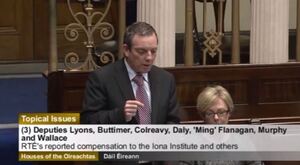
[Fine Gael TDs Jerry Buttimer and Labour’s John Lyons, above]

During Topical Issues in the Dáil yesterday, several TDs, from different parties, expressed their concerns to Communications Minister Pat Rabbitte in relation to the €85,000 RTÉ paid to John Waters and members of the Iona Institute.
Minister Rabbitte responded saying he had “no role in managing editorial matters, making decisions around programming or dealing with litigation claims. I therefore have no intention of interfering in RTÉ’s management of this specific file.”

From the debate:

[Labour TD John Lyons]

“I want to ask some questions in relation to the issue for RTÉ to pay out a reported €85,000, in the time that I’ve left, I want to ask: was there one person in charge of this issue? One point of contact, from the moment that they decided to deal with this issue, until they paid out this compensation? And, on what decision did they decide to pay out this compensation? It’s quite clear Ceann Comhairle from the information I’ve received from various sources that, and including from the managing director in his own press release, where he says that the legal position was far from clear. Well the question I have for RTÉ, here today is, if the position was far from clear and they had various pieces of legal advice given to them over a number of weeks, stating basically that they shouldn’t pay to that they should pay, on what basis did they decide to pay this money out. Finally, Ceann Comhairle, cause I know I’m over time, what I want to say is, I know that the legal advice that RTÉ used, sought to pay out this money, is a privileged position and we are not entitled to it, but I believe there has to be a political will, in the interest of the national public, to find out on what basis they paid this out. Because I certainly believe that RTÉ were wrong to pay out this money on what was, essentially, an anti-gay prejudice issue that people were challenged on. Thank you, Ceann Comhairle.”

Later

“I really just want to say at this stage, because I actually have this one minute left, you know,  there’s two people in here I think at the moment who knows what homophobia feels like, who knows what it’s like to be called a queer, to be called a fag, to be called a gay. Only recently, I think, just before Christmas, I walked from my own house, around the the Centra where a bunch of teenagers called me gay or some other name they call us, you know, I thought, you know I was living in a society where this stuff isn’t acceptable any more. But yet, when people challenge people on these issues and that’s what Rory O’Neill did on the Saturday Night Show: he called it what it is. When it walks like a duck, quacks like a duck, looks like a duck, it must be a duck. And I think RTÉ were completely wrong and bang out of order when they got numerous types of legal advice, saying in fact perhaps that they should not even pursue and give any sort of compensation out. RTÉ got it wrong and everybody in the public knows they got it wrong and RTÉ need to come out and let us know that they got it wrong. Otherwise there will not be confidence in our national broadcaster to mediate any debate with confidence, particularly around issues that affect my life and the people who love me and love all the other people who aren’t treated properly in this society”

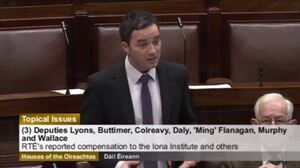
[Fine Gael Jerry Buttimer]

“I do believe, minister, RTÉ were erroneous and were wrong in what they did. I think they folded too quickly and I would like to ask you, who advised, what was the nature of the advice? What was their intent in the advice in terms of their…why did they fold up tents so quickly and were they involved in any other organisations other than advising RTÉ? Our public service broadcaster has an obligation to provide balanced, responsible, fair transmission of social matters and social issues and it must also, as a public service broadcaster, facilitate fair and balanced debate on matters of absolute public importance. And central to this obligation, ceann comhairle, I believe must be an entitlement of those participating on programmes on RTÉ, to voice honestly-held opinions and make fair comment. RTÉ must act as a fair arbitrator and stand by the right of people on its platform, to voice honestly-held opinions, otherwise it acts to undermine its public service remit. And Ceann Comhairle, I contrast, the role of RTÉ in its duty in this case, with what happened in the Abbey Theatre a couple of weeks ago, where the whole issue of homophobia and the whole issue of LGBT rights was fully explored on the stage of the Abbey. Yet you contrast that with RTÉ, where it parked, at the first opportunity, a debate on this. What would happen if we were discussing racism? Would somebody who was accused of racism have to come on and defend themselves?”

Later

“Minister, RTÉ got it wrong, they got it completely wrong and they folder their tent in and in this house, this week Ceann Comhairle, in this Oireachtas, we were  told, as gay people, that it’s a matter of social reengineering by the Gay Ideological Movement, and I’m quoting from a member in the Seanad. And Ceann Comhairle, let me put it on the record in this house, as I’ve done before. I speak here, not just as a gay person but as a member of society who wants to be treated equally. I’ve been beaten, spat, chased, harassed and mocked like Deputy Lyons because of who I am. I was born with a gift given to me and I’ve spent most of my life struggling and finding a place in my own country, which I love, to be accepted and to see the support from my fellow colleagues here in this house, and from you Ceann Comhairle is a demonstration of how our society is gone and come forward. But I will not, Ceann Comhairle, in a tolerant, respectful debate allow people who spout hatred, intolerance to be left go unchecked.”

[Sinn Féin TD Michael Colreavy]

“I could go into debate on what these people have said and written and how it could be identified as homophobic, however I’m willing to rely on Rory O’Neill and his alter ego, Panti, as the leading figure in Ireland’s LGBT movement, to know what homophobia is. I’m a straight, middle-aged man and I won’t pretend that I know how members of the LGBT movement are made to feel everyday when they face articles in newspapers, comments on the radio, abuse on the street and even accusations within the chambers of this institution but what I will discuss is RTÉ’s censorship of Rory O’Neill and the debate surrounding homophobia. The Government has promised a referendum on marriage equality in 2015, following a recommendation by a majority of the constitution convention, to amend the constitution, to allow same-sex marriage. Now, those who publicaly advocate an inequality cannot hide behind defamation legislation when they are called out on their views to seek to gain public support for. The demand of significant sums of public money by such individuals, or group, in place of a right to reply, sets a deeply worrying precedent. Now this country has a poor history of censorship. For many years, some of our great authors suffered at the hands of this censorship board. Section 31 kept republicans such as myself off the airwaves for many years. RTÉ has this tradition of facilitating censorship and as the public service broadcaster, it’s deeply worrying to see this rear it’s head again. It should not be the case that those who call homophobia out for what it is that should suffer the censorship.”

[United Left Alliance TD Clare Daly]

“I don’t know why RTÉ handed over money in this regard because nothing inaccurate was said and that is a critical point. The people and the organisation who benefited from this payout have clearly argued that LGBT people should be treated differently and that is nothing else, other than homophobia. And to call it anything else is in my opinion an abuse of language. Now Brendan O’Connor’s apology remarkably said that it is an important part of democratic debate, that people should be entitled to hold dissenting views on controversial subjects, and that is absolutely the case. But that means that you also have to have the right to express a different opinion on that dissenting view, and call it by it’s proper name and, as Deputy Buttimer said, if someone is known to be a racist, has expressed racist views and we call them a racist are we to then turn around and apologise for calling them by their right name. Now this issue has enormous consequences for Irish society and we, as a parliament, have to send a strong signal that we will not tolerate homophobia and unless this issue is addressed, the only conclusion that people will draw is that, if you have big pockets then you can use them to stifle debate and control opinion and Irish people don’t want to live in a society like that.”

[Independent TD Luke ‘Ming’ Flanagan]

“Hopefully, something good will come out of this. One good thing that has come out of it is that we get people like Michael Colreavy, or myself, from Leitrim, or from Roscommon, who can proudly stand up here and say we want to defend gay rights. Forty years ago, you’d have been worried going home if you did what Michael did here today. And that is massive progress, it really, really is. And the idea…it would be nice if there was no homophobia but pretending there isn’t doesn’t make it all go away. And that speech that was made in the Abbey Theatre explained it so beautifully and the fact that we’re all homophobic, we are. But it’s a case of working on it and trying to learn about the whole situation and fighting against it and, in the end, everyone gets their rights. But, sadly, some people are more homophobic than others and some people don’t seem to make any effort to deal with that homophobia and I think it’s sad that you’re now being denied the right to even use the word.”

[Independent TD Catherine Murphy]

“Ceann comhairle, for the last couple of weeks, some of us have thought we’ve been living in a parallel universe. A huge debate has been taking place online through sites like The Journal, Broadsheet, the Twitter and Facebook, the mainstream media, print media, largely, absent from that debate. The head of television, in RTÉ yesterday, explained to staff why they apologised and paid €85,000, that screams to me of discontent within RTÉ, it’s obvious that many of the station’s personnel know that there are times that defending the principles behind public service broadcasting ranks higher than the fear of litigation. John Waters, Breda O’Brien and the Iona Institute can all be described as opinion formers. They’ve made themselves part of the public discourse, I stress public discourse on such issues as same-sex marriage and frequently present gay people’s relationships as less then, as a starting point. For that to go, without challenge is about setting the parameters of the debate to their advantage and that’s at a time when we’re going to have a referendum next year and I think that that is, timewise, of critical importance. So why the rush by RTÉ to apologise and pay? Was it because they were aware of that those complaining had deep pockets and the ability to mount a credible legal challenge? If so, you must ask the question: how did those pockets get so filled? The second issue is: one of the people making complaints, one of the complaints that came was from John Waters who was then a board member of RTÉ’s regulating body, the BAI. Is it not a massive conflict of interest and was RTÉ under additional duress. Why did the BAI suddenly change their code of conduct on the 22nd of January, the day, the same day RTÉ agreed the payout? Is that the reason John Waters resigned from the BAI, on the 24th? Or did you, minister, ask him to resign? Given the massive payout and the obvious conflict of interest, minister, do you believe, as I do, that he should return that money to RTÉ?

[Independent TD Mick Wallace]

“I too watched Panti Bliss’s speech at the Abbey Theatre and it is powerful, it is very powerful. One would think that RTÉ had an obligation to facilitate free and open debate. In this instance it failed miserably, some people now more offended by the word ‘homophobia’ than they are by homophobia itself. This is censorship. In a press release last week, minister, you said that homophobia is too loaded a term to be used to categorise those who hold contrary views on what is a matter of legitimate public debate. I would like to point out that it is not for heterosexuals to define what homophobia is. We do not have the right to tell gay people what does or doesn’t constitute homophobia. This was eloquently summed up by Panti Bliss in her Abbey Theatre speech last weekend when she said ‘so now Irish gay people find ourselves in a ludicrous situation where not only are we not allowed to say publicaly what we feel oppressed by, we are not even allowed to think it because our definition has been disallowed by our betters. The word homophobia is no longer available to gay people, which is a spectacular, neat Orwellian trick because now it turns out that gay people are not the victims of homophobia, homophobes are’. Does the minister think that these contrary views, as he calls them, have no impact? Does he believe there is no link between discriminatory comments about gay people and physical attacks on gay people? Where does the minister think those that commit physical acts of violence against gay people get their ideas from. To quote Breda O’Brien ‘equality must take second place to the common good’. Does the minister honestly think these words have no impact on gay people?


90195545[Glenn Killane]

“Colleagues,

Over the last week a number of people have approached me questioning RTÉ’s apology to John Waters and members of the Iona Institute following the receipt of six legal complaints and you will, no doubt, have seen the ongoing debate on this subject.
I want to reassure you that RTÉ explored every option available to it, including right of reply. Legal advice was sought and all avenues were explored, including an offer to make a donation to a neutral charity.
However, based on the facts of what was broadcast, and having regard for broadcasting compliance issues, the seriousness of the legal complaints, and the decision by the complainants not to accept RTÉ’s proposed remedies, we decided that a settlement was the most prudent course of action. Senior counsel was consulted and confirmed that the legal position was far from clear.
As a dual-funded public body, RTÉ should not knowingly progress to defend an action when it is advised, internally and externally, that such a defence is unlikely to succeed before a jury.
RTÉ has not engaged in censorship, but has rather fallen foul of Ireland’s defamation laws. The topic reopened over the weekend and RTÉ will continue to cover this and related issues, as evidenced by last week’s Late Debate, coverage of the protest in Dublin city centre on Sunday, today’s item on Today with Sean O’Rourke on RTÉ Radio 1 and last weekend’s debate on the subject on The Saturday Night Show.”

Glenn Killane, Managing Director Television, to telly staff at RTÉ.

Thanks anon.

(Mark Stedman/Photocall Ireland)

OToole
[Fintan O’Toole at the Irish Small and Medium Enterprises Association (ISME) Annual Conference in the RDS last November]

It’s good that most of those who oppose gay marriage love and respect and cherish individual gay people, though they should hardly expect a pat on the back for not hating their fellow citizens. But they need to recognise that that’s not enough.

The whole point of the law is that it’s not about giving people equal status because you like them. It’s about freeing people from subjection to the arbitrariness of other people’s benevolence. Gay men and lesbians shouldn’t have to care one way or the other whether the members of the Iona Institute love them or not. Just as the rest of us shouldn’t measure the rights of our fellow citizens by what they get up to in bed.

Full equality often has to wait while mainstream opinion catches up (Fintan O’Toole, Irish Times)

Earlier: Miss Panti Goes To Europe

Leon Farrell/Photocall Ireland