
Tag Archives: Sean O’Rourke

0009c1c6-531Screen Shot 2016-07-06 at 11.06.30

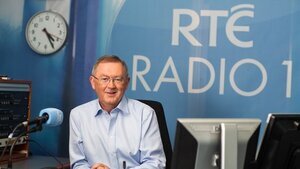
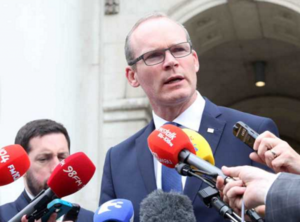
From top: RTÉ’s Seán O’Rourke and Fine Gael Minister for Minister for Housing, Planning and Local Government Simon Coveney

This morning.

RTÉ’s Seán O’Rourke interviewed Minister for Housing, Planning and Local Government Simon Coveney on his show Today with Seán O’Rourke.

They discussed the resignation of Joe O’Toole, from his position as chair of the Water Commission following his comments that people should pay their water charges; Independents 4 Change TD Mick Wallace’s bill on Fatal Foetal Abnormality; and housing.

During the interview, Mr O’Rourke appeared to be particularly riled by the promises made by Independent Alliance TDs Shane Ross, Finian McGrath and John Halligan that they will not vote with the Government and, instead, support Mr Wallace’s bill this week.

He described the three TDs’ actions as driving “a coach and four through the traditionally understood interpretation of the Constitution that’s there in black and white.”

From the discussion…

Seán O’Rourke:Why didn’t you, as minister, say, ‘Joe, you overstepped the bounds of sensitive commentary here, you have to go’ instead of just hiding behind Fianna Fáil or looking over your shoulder at them?”

Simon Coveney: “I’m not hiding behind anything. I’m just telling you the truth. So, like, I’m not putting any political spin on this, Seán.”

O’Rourke: “Yeah but you seem to be suggesting that it would have been OK by you if he stayed.”

Coveney:Yeah. Well I mean I asked Joe to do this job. I think he would have done a very good job. He’s very experienced politically. I think he did make a mistake in terms of being overly forthright in terms of his own views but he was asking, or he was answering questions that he was asked. What he wanted to do was get his own personal views out of the way early and then get on with being an independent and open-minded chair. Which I think he could have done.”

O’Rourke: “Do you know at this stage..”

Coveney: “I’m not going to start putting a spin on this, that I demanded he go or anything. I explained the position…”

O’Rourke: “But maybe you should have…”

Coveney: “Well, I mean, you can decide whatever you want but…”

O’Rourke: “But I’m asking you…”

Coveney: “I asked Joe to do a job. I think he would have done a good job. I was willing to support him through the comments that he’s made in the last number of days because I can understand the context around that. But others weren’t. And the important, this isn’t like a lot of other political decisions that I have to make as a minister. The Water Commission has to have the confidence, in particular of the two big parties that actually put it together in the Confidence and Supply agreement. And, also, I think, I hope it needs to have the support of other parties as well. Some of them would have been campaigning against water charges, who would at least have an open mind to the outcome of that commission report. And you know there was a lot of criticism of Joe because of the comments that he made. But I mean ultimately, you know, if I didn’t have the support of the other major party, that put this proposal together, with Fine Gael, well there was going to be a problem and I’m just being upfront about that, that’s what happened.”

O’Rourke: “So here we are, we have a situation where it’s Fianna Fail rather than you, as the minister responsible for his departure, you also have a situation where, we don’t need to go through it all, where you have partners in Government who refuse to abide by the principle of Cabinet collective responsibility, as outlined in the Constitution or they have refused as well, to accept the advice of the Attorney General. I just have a question for you about the viability and the strength of this Government. I mean, and I’ll put it in maritime terms because I know they’re ones you’re very familiar with, as somebody who is a seaman, but how would you feel about going around the Mizen in a Ford Seat with Shane Ross and company in your crew?”

Coveney: “Look, first of all, can I say that anybody who thinks that politics in Ireland should be politics as normal, as if the Government had a majority which a Government would normally have, doesn’t understand the new realities of politics. We are in a minority government, we’re trying to give leadership in that environment. Sometimes we have to negotiate with Fianna Fail as a main opposition party in areas where we have a Confidence and Supply agreement like on water for example. There are many other areas where we have no agreement with Fianna Fáil. And Fine Gael and our partners in Government will put policy together and we will debate it and implement it and…”

O’Rourke: “And that’s all perfectly understandable but what sure as hell is not politics as normal is where Cabinet ministers can drive a coach and four…

Talk over each other

O’Rourke:Where Cabinet ministers can drive a coach and four through the traditionally understood interpretation of the Constitution that’s there in black and white.”

Coveney: “Yeah and this is not something that should happen often in Government. I mean what we have is…”

O’Rourke:Often? It should never happen, surely.”

Coveney: “Seán, could you let me answer the question. What’s happened here is arguably the most sensitive political issue, which is around abortion, termination of pregnancy in areas or in circumstances where we have a tragic diagnosis of Fatal Foetal Abnormality. And where we have two independent opposition TDs bringing forward a bill that in our view, in Government, is unconstitutional, on the advice of the Attorney General and that is why Fine Gael’s position on this is absolutely clear. We have an agreed Government approach to trying to resolve this issue through a Citizens’ Assembly that will make recommendations that Fine Gael has agreed to have a free vote on at the end of that process, to try and bring a more permanent and real solution to this problem. In my view, what Mick Wallace is doing here is proposing a piece of legislation that will have no effect whatsoever in terms of outcome should it be introduced because it is unconstitutional and therefore won’t work. We have a Chief Medical Officer, to the Government and to the Department of Health, saying that this bill will not work and so, what Fine Gael wants to do is actually address this issue in all of its complexity and have an outcome that can help women who are in crisis. Unfortunately, what’s happened here is there’s a difference of opinion in Government…”

O’Rourke: “Yes but…”

Coveney: “The Independent Alliance, most of their members have already voted for this legislation when it was previously brought before the Dáil a number of months ago…”

O’Rourke: “And that’s all been well rehearsed, that’s well understood minister but essentially what the position here now seems to be, because it is such a sensitive issue, those ministers and members of your partners in Government, be they Cabinet or just beneath Cabinet level, are being told, ‘ok, because it’s so sensitive, you can do that on this occasion’ but they’ve been given a stern warning as to future behaviour but sure nobody will take that seriously.”

Coveney: “Well I think they will take it seriously because if we’re going to have a coherent government, you do need to take collective Cabinet responsibility seriously. And it’s important that the Government sticks together. And I think, you know, with what the Taoiseach said this week and I support him very strongly, you know, in a minority situation, in particular in a minority situation, a Government needs to stick together, you need to have collegiality and a Government needs to take a collective approach but there are circumstances and we have them this week, on an issue like Fatal Foetal Abnormality, and a piece of legislation relating to it where the independents feel that they want the freedom to be able to vote according to their conscience, is what they would say…”

O’Rourke: “Have you got assurances from them…”

Talk over each other

Coveney: “When the work of the Citziens’ Assembly is done and when those recommendations are made to the Oireachtas and when we are voting on those recommendations, at some later point, which won’t be the far distant future, Fine Gael will also have no whip in that situation because people will be allowed to vote according to their conscience…”

O’Rourke: “Right, but just before we move on…”

Coveney: “The difference here is that there is an expectation being built up that, actually, this bill can solve problems for women and, in our view, it can’t which is why we’re voting against it and we’re going to have a process underway that can deal with this in a more comprehensive and more sensible way.”

O’Rourke:Have you, and has the Taoiseach more importantly, got an assurance from Shane Ross that the principle of Cabinet collective responsibility, or collective Cabinet responsibility, will be adhered to into the future after this one-off exception?

Coveney: “Well I think there’s an understanding that this a one-off exception. I don’t think we’re going to have a repeat of this very often. And I think there’s an understanding across the Cabinet…”

O’Rourke:A one-off that won’t be repeated very often doesn’t sound like a very reassuring kind of understanding.”

Coveney: “Well I’m just, I’m just telling you that any, there’s nothing in writing here but I think the Taoiseach made it very clear, the responsibilities that members of Government have…”

O’Rourke: “Yeah, it shouldn’t actually need to be in writing.”

Coveney: “…that is protected by the Constitution and it’s our job as a Government to actually act in a way that’s consistent with the Constitution so, you know, what’s happening this week is not going to be a regular occurrence, I can assure you.”

Listen back to the interview in full here

Previously: ‘If This Is Let Slide, It Will Be Very Serious For The Attorney General’

Screen Shot 2016-07-01 at 12.52.32

Pat Leahy,headshots 5.08.05©tos

From top: Independents 4 Change TD Mick Wallace in the Dáil last night and Irish Times deputy political editor Pat Leahy

Further to last night’s debate on Independents 4 Change TD Mick Wallace’s bill to allow for terminations in Ireland in the case of fatal foetal abnormality – a bill which has been deemed unconstitutional by the Attorney General Máire Whelan.

Pat Leahy, deputy political editor of the Irish Times, spoke to Seán O’Rourke on RTÉ Radio One this morning.

During their discussion, Mr Leahy insisted that, having seen Ms Whelan’s advice, it is ‘utterly unconstitutional’.

He also suggested that if the Government doesn’t accept Ms Whelan’s advice, she may have to step down.

Readers may note that Mr Wallace has called for the advice to be published – to allow for a debate on the advice.

From the interview…

Pat Leahy:At present the Government is unable to reach a collective position on Mick Wallace’s bill which was debated in the Dáil yesterday evening but won’t be voted on until next Thursday. And normally what would happen is with a private members bill like this, the Government would oppose it or not oppose it. But normally would oppose it, put down a countermotion and Government TDs would be whipped into voting for the countermotion or the amendment but, at its meeting last Tuesday, the Government was unable to reach a decision. Now, constitutionally, legally, the Government must act with collective authority. That means that it must, all its members must agree to act and speak as one…”

Sean O’Rourke: “I’ve just happened to find that article 28 in Bunreacht na hÉireann, it says, one, well it says, ‘the Government shall be responsible to Dáil Éireann’ and then, ‘the Government shall meet and act as a collective authority and shall be collectively responsible for the departments of state, administered by members of the Government.’

Leahy: “Yeah. And at present in relation to this issue, the Government is unable to do that. And that’s despite having been advised by its chief law officer and legal advisor, the Attorney General, that the bill that Mick Wallace has put before the Dail is unconstitutional. And I’ve seen that advice, I wrote about it in the Sunday Business Post last year and again recently in the Irish Times, and that advice is utterly unequivocal, it’s not, ‘on the balance of probabilities, this is probably unconstitutional’. It’s completely unequivocal that, it couldn’t be stronger that the bill is unconstitutional. And despite that clear advice, the Government is unable to come to a collective position on that.”

O’Rourke: “Why?”

Leahy: “Because the Independent Alliance members want a free vote. Now it’s my understanding that the Independent Alliance members of the Cabinet are prepared to sign up, if you like, to a collective decision to oppose this bill. But they want to be allowed the right to abstain on it themselves. Now that sounds slightly constitutionally shaky to me but it may be a way out. And, ultimately, if you were to ask me, I suspect that that’s the way out that will be found. As of yesterday, I’m told, that the Taoiseach and Sarah Bardon writes about this in our paper [Irish Times] today, the Taoiseach was absolutely firm that that would be impossible. That having been advised by the Attorney General, the Government must follow his advice and ministers must act in accordance with that advice.”

Later – after Mr O’Rourke played clips of Fine Gael TD Kate O’Connell speaking during last night’s debate and Independent Alliance TD John Halligan speaking earlier today on RTÉ’s Morning Ireland

Leahy: John Halligan gave a very powerful speech last night in the Dáil. Not the first powerful speech he’s given on this subject and there was motions on this in the last Dáil as well and it’s peroration was that he didn’t care what the Attorney General’s advice does, sorry, didn’t care if it was unconstitutional. Anyone who was there last night or anyone who was watching last night, couldn’t have been in any doubt other than he’s certainly, if he’s not going to vote for this, he’s certainly not going to vote against it. I think that presents him with a problem.”

O’Rourke: “Here’s a question and I’m just wondering, I’m no constitutional lawyer but is John Halligan part of the Government in the sense of being part of the Cabinet, he’s not?”

Leahy: “No, he’s not. No, he’s not. He’s not. The Government in the constitution, we use it as a generic term to mean everybody in Government buildings and so forth.”

O’Rourke: “So could it not be said, look he’s not in the Cabinet, so he’s not, he doesn’t have the same constitutional responsibility, we’ll cut him a bit of slack. On the other hand, it’s very bad, is it not, for political discipline?

Leahy: “That deal could perhaps, maybe that’s what happens. But he’s got a slight problem with the programme for Government that he spoke about there and in the programme for Government it says that where the Government reaches a decision that all members and office holders specifically, and he is an office holder, are bound to support that decision. Now, so under the terms of that, under the terms of the programme for Government…”

O’Rourke: “That’s where his difficulty will lie…”

Leahy: “If the Government decides that to oppose this bill, and that depends on the independent ministers in Cabinet, resiling from their opposition to that collective decision being made, then he’s got…but there’s another problem here I think Sean, which is that if this is let slide and the Government does not reach a position on it, I think that’s a very serious situation for the Attorney General, whose advice to the Government is unequivocal. Now if the Government is unable to follow that advice, I think it probably puts her in a more or less untenable position.”

O’Rourke: “You think she might resign if the Government doesn’t stick by and accept the Taoiseach’s insistence, they have to vote against this…”

Leahy:If the Government doesn’t take the Attorney General’s advice on an issue such as this then it would be hard to know what the Attorney General is for…”

Listen back in full here

Previously: ‘You Allow An Unconstitutional Bill On Property Rights But Not Women’s Rights?’

mcw

David McWilliams

Amid a tragic parade of gloomy Europhile pundits [John Bruton, Pat Cox, Alan Dukes and Noel Whelan to name but four] on Today with Seán O’Rourke on RTE Radio 1 this morning, David McWilliams took a more cheerful stance on the Brexit vote.

G’wan McDreamy.

Seán O’Rourke: “I want to go now to David McWilliams, on the line, the economist. David you dissent from a widely held view, among economists, that this is very bad for Britain, very bad for Ireland economically. Just looking at one of the headlines on something you wrote in the [Irish] Independent recently. ‘We will do just fine if there’s a Brexit‘ – how so?

David McWilliams: “The most important thing was to get the result right, OK. There’s no point in analysing the wrong result. So I always believed the British would leave and that was an unusual position in Ireland but not an unusual position if you spent any time working or living in England.

So I think what happened, it wasn’t that I dissented, Sean, in actual fact I believe Official Ireland just got this totally wrong – underestimated the feeling, overestimated their use of propaganda when they deployed it. And, ultimately now, have got to pick up the pieces.

I couldn’t understand why Ireland bet so ubiquitously, Official Ireland that is, Sean, on one result in a two-horse race that we knew was going to go down to the line. We have to have a plan B and Official Ireland had no plan B so..”

O’Rourke: [audible sigh] “Well, we’ll see now…”

McWilliams: “But it’s very important to listen to that Sean. And it’s very important that your listeners are told this: That we had a two-horse race. For whatever reason, Cameron decided go for it, he did. When it became apparent that this was going to be 50/50 or close to it.

We should have a much more nuanced approach, rather than trying to scare people into voting one way. Now I’ll come back to the scare, right.

Every single institution, Sean, that has told us this will be economically a catastrophe, it’ll be detrimental, etc, etc..Every single one of those also told us in Ireland it would be a soft landing eight years ago. Ok?

The IMF, the European Commission, all these institutions that were so confident in the forecast about Brexit got everything wrong on the financial crisis.

So, let’s just stand back a bit. Nobody really knows what is going to happen economically.However, what we do know is that, during this period of uncertainty, some direct foreign investment will be diverted away from Britain because companies might think, ‘well, hold on a second, we’re not going to put, invest there, just in case, we don’t know really what the end result is going to be’.

Now where Sean will that DFI be diverted to? Americans will not stop investing in Europe, via the two English-speaking countries in Europe, just because Britain has said politically ‘we’re out of the EU’. So I suspect we could have a huge opportunity here, actually garner a percentage of that diverted capital and income to Ireland. So rather than assume that the world is going to end, what we know Sean, is that change is the only thing that is constant in life.”

O’Rourke: [faintly audible sigh] “Ok, I’ll come back to you on that..”

McWilliams: “And we’ve got to deal with it…”

O’Rourke: “In a few moments…”

Listen back here

Previously: ‘You Came Out Pretty Aggressive There, Dan’

092044-Patrick-TreacyYFYqU8gV_400x400

From top: Patrick Treacy and April Duff

Further to new proposals that would entail the Deaprtment of Education ‘encouraging‘ the Catholic Church to transfer patronage of primary schools.

Patrick Treacy SC, of new lobby group ‘Faith in our Schools’ and April Duff, chairperson of Education Equality, spoke to Seán O’Rourke on RTÉ Radio One this morning.

Mr Treacy, who runs a ‘domestic centre of Christian spiritually’ called Integritas, in Stoneyford, Co. Kilkenny, argued that he actually wanted more divestment.

Patrick Treacy: “We’re in favour of divestment because we want Catholic schools to be really Catholic, and Protestant schools to be really Protestant. And what we believe is that when parents start to see Catholic schools and Protestant schools really living out the Christian philosophy and understanding…”

Seán O’Rourke: “And are there Protestants in your group?”

Treacy: “Well, for instance, my wife is Protestant and just to say this, I have four children. And my three sons are Catholic and my daughter is  Protestant and we send all of our four children to an Educate Together school and we actually live through the very thing that April is talking about and it’s an absolute superb school in Kilkenny. But the problem is, we know from experience that what April is actually suggesting doesn’t work, it doesn’t work. Because what Catholic schools need to learn from Educate Together, which is a huge gift, that Educate Together give is that they really show you the importance of parental involvement. That’s what we’ve got to bring in, in particular to Catholic schooling. We’ve got to move away from this mentality that the parent is left outside the school gate. The parent has got to come right into the school but the problem is, is  that we need Catholic and Protestant schools to permeate the ethos throughout the invisible pedagogy, so to speak, throughout the entire working day, or sorry, the entire school day, I should say.”

O’Rourke: “What do you say that to that, April?”

April Duff: “I think the main point to make is that we don’t live in an ideal world. And, even if we did, we couldn’t have a Muslim school and a Hindu school and a Jewish school and a Scientology school in every single area where there is one child. So this idea that you have a right to be educated in accordance with a particular religious belief and for that to be the only, the only ethos that’s within that school, just isn’t sustainable because you can’t have that for every single religious belief and every…”

O’Rourke: “So on the basis of that logic then, there should be no schools based on any particular ethos, except where there’s a sufficient population to allow for one  for everybody in the audience, as it were.”

Duff: “No the school should cater for everybody. I mean, remember, the purpose of schools is to educate. We’re talking about education here. These aren’t religious institutions, they’re educational institutions, they’re institutions to educate people. Remember, those schools are paid for by the taxes, sorry, by the taxpayer and people – atheist parents, Muslim parents and Catholic parents – all pay the same taxes. So the schools simply have to accommodate everybody and have to respect religious freedom of everyone. And the current system simply does not respect religious freedom. Because, first of all, you’re penalised in accessing school because, if the school is oversubscribed, you won’t get in unless you have a baptismal cert or if you don’t belong to the right religion. So you’re penalised for the exercise of your religious right at that point and then, once you’re in the school, you don’t have a right to continue your religious belief without another…”

O’Rourke: “OK..”

Duff: “…religion being imposed on you.”

O’Rourke: “Brief response to that, Patrick Treacy.”

Treacy: “Well just to say, unfortunately, there’s been a gross exaggeration of the position in relation to the baptism requirement. The actual position there is that only 1.6% of Catholic primary schools have an oversubscription problem – 3.69% in Dublin. That’s the first thing, the second…”

O’Rourke: “But it doesn’t get away from her substantial point that she makes about what the children are subjected to, if you like – and I know that’s probably a loaded phrase – in the course of the school day.”

Treacy: “Well can I just say this, let’s just be clear about one thing we can all agree on too. The word education comes from the Latin ‘edu cara’. It means to ‘lead out’. Now you either accept that your child is a spiritual being or that your child is not a spiritual being. The vast, vast, vast majority of parents believe that their child is spiritual, all right? So if you want to create a schooling system that denies the spiritual basis of the child, that in my view is not education.”

There you go now.

Meanwhile…

90417634

The debate followed an interview on RTÉ Radio One’s Morning Ireland with Education Minister Richard Bruton.

Mr Bruton spoke about the Government’s plans to transfer patronage of primary schools from the Catholic church.

During the interview, presenter Gavin Jennings reminded Mr Bruton that there are more than 3,000 primary schools in Ireland and 90% of them are still run by the Catholic church.

Mr Bruton said:

We are committed to trebling the rate at which there is new options emerging, with a target of 400 schools which would be, you know, multi-denominational, over the next 15 years. So that would be trebling the rate at which we develop new options for people.”

Mr Jennings also asked Mr Bruton how many Catholic primary schools had been divested so far. Mr Bruton said 11 while Mr Jennings said some reports claim that the figure is just two.

In addition Mr Jennings asked Mr Bruton if schools will continue to be allowed to prioritise pupils on the basis of their religion.

Mr Bruton replied:

“The provision in the existing bill, there’s a lot of valuable things there and I think it’s very important to say what’s in it. It provides that there must be a written policy, it provides that children with special needs cannot be discriminated against, it provides that parents must, you know, be consulted in respect of any changes in that policy. Parents must have an opportunity to review, there can’t be discrimination in different areas.”

“Now the issue of whether an oversubscribed school, that is a religious ethos, can, if you like, choose a child of a religious background over those of a non-religious background, that is a thorny issue which the last committee recognised, raised, you know, difficult Constitutional issues.”

“And I will have to sit down with colleagues in the Oireachtas to discuss how we handle that because we don’t have a majority. There will be different views on how to handle this and indeed whether it can be done within the Constitution. But that will be something that I will sit down and discuss with others in the Dáil so that we can have not just the good elements of the existing admissions bill but have a debate about that issue as well.”

Listen back here

904201169021431500157454

From top: Former Garda Commissioner Martin Callinan; Fianna Fáil TD John McGuinness; Sean O’Rourke

You may recall Fianna Fáil TD John McGuinness’ speech in the Dáil last week in which he stated:

Every effort was made by those within the Garda Síochána at senior level to discredit Garda Maurice McCabe.

The Garda Commissioner confided in me in a car park on the Naas Road that Garda McCabe was not to be trusted and there were serious issues about him.

The meeting between Mr McGuinness and former Garda Commissioner Martin Callinan took place in the car park of the Bewley’s Hotel on the Naas Road in Dublin on January 24, 2014.

This was six days before Sgt McCabe finally appeared in private before the Public Accounts Committee, of which Mr McGuinness was chairman.

The Irish Examiner has reported that it was Mr Callinan who sought the meeting with Mr McGuinness.

Further to this, Mr McGuinness spoke to an indignant Seán O’Rourke on RTÉ Radio One this morning.

Grab a tay…

Sean O’Rourke: “The question is being asked again. I know you spoke on This Week with Richard Crowley about this yesterday. Just to quote to you, the heading on the Irish Independent’s editorial this morning: ‘It’s a bit late telling us this now, Mr McGuinness’.

John McGuinness: “But it isn’t, Sean. The fact of the matter is and I explained this before. That the reason why this is being put it into the public domain now by way of the Dáil debate last week is because Maurice McCabe continues to be questioned. His integrity was questioned by the Garda Commissioner, the context of O’Higgins, and arising from the O’Higgins report, I felt that it was absolutely necessary to make clear that there was and is an ongoing effort being made to undermine individuals like Maurice McCabe and they are fearful of coming forward to give their story. I had to make a decision back then when I met the Garda Commissioner and in my opinion, to put it simply, it was a decision, the lesser evil, for the greater good, because Maurice McCabe then did come forward in full uniform and gave us the evidence that was required to deal with the penalty points issue.”

O’Rourke: “Yes and some…”

McGuinness: “And everybody in the political system, and elsewhere, were against him coming forward.”

O’Rourke: “There was subsequently then a Commission of Inquiry, presided over by Mr Justice O’Higgins, into not just the penalty point issue but other matters. There were 97 witnesses at that commission, were you one of them?”

McGuinness: “No I wasn’t one of them, no.”

O’Rourke: “Did you not think though that you had this vital insight into the thinking, at senior level of Garda management, assuming that your story is accurate, that this should have been brought forward to the Commission.”

McGuinness: “Well that vital insight, as you describe it, Sean, was known across the system within Leinster House…”

O’Rourke: “Oh, what you talked about last week was a very, very specific intervention by the then Garda Commissioner..”

McGuinness: “Oh yes, the intervention was…”

O’Rourke: “And why didn’t you go to Judge O’HIggins and tell him?”

McGuinness: “Because, at that time, the decision had to be made, whether or not we could get Maurice McCabe before the [Public] accounts committee. Efforts were made to stop Maurice McCabe from coming forward and when he did, he did great service and…”

O’Rourke: “But…”

McGuinness: “The evidence was brought before us and we made our conclusions..”

O’Rourke: “But what about the sequence here though. Did, was the Commission not sitting after that appearance at the PAC, by Maurice McCabe?

McGuinness: “Yes but the point I’m making is that efforts were made prior to him appearing before the Public Accounts Committee to stop that appearance. In fact, when we had the evidence it was demanded of us that we would return the evidence to the Garda Commissioner at that time and we decided not to and we then went through a legal process whereby we would examine the evidence and then listen to Garda McCabe in private session. That session was the only session in the five years where evidence of that kind was taken from an individual and the rest came from there. Now at that point…”

O’Rourke: “That’s all, that’s all perfectly logical and people will not have any difficulty in understanding that, John McGuinness, but what they will perhaps have difficulty understanding is why you sat on your hands with this information about a secret meeting in a hotel car park with the then Garda Commissioner which, you say, was set out, was designed on the Commissioner’s part to undermine the credibility of Maurice McCabe. And you say you didn’t go to the, to the O’Higgins Commission with that?”

McGuinness: “It’s necessary, Seán to say this now because of the fact…”

O’Rourke: “But there was a judge of the High Court sitting on all this?”

McGuinness: “The O’Higgins…”

O’Rourke: “You didn’t go there?”

McGuinness: “Yes. otheThe O’Higgins commission has made their report and I allowed that process to go through, believing that Maurice McCabe would be exonerated. Now, what has transpired after that, in leaked documents and so on, is the fact that the Garda Commissioner set out to, it is reported, set out to destroy the credibility of Maurice McCabe and his integrity. And because that happened, I felt that it had to be put on record that this meeting happened and that, during all of this time, there was an effort made, at senior level, within the force, to undermine not only Maurice McCabe but many others who have brought forward vital information into how the whole, sorry, as to how their work is being done. And I point to the Lucia O’Farrell case. You have another case there this morning. But there is the Lucia O’Farrell which, if it was examined, would tell us everything that is wrong with the Garda investigation and that resulted in the death of Shane O’Farrell.”

O’Rourke: “But are you, are you saying in all of this, you don’t accept, for instance, there have been not just one but two statements by Garda Commissioner Noirin O’Sullivan, the most recent of which was issued on the 25th of May in which she states very clearly that they must radically and permanently change the pattern of their dealings with whistleblowers and they realise that there are shortcomings and she’s adamant that she did not set out to attack the integrity of Maurice McCabe.”

McGuinness: “Well, Seán, let me take you back to 2011, following the results of a report, sorry, an investigation into that district where a chief superintendent exonerated everybody. Everybody. And that particular report now stands in stark contrast with the findings of O’Higgins. And because of that we need to understand O’Higgins through that particular investigation in 2011. And serious questions remain unanswered and the questions are: is there a continuous culture to cover up, within the Garda force, the whistleblowers that are under siege in that…”

O’Rourke: “Yeah but you covered up your own meeting, your own secret meeting with the Garda Commissioner?

McGuinness: “No I didn’t. Had I brought that forward, at that time, Seán, it might very well have scuppered the whole Public Accounts Committee…”

O’Rourke: “No but long after, long after the successful appearance by Garda McCabe, which clearly, you know, had the desired result on your part, you go to hear him, and members had a chance to make their own minds up, but long after that, the O’Higgins Commission was still in session. You could have gone there with information about this meeting which would have helped Judge O’Higgins in his deliberations. Do you accept that?”

McGuinness: “I accept that that may be the case…I made…”

O’Rourke: “May be the case. Do you regret not going to him?”

McGuinness:I made the call, Seán that, having heard the O’Higgins report and having listened to the debate that it was time to put on record a piece of proof that showed that the culture within the force continued in a vein that militated against Sgt Maurice McCabe…”

O’Rourke: “Was it, was it remiss of you not to go to the O’Higgins Commission?”

McGuinness: “It was my judgement, it was my judgement that I would do it in this way and I believe that having the O’Higgins report come out and been accepted and Maurice McCabe be exonerated, that was fine. But now we have another controversy and it is because of that controversy, and in the intervention of a Dáil debate last week, that I raised this matter and I believe I was correct to do it in that way…”

O’Rourke: “You see nothing wrong…”

McGuinness: “For the better or the greater good, we have got the evidence out, we’ve had a public hearing in relation to Maurice McCabe, none of that would have been able to happen if a different course of action was taken prior to that. And I believe that my actions have been vindicated by virtue of the fact [inaudible] full disclosure.”

O’Rourke:Is it possible that you felt, in hindsight, at the time that it really wasn’t good form on your part, as chair of the PAC, to hold a meeting with the Garda Commissioner, not to tell your fellow committee members that you had done so and then you sat on that information because you didn’t want to be embarrassed by it becoming publicly and then very, very late in the day, you decided to come clean about it?”

McGuinness: “None of that is correct, Seán. The fact of the matter is…”

O’Rourke: “But it is correct to say that you didn’t go to the O’Higgins…”

Talk over each other

McGuinness: “The vile stories that were being circulated in relation to Maurice McCabe were known to most people that were interested in the plight of that individual, we knew about those stories and I believed in Maurice McCabe and I’m glad that I’ve now been vindicated in that position. Because Maurice McCabe’s character and his integrity has come out intact, although it’s still being questioned within the force, during the course of the O’Higgins inquiry and that is the fact.”

O’Rourke: “And what about the last line in that aforementioned editorial in the [Irish] Independent: ‘Mr McGuinness let down the whistleblowers, the Dáil and the public by keeping his secret to himself for so long.”

McGuinness: “No I actually think it was possible for the whistleblowers to come forward in the full, with the full protection of the Public Accounts Committee.”

O’Rourke: “Yes you did.”

McGuinness: “And indeed, the Public Accounts Committee itself, because it’s not about me, dealt with it in a very honourable and straight forward way and resisted the attempt by the authorities to take back the evidence and to not have it dealt with and had I done anything else, other than what I did, then we would not have heard from Maurice McCabe..”

Talk over each other

O’Rourke: “Yeah, there’s no disputing any of that but…you’re not answering the question we’re asking. That’s fine, nobody is criticising you for that but people are criticising you for is what you did after, or didn’t do after, Maurice McCabe had been to and from the PAC.”

McGuinness: “No you asked me about the last line in an editorial..”

O’Rourke: “Yeah and it’s about what you did or didn’t do when the Commission was sitting…”

McGuinness: “No, the last line in the editorial…”

O’Rourke: “…give O’Higgins vital information..”

McGuinness: “That last line in the editorial, which you speak about, suggests that I let down the whistleblowers, I would ask the whistleblowers…”

O’Rourke: “By keeping the secret to yourself for so long?”

McGuinness: “No, they would speak for themselves and, in fact, by dealing with the matter in the way that I did, I have supported the whistleblowers and I have up until now…”

O’Rourke: “Up to a point, up until the Commission was sitting…”

McGuinness: “When Maurice McCabe’s character and credibility is now even being questioned, is now even being questioned, you have to ask yourself, forget all the noise about who did what and when, what’s happening now in relation to the whistleblowers, it’s the same thing, over and over again, they’re having to defend themselves for a second and third time. What about the death of Shane O’Farrell and what happened in all of that, that was reported. How did the Chief Superintendent exonerate everyone in 2011? When in fact the O’Higgins report says that it’s quite the opposite. This whole debate is a nonsense and the use of unnamed sources is just another attempt to undermine not just me but others that are involved in this. And it would be far better for them if they put their names to their statements and they stood over what they are saying, similar to what I did. And I believe in Maurice McCabe and I still do. And people who are within the force, who have an issue with Maurice McCabe, who have an issue with dealing with the truth, should come forward and deal with the culture that is allowing this to happen. Many people may resign but that culture needs to be broken and people within the force need to be supported…”

O’Rourke: “Are you saying in that, though, are you not overlooking not just the new  Commissioner, the present Commissioner Noirin O’Sullivan’s statement and her assurances but also the very hard-hitting approach taken  by the new Policing Authority. They have clearly called sernior Garda management from the commissioner down to account for the changes that are needed.”

McGuinness: “But isn’t that a wonderful fresh voice that’s in there in the Policing Authority in terms of Josephine Feehily. Isn’t it wonderful that she was able to come out and stand up and question what was happening and doesn’t that vindicate all of the actions that were taken by the Public Accounts Committee, by me, and by many other people who were highlighting this to their detriment and yet they came forward and they battled to the very end. And now they have someone in the Policing Authority that is willing to take on the force, is willing to take on the establishment and bring about the cultural change that is absolutely necessary in this so that cases, such as Shane O’Farrell, and others, can be investigated and the truth be told at last.”

Listen back in full here

Saturday: Disgusting

Previously: ‘We Are Part Of A Cover-Up’

Rollingnews

CbaJ6V3W4AAh-SL

Taoiseach Enda Kenny on the Today with Seán O’Rourke show this morning

This morning Taoiseach Enda Kenny was interviewed by RTÉ’s Seán O’Rourke.

They discussed, among other things, the reported comment from a key Government strategist that “we will scare the shit out of them in the last 10 days” and the FG/FF will they/won’t they.

They also talked about his election promise to abolish USC, and how both Finance Minister Michael Noonan and junior finance minister Simon Harris missed two days of meetings in Brussels about the global markets.

While discussing Minister Noonan, Mr Kenny wasn’t asked about the report in yesterday’s Irish Examiner about barrister Garry O’Halloran’s claims that Mr Noonan ran away from a meeting to discuss concerns about sex abuse involving children at the Fine Gael Ard Fheis in 1997.

Mr O’Halloran claimed Mr Noonan’s alleged actions prompted him to quit Fine Gael.

From the interview…

Enda Kenny: “I don’t take much notice of polls, I’m always an optimist. General elections are always about a real fight, a real challenge, I’m up for this. Obviously, the challenge for me and for the party, is to explain to people over the next nine days what is on offer here. And what is on offer is a Government of stability with a very clear plan, create the 200,000 jobs, reduce taxes and invest that back for the employment of people and things are around the country that people need: primary care centres, schools and so forth.”

Sean O’Rourke: “OK, we’ll come back to some of those details but Frank Flannery, for instance, said you’re not explaining your case properly. We saw Richard Bruton warning in the Independent today, we could end up like Greece, Leo Varadkar saying ye mightn’t even be the biggest party, warning of instability. It’s all in line with a quote from Government strategist in the [Sunday] Business Post – “we will scare the shit out of them in the last 10 days”. So, Taoiseach, what’s your scare story this morning?”

Kenny: “My story is reality because I’m a realist. Politics is the lifeblood of, elections is the lifeblood of politicians and they’re about choices and this was always going to be a dogfight, it was always going to be a challenge in every constituency, every seat is a battlefield, everybody knows that. Did anybody think that this was going to be a cakewalk or a doddle – maybe some people did. Not from me. So my proposition…”

O’Rourke: “But this slump, the slump?”

Kenny: “My proposition, Seán, is that for the last five years, we were given a mandate, handed a pretty tough card, we’ve moved the country in the right direction, we still have to complete that job. So what I want to say to people all over the country is there’s a proposition on the table here for a clear, stable Government that will deliver on a costed plan, that will create benefits for everybody. I think, I think the weakness that I’ve had in the argument to date is to translate the recovery into what it means in every part of the country in people’s lives. And I can see that beginning to emerge with, the people have come back from Australia, and the Christening was at home, not away, but he said it’s not about monetary value, it’s about emotional reunification…and they’re coming home, Seán.”

O’Rourke: “But at the same time, the papers today are full of these scare stories being put out by your colleagues in Cabinet. Now how much of that is due to the Tory influence? Because we know your people spend time in London, studying their methods…”

Enda Kenny laughs

O’Rourke: “… and they succeeded by warning the people that a vote for Labour was a vote for the Scottish nationals.”

Kenny: “Oh for god’s sake, you study elections all over the world and who does what. I mean people are clued into American television and American elections. Also you’ve had elections in Britain, you’ve had referenda in Britain, and all, people who are interested in politics and these things. Our challenge here is on the 26th, there will be a general election. The people are making a choice, what do they want? My proposition is for a stable Government to that recovery to translate it into benefit for everybody.”

O’Rourke: “Yes, but the difficulty is maybe what really scares people is the idea that you will not do all in your power to give the Irish people a stable government with the results that they give you on the 26th.”

Kenny:I intend to give them every opportunity to have a stable government. That’s why my proposition is for a return of the existing government because in order to have a stable government, obviously, you’ve got to have the numbers but, more importantly, is that you have the plan and the programme and the capacity to implement it.”

O’Rourke: “But the numbers, they’re not pointing that way…”

Kenny: “It’s not just a list of promises, this is a costed plan. Because the more, when you reduce taxes, you take in more. So therefore you create more jobs. All of the parties are talking about spending money in the future. The only way you can have that is to have a process, is to have a programme that you can create the jobs, reduce the level of taxes and the USC abolition is a central feature of that and thereby invest that in…”

Talk over each other

O’Rourke: “Yeah but you’re basic contention seems to be that, you know, you reduce taxes and you take in more. Now what’s that based on? Because maybe this explains why people are not swinging around and supporting you and why there has been a slump because Fine Gael traditionally is associated with prudence, with sound finance, with stability and at the same time you’re offering people and this has more echoes really with the election campaign of 2007, you’re offering them, effectively, tax cuts, you’re offering them extra services and people see, look, this doesn’t really add up.”

Kenny: “Sean, we set out five years ago to create 100,000 jobs. Everybody said you can’t do this, it won’t work, you’ll never achieve it. But that’s what did happen. A central feature of the next programme, to create 200,000 jobs is to abolish the universal social charge because that creates more jobs, when you lessen the range of tax that are there. You then have more coming into the economy from those jobs that you invest in, in employing teachers, primary care centres, doctors, gardai, nurses and so on.”

O’Rourke: “You honestly think we can afford this? Because again, all, well I won’t say all, a lot of very wise economists, varying from the Fiscal Advisory Council to people like Colm McCarthy, are warning you and your colleagues that public debt in Ireland remains at a very high level. It could compromise our access to the markets, given the jitters that are there. It wouldn’t take a whole lot, Karl Whelan is saying that fiscal space, that can change very very quickly.”

Kenny:I love the economists, even Joseph Stiglitz said out to me in Davos, Ireland was the best of the lot. If we moved in a different direction, we’re further down the road than we should be. Still a long journey to compete. But the point is that, in order, to have the 200,000 jobs, a central feature is abolish the USC, you reduce the level of ta-, you create more jobs and reduce the level of taxation paid in those. That’s why we’ve had the 100,000 jobs created…

Later

O’Rourke: “As recently as last week, and again amidst all of this uncertainty, there was a meeting of the Ecofin ministers, the European finance and economic ministers in Brussels, two days, it was to address the global markets meltdown. No Michael Noonan, no Simon Harris. Why?”

Kenny: “I don’t know. Obviously, the issue that was, the issue may have been finalised before anybody attended, I don’t know, I can’t answer that for you. I’ll speak to Michael later on.”

O’Rourke: “This is the kind of thing that you used to remonstrate Fianna Fáil for…”

Talk over each other

Kenny: “I’m going out, I’m going out, I’m going to Brussels on Thursday and Friday to defend the interests of this country and Britain…”

Talk over each other

O’Rourke: “Is it acceptable to you that neither the minister nor the junior minister attends a meeting of that importance?”

Kenny: “I much prefer all ministers to attend all meetings. There must have been a reason for this, I’m sure somebody else…it is true to say that I did remonstrate before with Fianna Fáil for missing numerous meetings over the years. This is not a situation that I like. But I do make the point, I’m going out myself on Thursday and Friday, if you like, to defend the situation that we’re in now here where the proposals for Brexit are being put on the table but the British Prime Minister. I support this very strongly. That Britain should remain a central part of the European Union and I’m going out there to defend our interest and put our case very strongly to the colleagues around the table at the European Council.”

Listen back here

Screen Shot 2015-07-16 at 10.47.43

Taoiseach Enda Kenny speaking with Sean O’Rourke this morning

Taoiseach Enda Kenny was on Today With Sean O’Rourke this morning.

At one point in the interview, they discussed Greece and Mr Kenny told how he gave advice to Greek Prime Minister Alexis Tsipras and how he told the Eurozone leaders to ‘hold on a second here now’.

He also addressed those claims that Ireland didn’t increase income tax, VAT and PRSI.

Sean O’Rourke: “Right now, you and colleagues, around Europe, the European Union and the Eurozone are grappling with the Greece situation. I don’t know if you’ve time to read the letters page in the Irish Times but there was one yesterday, from a man in Limerick, a man called Michael Mahony and he talked about, and you’re somebody who admires Michael Collins and he said, you know, ‘The parallels are striking… The Anglo-Irish Treaty was signed under threat of “immediate and terrible war”, just as Tsipras has been threatened with economic annihilation of Greece if he did not accept the terms of the bailout agreement’. You effectively, along with colleagues in Europe, you threw the Greek Prime Minister under the proverbial bus didn’t you last week.”

Enda Kenny: “Certainly not. The position, in so far as Ireland was concerned, was that we were being used as a reference point by other countries as to an expression of common sense: what did you want here? Greece is about 2% of the European economy. Clearly, the Prime Minister himself had said on many occasions at the European Council meetings that I attended at, that Greece did not want a default, that Greece didn’t want to leave the Eurozone, that Greece would pay its way, that what Greece wanted was an infrastructure investment programme, that he was prepared to deal with corruption, that he was prepared to put in place a functioning taxation collection system and that he was prepared to go down to the OECD and take best advice from them and from every other country.

But I would say this Sean, you see, to be straight about this now, I have attended I suppose maybe 25 or 30 European Council meetings and we’ve had Prime Ministers from Greece before, who came before the European Council and said, ‘I tell ya we’ve got a problem, we’re nearly out of it, almost around the corner, another €5billion and we’ll be there and help us out. Prime Minister Samaras had a primary surplus brought in, he was approaching a 1% growth pattern and Greece was actually able to get back into the markets. All this…”

O’Rourke: “Yes but the people voted him out in the election last year and then it came to this new Syrizia government and they said, and Varoufakis was talking to the New Statesman a couple of days ago  said that their “most energetic enemies” in trying to get a better deal for Greece, one that people could live with, were countries like Ireland, Spain and Portugal. And it’s not just him saying things like that. And there’s a quote in from an Irish businessman, Patrick Coveney of Greencore. He said, ‘If you have kept a country together and inflicted shared and collective pain from some medium or long-term benefit, and someone else comes up with the political equivalent of a get-rich-quick scheme, it undermines the entire narrative.‘ Said Coveney, now whose brother happens to serve in your Cabinet – it just did not suit your political purposes to see the Greeks get some relief that they badly needed.”

Kenny: No I disagree. You see in the run-up to the election in Greece, which was triggered after the presidential election, the rise of populism brought about all of this instability, there was a pattern of growth and a pattern of movement in  the right direction but Syrizia came along and said, ‘Ok, you don’t need to pay for this, we want to reemploy all the people who’ve lost their jobs and everything. And that’s, that’s their right as a political party. The people made a democratic choice. And now that’s put it back further than ever before and yet the Prime Minister himself said, ‘look, I recognise the scale of the challenge that  we face here now’. I have never met the former [Greek] finance minister Yanis Varouvakis, Michael Noonan met him a few time and he said, ‘well, a lot of his comments are, you know, general rather than being specific – where you need to be if you’re in that business of being a minister for finance.’ But I would say this. From our point of view, before last week’s meeting, the all-night meeting, I actually spoke to Prime Minister Tsipras myself, before the meeting started and I said to him, ‘Alexis, let me give you a piece of advice here, if I may, there are people around the table who don’t trust you. You have got to show them that you’re serious about what you say here because you won’t build trust the way it’s being happening. You’ve got to have a step-by-step demonstration and proof of your conviction and you’ve got to go back to your parliament.‘ And I just say on your show here while the pressure was on to introduce X amount of legislation by a particular date, I did say to the Eurozone leaders, ‘Hold on a second here now, you can’t drive that extent of legislation through just like that and gave, for example, the  marriage equality referendum here which the people voted in but which the Government haven’t been able to put through the House yet because of an objection to the Supreme Court which must hear it. So I said like, in any case, there might well be objections, I’m not sure what the situation in Greek is about court objections or injunctions to prevent legislation but he himself, he himself, Alexis Tsipras was very clear and this went on all night between the involvement of the IMF and the monies that were being talked about. He said, ‘I’ll have these four pieces of legislation done by Wednesday’.”

O’Rourke: “Ok, and when you were talking to Alexis Tsipras, did you say to him, as you said publicly afterwards, in Ireland’s case, we did not income tax, we did not increase VAT we did not increase PRSI  and you were flatly contradicted – there was a torrent of contradiction from all sorts of economists because…”

Kenny: “I explained all that.”

O’Rourke: “…because we did it to the tune of €7billion.”

Kenny: “We didn’t increase income tax and what I was talking about was what the Greeks were talking about, they said their hospitality sector was absolutely critical to them and that the island, of which there are thousands have a very different system then operates on the mainland and and they were very concerned about that and I made the point that VAT in this country for the hospitality sector – you could you know  have tinkered about with it, reduce it by a half per cent. You could have put it down by from 13.5 down to 9, stabilises and created 35,000 jobs. I just made the point that our minister here, Minister Noonan and Minister Howlin, actually built a relationship with the Troika and said, ‘we don’t like that’. We’ll give you an alternative but the alternatives were focused on not creating obstacles to work and not taxing employment. Now, when you say, when you quote there that, Ireland didn’t want Greece to get any benefit here, it wasn’t just Ireland that was really upset about the extent of what might be called a write down because Spain, France and other countries have been exposed to Greek banks in a huge way but we always said that debt reprofiling and rescheduling – such as happened in our case with the promissory note and interest rate reductions – were always things that we support and do support and did support in the case of Greece.”

Listen back to the full interview here

Previously: The Man With One Point

Hello Greece

90375912Lynch

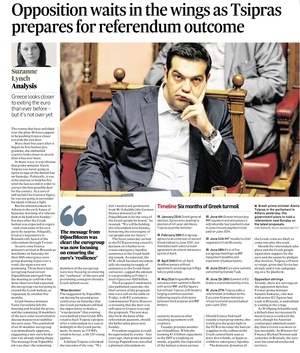
Paul Murphy (top) and the opinion piece by Suzanne Lynch in yesterday’s Irish Times

This morning, Anti-Austerity Alliance TD Paul Murphy and Suzanne Lynch, Irish Times’ European Correspondent, spoke to Seán O’Rourke on RTÉ Radio One’s T0day with Seán O’Rourke ahead of Sunday’s bailout referendum in Greece on Sunday.

What began as a chat about Greece turned into a discussion about pro-EU bias in the media.

Seán O’Rourke: “I see, I quote, in the Daily Telegraph today, from the Greek finance minister Mr Varoufakis effectively threatening to sue the EU institutions and to seek a court injunction to block any effort to expel it from the euro and they’re talking about taking advice and considering an injunction at the European Court for Justice if any such move is made because it’s just not provided for in any of the European treaties.”

Suzanne Lynch: “It’s possible, they haven’t confirmed that yet, here in Brussels, about that report but I mean there’s a lot of legal [inaudible] about a lot of aspects about what’s happened over the last week, not least whether the referendum in Greece is even legally possible because you’re not supposed to have referendums on fiscal measures.
So there’s legal questions everywhere you turn here on this issue and then one of your correspondent or your contributor there was making the point that the ECB is kind of acting, I suppose the implication, without, you know, beyond its mandate by effectively forcing the Greek government to impose capital controls. A lot of people in the ECB would say that already the ECB has being going past its mandate by keeping the banks going for this long with emergency funding. So, you know, no matter what way you look at this, really the argument is there on every angle I think on this saga.”

O’Rourke: “What’s your take on that speech made yesterday by the President of the European Commission Jean Claude Juncker – effectively using language that could be considered to be quite emotive and maybe not the most wisely judged of languages as well. ”

Lynch: “Yeah, that goes without saying, that his reference to suicide was badly judged. One can only think he wasn’t speaking his first language, that he meant something else but yeah, absolutely, I mean people are saying here that while he was trying to rally the Greek public, he may have actually achieved the opposite in this speech. But it was very wide-ranging.
He spoke for nearly a half an hour, he touched on everything from when Greece first joined the European Union in 1981, he talked about how personally he’d been involved in the association. He talked a lot about solidarity and how, you know, this isn’t about protecting one country against 18 others and he said a number of times about the other Eurozone countries, that you have to think of those countries.
And, again, he mentioned Ireland, he mentioned other bailed-out countries but I think he was implying these other poorer, east European countries in the European Union and the Euro, countries like Bulgaria, Slovakia, there’s huge opposition to any further concessions to Greece from those kind of countries. Their GDP is much lower than Greece. Their pensions are much less generous than the Greek pensions and that’s the reality so, you know, it’s very hard to sell this idea of further concessions to Greece. There are a lot of those poorer east European countries in particular.”

O’Rourke: “What do you say to that point, Paul Murphy?”

Paul Murphy: “Well I say first of all, about the Jean Claude Juncker speech, that it was peppered with falsehoods. The idea that the Greek side walked out of the negotiations is false. He claimed that the …”

Lynch: “Well I don’t think that’s the case, Paul, they did, they broke off negotiations on Friday. That’s exactly what happened.”

Murphy: “Well that’s…no it’s not what happened. You’re taking the line…”

Lynch: “What happened?”

Murphy: “…from the so-called creditors.”

Lynch: “No I’m not taking the line, I’m telling, I’m pointing out the fact there’s been constant spin from the Greek side on this aswell. So you think they didn’t walk out from the negotiations on Friday?”

Murphy: “Correct. Varoufakis was asked to leave at a certain stage so the Euro group could continue without him which is an unprecedented measure.”

Lynch: “That’s Saturday, that wasn’t Friday, that’s Saturday. You’re confusing, the Friday I’m talking about, in the negotiations.”

Murphy: “OK, I think the role of the media in this, to be honest, I think Suzanne Lynch’s articles have been consistently biased and taking the side of the so-called creditors, the Troika. In a recent article, she referred to Tspirias as a ‘self-styled Che Guevara figure’ – that’s not unbiased journalism. It’s taking the line of the establishment and repeating the propaganda here. Juncker claims …

O’Rourke: “Before you go any further, I want Suzanne Lynch to come back on that, if she wishes. Suzanne?”

Lynch: “I think I’ll just leave that actually, Seán.”

Murphy: “But I just think the behaviour there of..”

Lynch: “Well I’ll say on thing: that was an analysis piece that I wrote. In the irish Times there’s a strong division between news and analysis and I’m not going to get into a sense of my work with Paul Murphy on radio. I would like him to get back to the factual issues. The Greek negotiators did break off negotiations on Friday, that’s exactly what happened.

Murphy: “No that’s not accurate. So, on a factual issue, Mr Juncker caiamed that the reposal of the institutions does not include any cuts on pensions , that is completely inaccurate. Even the correspondent for the Financial Times tweeted, sorry this is not true, creditors bailout includes phasing out a solidarity grant , this is a pension cut regardless of what Juncker says. He claimed that the measures that the Commission is putting forward are socially just and not accurate, they’re abolishing heat oil subsidies, they’re enabling people who are less than €1,500 to have money taken directly from their wages. They’re heaping more tax on ordinary people, through payment on VAT. on basic goods, etc, and so there’s a massive spin going on about this, right? And the line is, the Greeks broke off negotiations, they’re unreasonable, they’re not capable, they’re unprofessional, etc, etc, etc. What they’re ignoring here is the question of democracy. What everyone fears is democracy…”

O’Rourke: “Going back to the point , you’ve dealt with that now, Juncker’s speech at some length but what about the point Suzanne Lynch has made and, by the way, sorry, I don’t think it’s right for you to accuse somebody of bias. I think Suzanne Lynch is a professional, honest journalist, reporting things that she sees and, by the way, to describe a man as a self-styled Che Guevara is a compliment.”

Murphy: “No it’s an insult, it’s a ridiculously insulting comment…I’m not questioning her integrity as a journalist.”

Talk over each other

O’Rourke: “Romania, the Czech Republic, or Latvia or Lithuania, these people are in countries that have a far lower GDP and income per head of population then the people in Greece. They’re not in favour. I mean where does democracy apply to them?”

Murphy: “No, but nobody, working people across Europe should not be paying for this crisis. The crisis should be paid by the banks in Europe, the bondholders in Europe, which are responsible for the crisis.”

Lynch: “But they are paying for the crisis, they have leant them billions of euro and that’s the problem.”

Murphy: “No, no they’re not. Suzanne, if you’re going to be accurate, you’ll know that 90% of the money that went to Greece from the Troika did not go to the Greek economy ,it went back out, it went on to the balance sheet of the Greek people and they’ll pay for it now, forever, unless they reject this deal and it went back out to bail out the banks. That’s what ‘s happening here, just like what happened in Ireland and I think people across Europe can hopefully see this. This is not a question of the people of Greece agains the people from elsewhere in Europe, it’s a question of ordinary people, the 99% across Europe versus the 1% represented by the Junckers and the Merkels and the Hollandes and the rest of them.”

Silence.

O’Rourke: “Suzanne?”

Lynch: “I just want to get back to the facts actually not engage in any of this kind of more ridiculous discussion with Paul Murphy there. The fact is that the two deadlines today, the IMF repayment of €1.6 million, it looks like Greece will not pay that repayment but, more importantly, the second bailout expires. I think this is probably more significant because this could give the trigger for the ECB to react further and to withdraw the emergency funding and essentially let the Greek banks go.

So what we might see today, and what I’m reporting today, is there’s definitely a sense that there’s a diplomatic incentive to get a deal agreed by the end of today. But what does seem likely is that , in any event, the second bailout that expires today, it’s very late now to get that extended. Enda Kenny said that as well this morning because, technically, it has to a lot of parliaments. Five other parliaments, including the German parliament. So that looks unlikelt. I mean the only possibility is that maybe Greece would apply for a third bailout because they, legally, again can request that.

So, I mean, there is this conundrum and this, somebody called it a parody of a referendum, in that Tsipirias called a referendum for next Sunday on something that will not exist anymore because that bailout expires today. And also, I think it’s showing again very bad political judgement by Alexis Tsipirias, he’s actually putting this to the people when they will have been faced without about five days of bank closures and capital controls so, of course, that’s going to galvanise more people, maybe to vote Yes and say, ‘hang on we’re not sure about this route, we better get back to the negotiating table’.”

Listen back in full here (starts at 16 mins)

Related: Analysis: Tsipras’s gamble backfires as Greece nears exit

(Photocall Ireland)

niamhcosgrove

Former Fine gael Senator Niamh Cosgrave and her French Spaniel


This morning former Fine Gael Senator Niamh Cosgrave, who’s been living in Chef-Boutanne, in the west of France, since 2007, spoke to Seán O’Rourke about how she was raped almost two and a half years ago.

Earlier this month, her attacker, serial rapist Christian Gladieux was jailed for 18 years. He was also sentenced to a further 10 years of psychiatric supervision on his release.

Sean O’Rourke: “Tell me what happened?”

Niamh Cosgrave: “Like everybody else, my door was open. I have a French spaniel and I have a handle on my backdoor and he’s able to open that door himself. I’m very lazy. If I go to bed, I don’t want to be woken up to let him out. So I’d gone to sleep, I don’t think I was that much asleep because when I felt a tap on my shoulder, I woke up quite normally. It wasn’t a deep, deep sleep. I immediately assumed it was the dog so I didn’t panic. I turned around and then I felt a hand on my head. And my head was pushed down and all I could see were tracksuit bottoms and a pair of runners. So I automatically assumed that this was a child, maybe some child that was in trouble or maybe some child that had come in to rob me. But then he made some gestures that made me believe that yes, I was in serious trouble here. I went into auto mode. I didn’t believe this was happening and I thought, ‘right how can I get away from this, how can I stop this?’ and I tried to talk him out of it. I asked him for a cigarette. The ironic thing is I’d been off cigarettes for three weeks. He gave me a cigarette, he rolled the cigarette for me but then I tried to delay the cigarette as long as I could. But then I knew I was in trouble when he held out his hand and he said, ‘put that cigarette into my hand’. And I thought, ‘I’ll burn him if I do that.’ And then I noticed the cigarette was out and he put it into his pocket. I then realised, this guy is covering his DNA and that he knows what he’s doing, he’s done it before, I really need to make an effort to escape here, I’m not going to talk him out of it. So I asked if I could go to the toilet and he said, yes. And he walked ahead of me and we got into the corridor, I knew that that kitchen door was open and I thought if I go back down into that bedroom, I mightn’t come out of it. And I went to run. And he turned around and broke my jaw.”

Sean O’Rourke: “He what? He struck you?”

Cosgrave: “He literally swung around and with the impact of his fist on my jaw, he broke it. And I knew it was broken because I could actually feel the click. And the pain was absolutely horrific. I’ve given birth to four children and I’ve never experienced pain like that before in my life. He then… I still tried to run away but he grabbed my by my hair, threw me to the ground and I was fighting, fighting, fighting because I knew if I had gone down that corridor, I wasn’t going to come back out of it alive. He eventually got me into the bedroom and, yes, he raped me and he raped me repeatedly. At one stage I tried to lean over because the photograph of my children was on the bedside locker, to turn the photograph down. I know it sounds strange but I felt they were in the room with me and they were looking. I felt their presence in the room and I felt humiliated and I felt disgusted. I tried to turn that photograph down and he said, ‘don’t bother, you’ll never see them again.’ Eventually, it was strange… people think of rape as being a sexual act but the amount of violence was horrific. In fact it got so bad that I no longer felt any pain and I divided in two. It was like I was looking at a horror film and I think, in some way, that saved my life because rape isn’t about sex, it is violence and he was particularly violent. I don’t know what was going on in his head but he was playing out some sort of sick fantasy. The only thing I could do was pretend to be dead. And I don’t know where I got the willpower to just lie there. But, as I divided in two, I don’t know what happened. I just stopped feeling pain and, eventually, when he’d finished, he’d said something strange like, ‘I’m going to Paris’. At that stage, I was convinced, he’s gone to find a knife. He can’t have done all this to me and leave me alive. And I lay there for I don’t know how long.”

O’Rourke: “Yeah and in addition to saying you acted as though you were dead, were you fearful that you were actually going to die?”

Cosgrave: “I knew I was going to die, I knew I was going to die. That’s exactly how I felt. What he was doing to me was so bad, I honestly did not think that he could leave that house without killing me.”

O’Rourke: “Did he, apart from saying things to you about, you know, you’re not going to escape or whatever, he said something as well, I think when you were trying to get the picture, to turn it down, did he say very much?”

Cosgrave: “No. In fact, the first question I asked him was, ‘why me?’ He said, ‘I think you’re a beautiful woman’ and I said to him, ‘well, this isn’t how you meet women’. And he didn’t answer that. The one thing I did notice was, in France and the French language, you have the ‘vous’ and the ‘tu’. ‘Vous’ is for when you’re being very formal with people but he was using the ‘tu’. And even though I couldn’t see him, didn’t recognise him, I got the impression he had seen me and felt familiar enough to [use] ‘tu’. He didn’t say much but he did answer my questions.”

O’Rourke: “How long did this ordeal go on for, Niamh?”

Cosgrave: “I went to bed at about I’d say quarter to 11, 11 o’clock, I’d organised a dinner party the next evening and the Gendarmerie report states that I rang the Gendarmes at about 2am so I, I would say he probably left the house, 10, 15 minutes maybe, it lasted I’d say about two and a half hours.”

O’Rourke: “He said he was going to Paris or something like that, something to that effect.”

Cosgrave: “Something strange, something weird, it came out of nowhere.”

O’Rourke: “And did he tell you not to do anything, not to, to stay in the room or…”

Cosgrave: “He said, ‘you stay there and don’t move’ and he left. But because he was wearing runners I couldn’t hear a door opening or closing, I couldn’t, I didn’t know where he was, I didn’t know whether he was still in the house or what. But, I lay there for a while and then I got this adrenalin rush, I can’t describe it. It was like, “I’m not going lie here and wait for this”. So I crawled out, I could barely move, the injuries were that bad but I crawled out to the kitchen. I did have a camera. And, I was tempted to switch it on the front drive but I was afraid if the light came on and he saw it, and he had left the house, that he’d come back. So I grabbed the phone and went running back down into my bedroom and when I rang the Gendarmes, I didn’t get through immediately, all I could hear was the music, asking me to wait and I remember hiding the mobile phone, in case he was in the house and realised I’d called the Gendarmes. And I thought, well, if he’s gone, at least it’s over. But, unfortunately, Sean it wasn’t over. Because the police arrive, the Gendarmes, they arrive with dogs, your house is no longer your own, your body is no longer your own, you’re covered in plastic, your bedroom is taped off, it’s like you’re still a bit of meat, you’re still a bit of property.”

O’Rourke: “Presumably, you got serious medical attention very quickly?”

Cosgrave: “Absolutely, in fact, the Gendarmes, they were in the house, I’d say a few minutes, very basic questions and they said, ‘we’re calling an ambulance’. And, like and idiot, I was like, ‘well why, why?’ I said, ‘I need to get dressed, I need to have a wash’ and they said, ‘no, you can’t, you can’t, you’ll have to go the way you are now’. So the ambulance arrived but from the minute I arrived at that hospital and I saw that wonderful Gendarme, dressed from head to toe in uniform and he just said, ‘yes, we’re going to do some examinations and we are going to catch that man’ and I felt safe and I felt secure.”

O’Rourke: “How long did it take for him to be caught?”

Cosgrave: “In fact he was caught the next day. After the operation, they asked me to do a photo profile on a computer. I said, ‘really, there’s no point’. And they said, ‘try it, try it, just you’d be amazed at what you’ll remember’. So it started by describing his hair and his face and before I knew where I was, we had his description and I said, ‘yes, that’s him’ and they immediately sent that the Gendarms in Chef-Boutonne who recognised him. The unfortunate thing is it took three weeks because, all, I discovered afterwards, although they knew who this was and because it was serious, they wanted to make sure that all the DNA matched up because when they did the tests, obviously, they did them three times – once for the Gendarmes, once for an independent body and once for me. And they wanted to make sure that every bit of that added up. He was also on the Sex Offenders’ List because he’d done this before.”

Later

O’Rourke: “Could you have chosen, in the court process, over there, to have remained anonymous and not to be identified?”

Cosgrave: “In France, you can ask for what they call is a closed court. However, my solicitor had said to me, given the gravity of the situation, there was a very real risk that the judge might go for a partial [closed court]. But, as he said to me, you know, everybody knows and it will be in the papers, even with the [closed court], ‘victim Irlandes’. I’m the only Irish woman in that town, my anonymity, my ability to remain anonymous was gone anyway.”

O’Rourke: “But you had a particular reason for speaking out didn’t you?”

Cosgrave: “Well, absolutely because this feeling of having reported him, I felt, until that case came up, I felt like a dirty little secret. I felt that rape was a dirty little secret and that’s what an awful lot of victims, I think, feel. They feel humiliated and they live in fear and they live in secrecy and their lives are destroyed. One of the things I wanted to get across is that, ‘yes, you can report these things, yes you will get the help you need. And yes you can do some good’ and it’s been amazing for me since. It’s been absolutely. I can’t, it’s my birthday when I think..”

O’Rourke: “What do you think lies ahead for you then, for the rest of your life, now that you, I won’t say that you’ve put it behind you but at least you’ve seen that..”

Cosgrave: “My counsellor said I will never forget it but I will learn to live with it and when I saw him in handcuffs I realised, ‘yes I can learn to live with it’.”

O’Rourke: “Needless to say we’ve had an avalanche of texts and messages of support, ‘beyond brave, what a woman’, ‘hope she has all he peace and…pardon me…it’s just, I think it’s so moving to listen to you, Niamh.”

Cosgrave: “I want to thank those people for saying that, too. That means a lot to me.”

Listen back in full here

Related and pic via: I Faced Down My Attacker I felt I had Power Again (Maeve Sheehan, Sunday Independent, February 22)

Dublin Rape Crisis Centre: 1800 77 88 88