
My Scottish wife said to me this am,”did you hear Vincent Browne interviewing the Trocaire?” I had to laugh, the Irish are great @ charity..
— artisan frames (@artisanframes) January 20, 2012



My Scottish wife said to me this am,”did you hear Vincent Browne interviewing the Trocaire?” I had to laugh, the Irish are great @ charity..
— artisan frames (@artisanframes) January 20, 2012

 Barbara Nolan is Director of the European Commission Representation. A former tax inspector, she has worked for the EC since 1989 serving as Head of Unit in the Education and Culture Directorate General and was the EC spokesperson for Employment, Social Affairs and Health matters between 1993-1999.
Her views were expressed most recently in an Irish Times article headlined ‘Reality Is That Austerity Would Be Worse Without EU-IMF’.
In it she states:
…the idea the EU-IMF programme was put in place to “save” German banks, while convenient, is far too simplistic. Most of the money being loaned to Ireland is to cover the day-to-day costs of running the State. Without this financing, the country would have no option but to immediately close the gap between spending and revenue. This would imply austerity on a draconian level.
The financing gives the Government the time and space to gradually reduce its budget deficit to a sustainable level.
If the programme were truly to rescue the German banks, why not keep the funds in Germany and directly inject them into that country’s financial institutions? Why risk lending money to Ireland? Why also lend money to Portugal and Greece?
She adds:
While the country is by no means out of the woods, it is important not to lose sight of the progress that has been achieved over the past year. Growth has resumed, on the basis of a strong rebound in Irish exports.
Of course, the domestic economy remains weak and unemployment is still far too high. But this is a reflection of the dramatic shrinking of construction’s share in the economy and the fact the high indebtedness of Irish households is holding back spending.
Furthermore, it is arguably only due to the programme that there has been such progress in repairing Ireland’s banking sector. While the job is not yet done, Ireland is on track to having a better-capitalised, smaller financial sector, vital to supporting the country’s economic revival.
And concluded:
Finally, thanks again to the programme, sheltered sectors of the economy, such as the legal and medical professions, are being opened up. This will bring prices down for Irish consumers and reduce costs for businesses.
With the ongoing turbulence in markets affecting more and more countries, the safest place for Ireland to be right now is in the programme, with its stable source of financing, now being made available at an interest rate that is far below what many countries are paying in the market.
While there is certainly an understandable temptation to blame others for the country’s predicament, Patrick Honohan concluded in his 2010 report that “although international pressures contributed to the timing, intensity and depth of the Irish banking crisis, the essential characteristic of the problem was domestic and classic”.
The simple truth is, the measures Ireland is taking under the programme would have had to happen anyway. Without the support of the EU and the IMF, they would have been far more painful to undertake. The real charade would be to pretend otherwise.
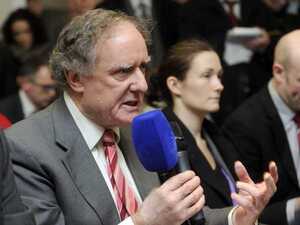
 Troika (EU, ECB & IMF) representatives, and Barbara Nolan, head of the European Commission representation in Ireland, held a press conference on the latest bailout review this afternoon.
Participants:
Klaus Masuch, head of EU Countries Division at the European Central Bank
Istvan Szekely, director of economic and financial affairs at the European Commission
Craig Beaumont, mission chief for Ireland at the IMF.
Barbara Nolan, head of the European Commission representation in Ireland.
Early in the conference, Istvan Szekely said: “I’m impressed by the depth of the discussion in Ireland and the understanding of complex, economic financial-sector issues, which is revealed by looking into the Irish place, looking into the discussion. But also when I come from the airport with the taxi driver they are often very very informed I must say, very very informed.”
[LATER]
Vincent Browne: “Klaus Masuch, did your taxi driver tell you how the Irish people are bewildered that we are required to pay unguaranteed bondholders billions of euros for debts that the Irish people have no relation to or no bearing with, primarily to bail out or to ensure the solvency of European banks? And if the taxi driver had asked you that question,hat would have been your response? That’s my first question.”
Barbara Nolan: “Well, well, well, can we take a couple together? Can you ask the second question?”
VB: “Well, my second question is a completely different issue and it may have a follow-through if Mr Masuch doesn’t answer the question in a way that would illuminate the taxi driver’s understanding of all this, I would have a follow-through question.”
Nolan: “Right, can I ask you then to pass the mic, and we’ll come back to you for the second question?”
Browne: “Well, if you don’t mind, that’s a way of breaking up the exchange, and I would prefer if it went this way: We’ve a tradition in Irish journalism that we pursue issues and that when somebody doesn’t ask [answer] a question we follow through on it and I hope that tradition will be respected on this occasion. So could you answer the question?”
Masuch: “I have answered a very similar question of you – I think it was two reviews ago – and can…”
Browne: “[inaudible] the question”
Masuch: “… and I answered it. I can understand that this is a difficult decision to be made by the government and there’s no doubt about it but there are different aspects of the problem to be, to be balanced against each other and I can understand that the government came to, came to the view that, all in all, the costs for the, for Irish people, for the, for the stability of the banking system, for the confidence in the banking system of taking a certain action in this respect which you are mentioning could likely have been much bigger than the benefits for the taxpayer which of course would have been there. So the financial sector would have been affected; the confidence of the financial sector would have been negatively affected, and I can understand that there were, that there was a difficult decision but that the decision was taken in this direction.”
Browne: “That, that… Well, that doesn’t address the issue. We are required to pay, in respect of a defunct bank – that has no bearing on the welfare of the Irish people at all – we are required to pay in respect of this defunct bank, billions on unguaranteed bonds in order to ensure the health of European banks. Now how would you explain that situation to the taxi driver that you talked about earlier?”
Masuch: “I think I have addressed [looking to Barbara Nolan] the question.”
Browne: “No you haven’t addressed the question because you referred to the viability of the Irish financial institutions. This financial institution I’m talking about is defunct. It’s over. It’s finished. Now, why are the Irish people required, under threat from the ECB, why are the Irish people required to pay billions to unguaranteed bondholders under threat from the ECB?”
Masuch: [silence]
Browne: “You didn’t answer the question the last time so maybe you’ll answer it this time.”
Masuch: [mutters to Barbara Nolan]
Nolan: “Well, I think he doesn’t have anything to add to what he’s already said. Can I.. [pointing at another questioner]”
Browne: “Well, just a minute now. This isn’t, this isn’t good enough… You people are intervening in this society causing huge damage by requiring us to make payments not for the benefit of anybody in Ireland but for the benefit of European financial institutions. Now, could you explain why the Irish people are inflicted with this burden?”
Manusch: “Well, I think I have addressed the question.”
Browne: “You’ve nothing to say. There’s no answer, is that right? Is that it? No answer?”
Manusch: “I have given an answer”
Browne: “You have given an answer that didn’t address the question.”
Nolan: “That’s your view.”
Browne: “That is my view and I think it would be the view of the taxi driver and a few of our viewers tonight.”
Nolan: “Right. Can we please move on?”
Earlier: Vincent Browne In Da House (Video)
httpv://www.youtube.com/watch?v=HAf7J4a_T1g&feature=player_embedded
“Could you explain why the Irish people are inflicted with this burden?”
Klaus Masuch (top) from the European Central Bank enjoys a demonstration of haranguing from Vincent Browne at the troika (ECB/IMF/EU) press conference this afternoon in government buildings.


How insufferable?
Oh, about two-thirds.
Ireland’s economy will grow at about a third of the pace forecast by the government, the country’s bailout partners said, as export growth slows.
Gross domestic product will expand 0.5 percent this year, representatives of the International Monetary Fund, the European Central Bank and the European Commission said today in Dublin. The troika in October forecast 1 percent growth, below the government’s 1.3 percent prediction.
“Ireland continues to face considerable challenges,” they said in a statement confirming the government had met its bailout targets in the fourth quarter. “Domestic demand remains subdued, unemployment high and trading partner growth is slowing.”
Irish Economy To Miss Government Growth Forecast, Troika Say (Bloomberg)

Ireland has passed the fifth review of progress under its bailout program by the European Commission, the International Monetary Fund and the European Central Bank, the Department of Finance said in a statement Thursday.
Unable to borrow in the international bond markets, the Irish government was forced to seek EUR67.5 billion in loans from the European Union and the IMF in November 2010.
Now GET back to work/job-hunt/sofa/trolley/journey-to-airport/pub, etc.


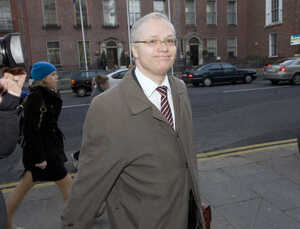
 They’re back. Literally rolling out of bed in the Merrion Hotel and crossing the road to the Department of Finance.
1. Senior Economist at the European Department of the IMF, Johan Mathisen (left).
2. Assistant Director at the (IMF) and Ireland mission chief, Craig Beaumont (front left).
3. European Commission representative Nigel Nagarajan (left).
4. Director of Economic and Financial Affairs at the European Commission, Istvan Szekely.
5. Economist at the European Commission, Sven Langedijk (front left).