



 Hmm.
Hmm.
Monthly Archives: May 2012
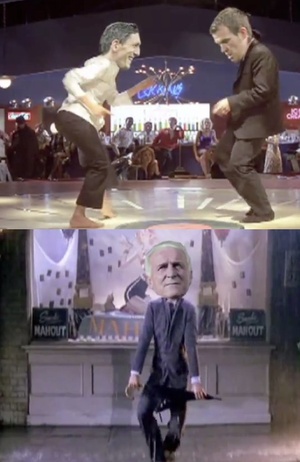


httpv://www.youtube.com/watch?v=7IWvtRvUEUs
“She’s going to have a look at you. I put you up on Done Deal.”
“Is he a goer?”
“Oh yeah.”
“I’ll take him.”
From Blinder Films. Directed by Lorcan Finnegan

Joss Walsh writes:
A young dead porpoise washed up on the east pier in Howth [North Dublin] today.
What’s going on?
Previously Sandymount Porpoise Latest.

This evening (taken by Trevor Durity).
Clue: it’s in Galway.
Story Bud?
at
Storymap is a Google Map of Dublin dotted with little speech bubbles, each of which links to a location-specific mini-film: personal reminiscences, local history and random snippets of Dublinia.
Above: the entry for Dame Lane wherein cartoonist Tom Mathews gives his take on the Universal Hair Studio’s Why Go Bald? sign.
Huge potential, well worth an extended browse and you can submit your own story here.
(Hat tip: Sean Doyle)

It appears the car of @endakennytd has been pelted with eggs in Donegal according to @greghughes2 of @HighlandNews
— Páraic Gallagher(@paraicgallagher) May 21, 2012
Should have stayed in Athlone.
Eggs Thrown At Taoiseach As He Is Met By Protesters In Milford (DonegalDaily.com)
Enda Kenny Met By Protests In Milford – Defends Decision Not To Meet Groups (Highland Radio)
 Shiela Flynn writes:
“Just hiked the 6km to Hag’s Head at the Cliffs of Moher to be greeted by the isolated tower…And this.”
Anyone?

httpv://www.youtube.com/watch?v=tlKaao8gdX8&feature=youtu.be
They’re calling him Squee-3pio.
Shaun O’Boyle writes:
Science Gallery [Pearse Street, Trinity College, Dublin 2] has a visitor I wanted to tell you about. This break-dancing robot by Intel can also do Tai Chi (top), be existential (above), and provide beaucoup de squee (see video). You can visit him (/her?) at Science Gallery on Tuesday or Wednesday this week as part of Intel’s Today is so Tomorrow exhibition (admission is free!)
 Larry Elliot, The Guardian’s Economics Editor writes:
The survival plan, such as it is, involves countries embarking on a long process of structural reform to make them more competitive, a fiscal pact to ensure that governments live within their means, and perhaps a bit of extra pan-European infrastructure spending to satisfy voter demands to soften the impact of austerity.
There is little prospect of this blueprint working.
Take Ireland, one of the three countries subject to harsh bailout terms. Does it have a competitiveness problem? As Dhaval Joshi of BCA Research notes, Ireland accounts for 0.3% of global GDP yet accounts for 3% of world trade in services and 6% of trade in pharmaceuticals. Ireland ranks third in the world for foreign direct investment, on which the return is 17%, compared with 6% in Germany. “As a trading economy in key sectors, Ireland is punching 10 or 20 times above its weight. This is hardly a sign of an economy that needs to become more competitive,” Joshi says.
Nor would the proposed fiscal pact, on which Ireland votes in a referendum later this month, have prevented the crisis that has reduced GDP by 15% and prompted a fresh exodus of the young and talented. Ireland, like Spain, had healthy public finances in the years before the crisis broke. The problem in both countries was not too much public debt but too much private debt. The reason there was too much private debt was that borrowing was too cheap in economies that were growing fast and at risk of overheating. And the reason borrowing was too cheap was that Ireland and Spain had given up the right to set their own interest rates and were subject to the one-size-fits-all dictates of monetary union.
The Euro Is Ripe For Creative Destruction (Larry Elliot, The Guardian)