



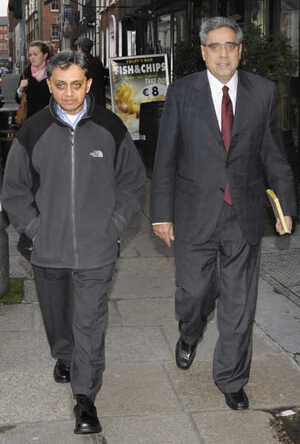
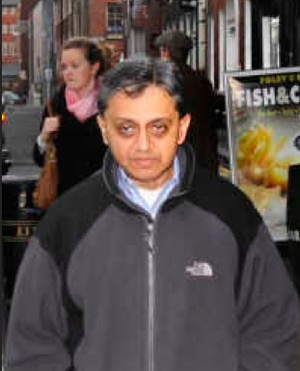
 Former IMF chief of mission to Ireland, Ashoka Mody, above left with Ajai Chopra in 2010.
Melancholy of eye and large of loafer, Ashoka was involved in negotiating Ireland’s EU/IMF bailout.
He could often be seen around Merrion Row, Dublin, during the bailout. Once Ewok spotted him in Centra observing the magazine rack forlornly with a 1990s-style bum bag about his person.
Anyway. This morning Ashok gave an interview to Gavin Jennings on Morning Ireland, in which he admitted Ireland’s bailout was riddled with mistakes, namely the non-burning of the senior bondholders and the program of austerity.
Ashoka Mody: “There were three choices. Choice one was to bring in the bondholders and they would bare some of the cost of the sovereign distress, either the bank bondholders or the sovereign bondholders. A second choice was to offer extremely concessional official financing. And a third choice was to impost austerity. And the decision then was that the entire reliance would be on austerity. And clearly the experience, if experience was needed, has demonstrated that reliance on austerity is counterproductive. And since there is no view currently on how much burden of this crisis should be borne by the private bondholders, we are left with only one choice and that choice is to increasingly make the official financing easier and more concessional. And that’s basically what we’re seeing. We’re seeing a belated recognition of the fact that the constrains imposed by only austerity was untenable.”
Gavin Jennings: “From what you’re saying to me, you make it sound like the construct for our rescue was wrong.”
Mody: “Yes, indeed, it was. It was wrong in the sense that there was never a real possibility, or let me put it a little bit more mildly, the risks of the program succeeding were such that the complete reliance on austerity was not a reasonable way to go.”
Jennings: “You were writing recently, and this was following the promissory note deal, that it was a good idea, albeit a belated idea, that some of the bondholders, some of the people who had lent Ireland money should take a haircut or a restructuring of what they had lent us. Why was that not done at the time?”
Mody: “I think at the time, and now, the view continues to be that honouring sovereign debt and indeed most of the debts owed by the banks which, de facto, have also become quasi sovereign debts, that those debts need to be repaid cause if those debts are not repaid, that will create financial instability. And so, that was the decision made at the time that continues to be the case today. Clearly what has happened is that some margin has to give. In Greece, that was the presumption that sovereign bondholders will remain whole but, over a period of time, that assumption proved untenable and so had to be, there had to be a compromise on that. And even with that, in the Greece case, the official debt was too burdensome and so easing of those terms began. And for Ireland, and for Portugal, what we are now seeing is that while the private creditors are remaining whole, the official terms are being relaxed because the debt burdens, especially if you view the likely prospects of growth in these countries, the debt burdens are still very large. We are in the range of 120% of GDP which, historically, is a large number. And the only real prospect, other than the official, concessional financing, is that growth begins to emerge in a very dynamic way. And I’m concerned that some of the growth projections have proven to be overly optimistic. And given that Europe is dragging itself down through this austerity process, some of the growth projections are likely to not be met and in that case, these debt burdens will remain higher than currently projected for longer than we currently think so something has to give.”
Jennings: “I’ll talk to you more about growth in just a moment. But, going back to what you said, if austerity was wrong, judging from your comments on both burning private and sovereign bondholders, and not following that policy, was that too a mistake in your view?
Mody: “I would say yes. The answer is yes. When everyone says ‘yes, it was a mistake’, there is an immediate reaction that doing so would have had catastrophic implications. And my reading of history on sovereign defaults is that such defaults can be well managed in a way that accommodates the interests of various parties and that the notion that a sovereign default, or a default especially on creditors to banks who have become quasi sovereign bondholders is very…the notion that those defaults are extremely costly, is historically just not true. We know from the evidence that we have that in a way bondholders treat that as almost welcome because it reduces the uncertainty and normally there is a very quick return to market, the output losses are relatively minor. And so the history is very clear on the cost of doing so.”
Jennings: “So, if imposing austerity on Ireland was wrong, or a mistake; if not allowing any burning of bondholders, whether official, sovereign or private was a mistake; you were centrally involved in that program. I know Ajai Chopra was very much the public face of the IMF mission to Ireland. But you were centrally involved in constructing this bailout. How much responsibility do you take for those errors.”
Mody: “Yes, so, obviously, I have to take the responsibility in…but I’m in very good company in taking responsibility in this. There were many parties involved. And my role really was to bring such matters to the attention of people who finally made these decisions.”
He then removed his shoes and cried softly .
Listen to whole interview here.
Previously: Remember Ajai Chopra’s Sad Eyed Large Loafered Friend?