







Tonight on #vinb, Ex-Greek Finance Minister Yanis Varoufakis talks to Vincent from @ILFDublin. Tune in at 11 pic.twitter.com/9tQSywrbcG
— Daniel Murray (@DanielTMurray) June 2, 2016
Tonight at 11pm.
On TV3’s Tonight With Vincent Browne.
There will be interview with former Greek Finance Minister Yanis Varoufakis, recorded at the recent International Literature Festival Dublin.
Via Daniel Murray
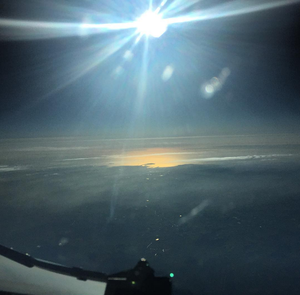
Brendan Murphy tweetz:
The sun beaming down on Dublin at 7am this morning…
Meanwhile, the latest from Met Éireann…

Yay!
UPDATE:

Inisbofin East Beach in Co. Galway this afternoon.
Thanks Stephen and Jeni


Archive photos and film clips transformed into darkly humorous gifs by San Francisco based filmmaker and stereoscopist Bill Domonkos.
More of his work here.

Yesterday.
In the Dáil.
Taoiseach Enda Kenny was asked by Anti-Austerity Alliance – People Before Profit TDs Ruth Coppinger and Brid Smith about the Goverment’s plans to hold a citizen’s assembly on the 8th amendment.
This happened:
Enda Kenny: “The fact of the matter is that in 1983, the 8th amendment was introduced into the Bunreacht na hEireann, the Irish constitution, by the Irish people. And that was guarantee to the right to life of the unborn. There were three referenda after that. And, in each case, in each of those referenda, by the people, not just by any parties, the people decided to keep that reference in the constitution.”
Ruth Coppinger: “Sorry, Ceann Comhairle, that’s completely. The people did not vote on the eighth amendment subsequently. They voted on side issues including information..”
Ceann Comhairle: “Will you let the Taoiseach answer, please.”
Further to this, the group Terminations For Medical Reasons (TFMR) has written an open letter to the Taoiseach, stating:
We in TFMR Ireland found it absolutely appalling that you deliberately mislead the Dail, the Oireachtas and the people of Ireland yesterday when in Dáil Éireann you made the following statement in relation to the 8th Amendment to the Constitution: –
“The fact of the matter is… there were three referenda after that and in each case, in each of those referenda by the people, not just by any parties, the people decided to keep that reference in the Constitution.”
This was a false statement and one which we believe was intended to deceive the Dáil, the Oireachtas, the people of Ireland and the watching world into believing that the Irish people have had three opportunities to determine whether or not to retain the 8th Amendment.
We would like to point out to you, Taoiseach, that the fact of the matter is that on no occasion since 1983 has any such choice been put to us.
…The people of Ireland have never had an opportunity to Repeal the 8th and could not therefore have, on three occasions “decided to keep that reference in the Constitution.”
You, Taoiseach, were a fervent advocate for the insertion of the 8th back in 1983 and have been complicit in the abuse of thousands of women in Ireland in the intervening period by continuing to deny them their Human Rights, as have been established by numerous International Human Rights bodies.
We are calling upon you to immediately correct the false statement you made in our Dail yesterday…
Open letter from TFMR to Taoiseach to correct false statement or resign (TFMR, Facebook)


From top: Paul Reynolds, of RTÉ; Garda Commissioner Nóirín O’Sullivan speaking to journalists at Phoenix Park this morning
Earlier today.
Paul Reynolds interviewed Garda Commissioner Nóirín O’Sullivan.
It’s the first time Ms O’Sullivan has spoken publicly about the O’Higgins Commission of Investigation.
Mr Reynolds reported on RTÉ’s News At One’s news headlines:
“The Garda Commissioner was anxious today to reassure the public that changes that are badly needed in An Garda Siochana will be implemented including changes in training, supervision, incident management and how victims of crime are dealt with.”
“She says it took some time to make the case for investment so that the gardaí could receive the resources necessary to make these changes happen.”
“In relation to allegations that some officers may have been preparing to give testimony against Sgt Maurice McCabe, at the O’Higgins Commission, which contradicted his, at a meeting in Mullingar, the Commissioner said she took action as soon as she became aware of the public commentary that gave this impression.”
“She said that she cannot comment further because the matter is being investigated by GSOC. She also said that the Garda needs to change its approach to whistleblowers but it’s already taken steps in that regard.”
Listen to Mr Reynolds’ interview with Ms O’Sullivan in full here (go to 10.20)
O’Sullivan acted ‘as soon as possible’ over allegations (RTE)
UPDATE: A transcript of the interview…
Paul Reynolds: “Commissioner, you mentioned there were recurring faults. What do you say to criticism from people like Mick Wallace and Clare Daly, elected representatives, who say that you were a part of the senior management who didn’t implement those changes when they should have been implemented because the faults kept occurring?”
Noirin O’Sullivan: “Well I don’t think that there’s either time or space to go into it here but that’s something we can explore further with the authority and that’s why we were very anxious that the authority would bring forward a public session because I think it’s very important that the public are reassured that there are lessons have been learned and I think also that…”
Reynolds: “But why were they recurring?”
O’Sullivan: “That the public can be reassured that there is now adequate levels of investment, to allow us to start implementing some of those changes that are very badly needed. So for example, if you look at some of the criticisms, quite right criticisms, in the O’Higgins Commission particularly, we had incident management and supervisory management about insuring that Gardaí are properly trained. That there are supervisory management practices in place to ensure that people are actually being supervised properly and they have been supported in doing the job that they have to do and providing the appropriate level of service. Particularly to victims in crime, we now have the opportunity to put those measures in place because we now do have the investment.”
Reynolds: “You’ve been criticised in relation to, following the publication of the report, in relation to the actions of some senior officers. Now, I know that allegations were made, they’re unfounded, and this has been sent to GSOC for investigation, but the questions in relation to you have been: what did you know about this? When did you know it? And why didn’t you act before the GSOC investigation was set up?”
O’Sullivan: “Well I think there are a couple of very important points that need to be made. Firstly, Mr Justice O’Higgins conducted a Commission of Investigation, of which we was the sole member. He had the opportunity to hear all of the evidence, from all of the parties and all of the submissions on behalf of all of the legal parties. And Mr O’Higgins’ report speaks for itself, having weighed up all of those submissions, all of the evidence given by all parties. When we received the O’Higgins Commission report, and some of the public commentary attributing, misplaced or otherwise, belief that senior officers had done something which was improper and inappropriate to do, then it was immediately required to the Garda Siochana Ombudsman Commission and that investigation, I’m not allowed, I can’t comment any further but it is being investigated by the Garda Siochana Ombudsman Commission.”
Reynolds: “But can you not say why you didn’t take action when you became aware of it?”
O’Sullivan: “Well you know, I’m sure Justice O’Higgins would have a view, if I were to go into the middle of his commission. But, as soon as I became aware of the public commentary which gave this impression, it was required to the Ombudsman.”
Reynolds: “You gave evidence to the Commission, didn’t you?”
O’Sullivan: “Well I think anybody that looks at the report, there’s an appendice of witnesses to the report. Obviously, the Commission was a private sitting and it was a matter for anybody that was before the Commission to request it to be in public but it is a matter of record, in the report, that I appeared as a witness.”
Reynolds: “But what about your handling of Sgt Maurice McCabe? The criticisms in relation to instructions to your lawyers, in relation to testing his credibility, his motivation and his integrity?”
O’Sullivan: “Well, you know, again, I’m on record as saying that An Garda Siochana have lots of things to change. One of them is our approach to people who want to have a different voice and who have a different voice and want to bring things to our attention. And very, very clearly, from day one, I’ve said that dissent is not disloyalty, we have taken a number of steps to ensuring that people can bring forward issues of which they want to raise. Some of those people just want to raise their issues and they want to have them dealt with and they have that right. In order for people to be able to come forward and people that want to, under the Protective Disclosures Act, bring forward disclosures. We have put systems into place to ensure that people can do that, that there will be a safe environment in which they can do it. And we are working with bodies, such as Transparency Ireland, to ensure that the proper environment is there so that people can do that. We’ve also appointed a Protective Disclosures Manager and we will have appropriately trained staff to deal with that.”
Reynolds: “Ok but why did you, why did you test his credibility and motivation… no, sorry, why did you test his credibility and motivation?”
O’Sullivan: “Well, I think, refer it back to the statement, you know, I’m very restricted in what I can say in relation to what happened at the Commission but I think a previous statement makes it clear what the approach was.”
Previously: Clarifying Matters
https://www.youtube.com/watch?v=PLuG04pb_yg&feature=youtu.be
Ah here.
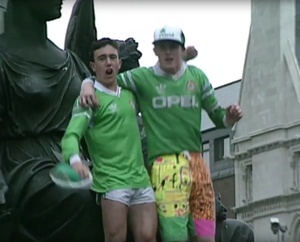
O’Connell Street, Dublin, during Italia 90.
Two supporters sporting budgie choker and neon cut-offs respectively, after the Ireland V Romania match.
Andy B writes:
If this doesn’t get you in the mood for the Euros…

Tomorrow.
At the Radisson Blu Royal Hotel in Dublin 8.
Independent MEP Nessa Childers is hosting a conference on ‘safeguarding journalism, media ownership and democracy’.
She writes:
This all-day conference will question the concept of media diversity and ownership in both online and traditional print media – and explore the implications for traditional notions of democratic accountability and journalistic independence.
To seek an answer to these questions and explore issues around ownership and challenges presented by online news sources two pieces of research will be launched on the day.
The research undertaken by Nessa Childers in partnership with the Institute For Future Media and Journalism (FUJO/DCU) examines the relationship between large media shareholders and media content through coverage of four major news stories in Ireland between the years 2012 to 2015 – and the second piece of research looks at how social media affects different news organisations differently through a series of interviews with these organisations to find out about their experiences.
Speakers will include Renate Schroeder, director of European Federation of Journalists; Seamus Dooley, secretary of the NUJ; Flutura Kusari, legal advisor at European Centre for Press and Media Freedom; Michael O’Keeffe, CEO of Broadcasting Authority of Ireland; Dr. Roddy Flynn, of Dublin City University; and Gemma O’Doherty, investigative journalist.
Daniel McConnell, political editor of the Irish Examiner; Jane Whyatt, of the European Centre for Press and Media Freedom; Dr Jane Suiter and Dr Eugenia Siapera, of DCU; Christine Bohan, deputy editor of TheJournal.ie; David Cochrane, social media editor of the Irish Times; Anne Marie McNally, political strategist and founding member of the Social Democrats; and Niamh Sweeney, head of public policy at Facebook Ireland, will also speak.
FIGHT!
Book a place at the conference here

A new video of northern Ireland from Tourism Ireland.
FIGHT!
You never know unless you go.
Thanks Ciarán Hall


From top: Mary Boyle; Ann Doherty
Ann Doherty has today launched the first stage in a legal action against Ireland, the Minister for Justice Frances Fitzgerald and the Donegal Coroner for their refusal to hold an inquest into the death of her identical twin sister Mary Boyle.
The six-year-old girl vanished on her grandparents’ remote farm in Ballyshannon, Co. Donegal in March 1977. She is Ireland’s longest and youngest missing person.
Her uncle Gerry Gallagher was the last person known to be with her.
Ann’s legal action has been taken on the grounds that the coroner Dr Denis McCauley has recently informed her lawyers that it is not his intention to hold an inquest.
The coroner has told them that an inquest would have an adverse effect on Mary Boyle’s mother Ann Boyle. He has also stated that An Garda Siochana would adjourn an inquest should one be convened.
Ann Doherty will challenge the decision on the grounds that Article 2 of the European Convention of Human Rights – the right to a thorough, effective investigation – has been breached.
She will argue that new evidence has come to light about her sister’s disappearance in a forthcoming documentary to be broadcast shorted called ‘Mary Boyle – The Untold Story’.
As part of this evidence, a number of ex-garda officers have alleged that there was a political interference in the initial investigation. They allege that there was a direct intervention by a politician who ordered that the chief suspect not be arrested.
Ann Doherty’s legal team will argue that this and other evidence has caused widespread public suspicion, rumour and speculation both in Donegal and throughout Ireland, and that an inquest should be held in an attempt to assuage that concern.
Further evidence has also emerged in the documentary, which had already been in the possession of the gardai, regarding information Mary’s mother had about her disappearance.
During a meeting with Ann Doherty and her lawyer Darragh Mackin in December 2015, the coroner stated that he had attempted to contact Mary Boyle’s mother Ann Boyle on at least four separate occasions regarding the holding of an inquest but had been unable to do so.
Ann Doherty has asked that an inquest be convened so that her twin sister can be officially declared deceased.
Ann contends that the coroner’s decision not to hold an inquest is unlawful and that the reasoning for same is entirely unreasonable and disproportionate.
She claims there is a substantive breach of Article 2 of the European Commission on Human Rights which obliges the state to carry out an effective and independent investigation when someone dies in suspicious circumstances.
She also claims that a delay of 40 years in opening an inquest is an irrational and disproportionate breach of Article 2 and that her constitutional right to the truth and justice has been denied.
Darragh Mackin of KRW Law has confirmed that an application will be made to the High Court in the coming days for a judicial review of the coroner’s decision.
‘Mary Boyle – The Untold Story’ will be broadcast shortly.
A statement from Families for Justice.