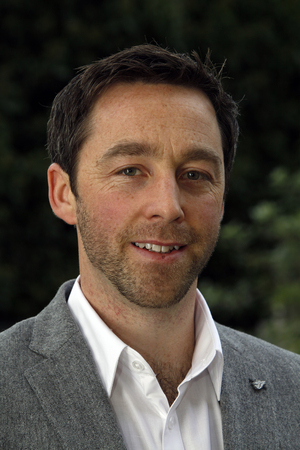
From top: IMF chief Christine Lagarde and Michael Noonan at an IMF conference in Dublin, January 2015; Dr Rory Hearne
Ireland is a study in failure of the neoliberal financial capitalist model.
Rory Hearne writes:
The mainstream economic theory and policy being followed by governments around the world has failed to produce economic growth and worsens inequality.
So say the International Monetary Fund (IMF) in a sensational new report entitled, ‘Neoliberalism Oversold?‘
The report is written by three of the IMF’s top economists. For the first time it accepts that the main economic policies of neoliberalism and austerity that the organisation has been forcing governments around the world since the 1970s to implement (including Ireland as part of our recent Troika bailout) do not actually work.
The IMF is not some insignificant organisation. It is one of the central international organisations in global capitalism and it oversees the international monetary system.
The report finds that core aspects of neoliberal policies have resulted in increased inequality and have failed to increase economic growth, and that increased inequality in turn hurts the level and sustainability of growth.
Neoliberal policies, known as “the neoliberal agenda” or the “Washington Consensus” are essentially policies that promote a free market or laissez faire form of capitalism.
Neoliberalism was first implemented in Chile in the 1970s through the brutal regime of General Pinochet (which the IMF conveniently fails to mention) and then advocated for by free market economists such as Milton Friedman and was implemented savagely in other developing world countries under the Structural Adjustment Programmes of the World Bank and IMF, Reagan and Thatcher.
Neoliberal policies include introducing free market competition into all aspects of the economy and society (such as de-regulating the financial sector and opening up economies to foreign investment and capital flows, reducing the role and size of the state by privatisation, public spending cuts, and limiting borrowing), and reducing worker and environmental protections (seen as a barrier to profit and enterprise).
It also includes the commodification of natural and public resources like water, housing, education, health care, that is, opening them up to private companies to convert everything into a commercial product that can be bought and sold for profit.
The Report highlights that two aspects of the neoliberal agenda (removing restrictions on the movement of capital across a country’s borders and austerity (public spending cuts and repaying debt) are the policies that have caused the most problems.
In particular, they are critical of capital flows such as “portfolio investment and banking and especially hot, or speculative, debt inflows” as “Surges of foreign capital inflows increased the chance of a financial crisis, and such inflows worsen inequality in a crisis”.
This has significant implications for Ireland. Ireland has one of the most globalised economies that is built around an openness to foreign capital and financial flows.
Ireland experienced this through the flow of investment from across the world (and particularly from European banks) that inflated our housing boom in the 2000s and we are now again experiencing it through the flow of speculative finance into housing through NAMA and financial capital flows through the IFSC, one of the largest hubs for financial flows in the world.
Ireland is, in fact, a study in failure of the neoliberal financial capitalist model. The Celtic Tiger was built on belief in the private market and in complete integration with globalised markets and this has continued after the crash. The Irish economic model is thus still built on the strong potential of crises and inequality.
Underneath the glow of the economic recovery, therefore, lies these dark clouds of potential financial crisis and growing inequality that suggest major problems lie ahead.
And yet no Irish media outlet (as far as I can ascertain) has covered the findings of the IMF report in any way.
This reflects a major failing in the Irish media to provide any serious analysis or critique of mainstream economic policy, despite the central role that neoliberal economic policies played in causing our crash and the devastating impact of austerity on Ireland.
The IMF report is very important because these mainstream economists have actually used the term neoliberalism to describe these policies.
Up to this point those of us who used the term neoliberalism to describe the phase of global capitalism post 1980s were dismissed as simply being overly ideological or political.
The IMF article gives important legitimacy to the critique of this policy.
It is highlighting that there is in fact an ideology underlying mainstream neoliberal economic policy – it is not an objective science but based around a belief and perspective that free market capitalism is the best way to organise the economy and that this ideology benefits the wealthy social classes and therefore represents their interests.
The problem is, as the IMF paper explains, neoliberal economic policies are not even working to reach their own narrow goals of increasing economic growth.
Global growth is sluggish (Ireland is an outlier and our economic growth has a lot to do with profit shifting by multinationals rather than real economic activity).
In the 2000s, critics demonstrated the unprecedented rise in inequality in countries that had most intensely implemented neoliberalism and that neoliberalism was actually a political project using the guise of free market ideology to redistributing wealth away from the welfare state and worker’s and back to the wealthy.
In my book on neoliberalism in Ireland published in 2011 () I highlighted how neoliberalism was pursued through the use of privatisation policies such as Public Private Partnerships (PPPs) in Ireland.
I found, in contrast to the IMF claims, the danger of these policies which profit corporations and financial investors, but result in rising costs and ineffective services for public service users, and the erosion of workers’ rights.
The IMF do point out that many neoliberal policies have worked well. This shows that they remain blinded by their adherence to free market ideology and the interests of the global wealthy 1%.
Neoliberalism has worked perfectly for the bondholders, banks, the wealthy 1%, big corporations, financial markets financial firms, global wealth funds etc.
It has worked for the corporations and private firms profiting from the commodification and commercialisation of water, housing, education, health etc.
It has certainly not worked for the poor and middle classes of Europe and the US who have lost wages, working conditions, public services and face increased insecurity and poverty.
By the 1990s neoliberalism had achieved global hegemonic status as the dominant political and economic policy and ideology. Francis Fukuyama wrote in 1992 that:
“…what we may be witnessing is not just the end of the Cold War…but the end of history as such: that is, the end point of mankind’s ideological evolution and the universalisation of Western liberal democracy as the final form of human government”
Thus neoliberal capitalism had apparently triumphed. Now, even the IMF are beginning to realise that it doesn’t work.
It’s now time for alternative equality and sustainability based economic models.
Dr Rory Hearne is a policy analyst, academc, social justice campaigner. He writes here in a personal capacity. Follow Rory on Twitter: @roryhearne