

Author Archives: Admin

ocallaghanfitz

This evening.

Leinster House, Dublin 2.

Further to her meeting with Garda Commissioner Noirin O’Sullivan yesterday.

Justice Minister Frances Fitzgerald made a statement about the latest Garda controversies including the near one million breathalyser tests that gardaí claimed they carried out, but didn’t, and the 14,700 wrongful convictions for motoring offences.

During her statement, Ms Fitzgerald said “the scale and detail of these issues became apparent last week at the Garda press conference but I want to say I’m determined that all of the facts will emerge”.

She also said:

“An anonymous complaint was made to the Road Safety Authority in April 2014, outlining a number of issues which included the operation of mandatory alcohol testing, MAT, checkpoints. This complaint was referred to An Garda Síochána by the then Minister for Transport, Tourism and Sport.”

“An Garda Síochána indicated in a detailed letter to my Department in May 2014 that it had looked into the claims regarding MAT checkpoints and was satisfied that correct procedures were in place to account for MAT checkpoints that ultimately did go ahead. Every MAT checkpoint, as we know, must be authorised by an inspector.”

“In June of last year my Department was made aware that some discrepancies had been identified in respect of MAT and that An Garda Síochána was commencing a national audit. An Garda Síochána indicated in June 2016 that no issues stemmed from this audit with regard to the performance of MAT checkpoints or prosecutions arising from same. It also set out the new procedures it had already introduced to facilitate the accurate recording of breath tests and outlined that an IT solution had been developed and would be implemented towards the end of 2016.

“Following this preliminary notification to my Department last year, updates were sought from An Garda Síochána by officials in my Department on a regular basis as to the progress of the audit that was then taking place. An Garda Síochána indicated in February 2017 that it was anticipated that the national audit would be finalised in the second quarter of 2017. Although that audit has not yet been finalised, An Garda Síochána announced figures at its press conference relating to the discrepancy between the number of test conducted at MAT checkpoints as per its own records compared with the records held by the Medical Bureau of Road Safety.”

“No indication was given as to the scale of this issue at the time of the June 2016 letter and indeed, it is clear from what the Commissioner told me yesterday and from her public statements, that it was not known at that time to Garda management either. It was in order to assess the scale of the problem that the national audit of MAT was launched. I did not become aware of the huge discrepancy in the breath test figures until it was revealed at last week’s Garda press conference.

“Regarding the issue of fixed charge notices, my Department was informed in June 2016 of an error relating to summonses having been incorrectly issued to persons who should have received a fixed charge notice for the offence of not having a valid national car test, NCT, certificate, which became a fixed charge offence in December 2014. An Garda Síochána indicated that following on from those initial findings, further inquiries were being carried out relating to all summonses issued for other fixed charge offences.”

“Colleagues should note that a press statement was issued that day by An Garda Síochána about this issue. In that statement, An Garda Síochána confirmed that it had commenced a review of prosecutions relating to all fixed charge offences. The letter set out the remedial actions already taken by An Garda Síochána at that stage, which included withdrawing prosecutions in any affected cases and putting in place a short-term IT solution within four weeks while a longer-term IT solution was being developed.”

“Following the preliminary notifications of these problems to my Department last year, updates were sought on a regular basis as to the progress of the review taking place into the fixed charge processing system issues covering the period referred to in the letter from An Garda Síochána, from 1 January 2014 to 27 May 2016. The results of this review were communicated to my Department in a letter received on 14 March 2017.”

“The letter indicated that a total of 1,781 cases had been identified where persons had been convicted in situations where they had been incorrectly summonsed to court, either without first having been issued a fixed charge notice or having been issued and paid a fixed charge notice. The letter also set out – this is important – that consultation remained ongoing with the Director of Public Prosecutions, DPP, with whose office there had been ongoing consultation and the Courts Service in regard to commencing the process of setting aside the convictions in the courts. That engagement with the DPP is ongoing.”

“An Garda Síochána also advised in that letter, received recently on 14 March, that the DPP had indicated that the review should be extended to include cases before 2014 and that this process was now under way. That, of course, is why the audit was meant to be ongoing until June of this year. That was to be when I was to expect the final report. That is when I had been advised I would get the final report.”

“I became aware of the figure of some 14,700 cases where a conviction took place after an incorrect procedure when An Garda Síochána made that information public last week. It is matter of great regret to me, as I know it is to everyone in this House, that anyone should be summoned to court inadvertently, with all of the consequences that follow for individuals. It is absolutely critical now that these mistakes be resolved and that the necessary remedial actions be taken.”

“As for the fixed charge penalty notice, FCPN, at my meeting with the Commissioner yesterday she assured me that arrangements are being put in place in regard to the persons affected. All of these cases will be appealed by An Garda Síochána to ensure the courts set aside these convictions, as they have to. All fines will, of course, be reimbursed and penalties will be removed, and all of those affected will be contacted directly by An Garda Síochána. Individual letters will be sent to all the people concerned and they will begin to be issued on 3 April.”

“The Commissioner also outlined to me the IT and operational solutions that have been put in place to ensure that these practices would cease. In fact, at the ministerial meeting yesterday, which was scheduled ahead of all of this emerging, both the Minister for Transport, Tourism and Sport, Deputy Ross, and I were assured by both Professor Cusack and all the other people present that the new procedures were in place, that we could be confident about the new procedures and that there are changes being made to the machines, using GPS and further information, so the kind of mistake associated with the technical attributes of the devices can never happen again.”

“In the case of mandatory alcohol tests, An Garda Síochána initially put in place new paper-based recording and verification processes and, in November 2016, a new specific data-recording IT upgrade was installed on the Garda PULSE system.”

“The net effect of the new IT upgrade was that personnel now have to record the serial number of the device used for each breath test plus the meter reading before and after the checkpoint was concluded. This, apparently, was not being done before. It is clearly only one of the explanations for this situation. Data from the device are now used to verify the total number of breath tests conducted at each checkpoint.”

“The focus now, however, has to be on what is being done to get to the full truth of what transpired and the accountability that must be brought to bear. Clearly, there is a need for an investigation to hold responsible those people, at all levels of the Garda organisation, who allowed such large discrepancies in the breath-testing figures to arise.”

Meanwhile…

After making her statement, Ms Fitzgerald fielded questions from different politicians, including Fianna Fáil’s justice spokesman Jim O’Callaghan.

Jim O’Callaghan: “The Minister said in her statement that she became aware of the scale of the number of convictions only this month, when she was notified of it. When did she become aware in general that there were issues in respect of wrongful convictions arising from this matter?”

Frances Fitzgerald: “The answer to that is the letter that I received in June 2016 from, the department received it actually, from Michael Twomey, outlining that they were concerned about some issues. There was no figure mentioned so I was not aware of the 14,700 and I don’t believe that the gardai, at that point, were aware of it because that was an earlier stage. The audit wasn’t completed and they had put some procedures in place to make sure though, that they would not be further, there would not be further problems. But they hadn’t done a national audit at that point. So they weren’t sure about the figures. And it was only when they had the press conference last week that they did a national audit, that involved well over 100,000 and that then got to a point where it was the figure of 14,700 was arrived at. So they hadn’t done the full national audit at that point. Is my understanding. Is that right? [to assistant on her right].”

O’Callaghan: “I’m taking from your answer that you were aware from June 2016 that there was an issue in respect of wrongful convictions that had been obtained  against persons in our district courts?”

Fitzgerald: “Thank you [to assistant]. Yes, at that point, in the letter, they did of course, because they also put some solutions in place in relation to what had happened to different individuals, it was clear that they were concerned that there would be a number but they had no idea, from my understanding that there were 14,700 at that point. But they were concerned that some people would have been taken to court, summoned to court who should not have been summoned to court. And that some solutions had been put in place. They were obviously linking with the DPP and all of the relevant bodies. But that a full audit needed to be done and the figure of 14,700 emerged at the press conference just last week.”

O’Callaghan: “Tanaiste, if you were aware in June 2016 that individuals had been wrongly convicted before our courts, you were Minister for Justice at that time. What did you do about it then?”

Fitzgerald: “At that point what was being done was that the full scale of this issue was being examined to see precisely what the implications of it were. I was aware that action had been taken so that no further such mistakes could be made and I was awaiting the results of the full audit and my department was in contact with An Garda Siochana on a regular basis to ensure we would get the full audit.”

Later

O’Callaghan: “I just want to ask you another question and, before I ask you the other question, I want to just preface it by stating that, as Minister for Justice, you’ve been aware for nine months that there were wrongful convictions that took place before our district court, and, in my submission, you did nothing about it.”

“I want to now ask you about the issues in terms of breath test figures. We know that the Medical Bureau of Road  Safety raised this discrepancy with An Garda Siochana in July 2014. We know that the gardai conducted a review in the southern region in 2015. We know that they extended it out to the whole country in 2016 and we know that in November 2016, they introduced a new IT system in order to overcome the problem. I want to ask you two questions. First of all, when did you become aware of these problems with the breath test figures and, secondly, are you satisfied with the fact that An Garda Siochana, to this date, have not been able to explain to the Irish people why it is that 937,000 breath tests were falsely recorded on the PULSE system.”

Fitzgerald: “I have put it on the public record that I received a letter in June 2016 outlining that some issues had arisen and actually they were examining what they needed to do and that they were doing a full audit, that it would be completed in the second quarter of this year. That was the information that I had. And my department continued to be in contact with the gardai…”

Meanwhile….

Transcript of statement via Oireachtas.ie
Screen Shot 2017-03-28 at 16.23.55Screen Shot 2017-03-28 at 16.26.07

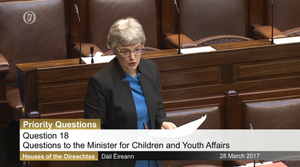
From top: Sinn Féin TD and spokesperson for Children and Youth Affairs Donnchadh Ó Laoghaire and Minister for Children and Youth Affairs Katherine Zappone


You’ll recall the second interim report from the Commission into Mother and Baby Homes which was given to the Minister for Children Katherine Zappone last September.

This interim report was to identify any matters that the commission felt warranted further investigation as part of the commission’s work.

Last week Fiach Kelly, in The Irish Times, reported that the indemnity agreement signed in 2002 between the then Minister for Education Michael Woods and 18 religious congregations – which served to cap the orders’  liability – may be extended to include children abused in mother and baby homes.

Mr Kelly reported:

Well-informed sources said the delay in its publication was due to the controversial nature of the proposed form of redress.

One source suggested that it may never be published if there had not been public outcry over the commission’s confirmation last month of the discovery of the remains of babies and infants at the site of a former mother and baby home in Tuam, Co Galway.

Further to this.

This afternoon.

In the Dáil, during Priority Questions.

Sinn Féin TD Donnchadh Ó Laoghaire raised the second interim report in the Dail this afternoon after asking what steps the State is taking in regards to protecting unmarked graves – other than the remains recently found at the Bon Secours mother and baby home in Tuam, Co. Galway – in order to prevent them from being interfered with.

Mr Ó Laoghaire also claimed that the second interim report does not recommend widening the terms of reference in the Commission into the Mother and Baby Homes.

From their exchange…

Donnchadh Ó Laoghaire: “It’s my understanding, Minister, that the second interim report was before Cabinet this morning. The 27th of July last year, you issued a press release saying that the commission was to report back in September. That report has still not been published. Now you’ve committed to publishing it by the end of the month. It’s not published today, to the best of my knowledge. I presume it will be published in the coming days so I want to hear from you, when you intend to publish it.”

“But also, minister, to outline the reason for the delay because it has been with your department and with you for some six months now. And that has caused a great deal of concern and anxiety among survivors and I think it’s important that we get a sense of, for what reason was, what I think, was an inordinate delay in publishing this report was.”

“And also to state, Minister, it’s my understanding or has been reported that the report does not recommend an expansion of the terms of reference. That being case, I believe that the Commission [into Mother and Baby Homes] is no longer fit for purpose.”

Katherine Zappone: “Thank you, deputy Ó Laoghaire, I’m interested in your comments in that regard. I’d like to bring my comments though, responses, back to the question that you actually have asked me. As I know, I will take up some of those issues later on in terms of other questions and I think again in terms of the question about making decisions to bring forward injunctions. The Government, arguing, has the responsibility, something that we should consider, I’m saying I’m not necessarily, not willing to consider that. But my understanding and in terms of the advice that I have received that in order to do that, we need to have it brought to our attention, that there are some real concerns in relation to a preventative measure, in terms of different sites that may require, that may require an injunction. On the basis of people who have an interest in that regard. And so I would be open to hearing from those and consider the issue again in that regard.”

Acting Ceann Comhairle: “Thank you, Minister…”

Anyone?

Previously: ‘What’s In It That’s So Frightening?’

12

This afternoon.

Government Buildings, Dublin 2

Fine Gael Minister for Housing, Planning, Community and Local Government Simon Coveney, with Paschal Donohoe, Minister for Public Expenditure and Reform, announcing details of allocations to local authorities of the €200m Local Infrastructure Housing Activation Fund (LIHAF).

A total of 34 public infrastructure projects across 15 Local Authority areas have been approved.

The Local Infrastructure Housing Activation Fund (LIHAF) is “a key element of Pillar 3 of Rebuilding Ireland: An Action Plan for Housing & Homelessness” to provide “public off-site infrastructure to relieve critical infrastructure blockages”.

Anyone?

Yay.

Rollingnews

Previously: A Rental Revolution

enda2

This afternoon.

Some online feedback on Taoiseach Enda Kenny’s performance during Leader’s Questions concerning the fate of Garda Commissioner Noirín O’Sullivan.

Earlier: Every Breath You Take

oadsafetyFrom left: Denis A Cusack, Director, Medical Bureau of Road Safety, Chief Superintendent Aidan Reid,, Ms Moyagh Murdock, Chief Executive, Road Safety Authority, Shane Ross, Minister for Transport, Tourism and Sport, Maggie Martin, Research Manager, Road Safety Authority, outside Store Street Garda Station in Dublin as they launched a Road Safety Authority (RSA) and An Garda Síochana drink drive safety campaign last Summer.

Screen Shot 2017-03-28 at 14.41.29

Top: Figures showing significant discrepancies between the number of breath tests recorded by PULSE and the number of tests recorded by the actual devices; Director of the Medical Bureau of Road Safety Professor Denis Cusack on Morning Ireland

This morning.

On Morning Ireland.

Professor Denis Cusack, director of the Medical Bureau of Road Safety (above), spoke to RTÉ’s Cathal Mac Coille about the near one million breath tests that gardaí recorded they took between November 1, 2011 and October 31, 2016, but conceded last week they didn’t take.

Professor Cusack explained the MBRS’s role in supplying breath tests to An Garda Síochána and outlined the timeline of events from when the MBRS first became aware of concerns about breath tests, in July 2014, up to An Garda Síochána requesting the MBRS’s database on March 8, 2017.

Readers will note how An Garda Siochana have already said that on April 11, 2014, the then Minister for Transport Leo Varadkar wrote to the Garda Commissioner [Noirin O’Sullivan] about information that was sent anonymously to chairman of the Road Safety Authority Gay Byrne.

The information contained allegations in relation to the manner in which Mandatory Alcohol Testing (MAT) checkpoints were being performed in the west of Ireland.

Mr Varadkar passed this information on to Ms O’Sullivan but, almost a year later, on January 8, 2015, a report issued by the gardaí to the Department of Justice and Equality found it was not possible to identify the author of the information sent to Mr Byrne and so it was not possible to progress the matter.

Further to this…

Denis Cusack: “We’re responsible for approving, in other words, checking out that the device is fit for purpose. We’re also responsible for testing it from time to time which we do every six months, every single device in the country. And we also supply the device, the breathalyser to the gardai. And we’ve about 1,200 that we supply to garda stations nationwide.”

Cathall Mac Coille: “Just to be clear about this, because you’ve got a breathalyser in front of you and I know you’re going to explain to us what you do with it: you check out and approve and issue every single one, not batches?”

Cusack: “Well, what happens is the board of the bureau is presented with a report, whenever there’s a new device so, for example, shortly we’ll again be going through a process for the roadside and Garda station drug testing device. So, a report is drawn up, this is called the Drager Alcotest 6510. So, after a competitive process, a number of manufacturers will have put in their devices, we’d look, which is the most suitable, all of that specification is then given to the board which says, ‘yes, we approve this device’ and that is what is meant by approval. And then each device is approved by that process, not individually but we test each and every single device every six months to make sure that it’s still doing what it’s meant to do. And indeed, if there’s ever a problem in between times, the garda will bring it to the bureau.”

Mac Coille: “And the device you have in front of you there, has it a specific number on it? Issued by you?”

Cusack: “Yes, each device is Garda station specific so we know that, when a device is brought in and…each device is Garda station specific so when it’s returned, every six months or so, and if it’s not returned we follow up and remind the gardai that they’re meant to return it because we need to test it to make sure that it’s still well within what it should be doing.”

Mac Coille: “And each device can be used how many times?”

Cusack: “Oh, limitless. And that’s how we know. I’m pressing a button now [holds it up to microphone] and, in a moment, it’s going to tell me how many tests have been carried out on this device, I tested it myself again last night at home, so it comes up with a number. So let’s say, for example, a garda has a device at a Garda station, he’s going out to one of the checkpoints, it’ll say test number, let’s say 200, and if the garda returns later that evening and it says 220, the guard knows that 20 tests have been carried out. And the protocol that we’ve recommended is that it be noted and the number of tests done. And then, every six months, when it comes back to us, if, for example, we have that device at 200 today and it comes back in six months time to us with 500, we know that 300 tests have been done and we confirm that with the Garda and that’s how we’re able to do that.”

Later

Mac Coille: “When did you first raise the question of the number of tests being carried out? And the number of devices being used with the gardaí?”

Cusack: “There’s been a lot of discussion about this. We need to be very clear. In summer 2014, as part of our process, we have to buy the mouthpieces and I have one here with me that you see there, each one is individual in terms of its packing. It’s to make sure that it’s not contaminated with alcohol and, indeed, nobody wants to put in their mouth something that’s been used by two or three drivers beforehand. So, each breath test, has one mouth piece.”

Mac Coille: “Wrapped in plastic.”

Cusack: “Wrapped in plastic. It’s sealed there, I’ve opened one there and another is sealed. So we buy them every year, we’re buying between 400,000 and 600,000, it costs anywhere between €80,000 and €120,000. We became aware that there appeared to still be a large number…”

Mac Coille: “What do you mean? How did you become aware of it?”

Cusack: “A large number..well, we liaise very closely with the Garda stock keeping, central stock, in Santry. So they ask us, from time to time, and we became aware that there wasn’t a request in and, clearly, on the Garda website, we noted that there were more than, between 400,000 and 450,000.”

Mac Coille: “What?”

Cusack: “Breath tests on the website there.”

Mac Coille: “Carried out?”

Cusack: “Carried out.”

Mac Coille: “In that year? 2014?”

Cusack: “No, over the last year, two previously.”

Mac Coille: “Ok.

Cusack: “So it was very simple. We said, ‘look, you know, the numbers just don’t add up, we need clarification because if those numbers being done, clearly we wouldn’t have expected that there would have been that number of mouthpieces left. So for the purpose, first of all, of actually purchasing them, we had to look at it.”

Mac Coille: “So you wrote to them?”

Cusack: “We wrote to the gardai…”

Mac Coille: “Can you put a date on it?”

Cusack: “Yes, it was in July 2014. I must be very clear. We didn’t know what we were dealing with at the time except that the numbers didn’t add up.”

Mac Coille: “We should mention by the way, just to get the timeline straight, this is after Noirin O’Sullivan has taken over as provisional Garda Commissioner. Later that year she became, she was confirmed as the Commissioner. She was in charge. So in July 2014, you wrote to them and said, was it a question?”

Cusack: “No, it was simply, could you set out, and we, for the equipment. Now usually we didn’t write, we would be able to do this by just our meetings, we’ve very regular meetings with the gardai to make sure that we’re helping them and supplying them with these. So all it was was an alert that something wasn’t adding up. And, some months later, we got a reply to say they weren’t seeking any more but we didn’t order any more mouthpieces for 2015 or 2016. And we keep in close consultation with the gardai. So that’s where it lay until about 2015…”

Mac Coille: “But at that stage, just to be clear. In either 2014 or 2015, did you ask them the question: you appear to be carrying out or, at least according to your records, carrying out more breath tests than you’re using these mouthpieces. Did you ask that question?”

Cusack: “That would have come up in the discussions at the meeting but it…”

Mac Coille: “In 2014?”

Cusack: “In 2014/2015 but I must be very clear: the gardai wouldn’t have known themselves it appears because we didn’t learn of the figures until last Thursday and I’ll come to that in a moment…”

Mac Coille: “But you knew enough in 2014 to ask the question, correct?”

Cusack: “Well, simply, we said: the numbers don’t add up. And it was in the context of the number of mouthpieces we should be purchasing.”

Mac Coille: “Did you have a meeting with them?”

Cusack: “We have regular meetings with..”

Mac Coille: “So you would have met them subsequent to this letter in July 2014. Did you have a meeting with them that year to discuss this?”

Cusack: “Well simply they said we didn’t need any more mouthpieces. So we don’t in any way become involved in in Garda operation matters. We take that at face value.”

Mac Coille: “So you left that there in 2014. In 2015?”

Cusack: “2015, in fact it was on foot of a newspaper article where questions were raised about the numbers of tests. So at that point, I asked the staff, our senior staff, could they actually look at this because clearly the numbers were still not adding up. So, in August 2015 we actually carried out a survey of 200 of the 1,200 devices and what we found at that time was, on the estimation of the average use and so on, for those 200 devices that it appeared that there were not 400,000-plus tests being done on our devices but rather closer to 200,000.”

Mac Coille: “When did you tell the gardai about this?”

Cusack: “We told the gardai, and again it had to be in the sense that we were quite surprised, obviously that there was such a difference so we alerted the gardai…”

Mac Coille: “When?”

Cusack: “In the end of summer 2015.”

Mac Coille: “Can you put a month on it?”

Cusack: “It was August to September 2015.”

Mac Coille: “And, by the way, your communications with the Gardai are to whom, are they to the Commissioner or what level?”

Cusack: “We meet with members of what was then the garda traffic bureau but again you must remember…”

Mac Coille: “That’s headed by or was it headed at the time by Garda, Assistant Commissioner John Twomey?

Cusack: “Yes and…”

Mac Coille: “So it was to him?”

Cusack: “Well it was to his staff and my staff would have met his staff about that. So it was an alert and, again, nobody knew what they were dealing with at that stage except that there was a discrepancy.”

Mac Coille: “Of 400,000 reported tests but only 200,000, according to …”

Cusack: “And that was the first time we had firm, solid information. So we alerted the gardai and, in fairness to the gardai, they reacted and they said they were going to carry out an audit. They carried out the audit, as I understand it and it’s a matter for the gardai to give the details in 2015 and 2016. And then earlier this year, after the gardai had completed their audit, they then asked us in March if we could share our database information about the devices with them and we’re very happy to do so, to help them in any way and then when they compared their audit with our numbers, they come up with the answer which, again, we didn’t know about until last week and coincidentally, or perhaps it was both good and bad news, it corresponded quite closely to what we had found in 2015 – that there did appear to be twice the number recorded by the gardai as our devices indicated.”

Mac Coille: “And we find that out nearly three years after you first raised this.”

Listen back in full here

Pic: An Garda Siochana

Screen-Shot-2017-02-01-at-16.39.39-1

Meeting of the Joint Committee on the Future Funding of Domestic Water Services last month

Niall O’Connor, on Independent.ie, writes:

Households that “wilfully abuse water or permit wastage” should be prosecuted and have sanctions imposed, according to a draft report being considered by TDs and senators.

The report, seen by Independent.ie, aims to form the basis of a compromise between the main political parties.

…According to the document, circulated to members by committee chairman Pádraig Ó Céidigh, those who waste water should face prosecutions.

“The Committee recommends that the Water Services Act 2007 be amended to ensure that those who wilfully abuse water or permit wastage can be prosecuted and that sanctions can be imposed,” the document states.

It also recommends that households that have paid all or some of their bills should be compensated.

Households that ‘wilfully abuse water’ to face prosecutions (Independent.ie)