
Latest edition of The Phoenix magazine.
On all good shelves and online now.



Last night.
On RTE One’s Cutting Edge.
Dublin documentary maker and YouTuber Riyadh Khalaf spoke about coming out to his Iraqi father, who was brought up as a Muslim.
Thanks Anne-Louise


From top: Yesterday’s Irish Independent; and from the Irish Independent-sponsored data security conference
Further to the alleged data breach at Independent News and Media…
And reports that the Data Protection Commissioner Helen Dixon is to investigate into the alleged breach…
And the Irish Independent-sponsored data security conference in Dublin on Monday…
Gemma O’Doherty tweetz:
I have asked @DPCIreland Helen Dixon whether she still intends to be the keynote speaker at INM’s conference on data protection next week given she is investigating an alleged data breach by the company #INM19 #INM #dataprotection
Previously: Look Hack In Anger
‘Arguably One Of The Largest Data Breaches In The History Of The State’
UDPATE:
A spokesman for @DPCIreland Helen Dixon has confirmed that she still intends to be the keynote speaker at INM’s conference on data protection next week despite the fact that she is investigating an alleged data breach by the company #INM19 #INM #dataprotection pic.twitter.com/dmn8zjho3H
— Gemma O’Doherty (@gemmaod1) April 5, 2018

Patrick Street, Cork city
Roisin Burke, in the Evening Echo, reports:
Cork has been rated the most culturally vibrant city in Europe, according to a report carried out by the European Commission.
The EU report states that Cork obtained the maximum score for concerts/shows and cinema attendance which correspond to around 12 concerts per 100,000 inhabitants and 10,700 cinema tickets sold for every 1,000 inhabitants.
The city was also named the best small city in Europe for ‘business friendliness’ by the Financial Times magazine, which ranked Cork as one of the overall top 25 European Cities of the Future 2018/19.
FIGHT!
Cork is the most culturally vibrant city in EU (Evening Echo)
Pic: Esq
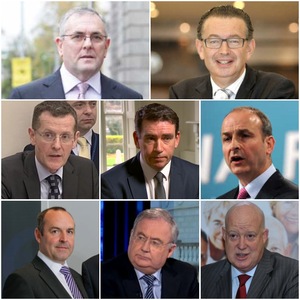
Left to right (row one): Fianna Fail TD John McGuinness, solicitor Gerald Keane; (row two) Comptroller & Auditor General Seamus McCarthy, Fine Gael TD John Deasy, Fianna Fail leader Micheal Martin; (row three) Noel Brett, formerly of the Road Safety Authority, former Labour leader Pat Rabbitte and former general secretary at the Department of Justice Brian Purcell
On Monday.
The Disclosures Tribunal – which is examining allegations of a smear campaign against Garda whistleblower Sgt Maurice McCabe – is scheduled to resume at Dublin Castle at 10am.
It will be first hearing from Fianna Fail TD John McGuinness.
Mr McGuinness claims that, on January 24, 2014 – the day after the then Garda Commissioner Martin Callinan made his infamous “disgusting” remark about Garda whistleblowers John Wilson and Sgt Maurice McCabe at the Public Accounts Committee – he met Mr Callinan in the carpark of Bewley’s Hotel in Newlands Cross and that Mr Callinan told him Sgt McCabe abused his children and nieces.
Mr McGuinness was the chairman of the Public Accounts Committee at the time and Sgt McCabe was scheduled to appear at PAC – to discuss the penalty points issue – a short time later (on January 30) – despite efforts by Mr Callinan to prevent this appearance.
In relation to Mr McGuinness’s claim, the tribunal has already heard that Mr Callinan has told the tribunal the following:
“I did not at any time state to Mr McGuinness that Mr McCabe had sexually abused anyone or that he was not a credible person… I never at any stage indicated to Mr McGuinness that Sergeant McCabe had sexually abused family members.”
In addition, the Comptroller & Auditor General Seamus McCarthy is also to appear next week.
Readers will recall Mr McCarthy has told the tribunal that he met Mr Callinan at the PAC meeting on January 23, 2014 and that…
“Commissioner Callinan referred to Sergeant McCabe by name and made statements to the effect that Sergeant McCabe was not to be trusted, that he had questions to answer, and that there were allegations of sexual offences against him.”
In his response, Mr Callinan said:
I did not at any point state that Sergeant McCabe was not to be trusted nor that he had questions to answer. I did not state that there were any allegations of sexual offences against him.
As it stands, the witness list includes the following:
Monday, April 9: Fianna Fail TD John McGuinness and Garda Paul Hynes – former Garda Commissioner Martin Callinan’s driver.
Tuesday, April 10: Comptroller & Auditor General Seamus McCarthy, Fine Gael TD John Deasy, Noel Brett, former of the Road Safety Authority.
Wednesday, April 11: (no sitting).
Thursday, April 12: Solicitor Gerald Keane, retired Chief Supt Diarmuid O’Sullivan, director of communications at An Garda Siochana Andrew McLindon.
Friday, April 13: Mr McLindon (continued).
Monday, April 16: Fianna Fail leader Micheal Martin; former Labour leader Pat Rabbitte, John Kennedy, Superintendent Frank Walsh (former Garda Commissioner Noirin O’Sullivan’s private secretary) and former general secretary at the Department of Justice Brian Purcell.
More to follow.
Previously: Disclosures And Non-Disclosures

This evening.
Spotted in an unspecified Aldi.
Steve writes:
Emm…. really??? This is a thing? #aldihasitall

Tom Lyons tweetz:
“So this happened in INM…”
Meanwhile…
What is remarkable about this is how long it has taken @RAE_Stephen to get stuck in on the behalf of his colleagues to get answers from management…hopefully he will issue a full statement after the meeting to explain what went on.
— Tom Lyons (@TomLyonsBiz) April 4, 2018
Earlier: ‘Arguably One Of The Largest Data Breaches In The History Of The State’

Harry Browne, lecturer at the School of Media at Dublin Institute of Technology
In Village magazine…
DIT lecturer Harry Browne writes:
…media (like healthcare) have a capitalism problem, and that everything from fake news to clickbait to inadequate investigative resources to Denis O’Brien flows from that basic source. But you don’t have to agree with me and name the underlying problem as capitalism to understand that there are structural causes for crises such as the one that erupted recently over Government ‘advertorial’.
“I believe the Government is attempting to exploit the difficulties many local and regional titles are facing to promote their party interests”, said no less a media critic than Fianna Fáil’s Timmy Dooley, the party’s spokesman on communications. (How sweetly old-fashioned that word ‘communications’ can sound as it grapples with the changing world.)
Media literacy, if it is to be of any use, has to do more than implore us to look for the little ‘special feature’ tag on the top of a piece of paid corporate or government puffery, then to regard the ‘journalism’ below with due scepticism.
It must mean understanding ‘the difficulties’ for all journalism that operates in the current market, especially one in which technological change has accelerated existing trends toward blurred lines, and in which advertisers have alternatives to local and regional newspapers when it comes to reaching eyeballs.
If the most poignant aspect of that brief, quickly snowed-under ‘Ireland 2040’ crisis was the image of the Taoiseach issuing guidelines for labelling advertorial content – guidelines of which the most callow intern in a local newsroom should surely already be aware – we shouldn’t lose sight of the fact that media have been operating at the edges of such guidelines for decades, for the benefit of advertisers looking to buy a little ersatz editorial credibility. How can this fail to be a lesson about how fragile, at best, any such credibility has become ?
As the media may or may not have told you, global research shows trust in media is in tatters – media are less trusted than governments, NGOs, businesses – and Irish people are at the mistrustful end of the distribution. In this context, media literacy can hardly consist of legacy media saying ‘trust us, not them’.
What can be done ? (Yes, short of getting rid of capitalism.) Anyone who has worked in a newsroom knows what a frightening prospect it would be to try to earn the public’s trust with transparency and accountability about our editorial practices.
On a daily basis, contingent and incomplete information is transformed into definitive statements of ringing certitude. That’s one sausage factory we don’t want you to see inside, especially since the work often consists of sticking our label on someone else’s meat.
The irony is that the technology often over-simplistically blamed for creating the journalism crisis has long offered tools for remarkable transparency, tools that most journalists have chosen to use only in limited ways…
Read in full: Capitalisteracy (Harry Browne, Village)
Earlier: The Great Irish Fake-Off

