Author Archives: Chompsky

A dialogue-free ink-on-paper short by east London based animator Elizabeth Hobbs, based on the Grimm Brothers’ ‘The Fisherman And His Wife’.

As in the original fairytale, an enchanted flounder offers to improve a fisherman’s life in exchange for sparing his own but – again and again –  both are thwarted by the outrageous, spiralling demands of the fisherman’s wife.

Of course, it’s all a metaphor, and if you watch closely in the final minute, you’ll see what for.

shortoftheweek

Behold: the ‘NASA Motorcycle’ – an entirely conceptual lunar hog by Russian designer Andrew Fabishevskiy.

The dashing astronaut on the go gets: a long wheelbase moon-bobber with an elaborate tubular trellis frame, all wheel drive to fat tyres, fore and aft swing arms and a saddle composed of a soft sphere below a series of straps.

Kinky.

hiconsumption

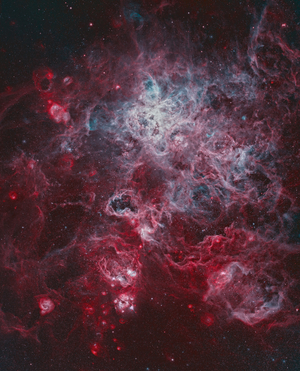
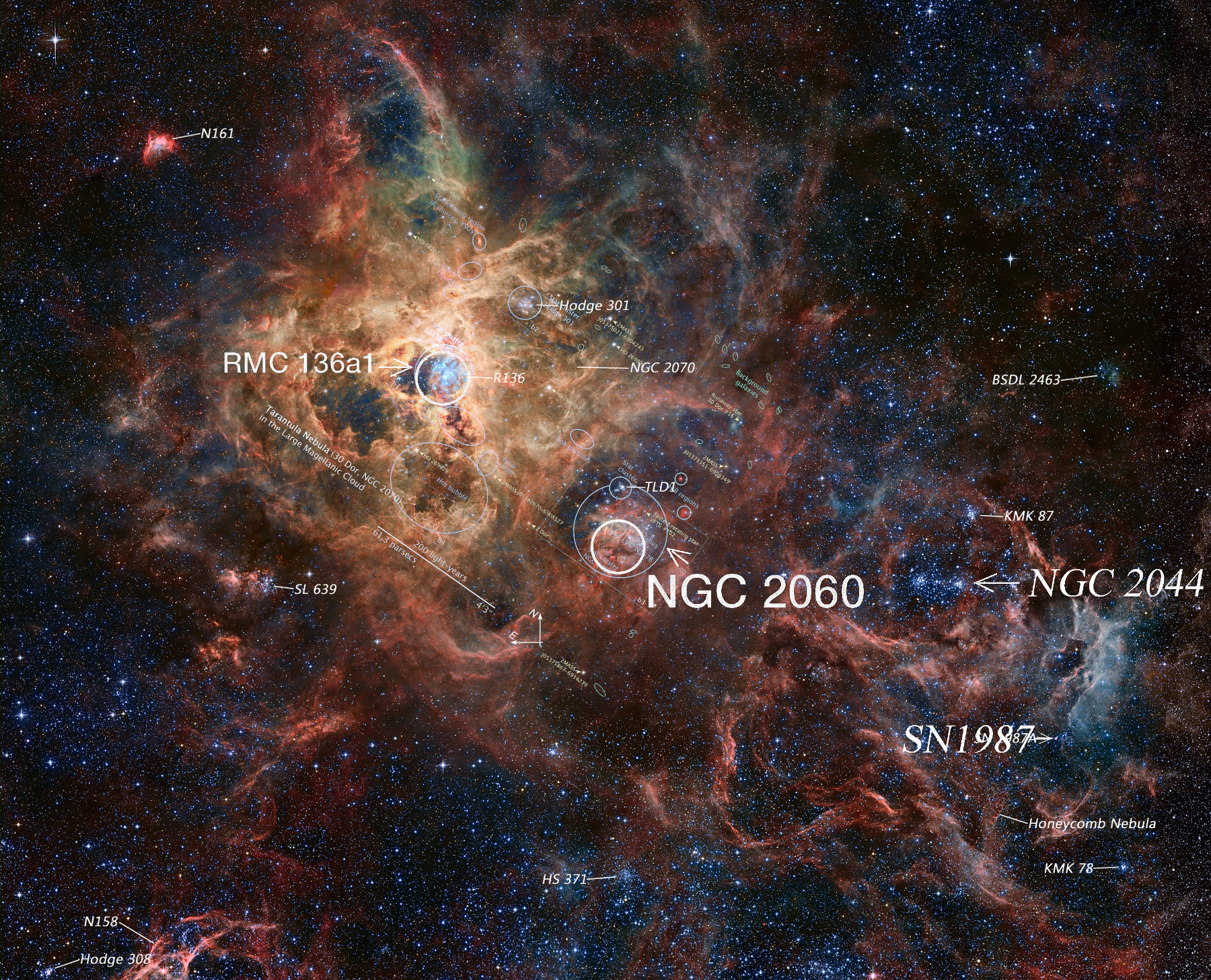
Behold: NGC 2070, aka 30 Doradus, aka, the Tarantula nebula – a giant star forming region within the Large Megellanic Cloud near 1000 light years from side to side. You don’t want to accidentally stray in there. To wit:

About 180 thousand light-years away, it’s the largest, most violent star forming region known in the whole Local Group of galaxies. The cosmic arachnid sprawls across the top of this spectacular view, composed with narrowband filter data centered on emission from ionized hydrogen and oxygen atoms. Within the Tarantula (NGC 2070), intense radiation, stellar winds and supernova shocks from the central young cluster of massive stars, cataloged as R136, energize the nebular glow and shape the spidery filaments. Around the Tarantula are other star forming regions with young star clusters, filaments, and blown-out bubble-shaped clouds. In fact, the frame includes the site of the closest supernova in modern times, SN 1987A, right of centre. The rich field of view spans about 2 degrees or 4 full moons, in the southern constellation Dorado. But were the Tarantula Nebula closer, say 1,500 light-years distant like the local star forming Orion Nebula, it would take up half the sky.

(Image: Ignacio Diaz Bobillo)

apod

Behold: the BMW Definition CE04 – a first-of-its-kind mid segment electric scooter from Motorrad (which already does a maxi-scooter and a concept bike).

A long wheelbase for stability, a step-through upright riding position and a large screen for GPS and systems control.

Proof of concept for now, and still testing, but production should follow soon. 

uncrate

Behold: NGC 5866, aka, M102, aka, ‘the Spindle’ – not the thinnest  galactic disk in the Universe but, seen edge-on from the perspective of our own Milky Way, pretty damn svelte all the same. to wit:

Classified as a lenticular galaxy, NGC 5866 has numerous and complex dust lanes appearing dark and red, while many of the bright stars in the disk give it a more blue underlying hue. The blue disk of young stars can be seen extending past the dust in the extremely thin galactic plane, while the bulge in the disk center appears tinged more orange from the older and redder stars that likely exist there. Although similar in mass to our Milky Way Galaxy, light takes about 60,000 years to cross NGC 5866, about 30 percent less than light takes to cross our own Galaxy. In general, many disk galaxies are very thin because the gas that formed them collided with itself as it rotated about the gravitational center. Galaxy NGC 5866 lies about 44 million light years distant toward the constellation of the Dragon (Draco).

(Image: NASA, ESA, and The Hubble Heritage Team (STScI/AURA); Acknowledgment: W. Keel (U. Alabama)

apod