

Author Archives: David Langwallner

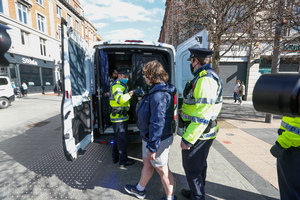
From top: Covid protest in Trafalgar Square, London, England last month; David Langwallner

I have been asked to do something about Summertime in England since I am here and, objectively and subjectively, involved in much. A watcher at a fin de siècle reset, I have not  been expressly asked for optimism but intend to offer some, although said quality will be tempered by realism and clinical cold judgment and I am a cold, judgmental human being at one level.

The Van Morrison song Summertime in England, one of his greatest songs and a perfect expression of his Celtic Protestantism, or is that mysticism, invokes King Arthur and Avalon.

The Glastonbury legend has the boy Jesus and his uncle Joseph of Arimathea building the first wattle and daub church on the site of Glastonbury Cathedral. So mystic, magical, and Christian traits, are all part of the British character and many are evident now, including some deceptive  traits such as sorcery and disinformation.

Shakespeare writes in IA Midsummer Night’s Dream:

“Are you sure/That we are awake? It seems to me/That, yet we sleep, we dream…”

And, in fact, the living or the living dead of zombie capitalism are not fully awake but often sleepwalking somnambulistically into the abyss, as the legendary Austrian writer Hermann Broch accurately predicted in a similar age of corporate fascism. A state between sleeping and waking is implicit in Shakespeare’s remark.

It is highly noticeable how many of my legal cases now involve derealisation, a psychiatric condition and potential defence related to being a spectator in one’s own life and living in an altered or hyper real state of reality. Well, what is real and fake, now difficult to judge?

Stay safe with unsafe vaccines of unproven utility with variants to come and the drug companies profit at our expense. Vaccine passports to restrict movement and divide the world and to curtail leisure activities. Checks at every border. Clean or unclean. Infected or impure. The division, cartelisation and obliteration of humanity and the attitude of our power brokers under neo-liberalism. Well, summertime in England.

There is a very famous American book by an American James Agee and a photographer Walker Evans called “Let Us Now Praise Famous Men” published in 1941. The phrase is, of course, religious (Jewish) in origin and in its fullest is “Let Us Now Praise Famous Men and the fathers that beget them”.

I am always, of course, deeply distrustful of the incantation of religious phrases and resistant to same, though I admire Agee greatly and he is curiously relevant for our time.

The book, partially state-funded, chronicles dustbowl America and Evans adds the pictorial record of the devastation wreaked by the great economic depression in the dustbowl of America. In terms of the picture of Walker Evans, it is noticeable how grim the faces are and how anguished the expressions, particularly on the faces of the children, highlighting lives lost or marginalised. Lives lost by neglect and the attrition and degradation of poverty.

Austerity, as is well documented in our present age, murders people by stealth through the gradual removal of all forms of social support. And emergency workers, lawyers or NHS workers, might share the same fate and whatever ramparts of social protection did exist have been whittled away by Covid.

As far as that economic system was concerned, these sharecroppers were surplus commodities, as are you, to many of them. Not one of them.

Les Misérables, adapted from Victor Hugo as a musical, is so intrinsic to the delicate boundaries between high and low art in the UK that it defines in many ways, or did the consensus, of the British culture. The uneasy line between kitsch, depth and lightness and meaning now somewhat lost. More to the point, Les Misérables is about protecting the little people.

The wretched of the earth have nowhere to go in lockdown with lockdowns to come. In fact, the wretched of the earth are the earth. And with variants to come in the endless and, obviously partly fabricated, shock doctrine of our universe.

But should you Stay Safe in your boltholes, or self-immolate in increments, death on the installment plan, or commit suicide as Stefan Zweig and Walter Benjamin, a bow to my Austrian heritage and a presager of the nearest comparable age, did?

Les Misérable is about but the persecution of Jean Valjean by the vengeful prosecutor. Valjean, as in the book, is chased to the ends of the earth for the theft of a loaf of bread while the brokers of power protect those who rape and despoil the universe. Prosecute the petty criminal but presidents get enriched by Goldman Sachs.

Covid, as Mr Farage says, creates opportunity. Well, where there is chaos, as chairman Mao, another presager of Chinese corporate capitalism, said, there is opportunity, and I am sure Mr Farage would understand.

The press, meanwhile, increasingly sanitised and committed to balanced coverage misunderstand balance. There is no such thing often as balance in our post-truth age with an internally censured and corporate press. The culture of dissidence and dissent gradually being marginalised and expurgated from our culture, though less so in Britain.

Thus, the educated and empowered little men and women have much less power than they think. Beautiful, hyper-educated creatures talking about relationships, knowing all the best art and cinema and powerless. Obsessed by marginal consumerist issues.

The justification of more executive powers is extremely dangerous when disproportionate measures are introduced to counteract a wildly overstated emergency, and pander to a worrying trend of compliance, or what is  called ‘anticipatory obedience’. Compliance for the sake of compliance and security.

More to the point, precious liberties are now being accepted as tradeable, to use a marketisation expression, for security or survivability. And, increasingly, that is how a docile or controlled population is now accepting.

Now the UK wishes to criminalise public interest disclosures by journalists, curtail protest by subjective assertions and introduce ouster clauses to usurp the jurisdiction of the courts.

Lord Sumption has argued bravely and recently in a codicil to his new book Law in A Time of Crisis (2021) that the over-compliant UK population are surrendering hard-won freedoms and liberties on a misplaced need for security. They are being manipulated by propaganda and increasingly controlled by executive decree and the scale and rapidity with which a nominal authoritarian democracy is being fabricated, breath-taking. I agree. And Ireland even more so.

So, the Les Misérables of the universe of venal corporatism and state authoritarianism need to reclaim what Habermas calls the public sphere and realise as he argues, as did Gandhi and Martin Luther King, that disobedience against tyranny is necessary.

So, in summertime, stay positive and social. Protest, organise, dissent, regroup. Fight for your rights against inevitable environmental and economic destruction. Fight for every penny and every ounce in coronavirusland. Do not allow yourself to be manoeuvred into destitution. For influence and talent is still power and there are independent vectors, however dwindling, to fight back.

It may be futile. As Puck speaks to Oberon about the humans that have found themselves in the forest, he despairs at the human intellect.  In A Midsummer Night’s Dream, the full line is:

“Shall we their fond pageant, see? Lord, what fools these mortals be!”

David Langwallner is a barrister specialising in public law, immigration, housing and criminal defence including miscarriages of justice. He is emeritus director of the Irish Innocence Project and was Irish Lawyer of the Year at the 2015 Irish Law Awards. Follow David on Twitter @DLangwallner

Getty

From top: Van Gogh self portrait (1889); David Langwallner

Several years ago, an estimable French lawyer and former student invited me to Arles Clara De La Barriere and I accepted. My abiding memories of the same are mad driving, utter unbridled conversation and constant chain smoking, a similar experience Clive James had with Francoise Sagan, the author of Bonjour Tristesse (1955).

On a disconnected note, but seriously relevant at one level, in the University Milan, where I gave an Innocence Project talk, Professor Luca Puparia, an estimable man, but I suspect a deeply religious man, took me to a lovely little church full of Christian bones and skeletons, an ossuary. Perhaps it was a lesson, or an intimation of the sort of lesson I have always resisted in Ireland and will continue to resist as the light dies for many in these awful times.

Santuario Di San Bernardo, just a 10-minute walk from the Duomo, but it was a world apart.Well, I do not want to meet my maker yet, Luca, and not be thrown to the lions by religious or corporate fascists or mad dog police officers or neo-conservative socialist totalitarians. Eros not Thanatos. I have a lot more to offer and they do not, nor ever had they anything to offer. Worth nothing. But they are running Ireland, the Neo Liberal Universe and now the world. As The Irish Times publishes an infomercial for the Chinese way of life.

More to the point, like Christopher Hitchens expressed beautifully in Mortality, I am afraid I shall resist conversion. It is uncivilised and I am unsaveable? There is no afterlife? The persecution of the Christians evident in the ossuary is yet another example of awful human barbarism such as the Crusades or the destruction of Inca civilisation by venereal disease, on behalf of the church. But with compassion, Christian or secular, l vote in favour of keeping one’s options, like Voltaire, open.

More pertinent in Milan is Santa Maria Dele Grazier, thrice seen, and of course Da Vinci’s restored but battered Last Supper. Now, I am not a fan of the clunky prose and dubious speculations of Dan Brown but, if one looks closely at the figure of Judas, it is in fact a woman, in my view, so arguably the suppression of the church of the gospel of Mary Magdalene among other suppressions is relevant.

And the church, of course, has much to conceal. The suppression and concealment of the church of sex abuse but, even more pertinently, financial corruption. The settlement of the Magdalene Laundries, long after everyone is dead, but no compensation to be awarded as the statute of limitations has expired and all that remains is the comfort of souls. The madness of Catholicism; the spiritual statute of limitations; token atonement well after the event; and a state apology of mixed emotional resonance and dubious sincerity without financial implications. The awfulness of the Irish state and their apparatchiks who write cover-up reports.

I visited another Catholic bone ossuary subsequently in Kunta Hera in the Czech Republic when a visiting professor. I am a terrible cultural omnivore, and it had the same effect in terms of memory and reflection, memory of the history of infamy as detailed above.

But, of course, the main reason for the visit to Arles if she, Clara, will allow me to say so was not her delightful presence and the fascinating discussion, but the opportunity to visit Avignon which, apart from all other cultural reasons, is the home of Vincent Van Gogh or rather the end of his career in an asylum near Avignon in Arles.

Vincent van Gogh thus had his final days in a sanatorium for the mentally ill before, of course, slashing his ears and killing himself, well documented in a succession of paintings. The fate of many artists or creative people in our time.

In Arles, there is a newly constituted Van Gogh museum with several often-reproduced paintings but some originals. While I was visiting, a rainstorm hit and I was caught in the museum in Arles.

Van Gogh’s Wheatfield (1889)

From the window, at mid-level, I saw in absolute particularity, Van Gogh’s most famous painting (above) and the crows did in fact rise in the rainstorm and it was exactly thus. But ominous.

Now, he is much celebrated as one of the great romantic expressionists artists and the works are incredible – best seen in the museum in Amsterdam, the most ambiguous of cities with its ordered Protestantism and utter decadence hand in glove. I prefer British Puritanism to Dutch, as it’s less ambiguous and at least one knows what one is meeting.

The association of mental illness or dysfunctionality with great artistry is overly romanticised but one must understand that there is symmetry between genius and a degree of social awkwardness and obsession. And Vincent seems curiously prescient for our times. Why?

First, I think the emphasis on simple café-side simplicity and convivial company in increasingly fraught times is important. Simplicity of living, if possible, and sociability is now exceedingly difficult – even as a barrister taking human, but not humane, remote instructions.

Second, the great representative paintings are about either self-inflicted human suffering or about the simplicity of nature, as in the crows breaking over the cornfield, though a dark image of flight and departure.

The Sunflowers, in their many forms and incarnations, are a kind of atavistic return to the primeval and that which is essential in human existence. Chrome yellow, environmental roundedness as the sunstorm hits over Vancouver causing heatstroke deaths in the most liveable city in the planet?

The best representation of The Sunflowers is in the Courtauld Gallery in London, in my view, or the Met in New York which I also had the privilege of visiting on an Innocence Project trip to Manhattan.

But starry night, sunflowers, cornfields, simplicity of living and human interaction. A return to the light and real human value of aesthetic appreciation of the environment and simple living, moderate values even religious, a sense of justice, the avoidance of destruction but also of destructive capitalism.

However, our most severe condemnation should be reserved for: Those that murder (for that is what it is) children and babies in the Magdalene Laundries and cover them up in useless reports and time delays with a very belated and pointless acts of apology, whilst enlisting statist lawyers to invoke the statute of limitations.

But is there a statue of limitations on slavery including but not limited to child trafficking, infanticide  and frankly torture? Such are obligations Ergo Omnes and Crimes Against Humanity.

It is children and vulnerable adults who suffer the most in this twisted universe denied worship, movement and liberty. Much of the world is  turning into a Magdalene ossuary while many are driven to the insane asylum.

So, Vincent is relevant and those of an increasingly narrow centre have much to say and need to be taken seriously.

David Langwallner is a barrister specialising in public law, immigration, housing and criminal defence including miscarriages of justice. He is emeritus director of the Irish Innocence Project and was Irish Lawyer of the Year at the 2015 Irish Law Awards. Follow David on Twitter @DLangwallner

Paintings via Van Gogh Museum

From top: Ballymun tower blocks in the 1960s; David Langwallner

I recently concluded a Crown Court Case with 16 defendants in an Inner London Crown Court which was effectively a drugs conspiracy trial of the young with some heedless older models. I am very much mindful of such social developments, having seen them in Dublin and the way they have corroded and destroyed the social structure in Ireland.

This is known in South America as the Pixote phenomenon. The radicalisation or corruption of the young. The degradation and the massacre of the innocents. Little Toy Soldiers.

It is based on the exploitation of young and often deprived people, sometimes in care and often, without generalisation, in dysfunctional family units. It is based on abuse and coercion and grooming, similar in a way to sex exploitation, and is an awful feature of our woe begotten times. In fact, it has led to a potential new defence in criminal justice terms of ‘modern slavery’. Usually applicable to the last person in the indictment or the ‘runner’.

It is an urban transplantation from the Third World to the First World, endemic across Southeast London and the Northside of Dublin, with younger gangs also trafficking the drugs across county lines in England. I recently gave a broadcast on RT UK in this respect arguing that the drug culture is now an all-pervasive social problem which the neo-liberal agenda has created and enhanced.

How? When you don’t invest or give people proper jobs or opportunities, ghettoise and marginalise them and treat them like animals, how do you expect them to behave? With the lure of consumerism and endless media barrages of lifestyle choices, hedonism, and easy money? A vicious circle and a Catch 22. Accentuated by Coronavirus.

In this respect, having role models or elements of personal discipline is important. But who is the role model, and can they impose their good values on you? Or you on yourself? Can you, at one level, break a dependency on gang culture?  A vicious cycle or circle.

And what is a gang? Can you avoid becoming a corporate lawyer for that, in my view, may be a different form of gangsterism.

Now through my various representations and through my involvement with the Innocence Project, I have had extensive experience with gang culture. A rather dangerous visit to South Los Angeles with the project should establish my credentials in this respect.

I am non-judgmental and understand the Marxist analysis that poverty and the lack of opportunity, allied with consumerism, creates this desire for emulation which leads to the drug industry. I also understand that all of us need to exercise a level of personal responsibility without going overboard. Though when blathering, right-wing idiots rabbit on about law and order well, I AM SCEPTICAL their deeply right-wing ideology contributed to the creating of the problem in the first place.

The drug problem in Dublin, for example, was in effect a failure of urban planning, putting people in tower blocks in Ballymun and elsewhere which created drug-infested infernos. people were moved from a local community with a sense of community to anonymous tower blocks. The London Drug Problem is no different.

I have written extensively about Catholicism and the mafia culture it engenders. More to the point and this I think distinctly relevant, as Roberto Saviano, the expert in the Italian drug trade and his book “Gomorrah” (2006) demonstrates, are the economics and indeed organisation of drug cartels.  Saviona wrote a subsequent book called “Zero, Zero, Zero” (2016) which makes the following incredibly significant points:

1: The drug cartels of South America and Italy among other places created a model of business organisation and funding that corporate organisations have emulated. What difference in moral terms is there between vulture funds, Goldman Sachs, and drug barons? None. The business of America is business. Or of Ireland or, more pertinently, of China.

2: Said model has become, both in ruthlessness, the Omerta code and indeed drug economics, a model for corporate business organisation. The transnational vulture funds of Canadian and American origin destroying Ireland are, in fact, morally drug cartels.

There is, in fact, no distinction between Steve Bannon, the late Peter Sutherland and Pablo Escobar in moral terms. In terms of organisation corporate law firms and the merchant bankers share the same dynamic with the drugs trade. Different forms and emanations of criminalisation.

So, if we have a Proceeds of Crime or POCA Statute or Asset Forfeiture Act, subject to safeguards, why use it against minor drug dealers when it needs to be used against the banksters and Goldman Sachs since of course they have adopted and emulated the modes of organisation and mentality of the drug trade and have caused the drugs trade or augmented same and unquestionably profited from same? And let us be reminded of Bob Dylan’s song Early Roman Kings and the sentiments it invokes.

The drugs of consumerism and corporate liquidation, to paraphrase a British pop song, do not work and in fact they blur people’s moral intelligence.

Sorrentino’s film Il Divo (2017) is about Andreotti the Christian democrat Divo. Prime minister eminence grise and ruthless criminal in league with the mafia. Pious Catholic and gangster, the perfect toxic combination. Christian fundamentalism, gangsterism and mafia drug money destroying the social fabric in Italy a model now exported all around the world.

In fact, the protection of the young against exploitation is called the Palermo Protocol and it is a beautiful pious document of the international sanctioning of abuse, coercion and grooming over-riding real or putative consent.

An anecdote: I visited Sicily and when in Palermo stayed in a beautiful old hotel with a golden bath frequented by Elizabeth Taylor and Richard Burton for £40. Why? I arrived and wished to go and see a famous restaurant recommended by Peter Robb in his book Midnight in Sicily (1996). It was just around the corner, a five-minute walk.

“Oh no, Sir, we will get a taxi the alleyway is bad,”  I was told. The resonance hit me. “Well you can walk left and round about it will be 45 minutes or you can take a cab which will take 15 minutes. It is a beautiful drive,” they said.

And it was. When I arrived in the restaurant with the fantastic Sicilian dish recommended by Robb of Pesto Al Sarna, the adjacent table has a mixture of the incredibly old and the incredibly young and lots of guns on the table and the alleyway the hotelier referred to… well there was audible gunshot in the drug crucible. Like Sicily, in general, beauty and repulsion simultaneously.

A trip from Palermo to Agrigento showed the classic mafia and corporate methods enshrined that which blend into one another and destroy the social structure. The drive into Agrigento is full of half-finished buildings. Not finished because of backhanders to the mafia.

So, investment in the young is now necessary, and real, not cosmetic, opportunities are necessary. If not provided, we allow further county lines developed in half-completed or derelict buildings, a point the author of the recent book also makes.

The environment in urban planning and opportunity creates high self-esteem and environment is everything needed to create appropriate adults. Beautiful spaces and buildings create balanced, adjusted people, as Alain De Boton rightly argues in his book about buildings and urban spaces. The Architecture of Happiness.

And we are rendering housing, both for the rentier and mortgaged class, impossible in Ireland. We are destroying generations from living happy and fulfilled lives on the road to an ever-compliant mediaeval feudalism.

David Langwallner is a barrister specialising in public law, immigration, housing and criminal defence including miscarriages of justice. He is emeritus director of the Irish Innocence Project and was Irish Lawyer of the Year at the 2015 Irish Law Awards. Follow David on Twitter @DLangwallner

Pic via Irish History

From top: Oliver Cromwell (left) and Samuel Pepys; David Langwallner

I have just completed a successful case, from the defendant’s point of view, in the sleepy market town of Huntingdon, Cambridgshire, which, from distant election broadcasts, I had appreciated was John Major‘s seat.

That was the extent of my initial knowledge. Perhaps there is a gap in my education, as it is the birthplace of two of the central British figures most relevant to our age: Oliver Cromwell and Samuel Pepys.

It is, in fact, like Sleepy Hollow, a kind of hangover from a Tim Burton film with an odd karma. Kind of half-museum theme park and half-dilapidation. But for the historic buildings, it’s not unlike a rural Bray. The land of the triffids.

Well, we all are now in that space and my co-counsel had not done a trial in person in 18 months. Mars attacks: Coronavirus Part 3.  The Indian variant with variants to come as convincing as Jaws: The Revenge (1987) , which I have kindly not  brought up with Sir Michael Caine as he saunters into my nearby Waitrose in Leatherhead, Surrey. Of that shark sequel he once said:

“I have never seen it, but by all accounts, it is terrible. However, I have seen the house it built, and it is terrific.”

Well, is that not the impetus behind the drug companies and the siphoning of wealth to the mega rich, further accentuating social division and compliant anarchy.

And that house in Leatherhead is now on the market. Well, Sir Michael is not stupid.

Ireland, of course, has always viewed Cromwell as a genocidist not to put too fine a point on it. He was also, of course, a regicidist. And a little plaque outside The George Hotel in Huntingdon shows that, during the religious wars, the soon-to-be executed King took refuge here. A brief respite in the storm before his execution in 1647.

The wars, of course, were religious and Cromwell was the defender of British Protestantism and dissent. So, his legacy in the UK of puritan principles is much greater and rounded and more ambivalent than in Ireland. His birthplace is also here in a reconstructed old folk’s home, currently restricted in visitation by Covid restrictions, though his actual house is in nearby Ely which I also visited.

At one level, the glorious revolution was an objection to extremism and a celebration of religious difference which is worth remembering in an increasingly divisive and extremist age, not least divided by religion. As religious fundamentalism is in the ascendent, Huntingdon reveals ever more messages for our age.

Cromwell, it must be said, was largely tolerant of other fractious Protestant sects –  “God’s Peculiar” – though not Quakers nor Ranters. He was also tolerant and encouraged, in effect, the readmission of the Jewish population, though not Catholics.

He certainly was also not tolerant of witch hunts. In 1649 Cromwell led an invasion force into Scotland to stop the Kirkland-led Scottish witch hunt, a witch hunt it should be said by Protestant extremists. But he was finishing off the glorious revolution when the ‘Witchfinder General’ Matthew Hopkins murdered 11 witches in Huntingdon where the Cromwell Museum now has a flagship exhibition.

‘This year is the 375th anniversary of the visitation of one of the most sinister figures in 17th century history to Huntingdon, the infamous and self-styled ‘Witchfinder General’ Matthew Hopkins. In May 1646, several people from the county were accused, tried, and found guilty of witchcraft; condemned, and executed. A display tells their story and includes rarely seen contemporary documents relating to the accusations and a local clergyman’s attempts to stop this persecution.’

The Cromwell Museum Huntingdon. Notice For a Present Exhibition.

It should be noted how moderate or considered Cromwell’s stance was, in context, as three witches in 1593 had been executed in Huntingdon for the murder of his grandfather’s second wife. The cult film Witchfinder General with Vincent Price (1968) is worth checking out as we enter an age of kitsch and grand guignol and disinformation.

People were led to believe that witches copulated with the devil – as bizarre as some of the untruths toda – as Witchfinders by Gaskill (2006), available in the Cromwell bookstore, intimates. Confessions were often induced by compliant poverty as consent is, in our day and age, forced or false confession as The Innocence Project has now flagged.

So, an authoritarian moderate as far as those who were not Catholics but no egalitarian and as a man of high birth, Cromwell did not endorse those working-class Protestants who fought for it, the Levellers. The revolution was ultimately, in Marxist terms, a middle-class revolution.

In Ireland, Cromwell was ruthless and hated Catholics. After the sieges of Drogheda, he refused to accept surrender and massacred over 2,500. He said re said butchery with butcheries to come:

“I am persuaded that this is a righteous judgment of God upon these barbarous wretches, who have imbrued their hands in so much innocent blood and that it will tend to prevent the effusion of blood for the future, which are satisfactory grounds for such acts which otherwise cannot but work remorse and regret.”

In effect, subhumans do not warrant human compassion. So those who invoke him as a hero should be careful about his demonisation of others. Puritanism or Brahmanism of all shapes morphs far too easily, as I wrote in a review of Geoffrey Robertson’s autobiography for Cassandra Voices into an uber mensch sense of rightness and a binary Manichaean division of the universe. The Kingdom of your heaven secular or religious, or your ideology, justifies your actions or rather those who have God or right on their side can do no wrong. For Cromwell, read Blair or any Jihadist fundamentalist.

In 1660, after death, his remains were exhumed and hung drawn and quartered. His head rehoused in Sidney Sussex, Cambridge for which he was also an MP. It should, of course, be noted that what Cromwell did to Drogheda is not that different to what Canadian and American venture capitalists, with their Irish aides de camp, are doing to Ireland.

Samuel Pepys, a near contemporary and a fellow Huntingdon resident whom one likes a lot more and much the greater man, whose house I visited of which more later, wrote the following in his diary about the exhumation of Cromwell:

‘This day the Parliament voted that the bodies of Oliver, Ireton, Bradshaw, & company should be taken up out of their graves in the Abbey, and drawn to the gallows, and there hanged and buried under it: which (methinks) do trouble me that a man of so great courage as he was, should have that dishonour, though otherwise he might deserve it enough.’
.

A rather nuanced assessment, as is want, in the greatest diarist the English language has produced. Pepys’ Diary also references, at great length the bubonic plague.

By August 1665, he was certainly concerned though diary references date from April of that year. He cited the bill of mortality as having recorded 6,102 victims of the plague but feared “that the true number of the dead this week is near 10,000,” mostly because the victims among the urban poor were not counted. Then, as now, statistics lie or are concealed. And the poor die unrecorded or of related diseases or ineffective vaccines or products of dubious utility or of non-supply, and in Brazil now in droves.

By mid-September, all attempts to control the plague were failing, Pepys notes. Quarantines were not being enforced, and people gathered in places like the Royal Exchange. Social distancing, in short, was not happening. Le Tout Ca Change. Unlike the Roundhead, Cromwell, the British Cavalier tradition still is remarkably resilient. And that’s largely a good thing.

Pepys was equally alarmed by people attending funerals despite admonishments. Having participated in a coffeehouse discussion about “the plague growing upon us in this town and remedies against it,” he could only conclude that “some saying one thing, some another”. Confusion abounds now also and disinformation. Popular misconceptions. And surely people should be entitled to attend funerals and religious ceremonies as our sense of humanity dwindles?

During the outbreak, Pepys was also overly concerned with his frame of mind; he constantly mentioned that he was trying to be in good spirits and his diary is most instructive in that respect.

On September 14, for example, he wrote that hearing about dead friends and acquaintance…

“…doth put me into great apprehensions of melancholy… But I put off the thoughts of sadness as much as I can”.

He was, in fact, a man of great fortitude and survived a major operation without an anaesthetic. For a small effete human being, he was extraordinarily courageous. Well, the weak can be strong and the Cromwellian brutalised strongman dangerous.

During the plague, the fear of the outsider loomed large, and Pepys found that when he left London and entered other towns, the townspeople became visibly nervous about visitors. Facts I have noticed in my two recent circuit trials in Huntingdon and Leamington. This is a time for absolute caution and prudence in human affairs.

“They are afeared of us that come to them,” he wrote in mid-July, “insomuch that I am troubled at it.” And, yet, he was willing to risk his health to meet certain needs that the puritanical Cromwell would not have approved of.

By early October, he visited his mistress without any regard for the danger…

“…roundabout and next door on every side is the plague, but I did not value it but there did what I could con Ella.”

Well, the rites of spring and summer will no doubt open in what will, at best, be a lull in the storm, now deferred in the stop-start compliance universe. The puritan and Brahmin Cromwell would no doubt have condemned such pleasures of the flesh.

So, as far as the two great inhabitants of Huntingdon are concerned, the messages for our time are those of plague; protestant moderation though not against sects such as the Levellers; forbearance; official lies and fear and panic in a time of chaos, but also, in fact, a different form of genocide. Death by attrition, neglect and culls. Death by increments and disinformation. And absurd Malthusian ideas gaining a dangerous traction.

We are living thus also in an extreme age of demonisation. An age of witches and witch hunts. Schiff’s book on The Salem Trials, not in the exhibition in Huntingdon, demonstrates how a conventional puritanical or fundamentalist or orthodox thought leads to a hatred of difference and sorcery that starts the problem and creates social sanitisation and indeed cleansing. The hatred of difference and exceptionalism.

The book also clearly shows that those who subscribe to such collective hysteria believe in superstition. Just as they believe in witches, they believe in unicorns, or the world is flat or creationism or… the efficacy of vaccines or the government are only doing it for our benefit.

Satanism, Schiff’s book also makes clear, is that witchcraft is also equated by narrow-minded people with subversion and dissidence. And it justifies torture, dehumanisation, and corporate state-sponsored murder, intentional or reckless.

Thus, Sleepy Hollow Huntingdon had much to say for our age. But all those who are like the Johnny Depp character Ichabod Krane should be wary. The ice age has arrived. A new dark age, non-receptive to a critical intelligence or a truth-seeking investigative force but divided by tribalism, demonisation, and witchunts of all shapes and hues as the world fragments.

And the weather in mid-Summer is most fickle and changeable in Huntingdon. Well does God forgive? And who is, or more pertinently what is, your God anyway? God a la mode. The God of Mammon and caste entitlement?

David Langwallner is a barrister specialising in public law, immigration, housing and criminal defence including miscarriages of justice. He is emeritus director of the Irish Innocence Project and was Irish Lawyer of the Year at the 2015 Irish Law Awards. Follow David on Twitter @DLangwallner

From top: Albert Camus by Henri Cartier-Bresson (1944); David Langwallner

The world is now increasingly being divided between an ever-smaller, dominant, medieval plutocratic class. Between them and the excluded others. Let us call them The Unvaccinated. Only a metaphor, but an important one.

I have written hitherto about how we are descending or reverting to the 1930s in terms of austerity, the rise of fascism and the decline of rational discourse.

Perhaps the most influential text of the 1930’s is Oswald Spengler’s “The Decline of the West” (1926) and the suggestion that much of the blame for the decline of European civilisation could lie on the doorstep of Slavic and ‘degenerate races’.  The prior unvaccinated and impure. The prior degenerate other.

The counterpoint of the argument was that Aryan blue blood, whether Germanic or Anglo Saxon, was the emblem of purity and that the other races corrupted the gene pool. particularly Slavic and Hassidic races. Of course, Spengler influenced Hitler and the snowball of fascism led to the extermination of those undesirable races and the nightmare of the holocaust.

Such matters were hitherto of historic concern and until recently a distant epoch but regrettably this form of Social Darwinism is back in fashion and a new corporatised Shoah of economic liquidation and segmentation, as well as the cartelisation of humanity, beckons, accentuated by Coronavirus.

It will further lead to the demonisation and exclusion of the other and rather than humanise him or her many will not interact with other races and nationalities even in the melting pot. For safety fears, as a result of hysteria or only on specific terms and for specific reasons.

Or rather, all will have to conform to survive, become part of the vaccinated and thus enjoy vaccine data retention tourism. If allowed to travel.

This epidemic will, I predict, only lead to others as the science suggests and in tandem we are facing a depression greater in scope than the 1930s as well as environmental meltdown. In an age of chaos and uncertainty, the power grab of the strongman is evident for all to see.

Intellectual ideas that gain traction are not necessarily good ideas. Social Darwinism and Malthusian ideas are back in vogue. A Gatesian world that thinks in numbers. Where economists and scientists rule.

State authorities and populations are reacting to the present crisis in an overly authoritarian way, either though the direct election of fascists or through an insidious authoritarianism pandering to scaremongering and introducing, through executive action or legislation, an authoritarian creep. The walls are closing in.

We have reverted to what the great Austrian writer Stefan Zweig (who committed suicide as an emigrant from persecution) in his book “The World of Yesterday” (1942)”,  a summary of the 1930s indicated:

“I feel that Europe, in its state of degeneracy has passed its own death sentence.”

And not just Europe.  There is now no haven for the migrant, the dispossessed and the unvaccinated. No shelter from the storm certainly not in Ireland.
.
Albert Camus is now crucial to our time and to the multi-cultural discourse. He was, in origin, a member of the French community in Algeria, doubly despised by the French mainland and by the Islamic majoritarian population in Algeria. He was a Pied-Noir, then, and now, a term of abuse. He had mixed race perspective as do I. and that is the crucial perspective of the outsider.

Camus, of course, was also above all else a product of the enlightenment and the French tradition of letters and reason. A product of Voltaire, with a prose style clipped and epigrammatic, much influenced by Pascal. It is a classic French prose style. Almost ridiculously tight. There is an austerity about it, but also a romantic lyricism born of his mongrel Algerian background. The twinkle was always in this lady’s man’s eyes, as is very evident in the famous picture by Cartier Bresson (at top).

In his writing on Algeria, as in his writings in “The Rebel” (1951) on extremism in the French Revolution, there is distaste for fundamentalism, secular and religious, which then and now is why he is relevant to our time as a cautionary critic of multiculturalism, but also an opponent of extremism such as authoritarian terrorism or state terrorism.

He would have no time for the compulsory imposition of vaccines which the European Court Of Human Rights (ECHR) has now implicitly sanctioned. He would see it as the destruction of freedom. A kind of corporate fascist creep.

It should be stressed in a balanced way that he advocated co-existence between the transplanted French and the native Islamic population and condemned the torture and the death penalty inflicted on the Islamic population by French authorities. Impeccable multiculturalism, but Camus saw clearly that there was going to be a bloodletting in Algeria arising from extremism and he was, of course, right then and indeed now, a new bloodletting is coming.

Those qualities of middle of the road temperance often get run over and railroaded by barbarism, whether fascist or communistic. Pleas for tolerance fall on deaf ears. But that is what is needed: the just man or woman, the legalist in fact, the moderate, the secular humanistic rationalist. The voice of courage and independence, the espousal of absolute human rights against the nonsense of relativism. The secular humanist intellect.

Edward Said, who criticised Camus, is, of course, the great intellect of anti-imperialism of recent vintage. He analyses, in his crucial texts Culture and Imperialism (1993) and Orientalism (1978), how the mission statement of an imperialist agenda is to civilise barbaric races and impose imperial subjection if necessary, by terror and barbarism.

He analyses texts such as Graham Greene’s The Quiet American (1955) and Naipaul’s Bend in the River (1979) to demonstrate how agents of imperialism work and how it morphs into murder, subversion, and the endless instabilities of so-called primitive societies. In a dispassionate way he also attacks virulent nationalism and tribalism. hallmarks of our age.

In a crucial passage at Page 22 of Culture and Imperialism he points out that:

‘Patriotism, chauvinism, ethnic, religious, and racial hatreds can lead to mass destructiveness.’

This perspective is crucial to our age, but now the logic of exclusion is international. Or as psychiatrist  Fritz Fanon put it:

“The Colonial world is a world cut in two.”

Now the entire world. Divided up, cut up and broken into fragments.

The classic colonial text is of course Hearts of Darkness (1899) by Conrad and the central character of the mad Kurtz where the civilising mission turns into barbarism and murder which Coppola recycles into his indictment of the American civilising mission in Vietnam with Brando doing his star turn as Kurtz in Apocalypse Now (1979).

Colonialism also caricatured the myth of the lazy native. Like the infamous Punch cartoons of the Irish at the end of the 19th century.

In The Wretched of the Earth (1961), Fanon is very insightful on degenerate essences and the portal of outsiders as degenerates, but his famous insight of how the wretched of the earth must pay the debts of the occupying powers is now the international model of austerity. Where vast sectors of even the developed world are now easy picking for a corporate colonialism emanating from transnational law firms, corporations and endorsed by governmental and inter-governmental entities such as the EU.

At Page 152 Fanon argues that:

“The people’s property and the people’s sovereignty are to be stripped from them.”

Well, that remark now applies to everybody of all nations. Fanon also demonstrates how mental illness; neurosis and de realisation are aspects of post-colonial subjugation or of austerity which coronavirus will now augment.

Both Fanon and Said have little hope as they internalise the norms of the state and in our Ted Talk universe sing for their supper. More likely they are bought and packaged. Or sponsored by Mr Gates or The Ford Foundation.

When the Black Death came to Europe in the 14th century, cities and towns shut themselves to outsiders – and assaulted, banished and killed “undesirable” people, mostly Jews. There has been a tsunami of racist taunts even in the UK recently and the status of non-nationals increasingly precarious. In fact, in a propagandistic way, the virus has been linked with multiculturalism.

The fascist Hungarian Prime Minister, Viktor Organ, recently announced:

“We are fighting a two-front war: one front is called migration, and the other one belongs to the corona virus. There is a logical connection between the two, as both spread with movement.”

Britain still is probably the last place that there will be rivers of blood and there are still residues of the qualities Camus espoused and that are desperately needed: rationality, rigour, tolerance, humanism.

But it is not just European civilisation that is falling apart. The wretched of the earth is the earth, as I have intimated. The insights of the post-colonial academics such as Fanon and Said gave a partial glimpse. Everybody is now in the same boat.

And now the vaccine passports to potentially monitor data and those who do not take the jab,  outsiders restricted in movement, will be confined to quarters in coronavirus panopticon.

But why should people consent, say, to the demonstrably unsafe Astra Zeneca vaccine and why are we having this dialogue anyway? Well, dummy, many want the world divided into their safe spaces and to be excluded from the others.

The unvaccinated is a metaphor for our time. Minds and borders are closing when they should be opening.

David Langwallner is a barrister specialising in public law, immigration, housing and criminal defence including miscarriages of justice. He is emeritus director of the Irish Innocence Project and was Irish Lawyer of the Year at the 2015 Irish Law Awards. His column appears here every Tuesday and Friday. Follow David on Twitter @DLangwallner

From top: Reggie Kray and Barbara Windsor in the Double R club, east London, 1964; David Langwallner

I had not been to the Thames Magistrates Court or Bow Street Magistrates Court in almost 30 years until two years ago and here I am now again in Covid times on an Easter Saturday. Well one has to eat in perilous times.

Magistrate work has become desirable since Crown Court work is at half-mast. Most courts cannot observe social distancing, particularly for jurors, and only a few are spacious enough to deal with the dangers of infection real or perceived.

More obviously, less pressing trials are being parked until Autumn of next year in many cases and there are endless adjournments. Trials may in fact never go ahead.

Certainly, much of the profession and indeed employability, is about to be obliterated. It is difficult to see how many sustainable lives can be built out of the chaos of economic, environmental, and social potential liquidation. Which is why with the light dying I am working round the clock.

And thus, I joined several of the slightly more prominent criminal barristers of London slumming it this Saturday in St Mary Le Bow, an epicenter of crime and intrigue and famous real or ersatz criminality.

In a previous article for Village on the legal profession, somewhat inelegantly entitled Law is Boring, Trials Are Fun, I recalled a former client who happened to be the most dangerous remaining remnant of the Kray gang.

My East-End client was perfectly polite until after the acquittal. He then asked to meet for a ‘sing-song’ in a seedy alehouse: 
“I did not want to say it to you, but you are Irish, and if you had messed up, I would not have taken it kindly. Know what I mean son?” The threat was noticeably clear. I did not go for the pints.

What I did not say was that the pub was The Bow Bells, a few yards down from Thames Magistrates Court and the same distance further to St Mary Le Bow, the famous cockney church of Bow Bells. To be a cockney you must be born within the sound of the bells, though the catchment area is quite wide. The sound of bow bells apparently led the future Lord Mayor Mr. Whittington not to leave London

The Bow Bells pub is a fine establishment of long vintage with a history of a ghost who mysteriously appeared from a toilet, and is probably the flagship pub of East London and often visited by the denizens of the underworld. It is not quite the ‘seedy ale house’ of my Village piece, that was poetic license by the Editor, but it was one of the watering holes of my client’s employers, The Kray twins.

On Bow Road is an inauspicious Enterprise Car Rental which none would really care about save that it was formerly a different establishment called The Double R, the nightclub centre of the  Kray gang, who co-mingled with the rich and famous. Designer gangster thrills are of course so dangerous then and now. Radical chic with the glitz of London and Barbara Windsor in attendance.

The clerk in Bow Street today was unclear about where I could find the ‘Kray’s pub’ and that is perhaps right. Some deserve to be forgotten.

Both that club and the Bow pub are now closed due to Covid regulations as indeed is the interior of the famous church. open in a limited way of Sunday observance at Easter. You can walk up the famous primrose path and see the graves. You can even see the door but that is all until tomorrow then you can go in.

A little sign reads:

‘Celebrate The Easter Resurrection on Sunday’

The church is one of the the great churches of London. It was redesigned after the great fire of 1666 by Sir Christopher Wren and, though blitzed in WW2, much of that design is still there.

That area of London is an era of reminder of economic destitution, of crime but also of the essence of being a Londoner. Of British decency and reasonableness.

It is also a reminder that, in a parallel universe, the corporate criminals, the vulture funds transnational interests and bankers now mirror gangster capitalism. And the ‘gang’ includes our new crypto fascist leaders from Orban to Varadker with their handmaidens in a bought judiciary and a pliant media.

I will leave of course Freddie the Fingers, for it was he, out of the conversation. As a deeply psychotic gangster he is not all comparable to such as Kissinger or Sutherland in terms of human evil.

He at least wanted to buy me a pint.

David Langwallner is a barrister specialising in public law, immigration, housing and criminal defence including miscarriages of justice. He is emeritus director of the Irish Innocence Project and was Irish Lawyer of the Year at the 2015 Irish Law Awards. His column appears here every Tuesday and Friday. Follow David on Twitter @DLangwallner

Getty

From top Marlon Brando as South African lawyer McKenzie modelled on Sir Sidney Kentridge in A Dry White Season (1989); David Langwallner

The most famous lawyer on the planet is 98 years of age and has only recently retired. But would our internet generation know who Sir Sidney Kentridge is?

Whistle-blowing is a zeitgeist issue. It should be said one can get seduced by glamour and whistle-blowing has increasing glamour. Right up to Mr. Assange of whom more later. It has been the centrepiece of works of art from Henrik Ibsen ‘s An Enemy of The People (1882) and  Halder LaxnessIndependent People’ (1934) to the filmic whistleblowing demonstrations: Elia Kazan’s On the Waterfront (1952), Lumet’s Serpico (1973) and Erin Brockovich (2000). It is noticeable that both Ibsen and Laxness show that stubborn principle in the face of official hostility is a recipe for personal disaster as Sir Sidney and I have found out to our personal cost.

The ambivalence of whistleblowing is embodied in Kazan, who shopped his communist colleagues in the McCarthy-era and showed that not all whistle-blowing is good or motivated for the right reasons.

Journalistic whistleblowing became a phenomenon with Emile Zola, who was convicted by a French court for criminal libel for his campaign to establish the innocence of Jewish army officer in his legendary pamphlet J’ Accuse.

An excellent  book by NUIG academic Kate Kenny, Whistleblowing: Towards a New Theory, 2019, Harvard University Press) makes the case, in fact, that journalists make life more difficult for whistle-blowers by spotlighting them and making them targets for scrutiny.

Ms Kenny writes:

“We see this clearly in the recent media obsession with well-known whistle-blowers such as Edward Snowden, Julian Assange and Chelsea Manning in which more attention is given to the individuals, their private selves and their personalities than to the information they report“.

Before his recent eviction and jailing for skipping bail and now presently unresolved extradition, Julian Assange was forced to seek refuge in London’s Ecuadorian embassy after facing an investigation by Swedish prosecutors into rape offences.

But, as those charges were dropped, the vengeful and hysterical US applied for his extradition for being in a conspiracy with Chelsea Manning “to commit computer intrusion” over the Collateral Murder video, the Afghanistan war logs, the Iraq war logs, and CableGate, which leaked diplomatic exchanges.

His extradition has been refused but he has been incarcerated. In fact, the judge in the Westminster Magistrates’ Court sensibly concluded that he could not be extradited to a country with scant or non-existent observance of human rights in its prison facilities, the obliquely named but utterly terrible Correctional Facilities.

Assange’s lifting from the Ecuadorian embassy after US pressure on April 11, 2019 evoked a Howard Hughes-figure: bearded, jagged, and aged, dragged in a semi-recumbent position and clearly terrified.

Meanwhile, Edward Snowden, who copied and leaked highly classified information from the National Security Agency in 2013 when he was a Central Intelligence Agency employee and contractor, has parked himself in Russia against the baying American hounds and is granted Russian citizenship.

Now Sir Sidney is well near Denning’s age but as a QC in his prime – which extended to his 90s as a commercial silk in London – he represented Mr Mandela. The South African judicial establishment forgave that but could not quite atone for compounding the sins of justice and integrity to represent the family of the murdered Mr Biko. He had to hopscotch, disbarred, to London and throw himself on the mercy of Brick Court Chambers.

So, the great hero of the legal profession was thus, in effect, disbarred, stripped of his title of QC, and run out of South Africa with a bag of clothes for de facto whistle-blowing in his representation of a black activist or being a dissident. The categories merged and were dramatised in the film, A Dry White Season (1989), where he is played by Brando.

There is  a mid-1970s film by the legendary Italian film director Francesco Rossi called Illustrious Corpses. (1976). The film in effect demonstrates how many fighters against corruption in Italy, including communist judges such as Falcone became illustrious corpses.

So, Sir Sidney was a whistle-blower also in that tradition, but survived and prospered. The ludicrous Bar Council in Ireland – time surviving nonentities and beholden to a corrupt establishment – attempted to do something like this to me for blowing the whistle and engaging in legitimate anti-corruption representations.

The US has, since 1981 and now through the Sarbanes Oxley Act 2002, protected whistle-blowers. First, they are provided with double back pay, witness fees and lawyers’ fees. Employers who impose gagging orders are sanctioned and, most controversially, employees are given a financial inducement to blow the whistle – by the Securities and Exchange Commission and the IRS, among others.

However, it is noticeable that, although the US  often cracks down on corporate and private whistleblowing, Mr. Assange and Mr Snowden are examples of the way the US treats state whistle-blowers. It seeks to destroy them. The Obama regime waged a state-sponsored war against any recalcitrant who blew the whistle against his government. Sir Sidney blew the whistle against the Apartheid government and just as the Americans target Assange the South Africans targeted him.

Kate Kenny notes that for the establishment whistle-blowers are usually…

“…engaging in impossible quasi psychotic speech that places them in a new category in which they are excluded and banished and not acceptable to the organisation. This primary exclusion then paves the way for a second categorisation that portrays them as viable candidates for normative violence. From the perspective of colleagues and managers then, violence against whistle-blowers is not violence because [the whistle-blower is] not valid. “

The process of demonetisation, exclusion and in effect dehumanisation of whistle-blowers mentioned by the author is in effect a product of the corporatocracy.

The Ken Kesey book leading to the famous anti-establishment film One Flew Over the Cuckoo’s Nest (1971) is in effect a last cri de coeur of the anti-establishment against oppressive statist oppression. In this respect I am all in favour of those conservatives who oppose an encroaching state and corporate fascism. As in an odd sort of way does the genuinely great Japanese documentary of relentless pursuit of a Japanese war criminal by a quasi-psychotic whistle-blower type. The Emperor’s Naked Army Marches On (1987).

And anyone who blows the whistle should contrast the image of sprightly and youthful Assange before his enforced exile with the raving husk of a human being pulled from the Ecuadorian embassy in London.

I have spoken out among others of the need for us to protect even a modicum of human rights in Ireland during this pandemic, which has reached the farcical proportions of not even allowing people go to church. Sir Sidney would I think see that as a pathfinder of civic dissidence.

The lion thus maybe in winter but the legacy stands. The line of human rights protection is now, at best, a thin, blue one and a social conscience is becoming a luxury precious few can afford.

Where the need for security will silence even the most fearless whistle-blower.

David Langwallner is a barrister specialising in public law, immigration, housing and criminal defence including miscarriages of justice. He is emeritus director of the Irish Innocence Project and was Irish Lawyer of the Year at the 2015 Irish Law Awards. His column appears here every Tuesday and Friday. Follow David on Twitter @DLangwallner

Pic: MGM/UA


From top: the statue on the cover of Midnight in The Garden of Good and Evil originally located in Bonaventure Cemetery, Savannah, Georgia; David Langwallner

It is Easter time, and one is reminded of the resurrection of good and evil.

The Southern Gothic tradition of such diverse figures as Faulkner, Cormac McCarthy and, above all else, Flannery O’Connor is a potpourri of hysteria, a crucible of awfulness. The dominant themes are race, class divisions, murder and insanity all inter linked and relevant to our age of extremes.

A later Southern Gothic crime novel is John Berendt’s Midnight in the Garden of Good and Evil (1994), also turned into a film, about murder most foul, or was it?

I had given a paper at an Innocence Project conference in Atlanta in 2010 and then, following an act of god, the volcano erupted in Iceland, we were stranded.

Atlanta is a dangerous city, even walking from our 5-star bland hotel to Martin Luther King’s birthplace and museum, a short ten-minute walk from our hotel, was to see much urban degeneration. Thus, after said visit, we hopscotched across the state of Georgia to Savannah with flights delayed. The conference had concluded on the 14th of April after Easter, or what Americans call Spring Break which is a decidedly different ritual.

Savannah, Georgia is an utterly eerie place. It contains some of the oldest courtly buildings in America and some of the best bookshops, including one where, except for financial impediment, I would have picked up, for next to nothing, a first edition with dust wrapper of The Great Gatsby. Funds were drying up.

These early colonial buildings included the mansion of a man put on trial for murder. Jim Williams was a successful art and antiques dealer. A wonderful tour of his mansion, Mercer House, from a man who knew and liked him well and saw him die was most informative. Antique dealers or art dealers who I have represented historically are the most ambiguously loved and hated people. Like Marmite. He thus seemed a loveable scapegrace. But said people have enemies in a local and closed community where people talk. Like Ireland, a valley of the peeping windows.

The book on its cover has a stunning example of Southern Gothic sculpture (above). It is the centrepiece of a museum displaced from its utterly macabre setting in the Bonaventure cemetery.

Oliver St John Gogarty, the Irish writer, surgeon, and dissolute, was sued for libel in his famous book As I Was Going Down Sackville Street (1937) for making a remark of antique dealers from the Dublin Liberties that:

‘They were in fact more interested in new mistresses than old masters.’

A typical callous Irish comment but, in substance, right, and I have also represented the same. Samuel Beckett who gave evidence in the subsequent libel case arising from Gogarty’s book, and obviously despised by the judge, was gloriously entertaining about this when I met him in 1981.

Jim Williams was put on trial four times and eventually acquitted for murdering his boyfriend. The argument was self-defence and, in effect, proportionate force as, he claimed, that after a tiff he had been attacked with a gun and merely responded.

All juries were hung until the final one when the trial was moved out of Savannah. Many wanted to hang him; many were fond of him. Either way, the strain of it all killed him. Local communities and small towns are riveted by blood feuds and animosities built up over time. It is always best not to become too prominent with a hint of unconventional notoriety in a local community.

Williams had friends. He was a conservationist and restored many historic buildings, but he made a lot of money and lived opulently and in a manner, which may have caused puritan eyebrows to be raised.

The title refers to the witching hour near midnight where folk magic is replaced by evil magic and the film features voodoo incantations that Williams be acquitted. Of course, a thought that has occurred to me often is that advocacy is like voodoo and sorcery. It is certainly a nonlinear dark art. It is not an entirely rational exercise and over rational formalistic predentary in advocacy has huge dangers in being effective.

The trial of Williams, at one level, was a form of the criminalisation and demonisation of someone for a lifestyle, perceived by some, as transgressive. Savannah is a most odd place with much old wealth of puritan stock and Mr Williams, with his parvenu, unconventional lifestyle and love of voodoo and alchemy, was a target.

The film and the sculpture are most unsettling, like the town itself ,with its interrelationship between high and low. Voodoo probably helped him not be convicted on balance. The film is also unsettling about prosecutorial zeal. They wanted him convicted. They were gunning for him.

But Williams you see, from a certain mindset, was a sinner.

But such statist absurdity is a feature of our age. Prior to the Catalan trial, for the simple civic act of hosting a referendum, a minister in the Spanish government Donna Luzon referred to the soon-to-be tried as the convicted. The lowering of criminal processes to hybrid civil processes to guilt by accusation and preventive detention is an awful feature of our age. The targeting of Julian Assange, which I have recently commented on (also see below) , is an act of state vengeance masking over their own criminality. The age of state authoritarianism not Aquarius.

I could afford some cheap books – not The Great Gatsby – for the journey home. A very courtly old lady with impeccable pearls and a blue rinse – when I asked for directions to Jim William’s mansion – said with a barely concealed flash of anger and a crimson blush, ‘He had it coming to him. He was known to the town’.

The volcano has now erupted worldwide and with the lowering of proof processes and an age of internment compulsory or otherwise and debates about vaccinations and viruses to come, the targeting of whistle-blowers and human rights lawyers, and a state of permanent coronavirus panopticon, we are all in Midnight on the Garden of Good and Evil and god only knows what is coming to whom? Or who is coming for whom or for what reason?

The question thus is fundamentally raised worldwide at all sorts of levels at Easter time as to what innocence is and who is truly evil.

David Langwallner is a barrister specialising in public law, immigration, housing and criminal defence including miscarriages of justice. He is emeritus director of the Irish Innocence Project and was Irish Lawyer of the Year at the 2015 Irish Law Awards. His column appears here every Tuesday and Friday. Follow David on Twitter @DLangwallner

Meanwhile…

Last night.

RT.

David discusses legal efforts to prevent Wikileaks founder Julian Assange’s extradition to the United States.

From top: Gene Wilder (centre) as Willy Wonka in Willy Wonka And The Chocolate Factory (1971). Charlie Bucket and his grandfather are on the left; David Langwallner

Roald Dahl created ambiguous books for children with dark metaphorical messages. The most famous are about Mr. Willie Wonka. Mr. Wonka owns a chocolate factory and closed it because of espionage and betrayal. Now, in seclusion, he creates the Wonka chocolate bars in a factory where a race of Oompah Loompas or dwarfs work for him. The little people. The excluded migrants of the world. The excluded soon to be all of the world. The dispossessed.

Mr. Wonka thus invites a competition as he is getting old and he needs someone to run the chocolate factory. Precious golden tickets are distributed worldwide. So, there is a test and the children invited – for he only trusts uncorrupted children as he is a child adult himself or a magician or sorcerer –  to run the business.  But children are also corrupted, and the children are all tested, and all fail. Fallen angels in a world of illusions. Charlie Bucket, the last recipient of the golden ticket, fails by cheating with the enlistment of his grandfather. But is redeemable.

Mr. Wonka is an odd person. Ken Dodd meets Jonathan Sumption. A fictional warlock perfectly portrayed by Gene Wilder, an American, capturing dotty land and decency, the past and metaphor. And remember it is the past. What was then a fairy tale morality play is now something perhaps unachievable. But let us try and fail again.

Bucket, Wonka accepts, Is the ideal man child to run the chocolate factory as he is a working-class child from a poor background, but his poverty, at one level, dictates an element of unintentional or rather forced dishonesty which he recants from and via his grandfather accuses the venerable but horrible beast Mr Wonka of hypocrisy and monstrous cruelty. For Mr Wonka is a genius but also an eccentric idealistic monster.

And so, shines a good deed in this dark world, Wonka incants when Charlie recants (but admonishes Wonka for his cruelty). A dark world. Thus, in a grim fairy tale, the destitute Charlie inherits the chocolate factory. in a world of grand illusions, La Grande illusion.

Now it is easy to venerate children but also easier to understand what they are like when they become adults. Through a glass darkly, an unsparing gaze.

Augustus Gloop is a bit like a merger of Michael McDowell and Helmut Kohl, disposed easily into the swamp of ridicule by gluttony and greedy stupidity. Mike TV has the attention span of a gnat and the consequent over confidence of a limited knowledge base, like a lot of our corporate entrepreneurs such as Smurfit.

Violet? Well she just likes the adulation and attention too much, a selfish nerdish queen like the Amy Coney Barretts of our universe. Fast talking, sassy and inconsequential, but destined to be powerful. And Verruca Salt? The name deliberates chosen emphasis on over confidence, self-entitlement and bears a curious resemblance to Varadkar, who is, in fact, much more sinister, a crypto fascist spoiled brat.

And so, to Charlie B. Childlike love is important, and he has a good support structure. His heart is in the right place and Mr Willie Wonka knows this. And the test is, oh so, cruel and devilishly inventive and rightly so.

But who is Mr Wonka to judge and what does the chocolate factory do? Well, it provides good chocolate and does not corrupt the innocent. Pleasure in moderate doses. It also employs the Oompa Lumpas evicted or deported from Lumpaland horribly targeted by the Vermicious Knids among others. The Charlie Buckets should be running the universe. But are not. In fact, the inappropriate adults are.

The recently departed Gunter Grass wrote many novels and was a vigorous political polemicist and a German national figure. He is most famous for his novel The Tin Drum (1955).

The premise is that Oscar, a severely mentally handicapped child, bangs a tin drum in Germany at the onset of fascism. He sees everything that is going on. It is the perspective of the outsider, the clown observant, the not to be taken seriously, the boy who cries wolf. His access to the inner sanctum of  society is precisely because he is not to be taken seriously. He cannot be a threat.

Like a lot of autistic people and those suffering from Asperger’s, of which I have had considerable professional experience, he is inclined to tell the truth or call it as he sees it. His mind is unfiltered by bourgeoise hypocrisy. Thus, he has common cause with human rights activists, fearless journalists, and defenders of free speech. When the definitions of madness as a social construct protect the mad and when the lunatics have taken over the asylum then the truth teller becomes the mad one.

What Oscar witnesses in The Tin Drum is the seeds of cruelty, barbarism, a lack of compassion and the demonisation of the other. This is what is happening now.

At a very fundamental level, neo liberalism has destroyed or warped human identity. We are only creatures of our development and upbringing and products caught in time and space of our environment. It is only exceptional people who cut the umbilical cord and escape the prejudices and predilections of their upbringing or at least must modify their prejudices. Few people have time to grow or are given the time. And children are now rewrapped or rewarped.

The neo-liberal mentality focuses exclusively on self and self-actualisation in an atomised Social Darwinist world where people are, in effect, products. The cult of self has led to the triumph of homo economicus and made the concept of community redundant.

This, of course, means that we do not define ourselves any longer in terms of associational ties or mutual obligations of reciprocity and give and take, but of self-defined take and exploit. It is the commodification of existence. And for children, manipulable, and dependent, it is worse.

Our educational systems are, in fact, producing ill formed, philosophically illiterate and, indeed, genuinely often illiterate children who are educated as corporate profit-enhancers. And semi education breeds the self-righteous nature of fascism. Why appeal to true argument when your thought processes stand unexamined and your prejudices unchallenged?

So, Mr Wonka needs the right child adult to run the chocolate factory, but how difficult is that going to be when neo liberalism, relativism, consumerism and semi literacy have done their work on our children.

How many Charlie Buckets are there? More likely the Verrucas/Varadkars will rule. The triumph of the unfit. Good old boys and girls.

And in any event Mr. Wonka does not exist and there are no clear leaders. It is a dark fairy tale.

David Langwallner is a barrister specialising in public law, immigration, housing and criminal defence including miscarriages of justice. He is emeritus director of the Irish innocence project and was Irish lawyer of the year at the 2015 Irish law awards. His column appears here every Tuesday and Friday. Follow David on Twitter @DLangwallner

RollingNews

From top: Gardai arrest a man protesting covid restrictions on O’Connell Street, Dublin 1 on St Patrick’s Day; David Langwallner

“My own opinion is enough for me, and I claim the right to have it defended against any consensus, any majority, anywhere, any place, any time. And anyone who disagrees with this can pick a number, get in line, and kiss my ass.” Christopher Hitchens.

I am increasingly interested in what constitutes deviance, dissidence, and political subversion in an age of the criminalisation of same, and when it is necessary, or desirable, to obey or consent, and when not. Questions crucial to our age.

Many of my professional experiences have shaped an understanding of these questions and have fed into further questions of legitimate punishment and social retribution or denunciation.

But the ultimate question becomes, denunciation by whom and why, and for what motives?

We must always ask: who should be punished as a criminal subversive and/or as a deviant? And are those inflicting punishment the real deviants, quashing dissidence and dissonance from Gandhi to Martin Luther King from the organisers of the Catalan Referendum to those behind anti-lockdown protests.

Deviation from what? Well, it is deviation from a social construct or a norm or a law. Of course, the norm may be morally fallible or sanctionable and thus the norm or law itself may be deviant.

The norm of Inca civilization was blood sacrifice of human victims. Euphemistically phrased, the norm of Nazi law was the ‘evacuation’ of the Jews or the Final Solution of the Jewish question. Now all of this is deviant, or the putative authorities of state are deviant. Thus, the deviants impose on others their deviant norms.

The control of deviance and subversion is also intimately related to the control of dissidence and dissent and the two terms are conflated and confused. Thus, the dissident or conscientious objector is prosecuted as a deviation from an oppressive norm. Sakharov is imprisoned by the communist state subversives. Salman Rushdie is prosecuted by religious mullahs. Thought censorship rules.

Thus, I disagree.

One of the perennial problems of the dissident is to accept, at any level, the legitimacy of their oppressor’s viewpoint. This is a psychological condition or conditioning known as Stockholm Syndrome and, in our age of compliance, it is to accept the legitimacy of a point of view devoid of rational foundation. To accept the torturers’ right to act in the manner they deign fit.

Moreover, in our increasingly controlled and controlling society, the channeling and control of behavior has become what Foucault would term an internalisation of punishment by those who seek to exercise control. The controlling of deviant behavior in schools and hospitals. Foucault also chastised against what many writers have termed blind obedience. Yes, boss. I was only obeying orders. The Eichmann defence.

In the recent Gros book on disobedience (Disobey!, 2020), the question of surplus obedience is mentioned like surplus to requirements where one obeys for the rewards or pledges, assumed promises, and out of a visceral sense of gratitude – the sort of nonsense compliance that neoliberalism engenders from a fractured undeserving sense of noblesse oblige. Be happy with your lot, Bob Cratchits of the universe. Do not, like Oliver Twist, ask for more. Comply in your self-destruction.

So, I disagree.

It is not, as Kant said, that in purely pragmatic and potentially ethical terms a measure of obedience is good; it is just that unconditional or non-reasoned obedience is bad, an excess of obedience. The loss of civic dissidence and its replacement by a Brave New World rushing into Covid compliance led to self-destruction with only partially proven vaccines and a disproportionate interference on rights.

Peter Ustinov said what the Eichmann trial revealed uniquely was the penalisation of obedience and that is what we should do now. Penalise compliance and obedience. Just say no.

Act with some measure of personal integrity and engage in peaceful civil resistance. Well, if you can, and, in the present universe, you must weigh the consequences. The consequences of not putting people on trains for you.

Though, not to resist at one level is to participate in one’s own self-destruction and, as Habermas points out, civil disobedience vitalises democracy and provides a corrective to purely technical decisions. What he terms decisionism.

Those who are overly docile or rely on precision and efficiency without outside-the-box thinking become, at best, part of the serf capitalist proletariat or, at worst, easily replaceable models. Our society, through neo-liberal austerity, as Gros correctly identifies, is now bordering on the indecent. The moral compass is now gone.

Surplus obedience and fawning also creates obsolescence. The casual disposability of useless people? Will all god’s children have wings or, at least, deserve a measure of protection and support or leniency.

The norm that is being enforced is a deviant norm and the intolerance and contempt for human frailty and what has been termed a laxity in conduct except of course by the power elite who can do anything they choose is marginalising the truly exceptional from contributing to our society or indeed any society and not giving them a voice.

Leaving that aside, political dissidence has become controlled by the technology of mediocrity, such as Facebook and other social media, creating a brand-new world of disinformation and, worse still, bland uniformity of discourse.

Trial by media and smear. The deviance of hysteria and semi-literacy. The destruction of talent by mere accusation in our sensationalist age. Nefarious tactics often used by trade competitors. The mare of criminally motivated people.

Whistleblowers are, of course, also branded as deviants and subversives and prosecuted or persecuted.

Now Ibsen is not an overtly political a writer but in An Enemy Of The People he is. The premise is simple: a prominent and well-connected local engineer whose brother is the town mayor is asked to conduct a survey of the waters of the town. The town in question has become famous as a spa resort attracting a great deal of tourism but when he tests the waters, he finds that they are polluted and informs the town and indeed his brother.

Now, it is the reaction to this that is interesting. Rather than lauding him and complimenting him for his finely attuned sense of ethics and correct analysis, they turn on him with ever-increasing ferocity. A storm of hatred is unleashed.

He will destroy the local economy. Our livelihoods will be affected. The industry of the town will be negated. He is shunned, ostracised, victimised. His family is torn apart and he becomes an enemy of the people. The mob descend in all their unfettered glory.

Now at the time the play, though I enjoyed it very much, did not as such have an emotional resonance for me beyond intellectual stimulus. I was not an enemy of the people nor had I represented at this stage enemies of the people. I had represented many deeply unpopular human beings but not truth-telling, ethical ones who got into trouble for the crime of telling the truth. I, or my clients, had not yet become a target for the mobocracy.

The problem thus, in a nutshell, from a whistleblower perspective is that if you blow the whistle, increasingly the solution is ‘frame and kill the whistleblower’. Frame the innocent to protect the guilty. Frame principle and integrity to destroy the innocent. Make an enemy of the people and a subversive of he or she who is trying to expose corruption. The fundamental problem in Ireland, and indeed the United States, is the lack of accountability for state criminality or state subversion.

So, Assange is pursued to the ends of the Earth and Sugarman in Ireland not heard in the banking inquiry until after the event where one Redneck says we have heard far too much of that, now, move on.

So, I Disagree.

Unless we are to consent to serf slavery and servitude in practical terms and become morally bankrupt as well as probably financially bankrupt and desensitised then it is time to change.

Practical disobedience is up to us personally and in community terms. Integrity is non-delegable. Protest and survive against these draconian times with draconian executive and legislative remedies undermining our very ability to function.

Preserve the previous right to speak out and say, ‘I disagree’. Rage, rage, rage against the dying of the light, even though frankly your disagreement and protest will lead to nothing except perhaps the deferral of the inevitable but, at the very least, it is the assertion of speech and intellect against the vectors of control.

So, I Disagree.

David Langwallner is a barrister specialising in public law, immigration, housing and criminal defence including miscarriages of justice. He is emeritus director of the Irish innocence project and was Irish lawyer of the year at the 2015 Irish law awards. His column appears here every Tuesday and Friday. Follow David on Twitter @DLangwallner

RollingNews