


Author Archives: David Langwallner

From top: Oskar Schindler’s desk at his former munitions factory in Kraków, Poland, now a museum; David Langwallner

In the late 1950s and early 1960s, Stanley Kramer contributed a variety of films assessing, in a critical way, the major issues of that time. One of these was Judgment at Nuremberg (1961).

The case the film deals with is the trial of an erstwhile honourable man, Professor Ernst Janning, and others for certifying various forms of treatment for mental defects, the infirm and the not fit enough. The Nazis, of course, practiced euthanasia against the mentally infirm and gypsies, leftists and all who did not fit in within the Spenglerian racist and political orthodoxy.

Such racist and judgemental evaluations are now all pervasive and, even in Ireland, the implementation of euthanasia, though to some extent justifiable, is a slippery slope in the devaluation of life. In fact, it has gone further with the disposal of the elderly and, in a Malthusian universe, the unuseful and the inception of a corporate fascist age, part of the coronavirus consensus.

The film also has that paradigm of middle American decency, Spencer Tracey playing the rather guileless, inexperienced and humble American judge trying to evaluate how an erstwhile good man, Janning, had turned so bad.

In fact, many of the American judges at the main trial itself were simply unprepared for the level of awfulness they encountered, especially Justice Jackson, which says something for that residue of decency that did exist in the American character and still to some extent does. They simply could not comprehend evil of this magnitude. The experiences of such horrors may have led to Jackson’s premature death.

The historic flickering video footage of the war crimes court at Nuremberg gives the impression the court is larger than it is but it is in fact quite small and thus the distances between the judges and the gallery of infamies that were people like Goering, condescending to the last, is very short, a matter of ten feet. They must have gotten very close to each other and evaluated each other respectively.

One crucial thought was, of course, that the very citadels of European civilisation, the human rights charters, were set up after 1945 so this might never happen again and to some extent this was also the impetus behind the EU. How quaint this all sounds now as we are in a new dark age.

Of course, genocide and ethnic cleansing, resurfaced in former Yugoslavia which I subsequently visited and wrote about, but that could could be dismissed as peripheral to the European experiment now on the brink of failure and indeed economic and social meltdown.

First, what the EU and the neo-liberal world order has ineluctably and imperceptibly led to, in my view, is a race to the bottom and the gradual insidious destruction of the quality of life of many world citizens: longer working hours, short term contracts, the quick replacement of the elderly, the diminution of health care, homelessness, mass evictions and repossessions under the false paradigm and economic model of Austerity.

In effect it is the infliction of poverty on the defenceless to facilitate the interest of those who caused the collapse. Or, as Stiglitz says, socialism for the rich, capitalism for the poor. An ever growing divide and feudal cartelisation of wealth.

The virus has also led to the development of the unsafe capitalist selling of products of scientifically unconfirmed utility. Everyone is in the test and trace industry. There has always been a lack of moral compass in the scientific community or as Habermas put it, they are often decisionist and their actions, consumed by and for profit and serving their sponsors, lack a moral dimension.

Scientists selling products and prognostications and indirectly scaremongering would do well to remember that Josef Mengele was a doctor and that Oppenheimer responded to the development of the atom bomb by quoting The Bhagavad Ghita: “Now I am become Death, the destroyer of worlds.”

The virus,  like a graphic novel of awfulness, a kind of real life or hyper real Japanese manga comic, has accentuated these trends and, in an age of the non-existence of truth and triumph of propaganda, created the possibility of and the profiteering from the return to medieval capitalism with most people placed as corporate serfs and fed with disinformation.

In fact the year of the plague has seen wealth transfers to multi nationals and conglomerates with ever increasing rapidity.

Fascism and ethnic cleansing succeed by scaremongering and the implementation insidiously of a form of social hygiene. They also succeed by breaking down communal and associational bonds and, as Primo Levi saw in The Drowned and The Saved, by the negation of the truth and, indeed, by excessive compliance.

Hand in glove with the rise of fascism and/or state authoritarianism is a growing state despotism with the crackdown on rights and liberties and the rapid growth of state surveillance and illegal and unconstitutional privacy violations accentuated by the virus with more to come.

In fact, the mining of data has become a nefarious human industry, a form of dehumanisation as is the black market in virus profiteering as fascistic late capitalism continues to spread. Vaccine passports will promote a two-tiered humanity and more to the point in my view the passport will conceal a multitude of potential other forms of data mining and retention.

As income structures collapse housing and health care rights are deeply imperilled. It is in fact an economic and ecological tsunami, not even started, and people are ill prepared. The snowflakes above all do not have the coping skills.

The city of Cracow, Poland has the painting The Lady in Ermine by Da Vinci and a whole host of beautiful churches. Pope John Paul II was of course the Bishop of Cracow, an ambivalent reminder of semi decency. The Jewish ghetto is recreated in Steven Spielberg’s Schindler’s List (1993) as is the sack of the ghetto and little of the original ghetto remains apart from a very moving memorial in a square and a factory.

Now the factory is very significant, and the factory is that of Mr. Oskar Schindler, womaniser, drinker, war profiteer, Nazi and arguably one of the greatest human beings who have ever walked the planet. He is, of course, correctly credited with saving over 1,200 Jewish lives at great personal cost and financial destitution and with defined risk to his life and is buried in the avenue of the righteous in Tel Aviv. He saved them from Auschwitz.

I have sat in his chair as he surveyed his factory and grew to love or respect his Jewish workers. They say his enormous humanitarian reaction was that he just could not stand cruelty. Well that is an important human impulse. The central point is that at a moment in time Schindler shifted from running his factories for profit to rescuing “his” Jews from the Nazis.

In his final factory, which was supposed to produce missiles, Schindler deliberately got the workers to produce duds. In this manner he squandered much of the fortune he raised on rescuing his workers.

It is arguable that Schindler demonstrates the fallacy of the American school of Jurisprudence called The Law and Economic movement, so crucial to neoliberalism, which argues that people can be assessed primarily as utilities and economic wealth maximisers. But Schindler demonstrates that people often act out of a sense of compassion and altruism,  though as matters deteriorate further how many will act in a principled fashion?

Yet of course if Schindler did not have money to give away, he could not have afforded to be so altruistic. It was a market economy of a perverse sort. A black-market economy. So, charity comes with resources if a human being is a commodity. which is where we are now. But charity also comes with strings and thus an agenda, stand up Mr. Gates and The Ford Foundation.

Further, what Schindler was doing was, in terms of Nazi positive law, illegal even treasonable. However, the film, in a sense, invokes the idea common to natural lawyers and to the German jurist Radbruch, that the Nazis were behaving so immorally that what they were doing could not be termed law. Lon Fuller subsequently argued that the system lacked “a tinsel of legality.”

The graphic nature of ethnic cleansing inspired a world reaction but the concept of crimes against humanity evident in both films needs to be expanded to our day and age. It needs to be shifted to a new context.

The concept of universal jurisdiction attaches to a breach of an obligation erga omnes and that is an obligation owed to humanity. Initially the list comprised such matters as genocide which ethnic cleansing broadly falls within, slavery and human trafficking were later added, and recent jurisprudence suggests rape also.

But crucial to our age of economics and ecocide and the virus are the destruction of health care and housing rights by increments by the ruling corporatocracy hand in glove with emergency powers and a hyper inflated virus that has us sleepwalking into a new form of serf mercantilism and a reversion in time to a corporate feudal and authoritarian age.

The tradition and simplification of language is omnipresent or, as Adorno argued, language died after Auschwitz and awful trends are accelerating in the negation of truth and the blandness and psycho babble tech speak of our universe.

Fascism and ethnic cleansing develop in stages. First evictions and the taking of assets, then expulsions and deportations, then individual physical destruction, cultural and personal erasure, as Kundera pointed out with respect to communism. The erasure of historical memory hand in glove with tactics in Ireland such as the tolerance of the destruction of evidence of state sponsored fabrications.

In Shoah (1985) by Lanzmann, there is a very moving scene where the sole survivor of Treblinka, a child singer, comes back many years later to a Polish after-church gathering and, though many like him,  they effectively say that the Jewish women in particular did not work and the Jews had it coming to them.

Hershey, in his book on Hiroshima, a classic of journalism, traces human lives of those of the survivors and the aftermath. many years later. Lives cauterised, traumatised and destroyed as many will be in the aftermath of the virus.

This is the beginning of the end or triumph of a set of values and systems such as neo-conservatism and neo-liberalism post-Bloomsbury and Keynes (which never made sense).

Why should one care? Life is short. Well, even Sumption does and, if you are a Burkean inter-generational conservative, a true caring socialist or even Greta Thunberg it matters a good deal in a broadly defined sense of common community.Thus, that little court in Nuremberg and that disused factory in Cracow have much to tell us.

And who should we put in a newly constituted dock, assuming we have any opportunity for any real-life courts and assuming the new powerful do not put us in the dock.

The question is also who to prosecute and how.

How do you indict a coalition of interests? A confederacy of dunces.

David Langwallner is a barrister specialising in public law, immigration, housing and criminal defence including miscarriages of justice. He is emeritus director of the Irish innocence project and was Irish lawyer of the year at the 2015 Irish law awards. His column appears here every Tuesday and Friday. Follow David on Twitter @DLangwallner
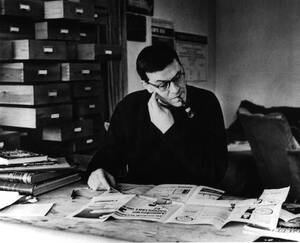
From top: German playwright and novelist Peter Weiss; David Langwallner

It is St Patrick’s day tomorrow. The Irish people are going to protest. Thus this may seem obtuse but it is not.

The Aesthetics of Resistance by Peter Weiss is the greatest German book of the 20th century. It has now only ⅔ appeared in English because of its complexity, difficulty and frankly perceived obscurantism. Thus, the project to have it published in its entirety by Duke University Press shows its relevance to our dark age.

Peter Weiss is the greater chronicler of the German consciousness from the safe vantage point of Sweden for much of his life. And distance did not make the heart grow fonder, not unlike Joyce, as he mined his experiences with and of the left and cautioned people to remember.

It is the emphasis on fact, memory, and the need to remember that is most intellectually significant. It is also a cautionary tale about the delusions of the left written in his curiously ungrammatical syntactical style. But who I am to talk (as the readership of Broadsheet are at pains to point out)?

The word book is apt; it is only pre-textually a novel. In fact, barely a novel but a memoir as of course are the works of Sebold, who we shall see later references him. The narrative is novelistically of real events and indeed real people. A kind of political Clarissa, which he references, as he does many other works in a tour de force through the European canon. In my view only Kundera, aged over 90, is left of that tradition, The European humanist intellect.

The book not novel is a cultural and political montage of confused intentions, often the best of intentions, with a crucial failure of understanding by the protagonists of what was happening and how they sleepwalked into becoming enemies of fate. Relevant then and now.

A visual and graphic artist of enormous power, Weiss is also known for the controversial play Marat Sade, which has the great nihilist The Marquis De Sade spectating on a play within a play about the bloodletting of the French Revolution, talking to the Jacobin extremist Marat with deliberate fictional tongue in cheek (“For you as just for me only the most extreme actions matter”) and implicitly that is what is wrong.

The endorsement and promotion of extremism. Though other aspects of our age from the Greek chorus of the Sans-culottes are relevant. not least that the lunatics took over the asylum then and now in an age of unreason, the populist mob also argues in the play in terms relevant for our time. We have rights, the rights to starve and, in a pointed further question, who controls the markets?

A caution against the extremism of our times and a historical rebuke against irresponsible intellectuals who embrace Jacobin terror however fashionable such as Zizek. Of course, in our age all sorts of lunatics have taken over the intellectual and proverbial asylum.

Weiss’ other play of significance is The Investigation a blow-by-blow account with condensed eyewitness testimony of The Frankfurt Nazi Trials, based on the transcripts. It is shocking in its lucid dissection of human debasement and self-degradation. The warning about excessive obedience and compliance is clear for all to see:

‘There is only one road to freedom its milestones are called obedience industry cleanliness honesty truthfulness and love for the Fatherland.’

Cognitive dissonance abounds. The dirtiness of the unworthy and the unclean demonised.

In Canto One. modeled on Dante:

‘I was only supposed to make sure that the train lines were in order and that the trains came in and came out according to timetable.’

A perfect amplification of Hannah Arendt and Eichmann. Fact not disinformation. An exhumation of horror to frighten people into remembrance.

As Ireland abandons history in the Leaving Certificate the words of Milan Kundera are apposite.

‘The first step in liquidating a people is to erase its memory. Destroy its books, its culture, its history. Then have somebody write new books, manufacture a new culture, invent a new history.’

The Aesthetics of Resistance is now being published by Duke University Press and two volumes are out with the final magnificent coda presumably to come. The final volume is still only available in German, but I will summarise the contents of the same including its incredible apotheosis for the readership.

The book is ostensibly a novel, but in fact it is a tapestry of people met, organisations affiliated with, fictional digressions, particular on Kafka and The Castle, the rise of fascism and the attendant rise of compliance. It is also about the abject failure of the left who then and now are participants in their own self-immolation.

The lengthy analysis of Kafka and The Castle is a lengthy digression about the asymmetry in information and power and power of knowledge between the lords of the castle and the ruling classes and the chattering, well-educated intellectuals of socialist inclinations who populate his work.

The book opens with a visit to Berlin and The Pergamon, which I have seen several times, the most well preserved of Greek marble friezes. A lengthy disquisition on how the narrative of the sculpture shows that even military demigods were destroyed by power. How Hercules, the leader of the gods and a man of the people, was ultimately rendered nugatory by the giants of power. A feature of our age. The faith of course of all dissenters, public intellectuals then and now as the book makes clear.

So, the book contains a litany of his acquaintances such as Brecht who were in effect expelled and expatriated from the body public as degenerate gangrenous elements to use the metaphors of our time prevalent again now. Dissidence, he pointedly remarks, has two possibilities in extreme times exile, self-imposed or imposed by others or captivity.

Not unlike Victor Klemperer’s I Shall Bear Witness there is a sense of unfolding chaos where the big picture is not properly appreciated or understood and where socialist entities distract themselves in fripperies, earning a meagre crust or more commonly dissension a bit like the People’s Judean Front in Monty Python.

By a focus on building coalitions with often duplicitous social democrats or others their idealism is sacrificed on buy-outs. Twas ever thus.

They are also oblivious to the sheer escalation of events and those who through making ends meet cannot cope with the same until it is too late to do anything about it. They become sleepwalkers into arrest, torture, exile, or liquidation by a failure to focus on the particular and to take remedial corrective action. A failure to act decisively. A very salutary lesson for our time.

A crucial failure of educated classes is that the truth often loses out to power particularly when power becomes a form of gangsterism, and the book clearly show how capitalism becomes a racket a bit like The Brecht-Weill song The Ballad of Mack The Knife from The Threepenny Opera and corporate gangsterism is not fully comprehended in time.

Brecht is in fact omnipresent in the book and not he, but all sorts of self-interested people, cooperate with a form of monopoly capitalism that morphs into corporate fascism for all sorts of reasons then and now. Well, as Voltaire remarked, people always have their reasons.

Thus, by naivete and the submission to coercion, the educated classes become victims and subjects in their own degradation and the analogy is drawn by him of the more overt degradation in Pasolini‘s Silo (1975) which is only a more extreme version of Marat Sade.

One crucial failing he identifies, as aforementioned, is the need to focus on the particular as the work, in a puritanical way. is all. Standards must not drop and given the blunted vision and the failure of perspective based on asymmetry of knowledge then unemployability beckons if in effect focus is not kept on what is really going on and how it really affects you. How to deal with an ever coarsening reality to achieve personally optimal outcomes in effect.

So, in this age ordinary people should not in any circumstances leave their sense of professionalism drop when as he sagely points the tactics have become so despicable that snuffing someone out is an acceptable mode of corporate fascist business or simply firing them to eliminate a competitor. Business is business and it is murder most foul, to quote Bob Dylan.

Weiss also emphasises, through various interlocutors, the importance of self-control and the development of mental coping skills and endurance. Discipline and perseverance is all important. The romantic self-delusions of all involved, as if intellect could beat power, is jaw dropping and a chastening warning.

Poverty and inequality of bargaining power can be exploited, and fragility exploited by coercive behaviour and duress then and now and the intellectual strata of society have limited bargaining power.

A hugely important point in the second book is how malleable and changeable the developments are. Precise plans also cannot alter chaos. Though a plan is desirable it must be flexible and adjust to the forces of evil or that which you confront. Otherwise, personal destruction for his protagonists

In fact, fighting the new form of Chinese corporate fascism is like fighting a shadowy consensus of ghouls who have no ethical compass or boundaries and are ruled by deceit and are all powerful.

Many who populate both volumes become travelling migrants, often rendered stateless as was Zweig in fact, with no safe refuge living a vagabond existence that is peripatetic and in victim terms pathetic.

The spectre of unemployment and layoffs and the focus on the short term is a tremendous lesson for our age. Worthy aspirations must lead to food on the table and the avoidance of the bailiffs and indeed the utilisation by state authorities of nefarious tactics of confiscation and liquidation. But a focus on purely short term would have not led to this essay.

It is a pitch-black reminder of our age of increasing control, widening inequality and fascism not even yet begun. In many countries.

The book is also most interesting on how the discourse gets coarsened and propaganda rules. The famous burning of the books has now become the triumph of Facebook and blandness rules. The gradual elimination of nuanced discourse from many vectors of our society.

The final volume, not yet published, is in my view the equal of Swann’s Way, The Trial, The Man Without Qualities, The Beckett Trilogy and The Death of Virgil as the greatest work of fictional art of the 20th century. It is a most unsettling work.

Intellectuals like Hellman feature and then, In prose of utter starkness, lucidity, and precision, Weiss shows, in the coda to the final volume, how members of he organisation known as Red Orchestra were executed in Plotzensee, including Hellman.

The horrors of this are a passage unprecedented in European letters in terms of its detail and precision; perhaps the only comparator is Kafka’s short story In the Penal Colony.

It is the process of murder and destruction and extermination. It is also about the banality of evil of bureaucrats. It is a warning for our age.

So protest to survive tomorrow.

David Langwallner is a barrister specialising in public law, immigration, housing and criminal defence including miscarriages of justice. He is emeritus director of the Irish innocence project and was Irish lawyer of the year at the 2015 Irish law awards. His column appears here every Tuesday and Friday. Follow David on Twitter @DLangwallner
Getty

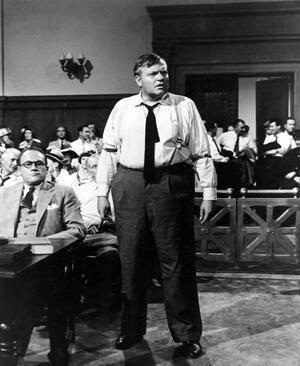
Orson Welles playing Jonathan Wilk, based on famed attorney Clarence Darrow, in Compulsion (1958); David Langwallner

Orson Welles arrived in Ireland as a 15-year-old farm boy, but precocious and overweight beyond his years. After a tour of the West Coast – a kind of obligatory rite of passage – he was penniless and, clutching fake representations and reviews, he presented himself before Mr. Micheál Mac Liammóir at The Gate Theatre, Dublin and said:

“I am a prominent Broadway actor.”

Now the great old whore and ham (Mac Liammóir) did not believe a word of it but gave him a job. Old Ireland. He was impressive. An impressive confidence trickster.

Mr. Welles acquitted himself brilliantly and used all of that and the glorious reviews of The Gate to springboard himself back into America.

The point of odd coincidence in my life is that the avuncular, cigar-chomping, rotund, bon viveur a far too kind expression out of loyalty, frequented The Gate even when MacLiammoir was dead, demonstrating one of his many great qualities. Loyalty to old friends. Nostalgia an emotion to be avoided.

So Mr. Welles went back to The Gate often and I met him once. It was an extraordinary experience to be in the presence of that level of lifestyle excess, utter egotism and diet and, let’s face it, genius. Forty five minutes of unbridled conversation with several bottles of claret downed. This was the 1980s and he died soon after from a heart attack at 67. Look at the achievements though admonish the self destruction non puritanically.

The greatest American trial lawyer of the century in terms of notoriety was Clarence Darrow. There are other American candidates. Gerry Spence is still alive though 90 with an unimpeachable 100 percent acquittal rate in criminal cases. The reputation of others are more like skyrocket, brief flashes that burn and or brought down by their imperfections.

Clarence Darrow avoids these pitfalls for a variety of reasons. He was part of the movement known as Progressivism splendidly documented in the book The Metaphysical Club (2001) by Menand.

This was a belief now somewhat quaint in scientific progress, pragmatism the notion that society should develop in progressive terms. It was also a faith in the Enlightenment and the power of reason and thus there was a divergence between the force of light and the forces of darkness, epitomised by religious fundamentalism, as important and dangerous then as now.

Darrow, unlike other trial lawyers, stood for certain things. He was in many ways a man of ideas and an intellectual and moral framework defined him and what he did and he was consistent.

Thus he did not judge his clients or shy away from controversy whoever they were and however damned in the eyes of the public they were. He was not a believer in free will but argued that societal considerations, environment and hereditary shaped a person’s destiny whatever their background.

Darrow, thus represented the preppy college boys of privilege in the Leopold and Loeb case, immortalised by the performance of Welles as Darrow in the film Compulsion (1958) a disturbing insight then and now into the American mindset or indeed any society based on the assumption of privilege.

Now the murder was heinous of a young boy and there was no possibility of an acquittal except on the grounds of diminished responsibility. Leopald and Loeb had colluded  in the murder of an eight-year-old boy due to a Dostoevskian ubermensch sense of themselves as supermen. That corporate sociopathy warped into the American and indeed Irish character and in elements also of the ruling class of all countries. Born to rule. Noblesse oblige. We the powerful from the good families are unaccountable and above the law. Particularly in our dark age.

The death penalty was at stake thus and that then and now adds to the drama of American trials. Darrow’s strategy was to plead guilty but seek to admit psychiatric reports which would be consistent with huge terms of incarceration rather than the finality of death

He succeeded brilliantly, though the judge did not in point of fact accept the psychiatric evidence ultimately he did admit it and it sub silento influenced the life imprisonment sentence.

The Prosecutor also to some extent put Darrow on trial. In fact for his late career he was always on trial. It was always a case of trying the man and his ideas as well as his client. The Prosecutor argued that Darrow believed that people were not in jail because they deserve to be but due to circumstances beyond their control.

Darrow in fact compiled or obliged this prejudice in his closing speech when He stressed the lack of responsibility of his clients.

They did it for the experience without reason and needed kindness and charity not outright condemnation. The sort of sentiments that might incur an outright knee jerk reaction in this day and age of right wing triumphalism and fascism

It was a noticeable feature of his representations that he seemed to find the good in anybody and had an extended sense of compassion to his clients not entirely evident in his personal life.
I think this is true of most defence lawyers that the surfeit of empathy required to do the job does not often translate into a comfortable private existence.

His graphic and lifelong hatred of the death penalty is also evident in the closing peroration:

“You can trace it all down through the history of man. You can trace the burnings, the boiling, the drawings and the quartering, the hanging of people at the crossroads, carving them up and hanging them as examples for all to see.”

In this he was influenced by a story his father told him when young of witnessing a public execution and his closing line was incredible, blending his hatred of the death penalty with his hatred of religion seamlessly.

The Leopold and Loeb Case not only gave rise to Welles as Darrow in Compulsion but also indirectly to Alfred Hitchcock’s Rope (1948), where the murder is of a more vulnerable adult and it obviously touched a raw nerve in the American character. In effect it is the phenomenon of the younger cuckooing the older person, the more vulnerable adult.

But there are more significant observations relevant to our time. It is about the imposition of power by the over entitled in our neo liberal universe and the assumption of superiority based on, what exactly? Thus it is about, in criminal lawyer terms, coercive and abusive relationships based on power and the inequality of bargaining.

It is also about the psychosis of the preciously well-educated and who they take advantage of and, in our distorted universe, that means there is little distinction between monolithic capitalist models and criminal cartels.

The same thing. A crucial realisation. The organisation of work. The business of business.

David Langwallner is a barrister specialising in public law, immigration, housing and criminal defence including miscarriages of justice. He is emeritus director of the Irish innocence project and was Irish lawyer of the year at the 2015 Irish law awards. His column appears here every Tuesday and Friday. Follow David on Twitter @DLangwallner

Pic: 20th Century Fox

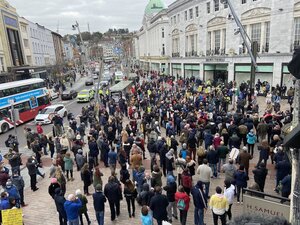
From top: Anti-lockdown protest in Cork city last Saturday; David Langwallner

Now of course we live in perilous times worldwide for the justice system and one can have far too much faith in legal processes to protect us as the rule of law and the cause of human rights diminishes and the gatekeepers have to enforce ever more draconian legislation. Constrained by the literal application of rules they often disagree with in civilised societies and by a worldwide society descending into borderline anarchy.

In this respect Jeremy Bentham developed the model prison The Panopticon of which Kilmainham in Dublin was an example to enforce 24 hour surveillance. not ultimately adopted due to its inhumane qualities.

Now modern society has become a worldwide Panopticon, as Foucault saw happening, and as the people of Cork in the peaceful protest last Saturday expressed beautifully.

A collective dehumanisation has undermined liberty, movement, privacy and indeed livelihood rights. All that is left for many people is the voice of dissidence. The cry above the suffering, as Leonard Cohen remarked.

But it has been coming for a while in Ireland.

The slippery slope for example of the negation of due process in Ireland began, in my view, with the Proceeds of Crime Act in 1996 which was upheld despite the layers of ambiguity it creates and its disproportionate effect on ordinary people.

The act with its negation of proof seeking processes also invested far too much faith in the ethical integrity of the police which also led to the appalling JC case which allowed the police to rely on a good faith mistake when the legal realist perspective is that in practice this will mean them calling a mistake that which was an act of deliberate criminality on their behalf.

The Charleton Tribunal and The Fennelly report papered up wholesale police malfeasance. Due process has in effect been subverted by the Irish state and the present pool of judges in criminal justice terms and we have now created a police state. The virus just caps it off.

A larger question thus is whether a constitution or a bill of rights or even Bentham’s preferred legislation is at all meaningful and operationally effective if the culture and civility of the society has broken down and where the virus has sacrificed the cause of liberty at the altar of an over stated need for security.

Where rights no longer are meaningfully protected against the might of the Leviathan seeking to secure compliance and a docile uncritical population.

In practice in the UK rights are often taken more seriously, thus I was recently able to save someone from a prison sentence and it was suspended given that his underlying health condition was such that there would be a real danger to his life under Article 2 of The Convention.

But The UK has also some disturbing trends. The Blairite bad character reforms have been a disaster allowing in amorphous bad character not just conviction but misconduct and engendering an almost automatic conviction in a sex case in particular.

The penalisation of lifestyle is also evident in the UK in anti social behaviour orders where a triage of state authorities goes after a person no longer deemed acceptable with the risk of homelessness on a lower standard of proof. Disapproval criminalised.

In the UK, South East London is becoming like The South American film “Pixote” (1980) where 5-year olds are radicalised. An urban transplantation from the third world to the first world is evident with younger gangs also trafficking the drugs across county lines and to counteract same super injunctions restraining behaviour with the possibility of committal in prison so called drug injunctions.

The drug problem in Dublin was in effect a failure of urban planning putting people in tower blocks in Ballymun helped create a drug infested inferno and a failure of proper levels of opportunity.

Draconian legislation fails to tackle the root of the problem. Roberto Saviano the expert in the Italian drug trade and his book “Gomorrah” (2006) and subsequent book called “ZeroZeroZero (2016) makes the point that the drugs cartels in ruthlessness, the Omerta code and indeed drug economics, are a model for corporate business organisations in general.

The international vultures of Canadian and American origin are destroying Ireland and other countries and being upheld by the courts where in the absence of housing and livelihood opportunities or rights people stand to be evicted in an age of pandemic. The gangsterism of Goldman Sachs is the same morally but not legally as Pablo Escabor as vested interests or self enriching corporations stagger the law in their favour.

Immigration courts which I have frequently appeared in the UK are more likely than Irish immigration tribunals to accept, despite reciprocal extradition warrants, a legitimate argument that in the light of false reassurances of prison conditions or survivability someone should not be extradited. But the acceptance of rubber stamped reports from other jurisdictions often does not probe in depth the quality of those justice systems.

There is also in the UK the increasing acceptance of detention centres that are dehumanised for migrants and of course quarantine centres for returnees. A further slippery slope ushered in by the virus. Worldwide detention with vaccine passports to come.

Zuboff in her book The Age Of Surveillance Capitalism on the eve of the virus shows how now our very identities are going to be mined as Facebook does for commercial gain and the virus has led to ever greater wealth to Facebook and Amazon as we work remotely. Small businesses are being destroyed and all the people of Cork can do is protest to survive.

Very few criminal trials are in fact going ahead in the UK and largely only those that cross the urgency criteria. More to the point the swearing of and accommodation of jurors is infinitely problematic not least in that social distancing has to be observed and courts made covid compliant.

So as neo liberal meltdown reaches its dark capitalist apotheosis I was sitting behind a plexiglass window in a courtroom. It is an eerie experience like being in the command of a TV studio or the front of a plane. Cylindrically surrounded.

More to the point the jury also encased in individual plexiglass clam shells. Very much like Maximillian Schell in the film on Eichmann in his glass booth. The jurors, not just the defendant, are covered on all sides.

The imposed confinement of all, of course, shows a tendency to the corralling of individuality and the division of the world into safe and unsafe spaces. The scope for individual freedom and liberty is shrinking…

Directly opposite my courtroom in Lewes, Sussex is the famous The White Hart Lane Pub and further up the high street a residence where Thomas Paine drafted the Rights of Man. Thus the covid laws nationally and internationally are restricting Paine’s rights.

The extension of surveillance is also part of matters and is now proposed in the UK to extend to terrorism and a proposed new Bill suggests the most draconian measures. Potentially the new Terrorism Prevention and Investigation Measures act could see suspects not prosecuted but subject to restrictions on travel and accommodation for the rest of their lives.

TPIMs are used against those who cannot be prosecuted, but breach of a TPIM is a criminal offence allowing for imprisonment. So in principle this could involve lifetime detention on “reasonable grounds” for suspecting someone is or has been involved in terrorist activity. Thus in cold terms lifetime detention is based on suspicion or subjective reasonableness.

At one level the provisions mark a return to the draconian control orders – a form of house arrest – in place previously. Introduced by Tony Blair’s Labour government in the Prevention of Terrorism Act (2005) which were deemed contrary to article 6 of The European Convention.

The ECHR in fact rightly so specifically prohibits the idea of preventative internment. Any detention must be for the purposes of bringing a person before a competent legal authority according to Guzzardi [1980] 3 EHRR 33.

Guzzardi was a Mafioso with a substantial criminal record who was charged with various criminal offences and ordered to reside in the Island of Asinara while he awaited trial. The court evaluated the facts and concluded there was a deprivation of liberty and a form of privative detention in that he was being detained not as a punishment for a specific offence but a preventive measure taken on the strength of indications of a propensity to crime.

The crucial point also is that we all are in covid times all preventatively restricted and detained in coronovirus panopticon and the justification of more publique is very dangerous when disproportionate measures are introduced to counteract a wildly overstated emergency and pander to a worrying trend of compliance. Compliance for the sake of compliance and security.

Another worrying trend is that crimes which were once the stuff of Science Fiction are now increasingly in evidence throughout the globe.

In India thinking an anti-governmental thought is a criminal offence in certain provinces. In Ireland a suggestion was made that vigorous and hurtful criticism of a politician should be criminalised and this seems to be gaining traction. Politically trumped-up charges are now in fact common across the globe.

The prosecution for treason of those in Catalonia who legitimately held a successful referendum. Show trials in Russia. The persecution of political movements such as the water-charge protests in Ireland. The ruthless amoral pursuit of Julian Assange by American authorities failing to fess up to their own criminality.

The virus has ushered in the legislative and executive implementation of serf capitalism or Chinese capitalism and such legislation becomes embedded and precious liberties fought for generations divested in a state of perpetual emergency. I

n fact the German jurist Carl Schmitt wrote about how executive actions responding to a subjectively perceived emergency paves the way for totalitarianism and it is minorities who will be most affected or those perceived to be dissidents.

In the US in the Second World War, many disgraceful things happened against mixed blood Americans, particularly those of Japanese origin who were locked up in concentration camps and exclusion zones. In effect internment on the dubious basis that they might be involved in espionage, disgracefully endorsed by the US Supreme Court in the infamous Korematsu Case (1942).  America and perhaps the world now to be divided into de facto or de jure exclusion zones. Direct provision in Ireland and quarantining a harbinger of things to come

Jury courts may be victims. Geoffery Robertson QC has been nuanced in responding to an emergency in the interests of the profession. At least a court hearing with the elimination of the jury would facilitate a hearing and the financial sustenance of the profession in time of plague.

There is, however, a larger conversation to be started which is the choice between common law, adversarial and continental-European-style inquisitorial systems.

The systematic collation of evidence by a judge aided a prosecutor building and assessing a file over time, favoured inquisitorial systems,  is often more effective in getting to the truth. It has merit if the judge is independent and not subject to influence which is often not the case in inquisitorial systems but would be, I would imagine, in the UK.

We are thus entering and have entered an altered state and a dangerous Brave New World where the cause of human rights has been negated by potentially embedded surveillance, restrictions of liberty and movement and a controlling society where civility and reason is lost and a new form of feudal mercantile capitalism has taken hold.

So , the people of Dublin on St Patrick’s Day should rid us of the snakes of venal corporatism and state authoritarianism and reclaim what Habermas calls the public sphere and realise as he argues as did Gandhi and Martin Luther King that disobedience against tyranny is necessary.

Protest to survive before it is too late.

David Langwallner is a barrister specialising in public law, immigration, housing and criminal defence including miscarriages of justice. He is emeritus director of the Irish innocence project and was Irish lawyer of the year at the 2015 Irish law awards. His column appears here every Tuesday and Friday. Follow David on Twitter @DLangwallner

Top pic via Paschal Sheehy

From top: Taoiseach Micheál Martin and Tanaiste Leo Varadkar; David Langwallner


To: Taoiseach and Tanaiste of the Republic.

An Open Letter by Citizen Langwallner Letter to Mr Varadkar and Mr Martin

(With gratitude for inspiration to Émile Zola)

Mr Taoiseach and Mr Tánaiste, our joint vectors of neo-liberalism and neo-conservatism, may I address you remotely?

Would you allow me, in my gratitude for the benevolent reception that you gave me, Mr Taoiseach, at one brief Fianna Fáil fundraiser, to draw the attention of your rightful glory and to tell you that your star, and that of the undermining sorcerer’s apprentice that is the Tánaiste, so happy until now, is threatened by the most shameful and most ineffable of blemishes?

The world is now in meltdown, economic, political and societal, and it is Stage 5 Coronavirus meltdown in Ireland. Such a happy vista.

You have, of course, both passed healthy and safe through base calumnies; you have conquered hearts or fabricated and manufactured said consent.

Pre-Covid, Mr Martin and you, Mr Varadkar, were ostensibly prepared to preside over the solemn triumph of our proposed economic recovery which would crown neo-liberal Ireland’s great decade of work, truth and freedom or not.

In fact, no recovery exists apart from the siphoning of growth to corporate law firms and multinational agencies. Growth goes out of the country, or in the coffers of our corporate law firms and accountancy firms, and little firms and little people go to the wall as vulture funds, fronted by Goldman Sachs, move in. And Ulster Bank has now left. The sun has got its hat on!

The country is, in fact, controlled by vulture funds and vultures play on the dead or the about-to-be-dead plain people of Ireland and let us not like Greeks worship false EU gods. They certainly did not bail out Greece and now there are other hands outstretched in the begging bowl that is Europe.

Thus, the virus coupled with 2008 double meltdown, and NAMA has kiboshed everything. Meanwhile, Eurocrats enrich themselves with one last ride. Nero fiddling as Rome burns and surging inequality increases and Ireland, no more so than Greece, will not be bailed out.

But what a spot of mud on your collective names – I was going to say on your reigns – is the state of our country at a wider level. And it is to you, Mr Taoiseach, that I will proclaim it, with the sorcerer’s apprentice and demiurge that is Mr Varadkar, this truth, with all the force of the revulsion of an honest man.

For your honours, I am convinced that you are unaware of it. And with whom will I thus denounce the criminal foundation of these guilty truths, if not with you, the first magistrates of the country?

For given our political appointment structure and flouting of Bangalore principles, you are both, in effect, the judge superior to the judge penitent.

Yeats foresaw much earlier in September 1913 what they were like and nothing has changed.

What need you, being come to sense,
But fumble in a greasy till
And add the halfpence to the pence
And prayer to shivering prayer, until
You have dried the marrow from the bone;
For men were born to pray and save:
Romantic Ireland’s dead and gone,
It’s with O’Leary in the grave.

Or now just pray and survive? Pray to survive. The Hunger Games

The ostensible neo-liberal agenda is purely cosmetic and abortion, at one level, is a sideshow and involves the devaluation of life or a detour not to reflect on the value and significance of life. Though proposed euthansia might be at one level a choice which is now proposed It will certainly suit a neo liberal agenda and induce a cull or nudge a cull.

In short, it is an awful Malthusian and superficial agenda of false liberalism not real liberalism that is being promoted. It is a Malthusian human liquidation in increments. Corporate facsist disposal of the useful or as Céline clearly saw, and he was a fascist Mr Varadkar. in Death On The Installment Plan.

Italy is often portrayed as a paradigm of corruption, a kind of benchmark of the same with the toxic interrelationship between organised criminality and, of course the Christian Democrats.

As is historically documented, many very strange and indeed criminal actions were perpetrated and covered up in Italy by the Christian Democrats and their cohorts, the Mafia.

In Ireland it is a much more complex picture. Shabby lies and shabby cover-ups concealing a much more awful deep-seated multi-generational institutionalised corruption involving our Mafia, bankers, lawyers and politicians.

Why? Well both social structures are run by Catholicism or should that be the secularisation of same? Catholicism, unlike Protestantism, exonerates the cardinal sins of simony, nepotism and greed and as they are so intrinsic and crucial to the way the Catholic mindset works, they are normalised, institutionalised and expurgated.

A quick trip to the confessional and you are born again, absolved, washed clean. This, of course, encourages wrongdoing, mostly of a financial nature, as the soul is absolved and you can start wrongdoing again. Bless me father for I have sinned. Can I sin again?

Continue reading →


From top: The Pass at Thermopylae, Greece, where for three days 300 Spartans are said to have held back a vast Persian army; David Langwallner

Several years ago I assisted a gentleman lawyer, Mr Leonidas Pegiadis, in The Mark Marku case in Crete and then Athens, Greece. Huge scepticism on his behalf as to what The Innocence Project was. Rightly so. Mr. Pegiadis, an oracle, said: ‘Neoliberalism, David is a form of decadence’. Like Zorba The Greek. Like Leonidas The Lion. I listen but judge.

When we were in the Marku case In Crete, on his instigation,  I took a long journey or pilgrimage to see the memorial and grave of Zorba author Nikos Katzianakis. Of course, Zorba the Greek (1946) is one of the great novels. A cry against the neo-liberal womb of destruction. Male or female.

The great writer himself was a chronicler of Cretan oppression under fascism and of the ambiguity of religious feeling, most evident in Christ Recrucified (1954) and the unfairly vilified The Last Temptation of Christ (1955). It was a man grappling with his shattered faith.

The sun is warmth and there is sex in Greece or at least light as many appreciated. including Lord Byron. The Greeks, like Italians but unlike the Irish, have a Catholic understanding in the broad sense of religious doctrine and the balance between pleasure and pain. But the light is dying as is the Greek way. Which is a tragedy as it is the crucible of civilisation.

Now Greece, of course, is immortalised in human rights lore in a foundational case of The European Convention Human Rights, The Greek Case (1967), an inspection by the then commission of the ECHR of the effects of fascism, brutal military dictatorship and the regime of the colonels.

It led to multiple findings of torture, revealing the practice of the bastinado, violations of the right to life and, ever since, Greece has veered uneasily between fascism and leftist proto communist parties and with an erratic disregard for human rights.

The enormous courage of Leonidas Pegiadis during our case needs to be dealt with. As a very well connected but deeply sceptical member of the Greek establishment, he represented Mr Marku for a few drachmas brilliantly and passionately. A shrug of the shoulders but deep seated vocationalism.

When I was there, the leftist communist government objecting to austerity which had destroyed the social fabric, had twice gone cap in hand to Brussels to be met with rebuke and the infamous phrase by Christine Lagarde that they [EU,IMF, etc] were the adults and the Greeks presumably children, which led to the book by Varafakis, ‘Adults in the Room‘.

Well the neo-liberal corporate elites are the inappropriate adults in the room and they are infantilising us and destroying our critical faculties. a form of dehumanised brainwashing.

Greece is, of course, the historic center of democracy. Thus everyone who goes to Athens visits the Acropolis, but that is a centre of culture and also of the inception of theatre. On the opposite side of the road, less visited but free, is the Agora and it contains much of democracy. Socrates‘ burial place the purveyor of truth and the first parliament where Pericles intoned overlooking the Greek hills.

The great Communist Greek director Angelopoulos was also, like Socrates, accused of the innocent and his wonderful film Travelling Players (1975) is a kind of homage to the victimhood of dissidence as are many of his works. The soul of man under fascism.

Our Brave New World of the Internet is incubating a dangerously compliant and accepting population, reflected in the far right or indeed soporific left’s obsession with marginal issues, democratic liberals persuaded to consent to their own demise.

This is what Timothy Snyder called ‘anticipatory obedience’  and involves going with the flow of home seizures and deportation of untermenschen migrants and demonisation of others, until at last they come for you, at which point there is no one left to protect you.

So stand up and be counted. Hopefully it won’t require you to walk out in front of a tank, but be prepared. An image not dissimilar to the pass of Thermopylae, Central Greece, which I also visited.

Spartan discipline and brutality is something I disapprove of but it did make them a warrior caste so that 300 plus Spartans and sundry others kept the Persian hordes at bay for an extended period of time of  seven days before betrayal. Matters got exaggerated over time but there were probably at least 150,000 Persians and it may have ultimately been part of a chain reaction that led to Greek victory.

It is a classic example, like David and Goliath, of how great training and great methods can defeat superior numbers but of course all were wiped out including the leader Leonides the namesake of my leader in Greece.

The sea has moved and it takes an act of imagination to work out what happened in 480 BC. But geography and a narrow path assisted the Spartans in hand to hand combat. The Greeks are not Spartans now and their friendly casualness is not confronted with Persians but a technocratic autocracy, There is no alternative.

The control of the EU and indeed world governance by corporations is precipitating disaster and Coronavirus is only a symptom of the same. People are commoditised by banks and financial institutions: there are far too many of them, and their number needs to be reduced.

As the former Greek finance Minister put it, ‘And the weak suffer what they must.’ And he has scant hope for a post virus universe if that ever is the case. Increasing inequality and wealth cartelization, the gradual implosion of the EU after enrichment and the growth of what he terms nationalism, but is in reality fascism and extremism and indeed racism. EU plutocrats self enriching as Rome burns and Europe elects fascists.

Why? Well genuine democracy requires mass literacy and proper education, which is diminishing, as is access to accurate information. Bannon and Cambridge Analytica have used artificial intelligence to influence voting patterns, and warp the human mind.

We are witnessing the dissemination of disinformation, and what Zizek calls ‘Ideological Misidentification’, and now the actual mining of human identity, which Zuboff correctly identifies.

The Left is nostalgic and sees opportunity in Austerity but, lest we forget, after the Wall Street Crash the Weimar Republic did not witness a Populist socialist insurgency, but Nazism. Our present economic collapse is ineluctably leading towards a new form of corporate fascism.

If the Left is to salvage democracy it must borrow the approach of Antonio Gramsci, the leader of the Communist Party of Italy in the 1920s, which is to construct a cultural hegemony with a receptive middle class (especially now as the distinction between working and middle class is being obliterated).

This will involve an expansion of state institutions and husbandry of natural resources to bring an electable and progressive broad social democratic front to power. A balance of moderation between left and rights and a reassertion of national autarchy and self sufficiency with a public private partnership. A new politics. I doubt it.

On my plane journey to Athens I read an extract from a speech by Barack Obama about visiting the same birthplace of Periclean democracy I had visited. He expresses himself beautifully: precise, as is his want; erudite (something he is given too little credit for); and with pristine socially-democratic-convictions.

But his achievements are merely a modest corrective indeed, flawed by his excesses with Goldman Sachs and the persecution of whistleblowers as well as the embrace of a false political correctness. The falsity of liberalism that has destroyed America and led to the alt right.

Using the excuse of such shibboleths as national security, public order and the common good, rogue state institutions classify their enemies as criminals and subversives. When marketisation criminalises. Democracy is dying because our elected leaders, rather than distancing themselves from extremists, are embracing them.

There are insidious forms of subversion: a coup can not just be the regime of the colonels as in Greece but governance by the grey, for the grey, where small but influential think tanks and special interests pull the strings.

The Greeks, of course, had a great British hero. According to Lady Caroline Lamb, he was mad, bad and dangerous to know. He was Lord Byron and before taking the boat to Crete there is his inscription not far from the scene of his death on the edge of the mainland in Sounion at the base of the Temple of Poseidon with the perfect overview and gateway to the Greek islands.

His romantic words have been quoted by rakes for centuries and his life the stuff of excess and legend. Odd then that he extolled the power of the word and the script to conscience raise. For the Greek contribution to humanity is enlightened thought, Aristotelian moderation and reason, Sophoclean scepticism, the great works of Homer, the incomparable Callas the Diva of all Divas and in good measure Byronic rebellion and of course democracy.

So Byron:

‘But words are things, and a small drop of falling, like dew, upon a thought produces
that which makes thousands, perhaps millions think.’

And if not these words, then the dance of Freedom of Zorba The Greek.

The dance of the light against the dying of the light.

David Langwallner is a barrister specialising in public law, immigration, housing and criminal defence including miscarriages of justice. He is emeritus director of the Irish innocence project and was Irish lawyer of the year at the 2015 Irish law awards. His column appears here every Tuesday and Friday. Follow David on Twitter @DLangwallner

Pic: Eagles and Dragons Publishing

From top: Lockdown critic, British Lord Jonathan Sumption; David Langwallner

The central Shakespeare play on law and legalism is ‘Measure for Measure’. The Duke of Vienna has unwisely left, as custodian of the state, Angelo, a religious maniac. The engine of the play is that the Duke does not leave Vienna but disguises himself as a monk in order to ascertain what is happening in his Kingdom.

From a Renaissance thought perspective, the true ruler or judge was not the most holy or zealous of men, but one in whom reason and moderation existed. The law, the play implicitly argues, must not be a terror or enforce a terror.

Former UK Supreme Court justice and vocal lockdown critic Lord Jonathan Sumption, in his Trials Of the State (2019),  advised well that, above all, a judge should be moderate. Legal training, he argues, conditions moderation.

I agree with Sumption that legislation is being introduced which is terrifying people and conditioning compliance, but has he the historical self-reflexiveness of understanding his own culpability? Perhaps this former adviser to the Conservative MP and Cabinet Minister Sir Keith Joseph – a formative influence on Thatcherism – is on the road to Damascus. Or at least the garden of Gethsemane?

In the light of the Coronavirus epidemic, though, for the good, he has sagely warned about the long-term restriction on liberty in The Times initially and then other outlets.

Of course there is a liberal consistency or, at least, a neo-liberal consistency to his approach, in that he complains, even in his pre-virus book, about the disproportionate interference by the state into the private lives of others.

With police officers restricting movement and enforcing self-isolation, or potentially intruding on privacy and, for that matter, restricting and fining travel and enforcing quarantines and measures being increased in a draconian fashion to deal with migrants and indeed returning nationals. we have all the indicia of a slippery slope to the creation of a police state if that is not where we are now. Certainly in Ireland.

Even in the UK, the ostensible land of liberty and the faerie queene, which Sumption, the great wizard of humanism, a kind of white haired legal Willie Wonka represents, where liberties were historically taken seriously, we find the emergence of transhumanism alongside unchecked executive authority.

If you mosaic all of Sumption’s writings recently together we see a sense of apprehension and dread foreboding of entrenched and embedded extremism with pandemics and variants of the same to come. In a sense the state of exceptionalism or perpetual emergency which the German jurist Carl Schmitt warned against continuing indefinitely. A state of siege.

Lord Sumption, in effect, sees a return to serfdom and the imposition of mechanisms of compliance and control which are in increments creating a form of Chinese capitalism, or I would argue, corporate totalitarianism. The negation and destruction of freedom. The return to serfdom, as his mentor Hayek pointed out, was not socialist serfdom but corporate compliant serfdom.

All of this is the context of The Plague which has been vastly overstated and bears at best a distant resemblance to the catastrophe of previous plagues he and I argue.

There is a famous book by The Portuguese novelist Saramago called Blindness (1989), where a blindness epidemic takes sway and blindness becomes a communicable disease. The effect is an escalated sense of panic as individuals are quarantined and dehumanised.

Human nature descends to Hobbesian force and brutality. The concept of due process or fairness of legality or the rule of law or human rights goes out the window. Inept authorities make mistakes. Asylums are created for those quarantined and descend into murder and chaos. An armed clique gains control.

Albert Camus in his seminal The Plague (1947) uses the historic plague affecting Oran to emphasise the need for humanism, engagement, heroism and community in difficult times and, above all, the rule of law, as Sumption is to some extent doing.

History is, in fact, littered with far more destructive plagues. The most famous exported by the Mongol warriors was the Black Death which devastated Europe in 1347 or more recently, its nearest comparator, the 1918 Flu.  It is a noticeable matter that more people died in that epidemic in the immediate aftermath of the First World War then the entire war itself, some 50 million.

Of course the reason for such mass deaths then was a lack of vaccination and the overall ratio of death and infection was considerably higher than in the Coronavirus. So why the massive overreaction and the imposition of control and compliance creating dehumanisation?

There is no question but that the rate of death to infection is nowhere near as high as those pandemics and there is no sense in arguing it presents an existentialist threat. Survivability is probable, absent an underlying health condition, and age or the luck of the draw, the bend of the river and the twist of faith, if you believe in that sort of thing.

Sumption, as an ostensible Thatcherite, also should notice the Inequality as small businesses are being destroyed with wealth channeled to transnational corporations and vulture funds.

Human dignity is also, he should empathise, difficult to maintain when you wait on a trolley in a hospital corridor with an undignified death on the horizon and suggesting, as Sumption has, that a Stage 4 cancer patient’s life is worth less than a healthy person is really outrageous, and a sentiment he did not endorse when a judge.

One senses the beginning of a reversion to a medieval standard of justice. One also senses that deep down the noble King Lear-Lord Sumption is revealing less than he has demonstrated and that he is speaking and writing, if not in forked tongue, at least in code.

Maybe representing the Russian billionaire Roman Abramovich woke him up, a giant from his slumber, and gave him – shall we say –  a certain knowledge base. Who knows? Not me? One can attempt to decode the code but much of it is guesswork, cryptography and surmise though I have a fair idea of what he is really saying.

David Langwallner is a barrister specialising in public law, immigration, housing and criminal defence including miscarriages of justice. He is emeritus director of the Irish innocence project and was Irish lawyer of the year at the 2015 Irish law awards. His column appears here every Tuesday and Friday. Follow David on Twitter @DLangwallner

From top: A still from Give Up Yer Auld Sins (2001); David Langwallner

Several years ago, I gave a talk on The Common Causes of Miscarriages of Justice in The University of Milan, subsequently published by Kluwer.

Professor Luca Luparia, an estimable man, but I suspect a very religious man, always perhaps a failing, took me to a lovely little church full of Christian bones and skeletons. An ossuary. Perhaps a lesson or an intimation or the sort of lesson I have always resisted. Santuario Di San Bernardo 10 minutes walk from Duomo, but a world apart.

Well I do not want to meet my maker yet Luca? I choose the light Eros not Thanatos and I certainly do not want to be thrown to the lions. That is, if I can choose? Can anyone? We are all powerless before god and acts of god, to use a legalism which describes the pandemic.

Though the persecution of the Christians evident in the ossuaries is yet another example of awful human barbarism, there are others such as the Crusades or the destruction of Inca civilization by venereal disease on behalf of the church,or all sorts of pogroms and acts of genocide. secular, tribal, religious or atheist. Crimes against Humanity.

It should be noted that the barbarities of virus lockdowns have no intrinsic demonised enemy, as in other such crimes, though the weak suffer the most. Thus compassion, christian or secular compassion or indeed moderation, l vote in favour and it is not much in evidence in these awful times.

Also pertinent In Milan is Santa Maria Delle Grazie where Da Vinci’s restored but battered Last Supper resides. Now I am not a fan of the clunky prose and dubious speculations of Dan Brown, but it is a fact that the church suppressed the Gospel of Mary Magdalene and the fallen woman. Mary Magdalene is, of course, the inspiration, such an oddly resonant word, for the Magdalene Laundries.

I visited another Catholic bone ossuary subsequently in Kutna Hora in the Czech Republic while a visiting professor. I am a terrible cultural omnivore and it had exactly the same effect in terms of memory and reflection. Memory of the history of infamy as detailed above.

Let us atone for our sins? Give Up Yer Aul Sins, as in the title of a CD and an Oscar-Nominated animation. The church profited from at the expense of children as they often do and still do and I historically represented a client who was not compensated by them, but oddly by EMI based in London.

So she was abused or exploited also by the church as they did in the persecution of the Magdalene Laundries and the non-payment of compensation. Here is the video they made millions from featuring her as a five year old.

Some souls are worth more than others? Some girls or indeed boys are better than others? Sinners are discounted or exploited. In God we Trust Inc.?

Though in this day and age we have all been thrown to the lions, not least by the greed, not just of rapacious Catholicism and consiglieres to the Vatican such as Mr Peter Sutherland, but to the world wide wealth cartelisation and the corruption and manipulation of the innocent.

And now Ulster Bank is leaving the country and Goldman Sachs and Cerberus will likely step in. More evictions and repossessions in the centre of the storm of a global pandemic.
So the full force of our odium and contempt should not be reserved for those who seek to break minor lockdown regulations. It is a misplaced moral outrage.

The full force of odium should be reserved for those that murder, for that is what is is, children and babies in Magdalene Launderies and Mother and Baby Homes and those that cover the deeds up in useless reports and time delays with a very belated and pointless act of apology or exploit children reciting bible stories for commercial gain to line the coffers of the church and their own pockets. To baby farm the innocent. Or use vulture funds and corporate transnational entities to funnel wealth out of the country while evicting those in the country.

Throwing Christians to the lions with politics, bread and circuses and a vastly overstated emergency at one level that is pandering to excessive compliance, control and the destruction of liberal democracy, as Lord Sumption argues, as well as the obliteration of the leisure and small business community.

The full force of odium should be dedicated against the inappropriate adults in the room creating a Road To Serfdom for all the children and indeed child adults of the universe.

So awful though the Magdalene laundries and other historic crimes against humanity were and are in certain sectors of the globe let us focus on the present crimes against humanity of economics and ecocide and the all too obvious creep of a police and authoritarian state morphing the universe into a form of sanitised Chinese capitalism where as all the indicators show the major corporations and law firms have had profits escalate during the pandemic and one wonders why?

Who is profiting from what. the infliction of misery, the selling of dud products, the mining of our identities or perhaps an even more complex derivative for the further cartelisation of wealth into ever narrower hands,

The trends Arundhati Roy identified in Capitalism A Ghost Story (2014) where huge swathes of India were dispossessed and left to die or simply murdered have taken an insidious grip in the developed world and It is tolerably clear who are suffering and stand to lost their jobs and livelihoods and, as Sumption and I both maintain, that precious sliver of protection afforded by civilisation and liberal democracy of rights of liberty, movement and privacy.

The thin blue line steadily eroded. a kind of reversion to a form of social primitivism. The dying of the light.

David Langwallner is a barrister specialising in public law, immigration, housing and criminal defence including miscarriages of justice. He is emeritus director of the Irish innocence project and was Irish lawyer of the year at the 2015 Irish law awards. His column appears here every Tuesday and Friday. Follow David on Twitter @DLangwallner

Brownbag Films

From top: Garda Commissioner Drew Harris (right) on RTÉ One’s The Late Late Show with Ryan Tubridy last Friday: David Langwallner

‘I was burned out from exhaustion
Buried in the hail
Poisoned in the bushes
And blown out on the trail
Hunted like a crocodile
Ravaged in the corn
“Come in,” she said, “I’ll give ya
Shelter from the storm”‘

Bob Dylan: Shelter From the Storm

Frederico Garcia Lorca was, of course, murdered and abominated by fascists, but more of that later.

Drew Harris, our imported Garda Commissioner brought in to try and improve the Irish Police force, went on The Late Late Show and was given a far too soft ride by the terrible D4 lightness that is Ryan Turbidy, with an obviously pre-selected set of questions, focusing on the sideshow issue of prosecuting holiday makers or others who wish to flee Ireland in a fake visit to a Tenerife dentist. The sort of initiative the Irish might have historically approved of.

Now what they intend is of course the commission of a criminal offence, but to say what is proposed to be done is odious or deserving of condemnation and to focus on it in the present climate with the guest in question is a distraction and a decadence.

Fake outrage for the fake news generation. Fresh consumerist fruit for rotting desensitised vegetables, as The Dead Kennedys might argue. And a smokescreen and a deflection from the tough questions the Garda Commissioner ought to have been asked but was not by Turbridy.

It is an interesting insight into the decline in standards and a generational change that neither Gay Byrne nor Pat Kenny would have left him off the hook. More revealingly, later in the interview, Drew Harris indicated he did what he was told and that, in effect, he obeyed orders. This should have been probed but was not.

Of course ‘I was only following orders’ is the Eichmann excuse. The legendary public intellectual Hannah Arendt caused a proverbial shitstorm by her coverage of the Eichmann trial and her coining of the phrase the banality of evil applicable then and now in Eichman in Jerusalem (1961).

The book makes many significant points about how the obsession with compliance and promotion by officialdom blunts a moral sensibility and how a certain cognitive dissonance takes sway where the individual in question does not fully comprehend, through obedience, compliance and a gradually corroded sensibility or lack of same, what he or she is doing or the moral implications of same.

In her most comprehensive book, The Human Condition (1958), Arendt emphasises the moral conscience. It is not enough to do something you have to understand what you are doing and for whom and why. Or at least investigate,  or should that be interrogate, your motivations without being a perfectionist. That is if you are able to do so or allowed to do so.

In Eichmann in Jerusalem, Arendt also notes how Eichmann was more concerned with consorting with powerful people, networking without a moral comprehension of what they or he was doing.

So, perhaps Drew Harris should deal with the controlling interests in Harcourt Street or the Department of Justice where traditional methods of heavy gang brutality have been replaced by even more sophisticated forms of state framing.

Perhaps he should also reflect on the fact that he is supposed to head an independent investigative force but the police are not in fact an investigative force but a prosecution force, replete with cognitive and confirmatory bias, tunnel vision at best or with no moral compass at worst, and badly-trained, and with a ready cohort of prosecution lawyers to serve their interests. He might also reflect on who tells him what to do and which political and corporate class instruct him what to do and who to target.

There seemed at least the fledglings of a conscience and a form of reflectiveness and certainly a degree of nuance about prosecuting Tenerife holiday makers in our twisted universe.

In my role as cultural commissar to the Irish establishment I recommend Drew reads Les Miserables by Victor Hugo and how the vengeful prosecutor went after Jean Valgean for the theft of a loaf of bread. Perhaps he should also determine not to misapply scarce resources in prosecuting petty crime but going after white collar crime.

One hopes so, but he is also a passing shadow and, if not gone native, probably appreciates the art of the possible and not alienating those who pay the piper.

The gatekeepers, the custodians of the system, have to be above reproach or a crisis of legitimacy takes hold as in Germany historically or Serbia recently or recently in many countries with the advent of the virus.

It is noticeable in this context that East German border guards were retroactively convicted for shooting people as they sought to escape East Berlin over the Berlin Wall for, at that stage, doing their duty.

The German Constitutional Court and indeed the Eurpean Court of Human Rights utilised the great anti Nazi German jurist Radbruch’s formula that the perceived positive law must always yield to fundamental principles of humanitarian morality. Thus the law was not a law as it did not comply with fundamental moral principles which conform to humanitarian obligations.

The defence of only obeying orders – the defence Drew Harris seems to preemptively invoke – is not available. More to the point his words, as Arendt would say of Eichmann, show a cognitive dissonance and a lack of a moral conscience about what he is supposed to be doing.

Now, all police forces are hierarchical and in our present universe he must feel coercion and duress but he should avoid singing for his supper. Or at least all of the time. Simply say ‘No’ to quote the title of a 2012 Chilean film about an advertising consultant who engineered Pinochet’s downfall. In fact ‘Yes, boss’ is the Mafiosa defence or indeed the corporate compliance defence and it gets people into all sorts of trouble and moral compromises.

If you are to be a police commissioner for the people and not the elite just say no. Or say yes and no sometimes. At least be equivocal. Exercise judgment.

Moral priorities were also skewed, I might add, when I represented Ben Kimani in the death row in Nairobi. After three hours, a coffee break and a request on my behalf for a cigarette, I was taken on a walk down through security checkpoints from the 6th floor of government buildings half a mile up the road to the top floor of a building and a dusty annexe of a bar where I was told I could smoke.

President Kenyatta had in fact banned smoking in all public places in Kenya and, as I was informed by a senior government official, two American tourists had been arrested for lighting up in the previous few days. A crime against Kenyan law but not a crime of the magnitude of the crime Kenyan law has inflicted on Mr. KImani by keeping him on death row for many years.

Commissioner Harris now has all sorts of emergency powers invested in him and his force with more to come. His force does not deserve it.

Jonathan Sumption in the light of the Coronavirus epidemic, has sagely warned about the long-term restriction on liberty, by such powers, in The Times.

With police officers restricting movement and enforcing self-isolation, curbing the natural sociability of human beings, he pointedly decries an appalling vista. in the land of liberty and the Faerie Queene even. The gateway to a state of perpetual emergency. A state of permanent exceptionalism with ever more draconian legislation.

Well my advice in difficult times is simple, even to a police commissioner.

Be your own man Drew, just say no sometimes and do not do what political or corporate paymasters say to you. It will be to your benefit in the long run and your conscience will be clean or perhaps not as the universe is now so fractious and short term. Avoid the disproportionate implementation of draconian powers when you have the discretion to act prudentially.

His task is unenviable but he certainly should not focus on prosecuting the little people or rather they should be prosecuted responsibly and the force of his attention dedicated to his own rot. The rotten apples of Ireland and those who tell him what to do.

Remember as matters deteriorate further In a never-ending crisis and spiral it may be all the salvation that people have left. That is to go to Tenerife. A few weeks in Spain. a little shelter from the perfect storm to transpose Mr Dylan. A little respite from income collapse, homelessness, dehumanisation and early death.

And those reading this should listen to one of the last great humanist artists, Leonard Cohen’s acceptance speech before the royalty of Spain in accepting the Princess of Asturias prize.

Mr Harris should understand what facism did to Lorca and the importance, even for a police officer, of those that represent dissidence and the flamenco guitar player

Are you listening Mr. Harris. do you hear the guitar players or just the bean counters?

David Langwallner is a barrister specialising in public law, immigration, housing and criminal defence including miscarriages of justice. He is emeritus director of the Irish innocence project and was Irish lawyer of the year at the 2015 Irish law awards. His column appears here every Tuesday and Friday. Follow David on Twitter @DLangwallner

From top: Idrissa (Blondin Miguel) and Marcel Marx (Andre Wilms) in Aki Kaurismaki’s Le Havre (2011); David Langwallner

The great Finnish director Aki Kaurismaki is still alive and, given the amount of booze and cigarettes he ostensibly consumes, that is a minor miracle. We are lucky to have him with us still.

In my view, apart from the Japanese director Koreeda, whose film I Wish (2011) about children is as great as Ozu, the highest compliment, Kaurismaki is possibly the last humanist director.

Kaurismaki’s focus  is always on the little people. The exploited Match Factory Girl (1990) working in Lowry-like or even Indonesian work conditions. His films concern those and ageing rock stars doing work for charity or wide boys going to America. Leningrad Cowboys of which there are several films always for the right, if nostalgic, reasons.

At one level, it is an offbeat sensibility; at another level, absolutely central to our culture. The sort of thing only Nordic countries could produce – spiv, hyper-educated sophistication. That focus on the particular human story affected by the political superstructure is what most concerns him. The powerless of ordinary people in the case of state bureaucracy.

His greatest film as great as Koreeda’s I Wish is Le Havre (2011). It is a masterpiece, possibly one of the greatest films ever made, a grand claim, and 90 minutes long, excessive by his standards.

He is a great miniaturist artist. No great political statements, just like Lowry’s matchstick men and cats and dogs, or Bonnard doing family scenes, or Brueghel’s focus on the common peasant wedding. It is the little people that matter.

So Le Havre is about a young, black immigrant child alone and lost in that city of ambiguity, a kind of Greenland to reference Salman Rushdie’s sense of Graham Greene, a half state, a waiting house, a weigh station. A netherland. The film has awful scenes of the way French detention centres such as Songatte work.

The French are often extremists in Gaullist terms and the half weight houses of the detention centres near Heathrow, where I have represented, are more civilised in awful times. Or at least until recently as a campaign is orchestrated to prevent the internment in Portakabins, not different to a prisoner of war-type camp of asylum seekers, in Yarl’s Wood and anticipation of the shape of things to come?

The judges in immigration courts which I have extensively appeared in are often fair-minded but, of course, constrained by a paraphernalia of rules that make no sense in terms of the human condition in present times. Doing their absolute best no doubt in awful times but constrained by an incomprehensible set of rules.

One can have too much faith in the law, as Hardiman J in Ireland often said to me. Why do immigrants flock to the UK or America? Well, the way the question as framed dictates the mediocrity of those that ask it as a question? But, of course, perhaps not now as the deluge of migration is trickling out and constrained intra jurisdictionally.

Yes, the social structures coming from afar to the UK are inadequately assessed. Often awful and inadequate international inspection dictated to by the Schengen treaties and this state-appointed mediocrities of host nations parroting conclusions, far too perhaps readily accepted, dictate that quite clearly.

Economic migrants of frustrated opportunities as a concealment of coercive political and economic persecution are difficulties to disentangle but not for me in some respects. Always important to focus on the human condition.

Thus, in Le Havre, the young migrant is befriended by a dissolute middle-aged man who enjoys far too much wine and makes his money busking in the streets. At one level, it is a kind of rustic idyll and how much it is replicated in practice in this day and age is difficult to work out.

But he goes home every evening to a loving, too indulgent, wife who, at the very least, tolerated him, understands his need for a few drinks and has dinner provided. Why does she like him as, in conventional terms, he is a failure? Well, he is nice and puts his reputation on the line to protect the young migrant at the cost of prosecution by the gendarmes, and the local prosecutor in bureaucratic officiousness looms large and sinister but also charitable. A kind of reverse of the prosecutor in Camus’ The Outsider.

Then he finds out she is dying of cancer. A crisis of conscience. Why her, not him: and of course he is a helpless man without her and madly in love.

But all is well in the bittersweet Kaurismaki universe. The diagnosis was wrong, she is saved  and so is the migrant. All ends well in a non-Lynchian good fairy tale from the last of the European humanists.

All immigration and extradition lawyers should watch this film and those representing in immigration and asylum cases should be conscious of the protection of those who are subject to international legal and regulatory regimes approaching absurdity.

Humanity and humanism are all important and often nonsense reports by state authorities should be treated with utmost scepticism.

I defy any lawyer to watch it and not be moved about the responsibility of the profession.

Karismaki, of course, supported Corbyn and Le Havre was a response not just to Finnish immigration policies but a form of dehumanisation he perceives even in Nordic countries. but, given a culture of a measure of social sanitisation, perhaps more so.

His The Other Side Of  Hope (2017) won many awards and is also about immigration and the casual and violent racist attitudes that lead to the casual acceptance of violence. He is in danger of becoming mainstream and acceptable but I think not. He says he is retired. I doubt it and I hope not.

David Langwallner is a barrister specialising in public law, immigration, housing and criminal defence including miscarriages of justice. He is emeritus director of the Irish innocence project and was Irish lawyer of the year at the 2015 Irish law awards. His column appears here every Tuesday and Friday. Follow David on Twitter @DLangwallner