
Author Archives: Derek Mooney

Derek Mooney

Welcome to my fifth annual summer political reading list. As the name suggests, the books on the list have a political theme or connection. All the books in this year’s selection are non-fiction and reflect my own tastes and prejudices.

I have included a few biographies, histories, and polemics on issues of domestic and wider interest.  While none of the books could be said to be a light read, they are not heavy going either. They are all well-written and accessible. Most have been published over the past 6 – 12 months, which means they are mostly hardbacks.


From Whence I Came, Editors Brian Murphy & Donnacha Ó Beacháin

This is a collection of original essays on the Kennedy legacy and the special political ties between Ireland and the United States. Contributors include the editors, both key figures behind the annual Kennedy Summer School, plus a stellar cast of informed and interesting writers, such as Cody Kennan, President Obama’s former speechwriter, Kerry Kennedy, President of the RFK Human Rights organisation and Tad Devine a former senior adviser to Bernie Sanders, Al Gore and John Kerry election campaigns.

In addition to being a cracking good read, all editor royalties are being donated to the New Ross Community Hospital in memory of the late Noel Whelan.
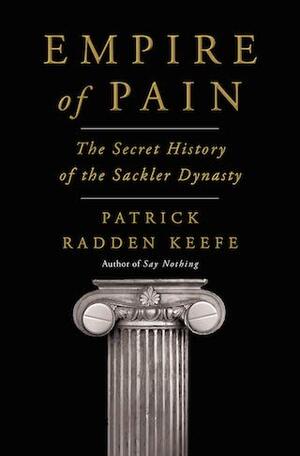
Empire of Pain: The Secret History of the Sackler Dynasty by Patrick Radden Keefe

I came to this book via the author’s brilliant 8-part 2020 Podcast series Wind of Change. That explore the remarkable claim that the hit song at the time of the fall of the Berlin Wall: “Wind of Change” was in fact written by the CIA as part of a pys-ops campaign to foment a clamour for democracy behind the Iron Curtain.

One of the Podcast’s bonus tracks is Reddan reading Chapter 16 of Empire of Pain. It’s a pleasing and tempting appetizer.

In Empire of Pain, Reddan details how the Sackler family built a multi-billion fortune on producing and marketing Valium and then saw their reputation, though not their fortune, ruined by their aggressive and reckless marketing of OxyContin, a powerful prescription pain killer. OxyContin has generated over thirty-five billion dollars in revenue but has also been the catalyst for an American opioid crisis that has killed hundreds of thousands.

It is devastating portrait of a super wealthy family who lavish donations and endowments on the arts and the sciences while deploying scorched-earth legal tactics to evade any accountability for their products and crush anyone who dares to challenge them.

An Ugly Truth: Inside Facebook’s Battle for Domination by Sheera Frenkel and Cecilia Kang

Though there is no shortage of excellent books and documentaries on Facebook, this one stands out because the authors tell the overarching story of the world’s largest social network in considerable depth and detail.

The New York Times review described the authors as producing “the ultimate takedown via careful, comprehensive interrogation of every major Facebook scandal”. While it can be seen as a takedown, you still don’t get the sense that the authors intended this as a hatchet job.

Their research leads where it leads… and, unfortunately for Zuckerberg, Sandberg and others, that leads to a top layer of Facebook executives exhibiting naïve hubris at best and toxic levels of factionalism and corporate cynicism at worst. It’s a chilling, but fascinating read, that details the problems, but can offer no solutions.

Political Purgatory: The Battle to Save Stormont and the Play for a New Ireland By Brian Rowan

I know many folks’ eyes will glaze over at the mention of the words Northern Ireland, but like it or not, the politics of the North matter across this island, and the neighbouring one too.

Political Purgatory by the respected political journalist Brian Rowan impartially charts the events of the past four years in careful and meticulous detail with valuable insights from key current, and past, political players.  The result is an essential primer for anyone looking to understand the political impact of Brexit, NI Protocol on what is happening at Stormont, and on relations with Dublin and London.

At just 80 pages, Dr Kathy Hayward’s The Irish Border What Do We Know and What Should We Do About…  is both a valuable and concise companion to Brian Rowan’s Political Purgatory.  Very few academics have written as knowledgeably and accessibly about the impacts of Brexit on relations on and across these islands as Kathy. Her book is detailed and informed examination of the political, economic, social and emotional impacts of the Irish/Irish border and the extent to which its existence has helped define unionism.

Agents of Influence: Britain’s Secret Intelligence War Against the IRA By Aaron Edwards

Sticking with the North… well, kind of… Belfast born historian and lecturer in defence and international affairs Aaron Edwards charts just how comprehensively British Intelligence infiltrated the provisional IRA and Sinn Féin during the height of the Troubles.

While we know the codenames and stories of some of the Brits most infamous agents, such as Stakeknife and Infliction, it seems the penetration of the Provos by the British Army’s notorious FRU (Force Research Unit) was both deeper and higher than thought – though how much we can now believe either side from a murky battle where truth was the first, but alas not the only casualty, is a question the reader should ask themselves throughout.

Nonetheless, Edwards attempts to tell the story fairly by way of now declassified documents and the first-hand testimonies of agents and their handlers. The book is a follow-up to his 2017 work: UVF: Behind the Mask a history of the vicious loyalist terrorist group from its post-1965 incarnation through its sickening list of atrocities, such as  McGurk’s Bar, the Dublin and Monaghan bombings and the Miami Showband massacre.

The next two picks are personal indulgences. Though LBJ remains my favourite (though flawed) American political figure of the 20th century, I am also fascinated by US politics kin the second half of the 20th century, perhaps due to the many larger than life figures who dominated the era.

The first book looks at one US political figure whose name you rarely hear mentioned these days, Spiro T. Agnew. For good reason too. Agnew, who served as Richard Nixon’s Vice President from 1969 to 1973, was a complete crook.

Agnew was forced to resign as Vice President after federal prosecutors uncovered his involvement in bribery, corruption, and extortion as Governor of Maryland, including taking kickbacks from local state contracts even after he entered the White House. Not that he went easily, a plea agreement saw him plead nolo contendere (no contest) to a single charge of tax fraud and so he was spared any prison time.
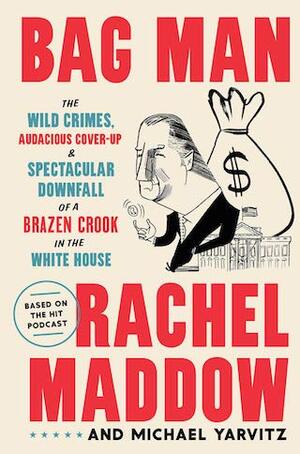
Bag Man: The Wild Crimes, Audacious Cover-up, and Spectacular Downfall of a Brazen Crook in the White House by Rachel Maddow, Michael Yarvitz tells the story of Agnew’s undeserved rise, but well-earned fall with both wit and style. It is a remarkable political scandal which we have all but forgotten as it was quickly surpassed by the Watergate revelations. While reading it do not forget that if the Maryland prosecutors had not been so assiduous, Nixon would have been succeeded by Agnew and America would have wound up with having two Presidents impeached, in succession.

The Man Who Ran Washington: The Life and Times of James A. Baker III By Peter Baker, Susan Glasser

The second personal indulgence book is a biography of James A. Baker III, one of the GOP’s most accomplished political leaders. It serves as a welcome antidote to the Agnew book.

A legendary White House chief of staff and secretary of state, Baker was a power broker and pivotal figure in both Republican and American politics for a quarter-century after Watergate. As the blurb observes no Republican won the presidency without his help or ran the White House without his advice, for all that time.

It is well titled. Baker really did understand better than anyone how to make Washington work. He knew how to negotiate and how to make, and deliver on, agreements. He was a tough election campaigner, but also understood the need to work with Democrats to deliver on the domestic agenda – a skill that today’s Trumpian GOP has either forgotten or chosen to ignore.

I was about to close the list here, but I have two other books I want to quickly include. Both deal with the UK’s continuing problem understanding its place in the modern world. A problem witheringly identified by the former US Secretary of State, Dean Acheson back in 1962 with the line: “Great Britain has lost an empire and has not yet found a role”. 

The first is: Empireland. How Imperialism Has Shaped Modern Britain by Sathnam Sanghera. Sanghera looks at the legacy of empire and where so many of today’s little Englanders only see light and dismiss any criticism of empire as unpatriotic, he shows that there is much about it that is dark and hidden. He does not approach the subject as a historian, but rather as a journalist. The net result is a book that tackles Britain’s collective amnesia over its colonial past but also shows how the Brexiteer dreams of reviving colonial links to replace trade with the EU are based on myth.

The second book is an even more critical assessment of the legacy of empire. Time’s Monster: History, Conscience and Britain’s Empire by Priya Satia is an important corrective to the heaving shelves of British Empire histories. While Dr Satia has produced a highly critical history of a British imperialism rooted in violence and inequality, it is less a corrected history of the empire and more a detailed examination of how and why British historians sought to frame how the empire was understood.

****

So, that’s my list. I hope you can check out a few of them over the coming weeks.

I will be back here in early September, well-watered and rested and ready to offer my thoughts on what’s happening, and what’s not happening on the Irish political scene.

Who knows, perhaps I will be able to explain why An Taoiseach Micheál Martin disingenuously claimed in yesterday’s Sunday Independent that:

“Some commentators choose to ignore that in four recent face-to-face opinion polls, my party [Fianna Fáil] was at between 20% and 22%.”

A claim curiously foreshadowed by a political commentator in Saturday’s Irish Times.

There have been 39 national newspaper opinion polls since GE2020. Fianna Fail’s average rating across all 39 is 15.6% (its median rating is 17%). While four polls since January 1st 2021 have shown FF at 20% or 22%, the other 14 polls taken over that period showed it at anywhere between 11% and 16% (averaging 14.1%).

As I pointed out here a few weeks ago:

Even the more optimistic Irish Times/Ipsos-MORI poll finds that Fianna Fáil is in 5th place on just 8% among Dublin voters aged below 35. Their poll results put it almost 30pts behind Sinn Féin, 13pts behind Fine Gael and 9pts behind the Greens.

… so if this claim is central to Martin’s personal defence, then his case is about to collapse.  Enjoy the rest of the Summer, wherever you get to spend it.

Derek Mooney is a communications and public affairs consultant. He previously served as a Ministerial Adviser to the Fianna Fáil-led government 2004 – 2010. His column appears here every Monday. Follow Derek on Twitter: @dsmooney

Rollingnews

From top: Fianna Fáil TD Jim Callaghan and the party’s Dublin Bay South by-election candidate Deirdre Conroy outside the RDS count centre last Friday; Derek Mooney

A few weeks after the February 2020 election I said that Fianna Fáil’s Micheál Martin needed to stop and “take a hard look at why his party lost support and seats”. I said it again, several times, over the weeks and months that followed. I even offered the independent review the Australian Labour Party had commissioned into its electoral failure as a template.

I thought it was essential that the party examine why it had done so badly before doing anything precipitative, such as going into government with the party it had promised to put out of office.

The leadership thought otherwise. It felt Fianna Fáil’s best course of action was to get into office and that its political revival would come from the government program for recovery. It seemed to miss the inconvenient truth that this meant giving Fine Gael a veto on Fianna Fáil’s fortunes.

This was one of the main reasons I ended my 40-plus year membership of Fianna Fáil. Why would I knock myself out trying to rebuild a party, when the top Fine Gael brass would have a bigger say in it than grassroot members?

Martin did agree a general election review as part of the package of measures to accompany the membership backing the Programme for Government. Twelve months later, that review has yet to be published. But then, the white paper on reunification that Martin told the Irish Times about in March 2017 is now only four years overdue.

Last November when the Red C/Business Post poll had Fianna Fáil’s support down to 12% I wondered: What is the purpose of now commissioning a report into why you lost 8% support between Sept 2019 and Feb 2020, when the latest polls show the decline today could be as high as 18%?

Last Thursday’s Dublin Bay South result shows the decline from the potential 28% identified in the Sept 2019 Red C Poll is even greater. In a measured but well considered letter to party colleagues circulated on Saturday, Barry Cowen TD said that the party needs all its TDs and Senators gathered in the same room to “reflect, discuss and take on board the message” sent by voters.

He is right.

Fianna Fáil now has a crisis level problem with both relevance and viability. A problem which its leader of over 10 years seems unwilling to address and which some of his Ministers seem blissfully unaware.

So, let me offer this concise independent review of what I think went wrong in the by-election. I offer this as an ex-party member who spent four decades in this and neighbouring constituencies. (NB when I joined, Fianna Fáil held two seats out of three in the old Dublin Rathmines West constituency, so the notion that people in Dublin 2, 4 or 6 are inherently unwilling to vote Fianna Fáil is nonsense.

As for the wider issues… I can send several dozen columns published here over the past two years.

Let me look at the Dublin Bay South by-election campaign an under a couple of headings.

Messaging.

It is not that Fianna Fáil’s by-election messaging was wrong. Quite simply, it had none.

All it said to voters was – vote for us because you voted for us in the past, and you might do so again in the future. All that was missing was, vote for us as your Ma and Da used to.

Worse still, it was trying to run twin-track messaging. While its canvassers and volunteers were out extolling the party’s record in government, party strategists were telling all within earshot that they hadn’t a prayer, and this was all the local TD’s fault.

Not that the messaging was much better from other parties. Fine Gael’s message was vote for us to keep the Provos out. Indeed, they were pounding out that message online and on doors right up to the last hour campaign. Not that it mattered.

Ten days earlier an Irish Times poll blew the FG strategy out of the water. It showed that Ivana Bacik was the challenger, not Lynn Boylan (as I explained last week). Sinn Féin’s vote dropped across large parts of the constituency outside of the canal. I did not see that coming.

Meanwhile, with just two days to go before polling, Fianna Fáil, which had fought the last election saying that no single buyer should be allowed to bulk purchase entire developments, allowed itself to be portrayed as helping vulture and cuckoo funds to profiteer.

That is virtually a textbook example of bad messaging, and it cannot blame the sitting TD, the candidate or the local party organisation for that.

Campaign Strategy

While there was a local strategy on campaign organisation, there was no national campaign strategy. Bad enough that there was no Fianna Fáil national response at the outset to Fine Gael’s this is between us and Sinn Féin, but there was no pivot when the Irish Times poll showed that voters were going to Labour’s Ivana Bacik as the best way to reject the Sinn Féin/Fine Gael best of enemies’ approach.

That poll put Fianna Fáil at 10%, but the party failed to act. It could see that the momentum was with Ivana and there was a distinct risk that moderate voters would increasingly see Bacik as the safest way of frustrating both Sinn Féin and Fine Gael.

Its failure to tackle the false SF vs FG narrative at a national level hurt the by-election campaign. Fianna Fáil must find a counter strategy, and fast, as the best of enemies look like they plan to stick with this stratagem for a while.

Social media.

I could write paragraphs on the problems with the party’s social media strategy, but rather than doing that, look at this compare and contrast video featuring the official Fianna Fáil and Fine Gael Twitter feeds on the eve of polling. Fine Gael tweeted as much material, almost all by-election related, in 4 hours as Fianna Fáil managed over two days, though only a fraction of Fianna Fáil’s tweets were about the by-election.

The party has capable and proficient staff on the payroll, but the party’s problem with crafting clear messaging gives them nothing to work with. You cannot have a social media strategy unless you first have a message. Fianna Fáil still has none.

Candidate.

Fianna Fáil’s candidate in the by-election has come down for a lot of personal criticism, much of which I think was unfair.

While Cllr Deirdre Conroy went into the arena with her eyes open, it is still disheartening to hear suggestion that elected and appointed party officials were briefing against the candidate who did offer to run when others would not.

Electoral politics has become such a no holds barred game that you have to wonder why anyone with any experience in other walks of life would offer to get into it. I am not trying gloss over Deirdre Conroy’s less than confident media performances, but have no doubt that, as a private citizen, Deirdre Conroy has done this country some service.

Agree or disagree with her politics today, we should not forget that Deirdre took a public stance on a difficult issue when it mattered. In February 2002 she wrote a deeply personal open letter to the Irish Times recounting the severe complications she was then experiencing with her pregnancy. She went public, though understandably under a pseudonym, in the hope of changing views and changing the law, calling for terminations in the case of fatal foetal abnormalities to be legalised.

Her intervention played a major part in swinging public opinion against the 2002 referendum. She unsuccessfully took a case to the European Court of Human Rights in 2005/06 and in 2013, following the tragic death of Savita Halappanavar she waived her anonymity and again told her personal story.

The vote she received does not reflect the service she has done this country or the contribution she continues to make as a City Councillor. She has already contributed to substantively changing this country in ways that many of those who sniped at her online never will.

Responding to the result.

One of the great truisms of electoral politics is that you learn more from watching how someone handles defeat than from how they handle victory.

Micheál Martin’s studied avoidance of the by-election count centre was telling.

While An Taoiseach’s advisers may have imagined that his responding to the party’s worst ever electoral performance remotely from a Cork vaccination centre would help distance him from it, all it did was draw even more attention to the possibility that he was trying to distance himself from it.

To his great credit, Micheál Martin spent a lot of time campaigning on the ground. He was personally generous with both time and energy, indeed many colleagues remarked that very few past leaders of the party would have given so much time to going door-to-door and meeting voters.

So, why allow all that good work to be undone at the very end by not going to the count? Being a leader being as prepared to stand with your folks when the bad news is delivered as you are when the medals are being handed out.

If Micheál Martin thinks that it is sufficient as Leader to just say I’m sorry we lost, thank you Deirdre and now let’s just move on, then he simply does not grasp the enormity of the problems facing his party. As Barry Cowen says in his letter:

It cannot simply be brushed aside, ignored or not examined”.

In my view – and this will surprise no-one who has read anything I have written over the past 18 months – Martin’s time as leader must be drawn quickly to a close. Maybe not this month, or even next month… but soon.

Here ends my report.

Derek Mooney is a communications and public affairs consultant. He previously served as a Ministerial Adviser to the Fianna Fáil-led government 2004 – 2010. His column appears here every Monday. Follow Derek on Twitter: @dsmooney

Rollingnews

From top: Michaál Martin (left) canvassing In Cork with James O’Connnor during the last General Election; Derek Mooney

According to the many detailed leaks from last week’s Fianna Fáil parliamentary party meeting (an issue itself worthy of an article) the suggestion that young people perceive the party as toxic and inimical to their needs, angered and upset several TD’s and junior ministers.

And not in a good way. Rather than being angered that young people feel this way – and sadly they do, as almost every poll published over the past 18 months has shown – some ministers were outraged that colleagues would dare point this out.

Even the recent Irish Times Ipsos/Mori, which optimistically showed Fianna Fáil’s support increasing nationally by 6pts to 20%, still found that the party is only on 8% among Dublin voters aged under 35. This puts it in a very weakened 5th place in Dublin, well behind Sinn Féin, Fine Gael, The Greens and Independents.

Opinion polls published over the past 18 months have consistently shown that Martin’s party has a major problem with voters under 25. So, why do An Taoiseach’s supporters interpret saying this, at a private meeting of the parties elected representatives, as wrong?

Perhaps it was due to the rawness of many in government over what had transpired in the days before? It had not been a good week for the government.

While most people will understand the government’s desire to halt the spread of the Delta variant, even those closest to where the decisions are made would concede that the lack of preparedness and absence of any contingency planning was an unholy mess.

This was not joined up government. To its credit the government has managed to claw back some semblance of authority by announcing that young people (aged 18 – 34) can register at pharmacies for the Janssen single dose vaccines and by following the Danish example and purchasing 1 million excess Pfizer vaccines from Romania.

But, even so, the net overall impression is still that of a government caught unaware by the bluntness of last Tuesday’s Nphet assessment and one that did not consider how acutely its decisions would affect young people.

If this slowness to reopen opportunities for socializing was the only area where young people felt aggrieved with government action/inaction, then the government parties, particularly Fianna Fáil would have cause to feel they could recover that lost trust… but it is not.

As Fianna Fáil’s youngest T.D. James O’Connor (Cork East) told the Business Post:

“…in terms of what it stands for to younger voters in Irish society, Fianna Fáil, is not in any shape or form at a standard of where it needs to be… We’ve never seen such high costs of living. The cost of rental and the price of new homes are absolutely extraordinary. Access to third-level education for young voters is becoming increasingly difficult because of the cost of living…. I am quite concerned about the pace of delivery on housing and the political consequences of that pace of delivery.”

Deputy O’Connor’s comments are neither extreme nor excessive. They precisely echo the opinions of many young people I know, though they would go much further than Deputy O’Connor. They talk of the sense of feeling vilified and blamed for the months of continued lockdown.

Having waited patiently to take their turn to be vaccinated and try to return to some form of normal social life, they then heard the Taoiseach tell them that they will not get to use or enjoy any indoor facilities for several more months because the government has not been ready to vaccinate them… but that they can still work indoors and serve others while unvaccinated.

Though I‘m no fan of Micheál Martin’s, not even I think he intended to say that . But what one side means to say, and the other side hears and understands, are often two different things.

It appears that neither An Taoiseach nor any of his large coterie gave sufficient thought to how young people, who already feel alienated by many government policies, might perceive what he was saying.

So, at the very moment when Fianna Fáil needs to tell itself some exceedingly difficult and unpalatable truths, there is no appetite to hear them. Not only must be message go unheard, but the messenger must also be talked down.

Those ministers, Senators and Deputies who baulked at Deputy James O’Connor’s comments may have sincerely thought – or may even have been told – they were doing their leader a favour in silencing any criticism or dissent.

They weren’t. The leaking of invocations of loyalty to both leader and party, coupled with the criticisms of Deputy O’Connor, merely confirmed the impression that Martin’s Fianna Fáil is no place for young people.

It wasn’t always like this.

There was a time when Fianna Fáil recognised that attracting young voters and devising policies to attract young and first-time voters was the key to electoral success. Get young people into the practice of voting Fianna Fáil early, it mercenarily reasoned, and they will tend to stick with it as they go through life.

That time could broadly be described as the period from its foundation right up to 2009. Though it is arguable that it reached its zenith in the late 1970s and again in the late 1990s, and its nadir in the late 40s, 50s and early 70s. In other words, at the times when the party was weary, and its leadership jaded from being around too long.

Past generations of Fianna Fáil leaders understood the curious almost symbiotic relationship between the interests of people aged under 25 and those aged over 65. One that echoes the bond or connection between grandparent and grandchild.

Each has an interest in the welfare of the other, as both see themselves as being on the opposite end of life’s scale with mutual altruistic interests.

Young people want to see their grandparents enjoy a long and content retirements just as much as those grandparents want to see their grandchildren get a better start in life than they had. Playing one off against the other does not work.

It will be interesting to see in Thursday’s Dublin Bay South by-election just how motivated younger voters are to turn out. No one is expecting a high turnout. The constituency had the second lowest turnout in February 2020, so even a moderate youth turnout could see a big vote swing.

If the increased almost frantic activity of the Fine Gael campaign over the past few days is anything to go by, then the current Fine Gael leadership is deeply worried and sees defeat as a distinct possibility, if not a probability.

They are right to be worried. While I wouldn’t bet on whether it will be Labour’s Ivana Bacik or Sinn Féin’s Lynn Boylan who steals the win from Fine Gael, I would be shocked if one of them does not win.

Bacik seems to be getting the support of many of Kate O’Connell’s former voters. At the last general election about 1150 Labour votes transferred to Kate O’Connell, this time around they look like going straight to Bacik as Number 1’s, completely bypassing James Geoghegan. Meanwhile, Lynn Boylan should still benefit from Sinn Féin’s rising national support – even if the recent Irish Times Dublin Bay South poll says otherwise.

The poll itself could play an interesting part in the by-election dynamic as the Irish Times is as much a local paper to the people of Sandymount and Ranelagh as the Drogheda Independent is to the good citizens of Yellowbatter.

Not only did the Times poll show Fine Gael struggling to hold the seat, it also dulled, if not entirely blunted, an important weapon in the Blueshirts’ political armory – the Sinn Féin threat. Fine Gael needed Boylan in second place to push the myth that this was just as a binary choice between Sinn Féin and Fine Gael. A reputable poll showing Bacik in second place has just scuppered a core Fine Gael strategy.

Hence the Fine Gael leader’s handwritten letter to voters pleading for support. “Our three-party government only has a small majority and every TD’s vote counts in the Dáil”, Leo tells them – yet he was phlegmatic when the last Fine Gael TD elected by these very voters in February 2020 just upped and walked away from politics.

By-elections are unreliable predictors of the wider political mood. Bertie Ahern never lost a general election As Fianna Fáil leader, but he never won a by-election as one either. But they can help end leadership careers. With five weeks of losing the two November 1979 by-election in Cork City and Cork North-East, Jack Lynch was gone as both Taoiseach and party leader.

A change of leadership in Fine Gael or even the increased talk of a change of leadership will have many in Fianna Fáil wondering is it not time for them to do the same. It is past time for the party of Lemass to reconnect with young people and find a leader who can speak to the next generation, rather than one who epitomizes the one before last.

Derek Mooney is a communications and public affairs consultant. He previously served as a Ministerial Adviser to the Fianna Fáil-led government 2004 – 2010. His column appears here every Monday. Follow Derek on Twitter: @dsmooney
Pic: Twitter


From top: Dublin Airport; Derek Mooney

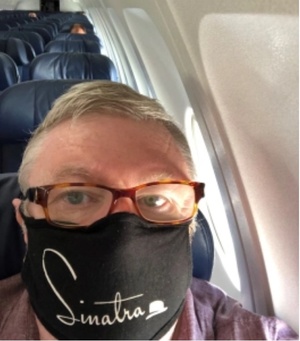
It has been about eight months since I recounted my experiences of travelling to Spain during the pandemic. Needless to add, like the vast majority of us I have not been travelling since. That is, up to last week.

As I explained the last time, my travel was essential as I was going to visit my mother who lives in Spain, having retired there, along with my late father (who died in 2011) just over two decades ago. For reasons too personal to go into here, it was essential that I visit my mother now.

The airport staff, the airline crew and the other passengers were extremely careful, cautious and prepared. There were a few bothersome aspects, but none so trying as to be worth commenting on here. The one area on which I will focus is testing… primarily because arranging and securing tests – particularly PCR tests – is not cheap and not always easy.

Long story short – while the journey itself was not too difficult, the bottom line is this: while my return flight to Spain for 3 nights via Ryanair cost about 250, the PCR tests required to make that journey costs 400 for PCR tests. By the way, the gap between the first PCR test and the last one was approx 9 days.

This is for three PCR tests: the first to be able to get on a plane in Dublin to travel to Spain, the second to be able to return to Ireland, and the third test to allow me to reduce my period of self- isolation/quarantine to just over 5 days. This third test is discretionary, but opt not to take it and you must do the full 14 days of self isolation.

Bear in mind that I am fully vaccinated. I have had two doses of the Pfizer vaccine, the first at the end of April and the second, four weeks later, at the end of May.

I fully back being vigilant in trying to stop the spread of Covid, especially new variants, but if the competent health authorities here in Spain feel it is sufficient for an Irish person to be fully vaccinated in order to arrive in Spain, then why would the Health Authority which is responsible for vaccinating me determine that I may only return home to Ireland and a potential 14 day self isolation if I produce a PCR test. Why not an antigen test?

Getting a full PCR test while away is not difficult, but neither is it easy. I had to book my appointment before I left. I did it through a private hospital that is approx 15km from my parent’s home here. Unfortunately, the hospital’s App is not designed to be used easily with non Spanish mobile numbers, so verifying my details in advance was complex and took a few days of trial and error before leaving to get it right.

I mention this, as most of the other non Spanish who were at the hospital for their PCR tests found that they had to return to the hospital the following morning to collect their results in person, on paper, meaning two return taxi journeys rather than one. A cost element I haven’t factored into my 400 estimate for PCR tests.

It is also worth mentioning that even those who had pre-booked their PCR tests still had to queue for over 1 hour, despite having an appointment. The test itself takes barely 30 seconds to conduct, but there were so many walk-ins for tests that the whole pre-booking system was overwhelmed.

Luckily, as I was able to get the App working fully in advance of travelling I was able to get my results on the App within about 8-10 hours of having that cotton bud rammed through my sinuses to the point that it touched the roof of my skull.

While I’m talking about Apps, the Spanish Health authorities have produced an excellent Spanish Health travel App and website. I mentioned this last time I wrote about going there.

It is easy to use, especially the English language version. It is neat, self explanatory and streets ahead of the online Passenger Location Form produced by the Irish Department of Health. While the Irish form requires you to show Irish passport control staff an email when you get to the desk, the Spanish one gives you a QR code – which you scan at a reception desk operated by the local health authority in the arrivals area, just beyond passport control.

The Spanish have wisely separated the requirement to check your passport and check your locator forms. The Irish have decided to hand the two important tasks to just one person.

So, while the Spanish official can then see your full details on screen, including where you will be staying while in Spain, plus your vaccination/test status, the Irish passport official gets a quick squint at your phone screen to see an email in your inbox.

Doesn’t seem quite as efficient, comprehensive or even reassuring as the Spanish system, does it?

The last time I travelled I said that I felt the weakest link in the four connection points: Dublin Airport Departures, Alicante arrivals, Alicante Airport Departures, Dublin arrivals, was the final one at Dublin Airport Arrivals. Sadly, the Department of Health and HSE has not done much in the interim to convince me that my first impression wasn’t correct.

This is not a comment on what Dublin Airport staff and management have put in place, it is purely confined to the absence of an Irish health staff presence, unlike their Spanish counterparts.

I do want to note the professionalism and attention of the Ryanair staff, particularly their airside team at the departure gate. They were meticulous in checking every passenger’s Covid documentation and cross referencing it against their passports. They did it efficiently, but also in a relaxed way that didn’t irk people who were already a little anxious about travelling. This calm professionalism was also on show by the security and customs staff at the Airport.

It looks like I will have to travel again in either late July or early August, though I would much prefer not to – for a variety of reasons. Hopefully the EU’s Covid travel system will be up and running by then, both for the sake of Irish passengers, who find that the price of their flight is only 40% of the cost of their journey, but even more so for the countless thousands of Irish airline and airport staff who must surely be wondering when will someone in government will start to show some concern for the security of their employment.

Derek Mooney is a communications and public affairs consultant. He previously served as a Ministerial Adviser to the Fianna Fáil-led government 2004 – 2010. His column appears here every Monday. Follow Derek on Twitter: @dsmooney

Rollingnews

From top: Taoiseach Micheál Martin has seen his popularity rise while his party falters; Derek Mooney

Though I probably keep this fact well hidden from readers, I really try to not write about polling too often. I say this through clenched fingers as I know it must seem that I have written about little else over the past few weeks and months.

It is a fair criticism to say that political pundits talk and write excessively about polling in the guise of political analysis. While the soap opera aspects of politics, who’s in, who’s out, who’s politically in bed with whom, does help liven up what can often be a dull area, the focus should be on the policies and the decisions rather than who makes them.

The old Heisenberg uncertainty/indeterminacy principle applies to politics as much as it does to physics. If you cannot accurately measure both the position and the velocity of an object simultaneously, then you should focus more on the  trajectory of an object or an idea than analysing snapshots of where it was a few days or weeks ago.

All of which is a long-winded way of me explaining/excusing – why I am once again talking about polling.

In my defence I do this as there is something that is worth discussing in the two most recent opinion polls: yesterday’s Ireland Thinks/Irish Mail on Sunday one and last week’s Irish Times/IPSOS/MRBI, as they offer some contradictory results.

Before we turn to the narrow, but important, area of contradiction let’s quickly deal with the many areas on which they agree. They both show the three main parties in the same relative order. Sinn Féin first, Fine Gael in second place followed by Fianna Fáil in third place.

The Irish Times poll thinks the three main parties are grouped across an 11pt spread, with Fine Gael 4pts behind Sinn Féin and 7pts ahead of Fianna Fáil. The Irish Mail on Sunday poll reckons the spread is much wider at 17pt – with Fine Gael 8pts behind Sinn Fein and 9pts ahead of Fianna Fáil. The two polls agree on Sinn Fein’s dominance, each putting it within 1pt of the other on 32% (MoS) or 31% (IT).

So, it is the degree to which Fianna Fáil is out of the game on which the two polls disagree. The Irish Times says it is 11pts off the lead, the Irish Mail on Sunday says 17pts. In the greater scheme of things this is not a major point of contention, unless you are worried by the prospect of a decade of vapid, binary, and polarised Fine Gael versus Sinn Féin politics and care about the prospects of a once great progressive and centrist party. And, although I am no longer a member, I do care.

So, why was the Martin-ite action of Fianna Fáil popping champagne corks and putting out the bunting last Wednesday and Thursday at the prospect of being third in this three-horse race?

Whether your horse comes in 11 minutes or 17 minutes after the winner, doesn’t change the fact that you are double digits off the pace and have gone from coming a poor second to coming consistently last in under 18 months.

Has the Martin leadership so dulled and becalmed the political sensibilities and expectations of the Fianna Fáil party that coming third by less than other polls is an achievement to be celebrated?

To be fair to the Martin-ites they can point to the Irish Times saying that Fianna Fáil has regained a chunk of the support that Martin lost for the party, by going so easily into government with Fine Gael this time last year.

But their joy at this pyrrhic win has been dulled by yesterday’s Mail on Sunday poll which says they haven’t regained ground. So which is it? Perhaps next week’s Business Post/Red C poll will throw some light on this issue.

For the record, my own view is that Fianna Fáil is not quite as low as 15%. It quite possibly could be on 16, 17, or even 18% nationally right now. But even if it is, the party has lost support across the country, and most especially in Dublin. I fear that one more year of directionless leadership will see it drop further back.

Even the more optimistic Irish Times poll finds that Fianna Fáil in in 5th place in the Capital among voters under 35. Their poll results put it almost 30pts behind Sinn Féin, 13pts behind Fine Gael and even 9pts behind the Greens.

Anyone in Fianna Fáil who is elected by a poll featuring that result either doesn’t understand politics or is exclusively focused on securing their personal position or pension over the next 18 months. To their immense credit there are many Fianna Fáil veterans who do see the warning signs. The misfortune for the party is that none of them are in positions or authority, having been meticulously marginalised by the leadership.

Speaking of leadership, one other point on which most recent polls have been united is on the increasing personal popularity of An Taoiseach, Micheál Martin.

The fact that his improved performance ratings are not converting into increased support for his party is not a new phenomenon. Research here, but more especially in the UK, shows that a party leaders’ approval ratings tend to fluctuate far more dramatically than that parties’ vote share.

The gap between his personal approval his rating and his party’s may be due to putative Fine Gael voters looking at Micheál Martin and thinking, yeah, he’s doing a decent job as Taoiseach in leading a government that pursues the kind of minimalist government approach we like.

They may well perceive him as impartial, non-partisan, even as politically non-threatening. But none feel this to such a degree that they would dare consider voting for his party, Fianna Fáil.

Conversely, there are former potential FF voters looking at him saying: Yeah, Fine Gael are happy with you. That’s why we’re not happy with you and that’s why we won’t support your party.

Martin’s personal popularity does suggest that he has been particularly adept at disassociating himself from his party. Even as I type this, I know it is an unfair characterisation… though it may be an accusation that has occurred to the Fianna Fáil leader.

He has been far more assiduous than other party leaders in going out canvassing in the by-election. Martin has been to the fore in identifying clearly with his party’s candidate, Cllr Deirdre Conroy, in party videos and on out on the streets.

It is not that he thinks Fianna Fáil can win it. Martin as good as admitted that from the start, but he knows his position in in trouble unless he can move Fianna Fáil out of the doldrums of perpetual third place.

A third place showing in Dublin Bay South would be a Godsend for Martin. As I have discussed elsewhere, the Dublin Bay South race is broadly going the way that both Fine Gael and Sinn Féin had hoped… well… kind of. This was Fine Gael’s seat to lose and right now they are on the cusp of doing that, with Sinn Féin snatching a seat that would never have appeared in a Sinn Féin list of 100 winnable seats three months ago.

Fine Gael’s preferred candidate will need every transfer he can get to hold on to this once most bankable of seats, while his colleague, the former Fine Gael TD who narrowly lost the seat last June watches from the side lines, that’s when she isn’t having her photo taken outside her Rathgar pharmacy with the Fianna Fáil leader.

The content, but more importantly the tone, of Leo Varadkar’s Fine Gael Árd Fheis speech hints of a leader who is deeply worried about his party’s declining poll numbers and sees a real prospect of losing Dublin Bay South.

It’s only 16 months since voters told Varadkar that his party has not done enough to tackle the housing crisis. Will those voters be persuaded by his announcement of wanting 40,000 new homes, per year? It is unlikely, especially when the Sunday papers were telling voters that it could be 2025 before the government can meet its existing commitment to build 33,000 new homes per year.

Yesterday’s explanation by Leo Varadkar on the Week in Politics on why his comments on Unity were not out of order, may have helped steer some core Fianna Fáil transfers his way in Dublin Bay South. Now if he could only get his candidate to stop driving them away when he goes on Zoom.

One more point on the Fine Gael Árd Fheis. It was unusual to see the Fine Gael leader get 45 minutes of live TV coverage on Saturday evening during a by-election campaign. Will RTÉ find some way to ensure that the leaders of Sinn Féin, Labour, Greens, Fianna Fáil, Social Democrats, and others, get similar coverage during the by-election period? We shall see.

The word is that Fianna Fáil is planning to hold its Árd Fheis in mid-October and that it will also be a virtual affair, just like Fine Gael’s. This seems an odd decision to take this far out.

In fact, it’s not just odd, it is ominous. Either it points to senior Fianna Fáil figures believing that there will still be Covid restrictions on large gatherings even when everyone is vaccinated, and society has reopened… or… it means the current leadership is less than enthusiastic about having its activists meeting up face to face to discuss how the party is doing.

Either way, this announcement will anger an already irate hospitality sector, who will see the move as a significant vote of no confidence in its future. Surely it was not beyond the small core of officials who run the party to either delay the Árd Fheis until early 2022 or come up with a hybrid model where members could meet regionally, in small safe gatherings, with the big speeches streamed from various locations?

I would be surprised if the leadership is not forced to revisit this decision sooner rather than later. After all, who knows what could happen between now and October?

Derek Mooney is a communications and public affairs consultant. He previously served as a Ministerial Adviser to the Fianna Fáil-led government 2004 – 2010. His column appears here every Monday. Follow Derek on Twitter: @dsmooney

RollingNews

From top: Fake political polls and fake political pollsters are two different things, argues Derek Mooney (above)

While All The President’s Men remains the best Watergate related movie, there are some credible challengers. Indeed a new 5-part TV series, the White House Plumbers is currently in production. Directed by VEEP writer and producer David Mandel, it stars Woody Harrelson as Howard Hunt and Justin Theroux as Gordon Liddy, the leaders of the crew of “plumbers” who broke into the Democratic Party HQ in the Watergate office complex.

Another contender is the quirky “Nasty Habits”, a film which manages not to mention Nixon, the White House or even Watergate. Instead, this adaptation of the Muriel Spark satire: “The Abbess of Crewe” which transposed the Watergate scandal to an English Benedictine convent, moves the action again, this time to Philadelphia and an order of nuns led by the Nixonian Sr Alexandra, played by Glenda Jackson.

Alexandra has schemed her way to the top of the cloister by secretly taping the confessions of her fellow sisters. She has her Ehrlichman and Haldeman like henchmen in the guise of Sisters Walburga and Mildred, plus the globe-trotting missionary Sr Gertrude, who shuttles around the world’s trouble spots, á la Henry Kissinger, played brilliantly by Melina Mercouri.

In one scene Alexandra calls Gertrude asking how she can defend her actions while protecting her tapes. Gertrude advises her to tell them it is a paradox. What’s a paradox? asks Alexandra. Gertrude replies:

“a paradox is something you must live with.”

I mention all of this as Sr Gertrude’s “paradox” came most to mind as the furore over party polling raged in the newspapers and on the airways, last week.

Ministers were rushed out to label Sinn Féin’s 2015 polling “sinister”… but, no sooner had certain party HQs sent TDs out to condemn it all, than the same HQs were revising their positions and conceding that they’d done it too, though there had stopped it in 2007… or 2011… or 2015.

Every time I talk here about the latest national polls, I remark that political parties do not do their polling in the same way as national opinion polls.

It is a simple truth that political parties do their polling at constituency level. There is nothing wrong with polling. There are rules by which it is done. The primary rule is that you protect and maintain the anonymity of the people polled. This rule applied long before the arrival of GDPR.

But doing constituency polls costs money and the bigger parties have looked to cut the costs, while safeguarding the accuracy of the results and the integrity of the process. Nothing revealed over the past week has shown that any of them have undermined either aspect.

That said, the revelations about how folks represented themselves at the doors have been embarrassing, though not as embarrassing as how the main parties have had to change their stories and admit to doing what they accused others of doing.

Parties using volunteers makes sense when you consider that the biggest single cost element in any poll is collecting the data. So, why would a party with a strong volunteer base pay an agency to hire 50 – 60 people to spend a Saturday morning going door to door, asking 500 – 600 people to anonymously fill in sample ballot papers? It has experienced volunteer canvassers who are well used to going door to door that it can send to do the leg work.

So, while those on the doorsteps may be volunteers, is it fair to label them as fake pollsters? Their task is to gather the representative samples as requested, by going to the streets in the constituency identified by the pollster who crafted the poll. The critical number crunching work is done afterwards, either by experienced pollsters working in-house or by independent professionals hired in from outside.

The polling itself is real, not fake. The results are tabulated fairly. The individuals polled are not identified. No one ever knows how they each voted on their sample ballot paper.

So, the main issue arising from the polls done by Leo Varadkar, Sinn Féin etc., is how the people going door-to-door represented themselves.

While some parties and individuals seem to have concocted elaborate backstories with fake company names, fake business cards, fake IDs, and 70-page manuals, others had the cop-on to send out experienced and savvy canvassers with the know-how to be obtuse when asked, who sent them. Rather than producing a fake business card, they shrugged and said: I’m not sure, I think its one of the big parties. We were just asked to go door to door. If you’d prefer not to participate; that’s no problem . 

All of which leads us back to the central paradox.

The fairness, accuracy and impartiality of the poll result is ensured and protected by the person being surveyed not knowing who is doing the polling.

As any professional pollster could confirm, if the person surveyed knew the poll was being conducted by, or on behalf of, Fine Gael or Labour, then it is possible that it will skew the respondent to give that party a higher preference than they might have otherwise. Therefore parties and independents doing these polls are reticent about saying “it’s us” when they go to the doors.

The easiest way out of this dilemma is to go to one of the many polling and market research agencies in town and pay them to look after the whole process from start to finish. In effect, that seems to be what most parties now do.

Perhaps, it is also due to a combination of parties finding it tougher to get people to volunteer in the way they used to and voters being more questioning and sceptical about responding to someone coming to their door seeking their opinions for a poll than they were a few decades back.

Thus, the volunteers who were once sent out to do polling are now deployed selling €50 national draw tickets. In my opinion, it’s not a better use of their time or energy.

So, while it is not unfair to label the fictitious polling companies as fake, that does not mean the polls were fake or that the people doing the legwork were anything other than sincere and honourable.

We should be careful about generalising the fake pollsters claim into one of fake polling. Fake polls are a vastly different thing.

One of the most pernicious examples of fake polling is push polling. Used a lot in the US elections in the 80s and 90s, this form of negative campaigning involves parties or groups calling voters by phone and claiming to be from a usually fictitious polling company.

Working from a carefully prepared script they ask the voter “if you were aware that candidate X of party Y was a drug user… or a serial cheater… or whatever… would you still vote for them.”

The purpose of the poll isn’t to gather responses, it’s to start a rumour going about the other party’s candidate and drive support away from them. One of the most egregious examples was the smear campaign mounted against Senator John McCain in 2000 in South Carolina as he sought he Republican nomination against George W Bush.

That’s a fake poll with a malicious purpose. There are other kinds of fake polls. Fake polls that verge on the benevolentand I am going to own-up to my role in one of these.

My first election run was way back in 1985. I was a Fianna Fáil candidate in the Rathmines city council ward. This was back in the day when Fianna Fáil could comfortably win two seats out of four across Dublin. As the second candidate selected at convention, it looked like my political career was set to take off at age 22.

However, within days of being selected party headquarters decided to add not one, but two other candidates to the ticket. My chances had not just been halved; they’d been slashed even further as one of those added was a publican whose premises on the Harold’s Cross Rd was barely 500 yards from my family’s small hotel.

I was in big trouble. I was the youngest candidate but also the most impecunious one. I was going to have to do something big to be myself noticed – but something that didn’t cost much money. My campaign manager and I decided to organise a fake poll, but without the need for fake pollsters or polling companies.

Armed just with a few sheets of Letraset, a typewriter, some scissors, a bottle of glue (for sticking, not sniffing) and access to a photocopier, we set about creating an opinion poll showing me set to win the second Fianna Fáil seat.

Key to this was a detailed report from an old (and real) opinion poll done a few years earlier in the neighbouring Dublin South-Central. We took the cover spreadsheet, removed the candidate names and area headings. Thus Crumlin became Rathmines, Drimnagh became Rathgar and Walkinstown became Dartry.

Now we had the poll, but how to get it out there? Luckily, there are certain people who have an abiding need to tell everyone and anyone how much they know. My constituency organisation was blessed with several of them.

So we photocopied our freshly baked poll and circulated it, directly and indirectly, to certain members urging them not to share it. Within days it was in the local free newspapers under the headline Mooney set to win second FF seat.

So, our fake poll got it the result we wanted. Only it didn’t. We forgot that in politics, as in physics. for every action there’s an equal and opposite reaction.

The local newspapers came out a full week before polling day. So, my cherished running mates had both the time and the resources to redouble their efforts in the final days. You couldn’t move in Terenure, Rathgar or Rathmines for personal literature, which back then was a bit of rarity.

My fake poll backfired. I came fourth out of the four. My first foray in electoral politics was a failure and I haven’t touched a fake poll since. Well, not intentionally.

Derek Mooney is a communications and public affairs consultant. He previously served as a Ministerial Adviser to the Fianna Fáil-led government 2004 – 2010. His column appears here every Monday. Follow Derek on Twitter: @dsmooney

Getty

From top; Housing Minister Darragh O’Brien arriving for a cabinet meeting  in Dublin Castle last week; Derek Mooney

Regular readers, by which I mean those who have read a few of my columns, opposed to those who have read just one while eating a bowl of fruit and fibre, will know that I have a few themes to which I like to occasionally return.

These include, Fianna Fáil’s future, Northern Ireland, defence/cyber security, and the old hardly annual: electoral politics. It is why opinion polls can be a useful grist to my mill. I say “can” as most of the polls published since last December have not – with the exception of one Sunday Times/B&A poll – shown much political movement.

The shifts in support between the parties over the past five months have been negligible. Across that time Red C has had Sinn Féin in a range of 27% to 29% and Fine Gael in an even tighter range of 29% to 30%. In effect, Red C polling has the two biggest parties in a continuing dead heat for first spot.

The range widens when you turn to Fianna Fáil. But is also drops. Like the proverbial stone. Red C has the party of Lemass in a range from 11% to 16%. If you treat Fianna Fail’s numbers as if they were high-diving scores (plummeting more like, says you), by removing the highest and lowest ones, the party ends up in the much tighter 13-14% range.

The story is much the same for the Ireland Thinks/Mail on Sunday polls held over the same time span. They, cumulatively, have Sinn Féin slightly ahead, putting it in a range of 27% – 31% against Fine Gael’s 25% – 28%. Once again, Fianna Fáil is behind, though not quite as far behind as RedC, on a range of 14%-16%.

Now comes my long standing and familiar disclaimer, when looking at national polls always remember that political parties do not do their polling in the same way as the national newspapers.

This is not to say that there’s anything wrong with these polls. It is just that they are not the best indications of how political parties will fare when they got the country.

This may give some comfort and succour to my former Fianna Fáil colleagues, or to Labour supporters hoping for a pleasant surprise from the Dublin Bay South by-election, but this is not my intention.

It is a basic truth of politics that if everyone who voted for you at the last election were to stick with you and not go out and vote for someone else at the next election but, you did not gain even one extra vote, then you would have fewer votes than the last time.

It’s simple maths. People die. They move on. They move away. So every party and every candidate needs to attract new voters from election to election, just to stay where they were. It takes forward momentum to just stand still.

Every party, and every independent, needs to attract new voters to refresh their voting pool. What the national polls have been showing, for over a year, is that Fianna Fáil is not doing this.
Even the slightly more optimistic Behaviour and Attitudes/The Sunday Times polls have the party below its poor 22.2% Feb 2020 performance, putting it on a range of 16% – 21% over the 4 polls it has conducted since September 2020.

But… as bad as the news coming from these polls is for Fianna Fáil, it gets even the worse… a lot worse… when pollsters ask the key question: who do you trust most on housing?
Those replies spell the end for Michael Martin’s Fianna Fáil, in the starkest terms.

The latest Red C and Ireland Thinks polls both asked this question, and both got similar results, albeit from differing sets of numbers.

When Red C asked which party was most trusted on housing and the rental sector, respondents said SF 29%, FG 19% and FF 11%.

They asked the same question about such other policy headings as crime, education, health, the economy, and handling Covid.

The disastrous news for Fianna Fáil is that it came third on all of them. One of its best ratings was on education, but even that was a feeble 15%, putting it far behind Fine Gael on 27%, and Sinn Féin on 21%.

The response on who voters trust most on Covid-19 firmly dispels any notion that Fianna Fáil will get a post Covid poll bounce. Though Martin as Taoiseach, and Health Minister Stephen Donnelly have been the theoretical public face of the government’s pandemic response since last June 27th last, when Red C asked who was most trusted on handling the pandemic, Fine Gael scored a massive 37%, compared with 19% for Sinn Féin and a paltry 12% for Fianna Fáil.

But it is the housing/ rental sector number that matters most as housing is once again the single most important issue for voters. It is now dominating and influencing voters’ thinking in the same way it did back in January 2020.

This was the point made by the last Ireland Thinks/Mail on Sunday. When it asked voters which of the three main parties they thought was best placed to tackle the housing crisis: 41% said Sinn Féin, against 22% for Fine Gael and 20% for Fianna Fáil.

While the individual ratings are different – partly accounted for differences in the don’t knows, but mainly by Ireland Thinks only enquiring about the three main parties, whereas Red C asked about all parties and groupings – the relative positions are clear and Sinn Féin’s lead on the single issue that matters most to today’s voters, is staggering. We can argue about whether that lead is merited, but the fact is that the lead is there, and it is growing.

Michael Martin’s Fianna Fáil now teeters on the brink of political decimation as it has gone from being the party [marginally] most trusted on housing in January 2020 (FF was on 24% then, while SF was on just 20%) to the least trusted of the three main parties.
But, in this dark reality lies the route to its potential recovery.

If – and it is an enormous if – Fianna Fáil can regain the trust of voters on its capacity to tackle the housing and rental crisis, then it can just about recover its electoral fortunes or, at least, recover them to the state they were at in January 2020.

It does this by convincing voters that it grasps the scale of the problem and has both the plans to address that scale and the political drive to deliver them.

This is a big ask from a party of government which seemed perfectly content in Cabinet to sign off on such minimalist measures as increasing stamp duty to 10% on purchases of more than 10 houses within a 12-month period to clamp down on the bulk-buying of new homes.

The dilemma for Fianna Fáil, and it is one that its current leader is now unable to address, is that it does not have a distinct and uniquely Fianna Fáil housing policy. The one it agreed at the Programme for Government with Fine Gael and the Green party has no clear or identifiable Fianna Fáil core. Any new one it tries to launch now is tainted on arrival if it is seen to have Fine Gael’s agreement.

Until Fianna Fáil can execute the necessary political changes to demonstrate that it both grasps the scale of the housing problem and can address that problem at scale, then it is fated to languish as the third out of three main parties… until a poll comes along showing it as the fourth out of four.

By that time it will be too late for the realists in Fianna Fáil to act.

Irish politics will then be treated to a decade long replay of the political stagnation which befell the UK in the 1970s, with a bleak binary choice of having either a government from the right, dominated by Fine Gael, or a government from the left, controlled by Sinn Féin. Each undoing the work of the other, dismantling more than they create, with no political middle ground party to call a halt to it.

Derek Mooney is a communications and public affairs consultant. He previously served as a Ministerial Adviser to the Fianna Fáil-led government 2004 – 2010. His column appears here every Monday. Follow Derek on Twitter: @dsmooney

RollingNews

From top: HSE CEO Paul Reid. The HSE was hit on Friday by a ransomware attack, while the Department of Health shut down its systems after finding a similar digital threat; Derek Mooney

Though I have related this Jeffrey Bernard anecdote here before, it still bears repeating. When Jeffrey Bernard was too “tired and emotional” to submit his weekly column to The Spectator, the editor would place an apologetic line explaining that there was no column that week as: “Jeffrey Bernard is unwell”.

There was also another one. It was longer, but less apologetic and appeared when the editor was feeling less charitable. It read:

“Mr Bernard’s column does not appear this week as it remarkably resembles the one he wrote last week”.

Broadsheet’s editor could be forgiven for posting a similar renunciation here, as the discourse on the HSE cyber-attack I propose to put to you is effectively a re-statement of arguments and commentaries I’ve made many times over the past few years.

I have been warning about our failure to take national cyber-security seriously since late 2019. I highlighted it as a sub-plot in this column from Sept 2019 and then expanded on the problem in a column entitled: Pleading No Defence On Cyber Security.

I could quote chunks from both pieces today, because the arguments made then are even more relevant as we count the cost of the sophisticated cyberattacks which hit the Department of Health over the weekend and shut down the HSE’s IT systems since last Thursday.

Similarly, I could quote large elements of what I said in my July 2020 column: No Ministering On Data Or Cyber Defence when I critiqued the glaring gaps in this government’s approach to data protection and national cyber security.

In all these articles, and some others, I did more than highlight the problems, I tried to offer proposals that would address them. These included assigning responsibility for the co-ordination of national cyber security and the protection of key elements of national infrastructure – included our communications, power, transport, and health IT systems to the Defence Forces.

Some in the political sphere get this, including the people who wrote the defence and cyber security portions of the Fianna Fáil 2020 manifesto.

It recognised that cyber security is a matter of national defence, not just because of the importance of the digital sector to our own economy but due to Ireland’s strategic importance to the EU’s digital economy.

The manifesto said that “Ireland needs to recommit to its Defence Forces and its defence capability” identifying cybersecurity as a vital element of national defence and committed to “…transferring this important function to the Defence Forces/Department of Defence”.

Sadly, the enthusiasm and commitment of the Fianna Fáil manifesto never made it through to the joint Programme for Government. In place of the specific commitments came this empty promise to:

“Implement the National Cyber Security Strategy, recognising the potential and important role of the Defence Forces”.

How did that happen? How did an active commitment turn into a barely passive suggestion? It can hardly be due to Fine Gael and the Greens being so opposed to the very notion of taking cyber-security seriously that they blocked Fianna Fáil’s efforts in the talks?

Or, is it not more likely that the inner civil servant mentality of many around that negotiating table – not to mention the cache of Dept of Finance bean counters outside the room, totting up the costs – won out. It was decided to do nothing, as doing nothing, costs nothing. The Irish Department of Finance’s secret mission statement is: proudly saying No for over 100 years, after all.

Not that the Merrion Street bookkeepers are wrong on costs. Having a robust national cyber defence capacity will cost a lot of money, particularly if we hope to attract and retain people with the highly specialised and transferable skillsets required.

Doing that would mean reversing the flow of qualified personnel out from the defence forces and towards the private sector, attracted by higher salaries and better career prospects.

It will also mean making tough decisions on co-operating with our European partners on cyber defence. Ireland is only involved in one of PESCO’s 46 projects – it is a very important one on upgrading maritime surveillance, but we have opted not to participate on any of PESCO’s four cyber defence projects, including the Cyber Rapid Response Teams (CRRTs) project that enables member states to help each other to ensure a higher level of cyber resilience and collectively respond to cyber incidents.

We do have a choice – having a modern cyber defence capacity costs money but, as the HSE and Department of Health attacks show, not having one also costs. Remember, the two attacks I am talking about here are only the latest of an increasing series of attacks.

Up to now, the Irish state has followed Homer Simpson’s “Can’t someone else do it?”  slogan from his stint as Sanitation Commissioner, and effectively relied on private militias, in the form of  security firms protecting the digital assets of IT giants like Google, Apple, Facebook etc.

Government has assumed that these big tech companies would more likely be the targets of malevolent cyberattacks, than it would.

But it forgot that those behind these attacks, be they criminal gangs or hostile foreign governments will attack out the weak spots, not the strong ones. (See this Reuters report on how Russian intelligence agency and Chinese spies were behind cyberattacks on the European Medicines Agency (EMA) last year)

Irish government policy over the past few years has effectively turned our critical national infrastructure into a soft target for bad actors. But Ireland is home to more than its own vital infrastructure. Around three quarters of all transatlantic cables* in the northern hemisphere pass through or near Irish waters, mainly along the South West coastline.

This matters as over 95% of all global data still passes along cables laid on the ocean floor. Despite all our talk of the “cloud” satellites still only account for a tiny percentage of global data transmission. This leaves Ireland, an Island that has successfully grown a digital economy, with the most to lose if those cables are attacked or damaged.

Fixing Ireland’s cyber defence problem is going to cost money – not fixing it will cost a lot more.

* For a better explanation of their critical importance please read the Chapter entitled: Patrolling Below The Horizon: by the Irish Naval Operations Command’s Lt (NS) Shane Mulcahy, in the 2019 Defence Forces Review. Indeed, check out the Defence Force Review archive for several more detailed articles on how Ireland could deliver an effective cyber defence capacity.

Derek Mooney is a communications and public affairs consultant. He previously served as a Ministerial Adviser to the Fianna Fáil-led government 2004 – 2010. His column appears here every Monday. Follow Derek on Twitter: @dsmooney

RollingNews

Taoiseach Micheál Martin at Dublin Zoo to mark its’ reopening to the public last week: Derek Mooney

There’s a Soviet era story comparing the leadership styles of three of its former leaders: Stalin, Khrushchev and Brezhnev.

It goes like this. The three leaders are sitting in the plush compartment of a special politburo train traveling across the western Siberian plain.

The train suddenly stops in the middle of nowhere. The leaders send for the train manager. He informs them that the driver, co-driver and engineers have gone on strike and are refusing to move the train another centimeter.

Stalin tells Khrushchev and Brezhnev:

“I’ll deal with this”.

He climbs down from the carriage and walks to the front of the train to berate the crew.

Before the great leader can utter a word, the driver complains vocally that he hasn’t been paid in weeks, hasn’t eaten or slept over the past 24 hours and has just heard that his brothers have been arrested and sent to a gulag.

Stalin warns him to re-start the train or be shot. The driver refuses. Stalin draws his pistol and shoots him dead. He then turns to co-driver and orders him to drive the train. The co-driver also refuses telling Stalin that his situation is even worse than the now deceased driver.

Stalin gives up. He returns to the compartment and tells the other two:

“I’ve tried everything I know.”

“Leave this to me” declares Khrushchev. He goes to where the co-driver and the engineers are waiting and delivers an impassioned two-hour-long speech on how the Soviet Union is in competition with the capitalist West and that the entire future of Marxist-Leninism depends on the train getting to Moscow.

The crew are unmoved. Khrushchev puts his shoe back on, returns to the compartment and tells his two companions:

“I’ve tried everything I know”.

At this point Stalin and Khrushchev look at Brezhnev.

He takes the hint. He stands up. He walks across the compartment and pulls down the blinds on either side. He then returns to his seat and says:

“let’s pretend the train is moving.”

If you are expecting me to spend the rest of this column arguing how and why Micheál Martin is like Brezhnev, you’d be wrong. I have no idea who Micheál Martin is in this scenario. Maybe he is the deputy train manager or the guy in the dining car responsible for keeping the samovar warm, whoever he is, it is not a pivotal role.

No. In this story the part of Brezhnev is played by the Fianna Fáil parliamentary party or, at least, by a sizeable chunk of them. Whether that chunk is a half, a third or a quarter is a matter for speculation, though I am sure it is not the majority.

They are the middle ground. The fence sitters. The ones who are not totally loyal to Martin, but not yet convinced of the need for him to go. Instead, they tightly close their eyes and ears to what is going on around them.

But are we starting to see move gentle movement from this Brezhnev wing? According to the many leaks from last week’s party meeting some of this previously silent and quiescent band are beginning to speak openly about they discontent with the party’s performance on housing.

They are starting to question why they must carry the can for Fine Gael’s past failures while being attacked by Fine Gael – Q.E.D. Fine Gael T.D., Martin Heydon’s brazen performance on yesterday’s ‘The Week in Politics’ on RTÉ One.

Having warned a year ago that backing the Programme for Government would lead to this, I take no comfort in saying: I told you so. They backed the deal and put themselves on this train to nowhere.

Thus Fianna Fáil now has responsibility for the two key policy areas that will decide the face of this government, and indeed the shape our politics for the next decade to come, housing and health. And, so far, they’re not impressing.

The issue isn’t whether the government is looking to the private sector or the public sector or, whether they are backing left-wing or right-wing policies, it is that they are not delivering.

Countless families and many not so young couples and individuals are crying out for affordable housing and accommodation – they want a safe, secure place they can truly call home, not a treatise on the housing market.

The one big political lesson that politicians must take from this pandemic is that the public will no longer accept governments claiming its hands are tied and that it cannot act on health, housing, education or public transport or other issues related to public well-being.

Though it has not done everything right – e.g. nursing home support, contact tracing and early vaccination rollout – we have nonetheless seen the enormous power and reach of the State over the past year. Government, as an institution, can shut-down an entire country, close businesses and industries, keep people off the streets and in their houses, when it chooses that this is what it wants to do.

When it has the political will, it has the reach and capability to do big things. That’s what government is about. It is about making choices and taking decisions – and the scale of the problem dictates the scale and radical risk of the remedy.

While there may be a cohort of Fianna Fáil-ers who hope there will be a vaccine bounce and that voters will return from a few weeks of feeling the sun on their backs, thinking more benignly about Stephen Donnelly, Darragh O’Brien, or Micheál Martin… they are wrong. There won’t be a bounce.

Fianna Fáil’s fatal dilemma is not just that voters won’t feel better disposed towards them by the Autumn, but rather that voters will have irrevocably made up their minds about them and will not be open to being persuaded otherwise, no matter what radical changes the party makes after that.

It is not that Fine Gael is delivering for its voters any better than Fianna Fáil delivers for its lot either. It’s that this team of ministers, with the possible exception of the odd Green, isn’t delivering for anyone.

Meanwhile the Fine Gael leadership team is content to focus more on messaging than delivery as it believes its core supporters do not see government as being as essential to delivering their wants as the free market is.

This strategy may well be tested to destruction in the upcoming Dublin Bay South by-election. Here Fine Gael has managed, in the space of two years, to go from two seats to one seat and now to no seat.

The good voters of Dublin Bay South will decide if they want to keep it like that. Though the blue party appears set to endorse a fine candidate in the shape of James Geoghegan – while ignoring the superior candidacy of Kate O’Connell – the real issue is whether voters deem Fine Gael’s performance in government and Leo Varadkar’s leadership as deserving of their endorsement.

Fianna Fáil has some by-election worries too. Though Dublin Bay South is one of the very few where its local T.D. bucked the general election trend and increased his vote by almost 2.5%, Jim O’Callaghan is already in the Dáil, so he can’t be its candidate.

So, will voting for whoever Fianna Fáil nominates be seen an endorsing the leadership of Micheál Martin or can the candidate get out from the outgoing leader’s shadow and portray themselves as an O’Callaghan proxy?

It will be a tough ask, bordering on the Quixotic, for whoever is chosen. Let me make two general predictions about this element of the campaign now. 1. The Fianna Fáil candidate won’t win and is unlikely to be in the top four on the first count. 2. You won’t see many Micheál Martin posters around the constituency.

So, who can win the by-election? It would be a foolish pundit who would attempt a prediction without knowing all the candidates, however I will say that if I were a Social Democrat supporter, I’d be looking for a candidate with a strong national profile. This is precisely the type of constituency where the Social Democrats could make a big breakthrough.

Their candidate would not have to come first or even second on the first count, but once they are in that top three, and are somewhere in or around the Sinn Féin candidate, they should be able to soak up the transfers needed to win.

If not, then a credible independent be it from centre-left or from centre-right stands an incredibly good chance, this includes Hazel Chu, if the Greens decide to deny her the run she wants and she then goes independent.

Either way, when the by election is over and the results are in, the Brezhnev wing of Fianna Fáil will have to decide if keeping the blinds down and pretending to themselves that they are heading somewhere is preferable to finding a fresh driver and a radically improved engine.

****

Postscript. I considered using this week’s column to discuss the Eoghan Harris saga but decided against it as enough folks have already piled-in on him.

Harris’s Twitter sock-puppetry was a shameful mess. As was his interview with Sarah McInerney. But has the outraged response been a little excessive?

He clearly did wrong and has paid the price by losing his national pulpit. Do we really need to build a virtual pyre and invite all and sundry to add tinder?

Besides, just think of the fun that will be missed in not having a political contrarian to kick around anymore.

Derek Mooney is a communications and public affairs consultant. He previously served as a Ministerial Adviser to the Fianna Fáil-led government 2004 – 2010. His column appears here every Monday. Follow Derek on Twitter: @dsmooney

RollingNews

From top: SNP leader Nicola Sturgeon; Derek Mooney

10-days from now people across Scotland will vote in what will probably be the most consequential election yet for both the people of Scotland and the of these two islands. I say “yet” as the second Scottish independence referendum that will inevitably follow, will be the most consequential.

With its bold and direct slogan: Scotland’s future is Scotland’s choice. And nobody else’s the SNP has left Scottish voters in no doubt as to what this election is about. It is not just about deciding about who sits in the Scottish Parliament and who forms the next Scottish Government, it is also about preparing for a second independence referendum.

That is why what happens on May 6 will be hugely consequential for us on this island because. It will set the course for the final steps in the move to Scottish independence and the breakup of the United Kingdom of Great Britain and Northern Ireland.

With 10 days to go, things are looking good for First Minister Nicola Sturgeon’s SNP, but a lot can happen in 10 days, and while the SNP’s dominance is in no doubt, the issue is now whether it can win a majority of seats (more than 65).

On the face of it, securing a majority should be an achievable task. The SNP did it back in 2011 when it won 46% of the popular vote. Right now it is polling close to 50% in most recent polls and the current seat projection on the excellent Ballot Box Scotland website has it set to pick up 6 seats extra and come back with 67.

But securing more than 65 seats is tough as the Scottish parliament was constructed in such a way as to make it “unlikely that one party will get an overall majority” – the quote is from the Parliament’s own information service.

This is due to how the Scottish Parliament’s 129 seats are elected. It uses what is called an additional members system. This means that 73 of the seats are filled via 73 local constituencies electing one member by first-past-the-post. The remaining 56 additional/top-up seats are elected by a modified form of d’Hondt PR from a party list, based on 8 x 7-member regions.

Voters get two ballots, one for their local constituency MP and one for their regional party list. In 2016 the SNP won 59 of the 73 constituency seats, but only 4 of the Regional ones. This is partly because the way the Scottish electoral system calculates d’Hondt, meaning that parties that do well in the constituency elections within a particular region will do less well in that regions top-up calculation.

It is also because many SNP voters have tended to view the second regional ballot as representing their “second choice”. This time around while polls show the SNP set to hit 50% on the constituency ballots, they also point to the party only getting 40% on the regional one.

To address this dilemma, the SNP is pushing a strong social media campaign with the hashtag #BothVotesSNP. If it can push its vote on the regional lists up to a point where it mirrors its support on the constituency lists, then an overall majority could well be in its grasp – even with its former leader Alex Salmond siphoning off votes, around 2-3% for his newly formed Alba party on the margins.

Securing that overall majority is not a sine qua non for Sturgeon remaining in government or for the prospects of a second referendum. There will be an absolute majority for both a second referendum and for independence in the next Scottish Parliament even without the SNP winning more than 65 seats, but the psychological impact in Westminster of the SNP being a single party majority government in a parliament designed to avoid such an eventuality, would be enormous.

That’s why the next ten days are crucial. You can expect to see Boris Johnson’s Tories and the entire British establishment throw absolutely anything and everything at Sturgeon and the SNP. The SNP’s opponents will fight this election as if their lives depended on it… because their (political) lives do depend on it.

This election is about the future cohesion of the United Kingdom. And it is not in Scotland that this is playing out.

As I mentioned here before, while the independence movement in Wales is nowhere near as advanced or as dominant as it is in Scotland, it has been on the rise since Brexit. This was evidenced in the ominous warning sounded in early March by the moderate, pro-union, Labour Welsh First Minister, Mark Drakeford when he told a House of Commons committee that:

“There is no institutional architecture to make the United Kingdom work.”

“It is all ad-hoc, random, and made up as we go along. And I’m afraid that really is not a satisfactory basis to sustain the future of the UK.”

It is further evidenced in recent Welsh polling which shows Drakeford’s Labour party gaining ground and the Welsh independence party Plaid Cymru set to emerge as the second biggest party.

Have those misanthropes who have been beseeching Irish politicos not to mention unity or border polls for fear that it will upset unionism given any thought to how what happens in Scotland will impact it?

What happens in Scotland over the next 10 days, 10 weeks and 10 months will influence Northern Ireland unionist politics more tangibly than the calm and reasoned arguments and proposals on unity they have objected to here.

Unionism’s cultural and historical connection to the United Kingdom is more often expressed through its strong connections and ties to Scotland, than to England or London. Break those and you undercut many of the historical and institutional binds that hold the Union together.

But the fact that what happens both in Scotland and between Scotland and London will profoundly impact unionist thinking, does not mean we should standby passively and wait to see what happens. We must prepare, if only on a contingency basis, for the possible break-up of the United Kingdom and the major changes in relationships that would cause.

What happens in Scotland on May 6 will have medium- and longer-term consequences. But it will also have lessons, which we can learn now.

The first is how a single party, which has been in government since May 2007, looks set to be returned to government for a fourth consecutive term, with an increased vote, an increased parliamentary representation.

There is nothing in our psyche, or in our system, that makes such an achievement here impossible, so it must be to do with the party itself, its leadership and its message.

Having struggled for the first forty years of its existence to win even 1% of the popular vote, the SNP started to make its breakthrough in the 1970s with the It’s Scotland’s Oil campaign and the adoption of a broadly social democratic platform.

The real progress came in the 1990s though, under the inspired and charismatic leadership of Alex Salmond. The party’s support grew dramatically. Within just eight years – from 1999 to 2007 – it went from being the second largest party in the newly created Scottish Parliament to being the largest and the lead party in a minority government.

In the space of under 20 years, the SNP has managed not only to put Scottish independence at the centre of the British political agenda, but to be on the cusp of achieving it. All accomplished using only democratic and constitutional political means, even when it felt the rules were stacked against it.  And all done without ever threatening menace or violence.

The other lesson, one which should be heeded by some in government here, is that being in government during the worst pandemic in a century does automatically lead to plummeting polling numbers. Your poll numbers do not fall just because you are in government, they fall because of what you do (or, more often, do not do) while there.

The SNP has consistently polled at 50%, or higher, in almost all 25 Scottish national polls taken between March 2020 and February 2021 – hitting a high of 58% in two polls from separate polling companies, one in September 2020 and one in October 2020 and hitting a low of 47% in one in early March 2021.

Even that low of 47% makes 14%, 15% or even 16% pale in comparison.

Derek Mooney is a communications and public affairs consultant. He previously served as a Ministerial Adviser to the Fianna Fáil-led government 2004 – 2010. His column appears here every Monday. Follow Derek on Twitter: @dsmooney