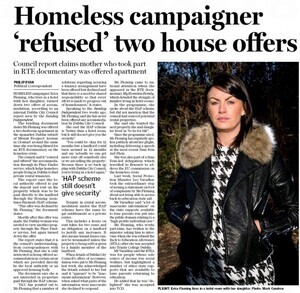

From top: last Sunday’s Sunday Independent; Gary Gannon
It is not the role of the State to misappropriate the personal information it contains on private citizens to gain political advantage.
Gary Gannon writes:
Those of us who retain the ideal that ‘The State has no right to enslave a conquered people’ watched with some bewilderment this week as Minister for Social Protection, Leo Varadkar announced that he was to seek permission from the Data Commissioner for ministers to be allowed to pass comments on individual cases were they believe incorrect claims are being made.
We often hear about data protection in the context of regulating what companies can do with our personal information such as our contact details. Most of us would seek to ensure that private companies cannot profit from selling on our email addresses or our phone numbers to other private marketers or worse.
Such expectations of data protection are even more important when it comes to our relationship with the State.
We can mostly choose not to share our data with private companies- we don’t have to sign up to club cards, mailing list or even social media sites. As citizens of a state however, we have no choice but to disclose our personal data to the multitude of different service providers that exist to serve the everyday functions of the State.
If we register to vote, or wish to have a medical test done, or pay tax, or apply for an entitlement then there is inevitably a form to be filled that requires personal information to be offered to the State.
It is an important component of the modern social contract that we fill out a lot of forms and in doing so; we must be able to trust that the personal information which we relinquish to the state is used solely for the intended purpose under which it was disclosed.
Where data protection has been breached – the bulwark against abuse is the Data Protection Commissioner. Ireland’s record on data protection is not great and in the past we have had to go to European Courts of Justice to get the State to conform to its obligations.
Now we have a minister proposing to pierce a great big loophole in our already pretty weak legislation.
The European Court of Justice has made it quite clear that Data Protection Agencies must act impartially and remain free from any external influence, including that of the State. As such, it would be interesting to see how the Minister’s proposal would hold up if it were to be brought through the European courts.
Independence in the case of Data Protection Agencies precludes not only any influence exercised by supervised bodies, but also any directions or other external influence which could call into question the performance of those authorities of their task consisting of establishing a fair balance between the protection of the right to private life and the free movement of personal data.
A spokesperson for the Minister quoted in the Irish Times stated that he “was not seeking to waive confidentiality in every case but specifically ones that make their situation public through the media.”
The state should not have the power to circumvent privacy legislation when it suits its own PR purposes. What is the logical extension of this? It can lead to silencing of people – it basically means that the price for speaking up about failures of the state becomes giving up yours and your family’s privacy.
Minister Varadkar’s request to the data commissioner came in the same week that his office had put out a press release which pertained to the high profile case of Erica Fleming and the fact that she had been vocal in the media regarding her declined application for Back to Education allowance.
The Minister in his press release to the media felt compelled to set the record straight on this issue as it was his fear that “a lot of inaccurate information had entered the public domain due to a high profile individual case that might cause lone parents to pass up educational opportunities.”
It was an extremely unfortunate week for Erica Fleming in regards the State and her personal information.
On the issue of data protection, an internal report that was prepared by Dublin City Council detailing Erica’s interactions with the council was leaked to the Sunday Independent.
This report gave the false impression that Erica had declined two housing offers while remaining as a campaigner on the issue of homelessness.
There are no indications that this report was leaked by any particular government agency but that it was passed to a journalist was clearly done on the basis that it would discredit Erica in the eye of the public.
This has now been referred to the office of the data commissioner for investigation. The circumstances around how the article came about will undoubtedly raise a multitude of difficult questions for Dublin City Council as its appearance in the public domain is in direct contravention of its own data protection code of practices.
Therein lays the danger of this desire by the minister to seek approval from the data protection commissioner to comment on individual cases should they appear in the media.
As a society we should we should encourage people to come forward as a whistleblowers who highlight malpractice within State services.
This is the duty of all citizens that reside within a State. It is not the role of the State to misappropriate the personal information it contains on private citizens to gain political advantage.
It is only the people who are sovereign, the government must remain distinct and accountable to the collective good.
Gary Gannon is a Social Democrats Councillor on Dublin City Counicil for Dublin’s North Inner City. Gar’s column appears here every Friday before lunch. Follow Gary on Twitter: @1garygannon
Previously: Erica’s Education