

Yesterday.
On Baggot Street, Dublin 4.
New Ferg tweetz:
“Solid parking job…”



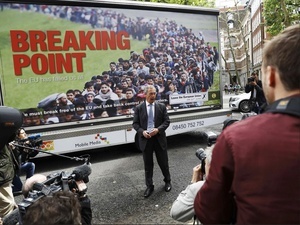

From top: Nigel Farage during the Brexit campaign; Dr Julien Mercille
The Leave side attracted many who are not Little Englanders but people who simply have been denigrated and attacked economically by the establishment — both British and European — for decades.
Julien Mercille writes:
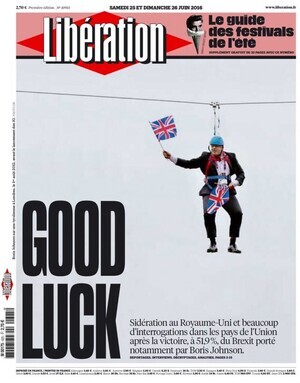
The UK voted to leave the EU.
The respective coalitions backing “Leave” and “Remain” were comprised of unexpected bedfellows.
The Remain forces gathered a significant portion of the Conservative Party led by David Cameron and George Osborne, as well as much of the Labour Party, the Liberal Democrats and the Greens. Important segments of the British corporate establishment also backed Remain, just like EU officials and institutions.
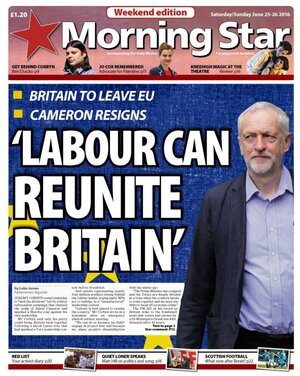
Jeremy Corbyn, the Labour leader, backed Remain, but was careful to distance himself from the Conservatives.
The Leave camp was also heterogeneous. It was dominated by the Eurosceptic hard right of the Conservative Party such as Boris Johnson and Michael Gove (nearly half of the Conservative Party MPs supported Brexit), and they also had big business supporters. They were allied with UKIP, led by Nigel Farage, riding on a strong anti-immigration platform.
On both sides, however, could also be found left groups, although they remained marginal in relative terms. On the Leave side was the Lexit group led by the Socialist Workers Party and other small groups.
Their counterpart on the Remain side was the Another Europe is Possible (AEiP) group, which called to democratise the EU from within (for a summary of the forces involved on both sides, see this piece.
There were thus a lot of roads leading to either one of two diametrically opposed alternatives. Indeed, there has been a lot of debate on what progressives should have voted for.
From my perspective, the first thing to say is that, as Bertie Russell and a number of analysts have noted, both options were “shit”.
The problem with voting to Leave is that it empowers the likes of Nigel Farage, the UK’s Donald Trump. The Leave campaign was so dominated by xenophobia that it’s very scary to head into a Brexit on those terms.
Some on the Left said we should have voted Leave no matter what because the EU is anti-democratic, hard core on austerity, pro-privatisation, and so neoliberal that it acts as a cage for progressive change (see, for example, Giles Fraser, Richard Tuck and in Ireland, Kieran Allen).
And so, the argument goes, British people are better off if they only have to fight their own right-wing politicians.
Those criticisms of the EU are all true, but the problem is that Nigel Farage is even more conservative than the mainstream of the Conservative Party, so things could well get worse in the short-term.
One solution to this dilemma is what people like Paul Mason and Ed Rooksby have suggested: progressives should prepare to leave the EU, but not now, as this would be a gift to the extreme right-wingers.
When and if there is a government led by, say, Jeremy Corbyn, then the conditions are more favourable for an EU exit, the time would be then more appropriate for Brexit.
On the other hand, voting Remain was not a great option either. It would have meant to stay within a very neoliberal EU, with a reinvigorated Conservative Party led by David Cameron and George Osborne, the two austerity czars.
In any case, people voted to Leave by 52% to 48% for Remain. For those disappointed with the results, it’s important to understand why this happened.
There’s been a lot of rather self-righteous commentary from the liberal commentariat looking down on ordinary people who voted to Leave. “Why would they be so stupid as to believe that Brexit would protect us from immigrants, Muslims, terrorists, whatever?”.
Sure there’s been plenty of racist tropes in that campaign. But let’s not forget that the Leave side attracted lots of people who simply have been denigrated and attacked economically by the establishment—both British and European—for decades, especially since the emergence of neoliberalism in the late 1970s.
Those towards the bottom of the income scale are rightly pissed off at government and elites which have failed them completely.
Therefore, while it is easy for those who are well off and comfortable to be outraged at those who fell for the idiocies of Nigel Farage, we should remember that Farage’s rhetoric gets traction specifically because he’s right on one important thing: the system is crap for a lot of people.
Same thing for Donald Trump and other far-right rising stars. They wouldn’t be there if there wasn’t so much justified resentment toward government in the first place.
For example, when Margaret Thatcher took power in 1979, manufacturing accounted for nearly 30% of the UK’s national income and employed 6.8 million people; but by 2010, it only accounted for 11% while employing 2.5 million [].
Similarly, why are there so many people unhappy with the EU?
As economist Dean Baker noted, because of the EU’s brain-dead austerity policies since 2010. Their consequence is that a number of countries have yet to reach their pre-recession level of output and employment.
Mr Baker remarks:
“GDP is still down from its 2007 level by almost 6.0 percent in Portugal and 8.0 percent in Italy. Employment in Spain is down by more than 2 million, which is more than 10 percent of its pre-recession employment. In Greece, employment and GDP are both down by more than 20 percent, a track record that makes the Great Depression look mild by comparison”.
In the UK, as Aditya Chakrabortty wrote, it shouldn’t be a surprise that places like “inner London voted so strongly for the Remain status quo.
“it’s one of the few places that is doing well out of it. Likewise, it’s no wonder south Wales mutinied, when all the status quo has offered people there for the past four decades is broken promises and rolling immiseration. The shame of it is that all these justified resentments were mobilised by the racists and the hard-rightists”.
In short, as John Harris summarised it “If you’ve got money, you vote in… if you haven’t got money, you vote out”.
Julien Mercille is a lecturer at University College Dublin. Follow him on Twitter: @JulienMercille
Picture: Press Association

Have a smuggled beer Picnic.
Are Ya Having That writes:
Leather Jacket Guy shows you the top five ways to sneak alcohol into a festival.

President Higgins (right) with Boris Johnson in London, 2014
Already they’re starting to spin
Away from an unwanted win
Do they want the UK
To make its own way?
The chances are looking quite thin.
John Moynes
Pic: Chris Bellew
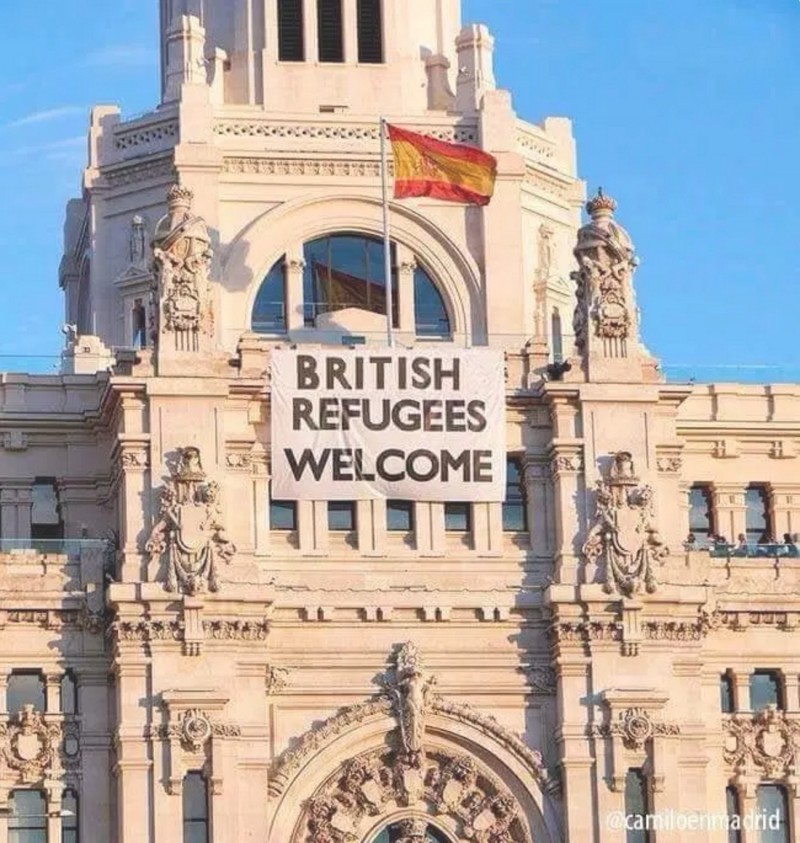
Update: El Photoshop!
Meanwhile…
PP wins Spain’s repeat election but falls short of 176 seats required for parliamentary majority https://t.co/hRTvOqjkLW #ELPAIS26J #26J
— El País in English (@elpaisinenglish) June 27, 2016

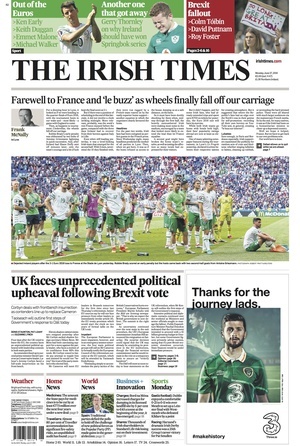


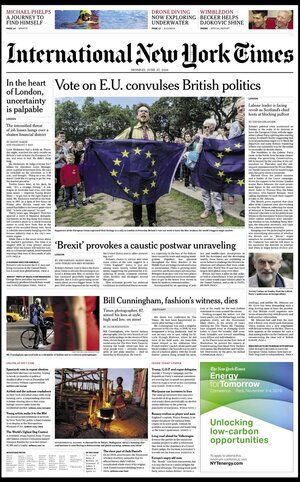


MORE to folly


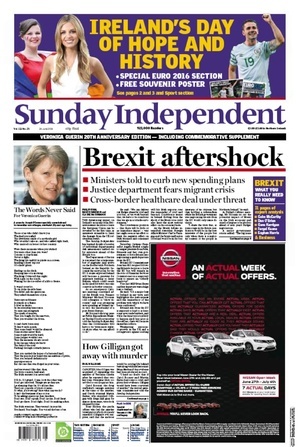
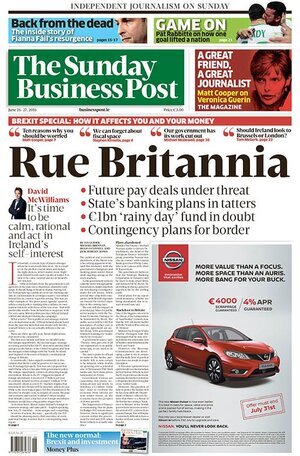





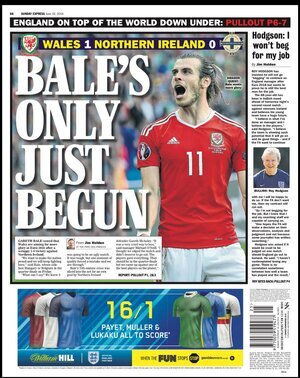



MORE to folly


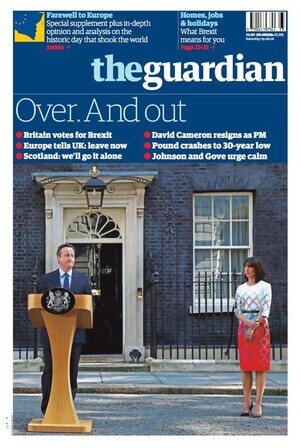
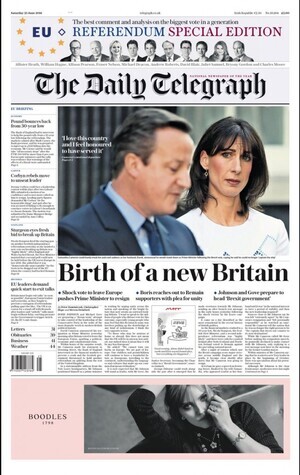
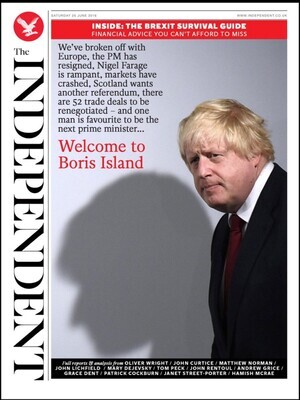
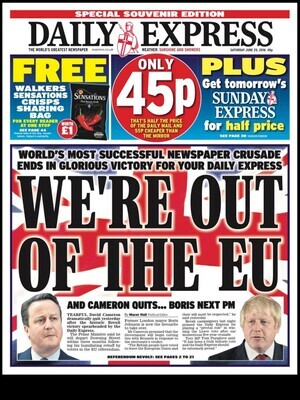
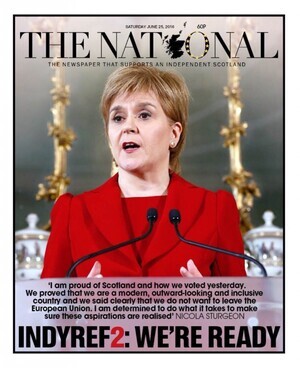

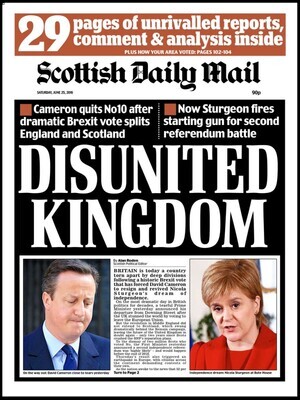
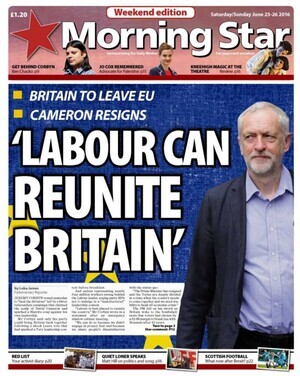


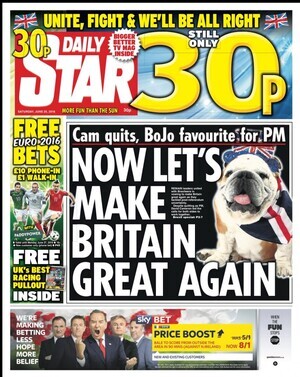
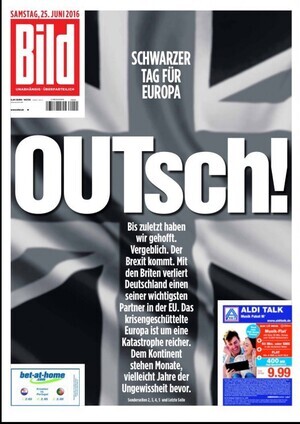

MORE to folly.

Earlier today.
2FM DJ Jenny Greene and Kelly Keogh tied the knot at the Wineport Lodge, Co Westmeath.
Yay!
Pictures: Jenny Green marries Kelly Keogh (RSVP)
Pic: Photocall Ireland
