

Donie O’Sullivan tweetz:
Spotted at a Hillary Clinton rally









MORE to folly

Clive writes:
Some clamps resting peacefully against a wall at South Lotts Road [Ringsend, Dublin 4]. Adjacent traffic island is subject of parking dispute between clampers and residents.
Amongst our patients at #Idomeni today were 3 kids under 10 with plastic bullet wounds to the head. pic.twitter.com/RDP0VN3CWC
— MSF Sea (@MSF_Sea) April 10, 2016

From top: A video of Dr Conor Kenny, based in Idomeni, explaining how he treated three children under the age of 10 for plastic bullet wounds to the head on April 10; and President Michael D. Higgins speaking at the Royal Irish Academy earlier today
President Michael D. Higgins, who turns 75 today, addressed the Irish Association of Contemporary European Studies at the Royal Irish Academy earlier today.
During this speech, he spoke about Europe’s collective response to the 1.5million people who’ve travelled to Europe in the pursuit of refugee protection.
From his speech…
Why did the member states of one of the globe’s richest and most powerful entities, a Union of 508 million citizens, feel so threatened by the arrival of a 1.5 million refugees and migrants last year?
This, I contend, is revelatory of a certain perception of ourselves as Europeans, one that is predicated on fear. It reflects a sense of helplessness, which of course is far from irreversible, should our elected representatives, our public intellectuals, our media, show constructive leadership and craft a discourse of confident hope for Europe.
Instead, in their coverage of the “refugee crisis”, European media have tended to conflate the image of Europe with that of the small Greek island of Lesbos; they have presented to us a vision of Europe as a frail isolated rock overwhelmed by a tsunami of uprooted people.
When one considers the prosperity and the rich diversity of so much of Europe, where so many people from all regions of the globe have settled peacefully and successfully over so many decades, confidence, not apprehension, should guide our response to the arrival of new migrants.
Yet, whereas one might have expected, in the face of the new challenge, a reviving of the old European adage – “strength through unity” – what we have witnessed instead is a ruinously and narrowly self-interested response on the part of many member states.
There were, and it is important to acknowledge them, several remarkable exceptions to such approach; but the rejection of the European Commission’s proposal for a binding quota system has left the “frontline states” of Greece, Italy and Malta to rely largely on their own, limited, resources in responding to the urgent needs of so many migrants and refugees.
This calamitous situation does not just jeopardise the future of Schengen and the principle of free circulation within the EU; it is also indicative of a severe breakdown of trust amongst the EU member states. Most alarmingly, it has the potential to undermine the values and principles at the basis of that humanistic spirit to which Europeans recommitted themselves after the devastation of World War II.
Can we leave millions of mothers and fathers, teenagers, children and babies, to wait in uncertainty, hopeless poverty and squalor at the border of Europe? Can we avert our gaze from the even larger numbers of those who are trapped in precarious camps in Turkey, Lebanon, and Jordan? Is our response to be defined by barbed wire, tear gas and rubber bullets?
We might, at this crucial juncture, recall the words of Hannah Arendt in her essay, “We Refugees”, written in the midst of World War II, when Jewish refugees from Poland, Germany, Austria, Romania, and elsewhere had found themselves trapped, in an utter state of vulnerability, in the middle of Europe:
“Refugees driven from country to country represent the vanguard of their peoples … The comity of European peoples went to pieces when, and because, it allowed its weakest members to be excluded and persecuted.”
Unfortunately, the element of fear, exacerbated by the threat of terrorism, has only increased our European leaders’ urge to find ways, to curb the influx of refugees at all costs, so as to reassure public opinions who tend to view through the same anxious lens “security crisis” and “refugee crisis”.
Many commentators have rightly noted that such hasty responses, sometimes achieved in disregard of usual European rules and procedures present serious risks for the rule of law and the principle of human dignity as cornerstones of the European project.
The agreement struck last month by Turkish Prime Minister, Ahmet Davutoglu, and EU leaders is an important effort at countering the exploitation of migrants by ruthless smugglers.
However, we must ask ourselves, does this agreement provide a lasting solution to the crisis? Will refugees not seek alternative routes for coming to Europe? And, most importantly, can such an agreement fully and effectively respect the human rights obligations which provide the foundation for the European legal order?
These are essential questions which remain to be adequately answered. I strongly believe that we should be wary of bending European and international human rights legislation to breaking point. The contravention of core principles might be politically convenient in the short term, but such breaches would only jeopardise the survival of our European Union in the long term.
Moreover, if we fail to uphold the values of human dignity and respect in our response to the plight of refugees, how could we expect to be taken seriously when we ask, quite rightly, that the newcomers also respect such fundamental European values as freedom of speech, freedom of expression and gender equality? How can we speak with authority, given such departures from what we previously acknowledged and proclaimed were universal principles?
These are the questions that were posed to us this week also by Pope Francis and Patriarch Bartholomew during their visit to Lesbos – the moral questions which are inescapable for all Europeans at this time.
They are questions, too, which are given a further poignant urgency by the reports emerging today of further tragic losses of life in the Mediterranean.
To give protection, food and shelter to those who are fleeing war, oppression or starvation is a matter of fundamental, universal human solidarity. It is also a matter of legal responsibility.
EU member states, through their being party to the Geneva Convention of 28 July 1951 on the Status of Refugees, have a duty to do their fair share to resettle people in need of international protection. There can be no cap on this fundamental responsibility, no limit set on the number of those eligible to request asylum.
The right of asylum – the notion that a person persecuted in their own country may be protected by another sovereign authority – is, as you all know, an ancient juridical concept, and one that is a corner stone of the European legal order.
Some of our most prominent European thinkers have been refugees: René Descartes, for example, who was persecuted in France by Voetius and his followers, sought refuge in the United Provinces [the Netherlands], while in the same years, French King Louis the XIII refused to extradite Dutch citizen Hugo Grotius, one of the founders of international law – the same man who wrote of asylum that it existed for those “who suffer from undeserved enmity”.
Rather than responding with regression to short-term interests, we Europeans can with so much benefit draw on our rich intellectual and philosophical tradition as we seek, in our time, to find a just compass by which to define our relation to the other, the stranger of today, the fellow-citizen of tomorrow.
In 20 years from now there will be Syrian men and women who will remember what happened to them in Europe as children, how they were kept waiting in the icy Balkan winter before being sent back to the other shore of the Mediterranean, or, on the contrary, how they were offered hospitality in a new country, and how they were able to rebuild their lives free of fear and embrace the opportunities to contribute to a new Europe of prosperity and tolerance.
As I wrote these words, I thought too, of my speeches in recent years in Boston, Chicago, New York where I spoke of the post-Famine Irish migrants arriving in the ports of Canada and the United States.
For us to have a positive, practical and human response to the current situation, for Europe to accommodate the dreams and hopes of so many families currently on the road, it is imperative, I believe, that we also focus on building up social cohesion within our states.
All of us Europeans should make it our priority to build thriving, inclusive societies, not just for our citizens, but also for all those residents of the European Union who were born elsewhere.
This involves, of course, adjusting our labour markets and crafting bold and ambitious policies in such fields as education and schooling, language training, housing, as well as political participation.
Read the speech in full here
Related: Idomeni: ‘I heard screams as people ran from the border fence’ (Irish Times)
Previously: For Your Consideration: Borderland

To celebrate Record Store Day last Saturday, Golden Discs offered us a Red Steepltone Discgo turntable (as above) to giveaway to a vinyl-coveting Broadsheet reader.
Consequently we asked, what was your first wax purchase?
You answered in your hundreds (mostly blokes).
Runners up:
Dudley: “My first ever purchase was a two-fer, in Golden Discs in Dun Laoghaire in about 1986 or 87.Queen – A kind of magic, and because I had the exact change left over in the gift voucher for it, Chris de Burgh’s greatest hits. One of those records changed my life forever. *waves from stripper pole*
Daddy Wilson: “My first ever vinyl purchase was Nirvana – Live From The Muddy Banks of The Wishkah, the first vinyl I owned/inherited from a collection in my parents’ attic was a Beach Boys live album. The next vinyl purchase was Radiohead: In Rainbows. Each of these albums holds pride of place on a shelf in my bedroom in my parent’s house. None have ever been played. Not even the old Beach Boys record!
The worst part of this? My daughter was born a few weeks ago and the first music she’s ever heard was Beach Boys, but she’s only heard it through online streaming!
The only thing that calms her now is listening to the Beach Boys and dancing with her Dad in the kitchen! It’d be great to be able to have our Beach Boys record spinning for her to look at while dancing.”
Ricardo: “My first ever vinyl purchase was Chris de Burgh’s Lady in Red single. I got it for my first true love the day before she returned to London after spending her summer holidays in Ireland. Ahhhh….1986, the summer of love.”
Father Filth: “My first ever vinyl record purchase was Queen’s – ‘Flash’ single, in the then supremely plastic-y orange branch of Golden Discs in Dún Laoghaire [Co Dublin] Barely able to view the top of the counter, I was a nipper, my Dad had to lift me up. Played until it was scraped clean of any audio grooves, on a Bush turntable from the 60s, with a stylus like a cat’s tooth…”
Garthicus: “Here goes (I’d really like that prize!): My first ever vinyl record purchase was… The Dirty Dancing sountrack… I was around 8 years old…”
Always Wright: “My first ever vinyl purchase was “Automatic for the People” by REM. I played it on Dad’s turntable, which was downstairs. To enjoy it fully I felt I needed to retreat to my own lair, which was upstairs. I turned the volume up and listened to that record for a solid year, muffled and magical, through my bedroom floor. It doesn’t sound as good any other way.”
Nathan Ketharinath: “My first ever vinyl record purchase was Lana del Rey’s Ultraviolence. I still don’t have a record player to properly make use of my few vinyls but I’d love the chance to do that someday!”
Liam Zero: “My first ever vinyl record purchase was Full Circle by The Doors. At the time, I was bitterly disappointed with the album because Jim Morrison wasn’t on it… ironically, I would now consider not having Jim Morrison on an album to be a major plus point. Doesn’t make Full Circle any less rubbish of an album though. God it stinks. And I still own it.”
But there there could only be one winner.
Barry the Hatchet;
“My first ever vinyl record purchase was Disney’s Snow White and the Seven Dwarfs.
This was when I was a small child in the 80s, living in London with my parents and my paternal grandmother. My parents were broke 20-somethings who hadn’t really expected to be parents when I came along (hence living with my Nan). They were too poor and too busy saving money to move out on their own to afford any newfangled contraptions like cassette players. But we did have my father’s record player, which was his pride and joy. He had bought it with the money he earned from a summer job when he was sixteen, just after his own father had passed away. And he had survived through his grief, and through my Nan’s remarriage to an extremely unpleasant man, by listening to records and losing himself in the music.
My father particularly loved to listen to Bob Dylan and I liked to sit on the floor of my Nan’s back room and listen with him, though I didn’t really understand any of the songs. Once we were listening to “Knockin’ On Heaven’s Door” and I asked him.. “who’s Kevin and why is he never at home?” This prompted something of a crisis for my father, given that both my parents were staunch atheists, my Nan was a staunch Catholic, and nobody had yet worked out how to explain the complexities of this situation to a four year old.
Every weekend my Nan would creep up to my bedroom after I’d gone to bed and empty out her purse. She’d give me all her small change and I would marvel at this shiny treasure, stockpiling it in a little leather purse she had given me and feeling like the richest kid on earth. My parents didn’t know. This was our secret, and it made me feel so special and important to share something with her that nobody else knew about.
One Sunday afternoon, my parents and I were wandering down the Broadway when we popped into a charity shop because my mother liked the look of a hideous fuzzy jumper with oversized shoulder-pads and a floral pattern.
My father went to look through the LPs, drawn to them as he always was (although he hadn’t bought one since I was born and he had developed Responsibilities with a capital ‘R’). I went with him and copied him, flipping though the records like I knew what I was doing. And that’s when I found the Snow White soundtrack. A record just for me. And I had to have it.
“Absolutely not”, said my father “that record player is for music – real Music!” (with a capital ‘M’ – he was and still reamins a purist about these things) And so he refused to buy it for me and we argued and my mother was summoned to intervene. And just when it looked as though he had won, I pulled out my ace-in-the-hole. My leather purse. My Nan’s secret treasure. Just enough to buy the record. And my father was beaten.
I listened to that record every day until we moved out and moved to Dublin and the record player had to be left behind because it was too big to bring along. My father stored it in the attic of my Nan’s house, whispering sweet nothings to it as he did, telling it he would come back for it. I think the only thing he was glad of was not having to listen to that damn Snow White record again.
And then, suddenly and sadly, my Nan passed away. Her horrible husband wasted no time in throwing out all my her things and all my father’s things and putting the house up for sale. And the pain of losing my wonderful Nan was, for my father, all the worse because the one symbol of what had kept him going through his father’s death – that record player – was gone now too. He had lost both his parents and his pride and joy.
He still has the records though. Inexplicably he brought them with us when we moved to Dublin. Like he wanted them close to him. If I win this turntable, I’ll give it to my father. And we can sit on the ground together and listen to ‘Knockin’ On Heaven’s Door’.”
Thanks all
Previously: All Hands On deck
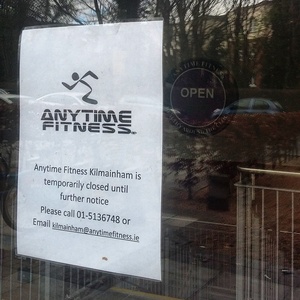
Oh.
This afternoon.
Heuston South Quarter, Military Road, Kilmainham, Dublin 1
Dave writes:
[Fitness chain]…Open a month… now closed for 3 weeks…

SPLUTTER!
Spotted at a Blackrock Market food-stall [Blackrock village, Co Dublin] on the weekend.
*lip tingle*
Thanks ChocolateWithAHintOfArsenic
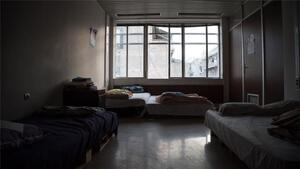
From top: A room for refugees at a shelter in an abandoned government building in Athens, Greece; Dr Julien Mercille
In Athens, Greece the author visits a shelter for refugees displaced by conflicts in the Middle East.
Dr Julien Mercille writes:
There are currently 53,000 refugees stuck in Greece, but you wouldn’t notice if you didn’t look for them.
So I decided while in Athens this week to see what the current situation was.
I heard about a volunteer-run project in the city providing accommodation for refugees and made my way there to check it out.
When I get there, two or three Afghan and Syrian families are at the reception desk and want to check in. The place is a makeshift hotel in a former government building.
The hotel’s receptionist is a middle-aged woman of the authoritarian, don’t-mess-with-me type, who constantly looks at you over her glasses. She communicates with the migrants through a younger female Middle Eastern volunteer who translates whatever goes on in the lobby.
The atmosphere is a bit chaotic but gives a good idea of how difficult it is to deal with a massive influx of refugees.
One Afghan family of eight (or two families of four, I’m not sure) is asking for a room. The receptionist is trying all possible combinations on the large spreadsheet on her desk.
“Room C6? No, there’s too many Syrians in that one. Room D11? No, there’s already three babies in there and only one mattress. Room B9? No, the Afghans there are already taking up all the space.”
The translator asks, “What about C6?”
“No, I told you—it’s full of Syrians in there!” replies the receptionist.
“What about B9 with the Afghans?”
“No, it’s too crowded, I just told you!”
The receptionist loses it easily, but they eventually find a room. Everybody is relieved.
Next is a Syrian couple.
The receptionist lets them know that they’re now full for tonight and that there are no rooms left. But the Syrians are determined and proceed to go down the list of progressively crappier options.
“Can we get a tent then?”
“No, the tents are all occupied for tonight”.
“Can we get the couch so?”
“No, the couch is already full for tonight”. I wonder how many people they can really pile up on that couch anyway.
“Can we get sleeping bags and sleep on the floor?”
The exasperated receptionist calls a volunteer who, a few minutes later, comes back miraculously with two sleeping bags. Sorted.
It’s now my turn. The receptionist is now in a sensitive state, and I’m suddenly reminded that it’s not only Broadsheet commenters who don’t like me.
I say I’m a journalist and I’m here to have a look around. Her reaction is instantaneous: “Journalists, no way! You have to leave! No journalists inside, the mass media is bad!”
I tell her not to worry, I write for Ireland’s least read mainstream publication,
It doesn’t work.
“Journalists are not allowed in, they have hurt what we do.”
I’m asked to leave without knowing what journalists have written about the place. I wonder if they insinuated there were terrorists in the place, or drugs, or something else. It could be any of those things. But if one needed an example of how low people’s trust in the media has sunk, regarding refugees or anything else, this is it.
As I walk back to my hotel I decide to go through the Parliament’s park for a change of scenery.
I see a few people walking their dogs and their weasels. Yes, weasels.
A weasel walker explains that there is a weasel party organised in the park today.
Life goes on in Athens.
Julien Mercille specialises in US foreign policy and terrorism and is a lecturer at University College Dublin. Follow him on Twitter: @JulienMercille
Top pic: Sorin Furcoi/Al Jazeera

Work taking place on the LXV building at the corner of Stephen’s Green and Earlsfort Terrace, Dublin 2 last October
Denis O’Brien took advantage of a new tax-efficient legal entity established by the government last year when he sold a landmark building on St Stephen’s Green in Dublin for a reported €30m profit.
O’Brien reportedly sold the LXV building, on the site of Canada House, for €85m last month.
A Sunday Times investigation has revealed that on May 25 O’Brien transferred the ownership of the LXV building into an Irish Collective Asset-management Vehicle (ICAV), a legal structure established by the government two months earlier to attract corporate investment funds to Ireland.
The Real Estate Development and Investment Fund ICAV was set up by William Fry solicitors, which acts for both O’Brien and Fieldsville, the company owned by Catherine O’Brien, the billionaire’s wife. Fieldsville was responsible for developing the six-storey high LXV block on the corner of Earlsfort Terrace, which is almost complete.
O’Brien uses government vehicle to avoid €10m tax on LXV sale (Mark Tighe, Sunday Times, April 3)
Revenue officials are investigating the operation of a new tax-efficient corporate vehicle designed for the funds industry, which is instead being used for property investments.
.. On Thursday, Michael Noonan, the finance minister, responded to questions about ICAVs tabled by Pearse Doherty, Sinn Fein’s finance spokesman, and their use by [Denis] O’Brien in a property deal.
Doherty stated this had resulted “in the exchequer being deprived of corporation tax, income tax and capital gains tax earned on profits from source assets”.
Noonan revealed the Revenue Commissioners have told him they are “currently examining recent media coverage concerning the use of investment funds for property investments. Should these investigations uncover tax-avoidance schemes or abuse, which erodes the tax base and causes reputational issues for the state, then appropriate action will be taken and any necessary legislative changes required will be considered”.
[Denis] O’Brien did not respond to questions relating to his use of an ICAV. The shareholders for the ICAV used by O’Brien are two William Fry trust companies. The firm regularly acts for O’Brien in tax cases.
Revenue probes O’Brien deal over LXV building (Mark Tighe, Sunday Times, April 17, 2016)
