





MOAR: Innocent Cats (Eatliver)



MOAR: Innocent Cats (Eatliver)






MORE to folly.

Pro Choice supporter in Dublin in 2012
According to the whichcandidate.ie election site, of the 44 elected Fianna Fáil TDs, only two – Lisa Chambers and Jim O’Callaghan – favour expanding access to abortion; of 50 Fine Gael TDs, only Kate O’Connell and Paschal Donohoe favour more liberal laws.
To put those figures in context: while 87% of the general population favour expanding access to abortion, only 4.5% of Fianna Fáil TDs and 4% of Fine Gael TDs do.
… I agree that the campaign to Repeal the Eighth Amendment isn’t going to lie down under a conservative coalition. I too believe that we can put a referendum on this government’s agenda.
But if our referendum is begrudged to us by overwhelmingly anti-choice politicians, are these really the people we want to preside over it?
Leo Varadkar, minister for health under the outgoing government, regarded by many as a future Fine Gael leader, has publicly stated that while the current legislation may be too restrictive, he wants to keep a “pro-life” amendment in the constitution.
After all our work, can Ireland’s feminist movement risk letting Fine Fáil scheme to replace the eighth with another constitutional amendment? To offer – masquerading as middle ground – not the opportunity to repeal the eighth but to amend it?
Laura Hutton/Rollingnews

Did you see them?
Garsehole writes:
I know you don’t normally do this, but….you have a good way of promoting Irish creatives/stuff even when created abroad. So here’s a new series on E4, written by London-based Fintan Ryan, from Blackrock (the place, not the school), which went out yesterday and has been well received.

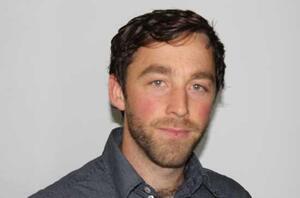
From top: Begging on the Ha’penny Bridge, Dublin; Dr Rory Hearne
The rich are getting richer and the vultures are circling.
Dr Rory Hearne writes:
“The test of our progress is not whether we add more to the abundance of those who have much; it is whether we provide enough for those who have too little.”
Very true words spoken by former US president, Franklin D. Roosevelt. Unfortunately if we apply them to Ireland we can see that we are certainly making plenty of ‘progress’ in adding to the abundance of ‘those who have much’, according to a report released last week by property agent Knight Frank.
Their Wealth Report 2016 showed that the number of ultra-wealthy individuals in Ireland increased by 18% between 2005 and 2015, and that number is set to increase by 28% over the coming decade. This follows on from the recent Sunday Independent Rich List which showed that the top 300 wealthiest Irish people doubled their wealth since 2010.
This increase in wealth at the top of society while we have growing numbers of homelessness and child poverty at the bottom is morally wrong and socially unjust. It is shameful and unethical.
Look at the stark contrast between this rising wealth for those at the top of Irish society and the reduction in wealth and income for those in the middle and at the bottom.
For example, in terms of deprivation, in the same period of time as covered by this increase in wealth, the number of children aged 0-6 suffering from deprivation in Ireland doubled from 55,000 in 2007 to 105,000 in 2014.
How is this right? How is it allowed to continue?
These ‘ultra high net worth’ (UNHW) individuals in Knight Frank’s Wealth Report 2016 are individuals who have a net worth of at least US$30 million (after accounting for shares in public and private companies, residential and passion investments such as art, planes and real estate). That is a massive holding of wealth.
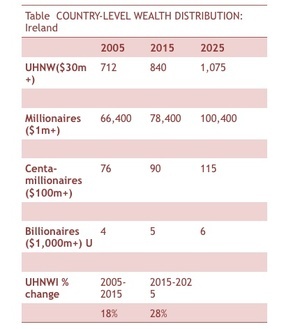
The Wealth Report (you can read it here) also finds that the number of millionaires in Ireland is projected to increase from 66,000 in 2005 to reach 100,400 by 2025 (see Table above).
The Knight Frank Wealth Report also needs to be looked at in the context of our worsening housing crisis.
The Report highlights that property (residential housing and commercial real estate property) is a key aspect of wealth accumulation by the wealthy. The report explains how “super-normal returns” from residential property “helps underpin the net worth of the ultra-wealthy”.
Knight Frank, of course, benefit from this themselves as they are a global ‘property agent’ and property advisor, handling sales of very large properties. Clearly, promoting the role of property in wealth accumulation for UHNW individuals is an important aspect of their business model.
Their Report shows that housing property (primary residence and second homes) accounts for a quarter of UHNW’s investable wealth, while commercial property investments make up 11%. Thus, total property investment makes up almost 40% of the wealth of the UHNWs while financial investments (equities, bonds, etc) makes up a smaller proportion (28%).
And the importance of property as an asset has increased in recent years. The reason for the increasing importance of purchasing property was its role as an ‘investment to sell in the future’ and a ‘safe haven for funds’.
This is in contrast to how most of us see housing as a home rather than an investment asset.
The investment in property by the wealthy is playing a role in recent property price increases in ‘prime’ markets (like Dublin). The report highlights that “it has been the weight of money from wealthy investors looking to secure assets in leading world economic hubs that has propelled markets to record levels”.
I have shown here before the role of global wealth funds in worsening the housing affordability crisis in Ireland by driving up rents through the sale of property and land by NAMA to vulture funds.
So the vulture and wealth funds, the wealthy and banks increase their wealth by dispossessing the poorest of their homes and extracting ‘super profit’s from speculative sales of land and property, along with what they get from rental income.
This wealth isn’t ‘created’ from thin air – it is being paid for by the Irish taxpayer through the bank bailouts, austerity and NAMA, mortgage distress, homelessness and escalating rents and house prices.
The result of this is most visible in our housing crisis –from the 37,000 still in mortgage arrears to the 1,570 children and their families who are now homeless in Dublin.
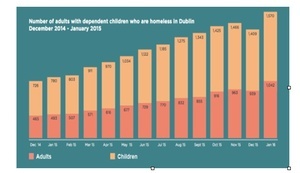
Source: Department of Environment
It is interesting to read in the Report that even the wealthy are realising that the growing concentration of wealth, particularly within the advanced economies, is a major problem.
There is a specific Chapter in the Report entitled ‘Wealth Inequality takes Centre Stage’ which highlights the ‘growing sense of disenfranchisement” that “is changing the political landscape globally”. They explain:
“wealth inequality has continued to climb the political agenda and is now one of the biggest issues facing politicians as they try to address those who feel disenfranchised”.
There is an increasing desire from ordinary people to see a stop to rising inequalities and for policies that will make society more fair.
One proposal that could make a fairer society is a wealth tax. Interestingly we had a wealth tax before in Ireland – it was introduced by a Fine Gael Labour government in 1975.
It was levied at 1 per cent of the value of assets in excess of £100,000, with family homes, bloodstock, livestock and pension rights exempt. But after the 1977 election Fianna Fáil abolished it.
It is time to look again at the merits of a wealth tax. A 1% wealth tax that would apply only to the top 1% of households (and would exclude homes, farm land and pension savings) in Ireland could raise up to €500 million.
That is a very large amount of money (but insignificant to the ultra wealthy) that could build housing for the homeless, fund our health service and provide school meals to address child poverty. Isn’t it time for a wealth tax?
Dr Rory Hearne is a policy analyst, academic & social justice campaigner. His column appears here every Wednesday. Rory is an independent candidate for the Seanad NUI Colleges Panel. He writes here in a personal capacity. Follow Rory on Twitter: @roryhearne

The red hand of a united Ireland.
CX writes:
A unique opportunity has arisen in our online shilling department…

 Aoife Murphy writes:
Casual placement at Post Office in Cork city


From top: Panel on last night’s Tonight with Mick Clifford, and graphs from early findings of a study by the Institute for Future Media and Journalism at Dublin City University
Last night, on TV3’s Tonight With Mick Clifford, the show’s panel discussed the media’s impact on the general election.
The panel included director of the Institute for Future Media and Journalism at Dublin City University, Jane Suiter; our own Julien Mercille; Sinead Carroll of the Journal; and John Devitt, from Transparency International Ireland.
At the beginning of their discussion, Ms Suiter presented the preliminary findings of an unfinished study by FUJO which is looking at the coverage of the election by the Irish Times, the Irish Independent and the Journal.
She explained that the study’s findings to date are solely based on coverage up to a week before the election and that the final week has yet to be investigated. She also said FUJO will be looking at the coverage of RTÉ and TV3.
Several graphics from the study were shown (see above), prompting Ms Suiter to explain:
“The [Irish] Independent was taking the Government line of ‘Stability v Chaos’ so ‘stick with [Enda] Kenny and it’s stability, go with [Gerry] Adams and it’s chaos’, whereas the Irish Times weren’t taking that line because they were saying, ‘well no it’s Kenny versus [Micheal] Martin’ so it was kind of the old choice that we’re used to. And then the Journal just took a very, sort of straightforward one between the three of them.”
Further to the study’s findings presented by Ms Suiter, the panel discussed the coverage as a whole.
From the discussion…
Julien Mercille: “I think there is maybe some differences between the various outlets but, by and large, the mass media gave a very favourable view for the Government. I mean you didn’t have much of a challenge to the Government parties. You did have that, maybe in a tactical way but not in a fundamental way. Take, for example, the best issue to illustrate this is healthcare. We know it’s the number one issue for voters. Exit polls show, and polls before, this is probably the most poorly reported issue in the whole country, healthcare. There isn’t a single article that calls for an Irish NHS for example which is the thing we need. It’s cheaper…”
Mick Clifford: “I saw a few…”
Mercille: “…and it’s also better for health.”
Clifford: “Absolutely but I saw a few of them, I have to say, I saw…”
Mercille: “Oh really?”
Clifford: “I did.”
Mercille: “Calling for an Irish NHS? Maybe once every now and then, but that’s not very…”
Clifford: “Well, universal health care, they didn’t necessarily say…”
Mercille: “It’s very different, it’s not the same thing. It’s not the same thing at all. It could be but it doesn’t have to be.”
Clifford: “Right and there’s one other thing there that I would suggest and that is that, despite that being shown, in previous elections and admittedly this turned out to be different, in previous elections, people concentrated on the economy, they concentrated on tax cuts and spending increases..”
Jane Suiter: “But actually they didn’t because we…”
Clifford: “Not in this, no, but in previous..”
Suiter: “Yeah, well in the previous election, it was all about the bailout and the Troika programme, that was the whole focus of it but actually in this one, in many, actually the focus was on party politics. So which party is up and down in the polls? Which party is going to go into coalition?”
Clifford: “Rather than the issues?”
Suiter: “Rather than the issues. So there was actually very little focus even on macro economic issues or on on micro, on tax and spending…”
Talk over each other
Mercille: “There were articles about Enda Kenny and his wife, as if this was any way important…”
Clifford: “Aaah Julien…”
Mercille: “Nothing, it is true. Nothing about..”
Clifford: “Enda Kenny and his wife.”
Mercille: “Nothing about the main policies, such as healthcare, poverty, the fact that Ireland is a tax haven. You didn’t have much of that. It was all about the person and the looks and all that.”
Later
Sinéad O’Carroll: “Because we didn’t know, we knew that there wasn’t going to be anyone that would run away and be able to get an easy majority, we knew there was no-one able to get that magic number, so it did become, then, a game of looking at who was going to go in with who and, because no-one was giving definitive answers, that became the narrative.”
Clifford: “Was that to the detriment of, was that to the detriment of examining policies?”
O’Carroll: “I think so, absolutely, and I think, but I think also, there was, the Irish Times had a really beautiful feature on their, online, and they had absolutely every issue covered and you went into it and you could see the party policy on every single issue. Not many people talked about that feature that they had.”
Suiter: “The other interesting thing was how little focus was on any of the smaller parties or the Independents.”
Clifford: “John [Devitt], did you find it balanced, imbalanced? Or how?”
Devitt: “Well, it’s difficult to say but I think the broadcasters appeared not to have planned much of their coverage of the election, they were led by the news cycle. So, in the first week, we had wall-to-wall coverage of the Kinahan-Hutch feud and the shooting in the Regency Hotel, in the second week there was a lot of talk about fiscal space and Kenny and Adams grasp, or lack thereof of financial, their own financial data and then, in the last week or so, there were two days coverage of the Taoiseach’s comments around whingers in Castlebar. So it appeared there was little focus on, as you say, on the issues themselves.”
Later
Devitt: “In Cork there was coverage around, or there was a lack of coverage in the national media, about and interview I think, on Cork local radio [Red FM] of Enda Kenny and there were allegations by the, was it Neil Prendeville, he had alleged that Kenny’s advisors, or his media handlers were putting him under pressure to wrap up a rather intense interview with the Taoiseach. We didn’t see that kind of questioning of Martin or Kenny elsewhere in the mainstream media.”
O’Carroll: “There’s a certain politeness, I think, that goes along with Cabinet ministries, positions and with the Taoiseach and I think, obviously, I think sometimes a lot of people, say the Vincent Browne style questioning, if you’re not answering a question, you don’t get away with that. I think, in other studios, people do get away with not answering a question because the impoliteness isn’t there and I think that is to the detriment of getting answers to questions.”
Mercille: “I agree. It’s also to do with the ideology. I mean Gerry Adams will be questioned a lot, whatever he is…”
Clifford: “Should he be questioned more than the other leaders?”
Mercille: “Not at all, I mean he’s not in power, he didn’t make the policies, he didn’t create the mess we have. He could be questioned, he should be questioned on other things, if you like, but I mean the imbalance is just blatant. I mean people were even saying, my god, if the Indo keeps going like that, they’ll backfire on their own terms..”
Clifford: “Just to make a few distinctions here. I think, and I think it is fair to say, and I think an awful lot of people feel that the Independent group in particular covered Sinn Fein in a manner that perhaps a lot of people felt was imbalanced. That doesn’t mean that the whole of the media did that. That’s the first issue…”
Mercille: “Well the media is very…”
Clifford: “Julien.”
Mercille: “The Indo was more explicit and I’m actually more comfortable with that because, actually, there is a view there and you can disagree with the Indo’s view. Sinn Fein is never covered positively in any media, any mass media, except for exceptions all right. You see the problem with Sinn Fein and the coverage is that let’s say when Gerry Adams was on Sean O’Rourke, people were making fun of his math and all that. Fine, you want to talk about the issue of economic policy, fine, but then you have to criticise Enda Kenny and Fine Gael for their austerity.”
Talk over each other
Clifford: “Hang on there’s a difference between, hold on, there’s a difference between criticising somebody for their grasp of the issues, and criticising somebody for the nature of their policies. Absolutely you…”
Mercille: “Well Fine Gael doesn’t understand economics because if you understand economics, no, if you understand economics, if you understand economics, the first thing you do is not austerity in times of recession.”
Clifford: “I know, that’s one side of it. That’s a different issue, that’s one side of an argument.”
Mercille: “It’s a more important point than not knowing about the math of this budget or something.
Later
Mercille: “The reason Sinn Fein is attacked so much is because it’s the only force in this country that can challenge the establishment. Whether you love Sinn Fein or you hate them.”
Clifford: “Oh, so Sinn Fein are not the establishment?”
Mercille: “They’re much less establishment than Fine Gael or Fianna Fail.”
Clifford: [Inaudible]
Mercille: “Oh you think? Oh really. When’s the last time they were in Government?”
Clifford: “They’re in the Government in the North, they’re the biggest party in the…”
Talk over each other
Clifford: “They’re the biggest party in the local elections…”
Mercille: “I’m not saying they’re a bit part of the establishment. But they can challenge Fine Gael and Fianna Fail much more than let’s say…”
Clifford: “You’re suggesting that questioning Sinn Fein has absolutely nothing to do with other elements, apart from their socioeconomic position?”
Mercille: “Do you have other aspects you could question? You could talk about the North, if you like, you could talk about anything, you could talk about nationalism, you could talk about Gerry Adam’s past. That’s all fine. But you have to do it, not in a double standards way. If you want to talk about the economy, fine. But then talk about austerity. If you want to talk about…”
Clifford: “Has it not been talked about?”
Mercille: “Not in the right way. It hasn’t been challenged, the media endorsed austerity all the way, across the board and they’ve said it explicitly themselves.”
Clifford: “Jane, just to, in fairness, because it is an issue, I’m not singling out one party but it is an issue as to whether or not Sinn Fein got a fair shake. What do you think?”
Suiter: “Yeah, absolutely, in the other ones, because the coding we used is coding that’s been used in Greece and in Spain and in Portugal and in Germany, so it’s developed in a pan-European group. And when we looked at it, and looked at the tone of coverage, there was a negative tone of coverage for Gerry Adams compared with the other leaders but it was driven by the Indo. And the tone of coverage for Gerry Adams, in the Journal and in the Irish Times, was neutral. It wasn’t positive, but it was neutral. And the tone of coverage for all of the leaders, in all of the newspapers was broadly neutral.”
Later
O’Carroll: “A lot of talk was about how they [Sinn Fein] wanted to abolish the Special Criminal Court and I think a lot of people might have thought that that was kind of at the forefront of their manifesto. It was in fact mentioned once on page 46 of their manifesto. It is, you have to put it to them when it’s, exactly…”
Clifford: “Because, a couple of weeks before it…”
O’Carroll: “Exactly…”
Clifford: “Slab Murphy was convicted… Gerry Adams introduces the Special Criminal Court..”
O’Carroll: “I’m not saying that that was something that was done in error. I’m just saying it’s a manner of the news cycle, that’s how it happens. So it wasn’t a vendetta about picking out something that may not have been on the top of their agenda and making it so in front pages, it was because it happened to come up.”
Devitt: “I think broadcast media, in particular, have a responsibility to manage the election coverage very carefully and not be so reactive to the news cycle. Print media also need to be very careful, or more careful I should say…”
Clifford: “The broadcast media though are restricted by the BAI and they have to literally measure balance…”
Devitt: “Oh absolutely but, by the same token, they were still very much led by what was in the newspaper, in the news, that day…”
Clifford: “The actual topics, yeah.”
Devitt: “And when you look at the questions that were asked of the leaders during the three debates, on RTE and on TV3, they were still very much led by what was in, or influence by, what was in the newspaper that day.”
O’Carroll: “Well it’s not only what’s in the newspapers, it’s what’s people, in general, are talking about and what people have questions about.”
Devitt: “Well, I mean there were issues like climate change or corruption – which was a big issue just in December – that were barely mentioned during the leaders’ debates.”
Suiter: “Or Repeal the 8th wasn’t mentioned much in the leaders’ debates. I think a big thing is that fact that the smaller parties, and Independents, weren’t covered much by the, you know, we saw in the poll afterwards…”
Clifford: “It’s a proportionate thing though..”
Suiter: “No, but they have a huge proportion of the vote now, as we’ve seen and they didn’t get it and, the same thing in the leaders’ debates. They had a huge proportion of the vote and they weren’t there.”
Watch back in full here

O’Doherty! Dobbo! Titley! Burtenshawe! Browne! Mmmercille!
Henry Silke writes:
Journalism’s independence from social and political forces has again come into question as seen with the cosy relationship between journalism and the financial and property sectors; while recently both newspapers and broadcasters are increasingly coming under accusations of bias in their reportage of social and political events.
This conference will bring together journalists, media workers and media theorists to discuss the role of journalism in the 21st century, conditions for journalists in the contemporary newsroom and prospects for the future of the media industry….
