
Category Archives: Science

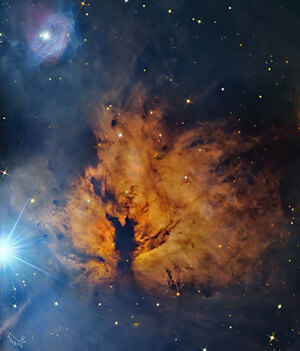
What lights up the Flame Nebula? What is the Flame Nebula sez you. To wit:

Fifteen hundred light years away towards the constellation of Orion lies a nebula which, from its glow and dark dust lanes, appears, on the left, like a billowing fire. But fire, the rapid acquisition of oxygen, is not what makes this Flame glow. Rather the bright star Alnitak, the easternmost star in the Belt of Orion visible on the far left, shines energetic light into the Flame that knocks electrons away from the great clouds of hydrogen gas that reside there. Much of the glow results when the electrons and ionized hydrogen recombine. The featured picture of the Flame Nebula (NGC 2024) was taken across three visible colour bands with detail added by a long duration exposure taken in light emitted only by hydrogen. The Flame Nebula is part of the Orion Molecular Cloud Complex, a star-forming region that includes the famous Horsehead Nebula.

(Image: Team ARO)
apod

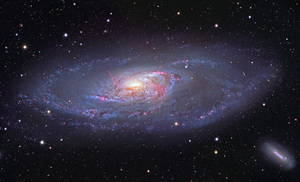
Behold: NCG 4258 – close to the Great Bear (Ursa Major) and surrounded by the stars of the Hunting Dogs (Canes Venatici), discovered in 1781 by  French astronomer Pierre Mechain and later added to the catalog of his friend and colleague Charles Messier as M106.  To wit:

Modern deep telescopic views reveal it to be an island universe – a spiral galaxy around 30 thousand light-years across located only about 21 million light-years beyond the stars of the Milky Way. Along with a bright central core, this stunning galaxy portrait, a composite of image data from amateur and professional telescopes, highlights youthful blue star clusters and reddish stellar nurseries tracing the galaxy’s spiral arms. It also shows off remarkable reddish jets of glowing hydrogen gas. In addition to small companion galaxy NGC 4248 at bottom right, background galaxies can be found scattered throughout the frame. M106, also known as NGC 4258, is a nearby example of the Seyfert class of active galaxies, seen across the spectrum from radio to X-rays. Active galaxies are powered by matter falling into a massive central black hole.

(Image: NASA, Hubble Legacy Archive, Kitt Peak National Observatory; Amateur Data & Processing Copyright: Robert Gendler)

apod

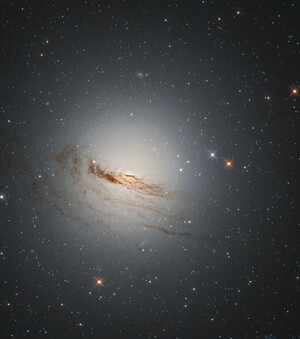
Behold: elliptical spiral galaxy NGC 1947 in the southern sky within the boundaries of the Constellation of Dorado. To wit:

NGC 1947 is some 40 million light-years away. In silhouette against starlight, obscuring lanes of cosmic dust thread across the peculiar galaxy’s bright central regions. Unlike the rotation of stars, gas, and dust tracing the arms of spiral galaxies, the motions of dust and gas don’t follow the motions of stars in NGC 1947 though. Their more complicated disconnected motion suggest this galaxy’s visible threads of dust and gas may have come from a donor galaxy, accreted by NGC 1947 during the last 3 billion years or so of the peculiar galaxy’s evolution. With spiky foreground Milky Way stars and even more distant background galaxies scattered through the frame, this sharp Hubble image spans about 25,000 light-years near the centre of NGC 1947.

(Image: ESA/Hubble & NASA, D. Rosario; Acknowledgment: L. Shatz)

apod

Behold: four of Saturn’s 82 true moons. Four you say? That’s right, four. To wit:

First — and farthest in the background — is Titan, the largest moon of Saturn and one of the larger moons in the Solar System. The dark feature across the top of this perpetually cloudy world is the north polar hood. The next most obvious moon is bright Dione, visible in the foreground, complete with craters and long ice cliffs. Jutting in from the left are several of Saturn’s expansive rings, including Saturn’s A ring featuring the dark Encke Gap. On the far right, just outside the rings, is Pandora, a moon only 80-kilometres across that helps shepherd Saturn’s F ring. The fourth moon? If you look closely inside Saturn’s rings, in the Encke Gap, you will find a speck that is actually Pan. Although one of Saturn’s smallest moons at 35-kilometres across, Pan is massive enough to help keep the Encke gap relatively free of ring particles. After more than a decade of exploration and discovery, the Cassini spacecraft ran low on fuel in 2017 and was directed to enter Saturn’s atmosphere, where it surely melted.

(Image: Cassini Imaging Team, ISS, JPL, ESA, NASA)

apod

A sample of the teeny-tiny delights on offer at the Journey To The Microcosmos channel – in this case a fascinating chapter called “Microbes Don’t Actually Look Like Anything’ wherein we learn that light and microscopy create visions of teeny-tiny life that don’t actually look like that in teeny-tiny reality.

Hey, it’s no biggie.

kottke

Behold: a stunning new image of the Veil nebula – the wispy remnants of a Milky Way star that exploded around seven thousand years ago. To wit:

At the time, the expanding cloud was likely as bright as a crescent Moon, remaining visible for weeks to people living at the dawn of recorded history. Today, the resulting supernova remnant, also known as the Cygnus Loop, has faded and is now visible only through a small telescope directed toward the constellation of the Swan (Cygnus). The remaining Veil Nebula is physically huge, however, and even though it lies about 1,400 light-years distant, it covers over five times the size of the full Moon. The featured picture is a Hubble Space Telescope mosaic of six images together covering a span of only about two light years, a small part of the expansive supernova remnant. In images of the complete Veil Nebula, even studious readers might not be able to identify the featured filaments.

(Image: ESA/Hubble & NASA, Z. Levay)

apod

Behold: the central black hole of supergiant elliptical galaxy M87 (it’s a big one). To wit:

The featured image represents the detected intrinsic spin direction (polarization) of radio waves. The polarization is produced by the powerful magnetic field surrounding the supermassive black hole at the center of elliptical galaxy M87. The radio waves were detected by the Event Horizon Telescope (EHT), which combines data from radio telescopes distributed worldwide. The polarization structure, mapped using computer generated flow lines, is overlaid on EHT’s famous black hole image, first published in 2019. The full 3-D magnetic field is complex. Preliminary analyses indicate that parts of the field circle around the black hole along with the accreting matter, as expected. However, another component seemingly veers vertically away from the black hole. This component could explain how matter resists falling in and is instead launched into M87’s jet.

(Image: Event Horizon Telescope Collaboration; Text: Jayanne English (U. Manitoba)

apod

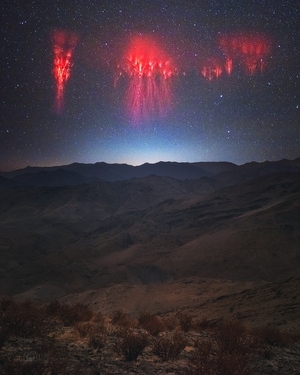
Behold: one of the most spectacular shots yet of red sprite lightning. To wit:

Recent research has shown that following a powerful positive cloud-to-ground lightning strike, red sprites may start as 100-meter balls of ionised air that shoot down from about 80-km high at 10 percent the speed of light. They are quickly followed by a group of upward streaking ionised balls. The featured image was taken earlier this year from Las Campanas observatory in Chile over the Andes Mountains in Argentina. Red sprites take only a fraction of a second to occur and are best seen when powerful thunderstorms are visible from the side.

Let’s look a little closer, shall we?

Previously: No Sprite Is Safe

(Image: Yuri Beletsky (Carnegie Las Campanas Observatory, TWAN)

apod

Look at him there: happier times, with the whole world looking up to him

Mmf.

To wit:

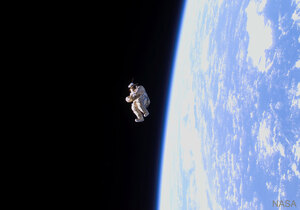
A spacesuit floated away from the International Space Station 15 years ago, but no investigation was conducted. Everyone knew that it was pushed by the space station crew. Dubbed Suitsat-1, [but also known as Mr. Smith, Ivan Ivanovich, RadioSkaf, Radio Sputnik and AMSAT-OSCAR 54], the unneeded Russian Orlan spacesuit filled mostly with old clothes was fitted with a faint radio transmitter and released to orbit the Earth. The suit circled the Earth twice before its radio signal became unexpectedly weak. Suitsat-1 continued to orbit every 90 minutes until it burned up in the Earth’s atmosphere after a few weeks. Pictured, the lifeless spacesuit was photographed in 2006 just as it drifted away from space station.

(Image: ISS Expedition 12 Crew, NASA)

apod