Category Archives: Science

Sunset: as seen from Earth and from Mars. To wit:

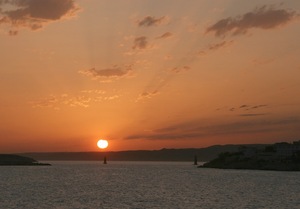
For comparison, two images of our common star were taken at sunset, one from Earth and one from Mars. These images were scaled to have same angular width and featured here side-by-side. A quick inspection will reveal that the Sun appears slightly smaller from Mars than from Earth. This makes sense since Mars is 50% further from the Sun than Earth. More striking, perhaps, is that the Martian sunset is noticeably bluer near the Sun than the typically orange colours near the setting Sun from Earth. The reason for the blue hues from Mars is not fully understood, but thought to be related to forward scattering properties of Martian dust. The terrestrial sunset was taken in 2012 March from Marseille, France, while the Martian sunset was captured in 2015 by NASA‘s robotic Curiosity rover from Gale crater on Mars. Last week a new rover and a helicopter — onboard Mars 2020launched for Mars.

(Top left Image: Damia Bouic; Top right Image: NASA, JPL-Caltech, MSSS; Digital processing: Damia Bouic)

apod

Behold: dark shapes winging their way through the dusty emission nebula  known as NGC 6188 in the southern Constellation of Ara, 4000 light years away. To wit:

Born in that region only a few million years ago, the massive young stars of the embedded Ara OB1 association sculpt the fantastic shapes and power the nebular glow with stellar winds and intense ultraviolet radiation. The recent star formation itself was likely triggered by winds and supernova explosions, from previous generations of massive stars, that swept up and compressed the molecular gas. The featured image accumulated over 10 hours through a backyard telescope in Córdoba, Argentina and was false-coloured using the Hubble palette highlighting emission from sulfur, hydrogen, and oxygen atoms in red, green, and blue hues. The field of view spans about four full Moons, corresponding to about 150 light years at the estimated distance of NGC 6188.

(Image: Ariel L. Cappelletti)

apod

That’s right – two tails. What do you mean you’ve only seen one? To wit:

Of the two tails evident, the blue ion tail on the left points directly away from the Sun and is pushed out by the flowing and charged solar wind. Structure in the ion tail comes from different rates of expelled blue-glowing ions from the comet’s nucleus, as well as the always complex and continually changing structure of our Sun’s wind. Most unusual for Comet C/2020 F3 (NEOWISE), though, is the wavy structure of its dust tail. This dust tail is pushed out by sunlight, but curves as heavier dust particles are better able to resist this light pressure and continue along a solar orbit. Comet NEOWISE‘s impressive dust-tail striations are not fully understood, as yet, but likely related to rotating streams of sun-reflecting grit liberated by ice melting on its 5-kilometre wide nucleus. The featured 40-image conglomerate, digitally enhanced, was captured three days ago through the dark skies of the Gobi Desert in Inner Mongolia, China. Comet NEOWISE will make it closest pass to the Earth tomorrow as it moves out from the Sun. The comet, already fading but still visible to the unaided eye, should fade more rapidly as it recedes from the Earth.

(Image: Zixuan Lin (Beijing Normal U.)

apod

Ultra HD ‘footage’ of Mars created by panning (using the Ken Burns effect) across high definition panoramas composed of stills taken by various Mars rovers. It’s not video but it’s very engaging.

Full screen for best effect and, if you’ve turned down the volume, ElderFoxDocumentaries sez:

Although the cameras are high quality, the rate at which the rovers can send data back to earth is the biggest challenge. Curiosity can only send data directly back to earth at 32 kilo-bits per second. Instead, when the rover can connect to the Mars Reconnaissance Orbiter, we get more favourable speeds of 2 Megabytes per second. However, this link is only available for about 8 minutes each Sol, or Martian day. As you would expect, sending HD video at these speeds would take a long long time. As nothing really moves on Mars, it makes more sense to take and send back images.

kottke

Behold: the Butterfly Nebula – one of the hottest heavy metal outfits in the galaxy. To wit:

Though its wingspan covers over 3 light-years and its estimated surface temperature exceeds 200,000 degrees, C, the dying central star of NGC 6302, the featured planetary nebula, has become exceptionally hot, shining brightly in visible and ultraviolet light but hidden from direct view by a dense torus of dust. This sharp close-up was recorded by the Hubble Space Telescope and is reprocessed here to show off the remarkable details of the complex planetary nebula, highlighting in particular light emitted by iron, shown in red. NGC 6302 lies about 4,000 light-years away in the arachnologically correct constellation of the Scorpion (Scorpius). Planetary nebulas evolve from outer atmospheres of stars like our Sun, but usually fade in about 20,000 years.

(Image: NASA, ESA, HubbleJudy Schmidt)

Another view?

apod

Why do we never see the Moon like this? Because of tidal locking.To wit:

…because the Earth’s moon is tidally locked to the Earth, showing us only one side. Given modern digital technology, however, combined with many detailed images returned by the Lunar Reconnaissance Orbiter (LRO), a high resolution virtual Moon rotation movie has been composed. The featured time-lapse video starts with the standard Earth view of the Moon. Quickly, though, Mare Orientale, a large crater with a dark center that is difficult to see from the Earth, rotates into view just below the equator. From an entire lunar month condensed into 24 seconds, the video clearly shows that the Earth side of the Moon contains an abundance of dark lunar maria, while the lunar far side is dominated by bright lunar highlands. Currently, over 19 new missions to the Moon are under active development from eight different countries, most of which have expected launch dates in the next three years.

(Video: NASA, LRO, Arizona State U.)

apod

For the next few nights, given favourable conditions where you are, Comet NEOWISE will be visible in the evening sky. To wit:

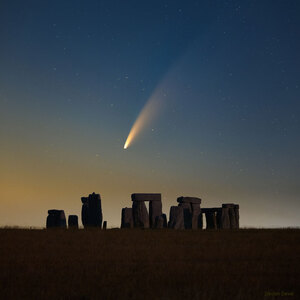
Go outside just at sunset and look to your northwest. The lower your horizon, the better. Binoculars may help, but if your sky is cloudless and dark, all you should need is your unaided eyes and patience. As the Sun sets, the sky will darken, and there will be an unusual faint streak pointing diagonally near the horizon. That is Comet NEOWISE. It is a 5-kilometre-wide evaporating dirty iceberg visiting from — and returning to — the outer Solar System. As the Earth turns, the comet will soon set, so you might want to take a picture. In the featured image, Comet C/2020 F3 (NEOWISE) was captured two mornings ago rising over Stonehenge in the UK. Discovered with the NASA satellite NEOWISE toward the end of March, Comet NEOWISE has surprised many by surviving its closest approach to the Sun, brightening dramatically, and developing impressive (blue) ion and (white) dust tails.

(Image: Declan Deval)

apod

For the last week, Comet C/2020 F3 (NEOWISE) has been rising before dawn in the northern sky and some have made the most of the morning display. To wit:

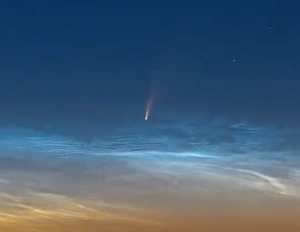
Up before sunrise, the featured photographer was able to capture in dramatic fashion one of the few comets visible to the unaided eye this century, an inner-Solar System intruder that might become known as the Great Comet of 2020. The resulting video details Comet NEOWISE from Italy rising over the Adriatic Sea. The time-lapse video combines over 240 images taken over 30 minutes. The comet is seen rising through a foreground of bright and undulating noctilucent clouds, and before a background of distant stars. Comet NEOWISE has remained unexpectedly bright, so far, with its ion and dust tails found to emanate from a nucleus spanning about five kilometres. Fortunately, starting tonight, northern observers with a clear and dark northwestern horizon should be able to see the sun-reflecting interplanetary snowball just after sunset.

Word to the NEOWISE.

(Video: Paolo Girotti)

apod