
Category Archives: Science

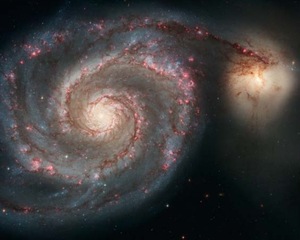
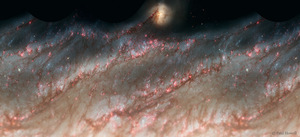
Behold: Messier 51, aka ‘The Whirlpool’ – a grand design spiral galaxy 60,000 light-years across – with its arms digitally unwound (bottom) in a transformation of a magnificent Hubble Space Telescope portrait from 2005 (top). To wit:

In fact, M51 is one of the original spiral nebulae, its winding arms described by a mathematical curve known as a logarithmic spiral, a spiral whose separation grows in a geometric way with increasing distance from the center. Applying logarithms to shift the pixel coordinates in the Hubble image relative to the center of M51 maps the galaxy’s spiral arms into diagonal straight lines. The transformed image dramatically shows the arms themselves are traced by star formation, lined with pinkish star-forming regions and young blue star clusters. Companion galaxy NGC 5195 (top) seems to alter the track of the arm in front of it though, and itself remains relatively unaffected by this unwinding of M51. Also known as the spira mirabilis, logarthimic spirals can be found in nature on all scales. For example, logarithmic spirals can also describe hurricanes, the tracks of subatomic particles in a bubble chamber and, of course, cauliflower.

(Image: Data – Hubble Heritage Project, Unwinding – Paul Howell)

apod

Despite its impressive name and the fact that it’s the largest moon of the second largest planet in the solar system, Titan is very hard to see. To wit:

Small particles suspended in the upper atmosphere cause an almost impenetrable haze, strongly scattering light at visible wavelengths and hiding Titan’s surface features from prying eyes. But Titan’s surface is better imaged at infrared wavelengths where scattering is weaker and atmospheric absorption is reduced. Arrayed around this visible light image (center) of Titan are some of the clearest global infrared views of the tantalizing moon so far. In false colour, the six panels present a consistent processing of 13 years of infrared image data from the Visual and Infrared Mapping Spectrometer (VIMS) on board the Cassini spacecraft. They offer a stunning comparison with Cassini’s visible light view.

(Image: VIMS Team, U. Arizona, U. Nantes, ESA, NASA)

apod

Like the Earth, the sun rotates, as it does, it changes in both subtle and dramatic ways. To wit:

In the featured time-lapse sequences, our Sun — as imaged by NASA‘s Solar Dynamics Observatory — is shown rotating though an entire month in 2014. In the large image on the left, the solar chromosphere is depicted in ultraviolet light, while the smaller and lighter image to its upper right simultaneously shows the more familiar solar photosphere in visible light. The rest of the inset six Sun images highlight X-ray emission by relatively rare iron atoms located at different heights of the corona, all false-coloured to accentuate differences. The Sun takes just under a month to rotate completely — rotating fastest at the equator. A large and active sunspot region rotates into view soon after the video starts. Subtle effects include changes in surface texture and the shapes of active regions. Dramatic effects include numerous flashes in active regions, and fluttering and erupting prominences visible all around the Sun’s edge. Presently, our Sun is passing an unusually low Solar minimum in activity of its 11-year magnetic cycle. As the video ends, the same large and active sunspot region previously Video Credit: SDO, NASA; Digital Composition: Kevin M. Gill mentioned rotates back into view, this time looking different.

(Video: SDO, NASA; Digital Composition: Kevin M. Gill)

apod

Ah, there you are. To wit:

…the Moon occasionally moves in front of all of the Solar System‘s planets. Just this past Sunday, as visible from some locations in South America, a waning gibbous Moon eclipsed Mars. The featured image from Córdoba, Argentina captured this occultation well, showing a familiar cratered Moon in the foreground with the bright planet Mars unusually adjacent. Within a few seconds, Mars then disappeared behind the Moon, only to reappear a few minutes later across the Moon. Today the Moon moves close to, but not in front of, Venus. Because alignments will not have changed by much, the next two times the Moon passes through this part of the sky – in early September and early October – it will also occult Mars, as seen from parts of South America.

(Image: Sergio Scauso)

apod

Yes you two, near the big grey arrows there.

Are there other solar systems, just like ours, with planets orbiting a star? Well, stars we’ve seen, obviously, and – when the light is just right –  exoplanets. But never both in conjunction. Until now. To wit:

Recently, however, and for the first time, a pair of planets has been directly imaged around a Sun-like star. These exoplanets orbit the star designated TYC 8998-760-1 and are identified by arrows in the featured infrared image. At 17 million years old, the parent star is much younger than the 5-billion-year age of our Sun. Also, the exoplanets are both more massive and orbit further out than their Solar System analogues: Jupiter and Saturn. The exoplanets were found by the ESO‘s Very Large Telescope in Chile by their infrared glow – after the light from their parent star was artificially blocked. As telescope and technology improve over the next decade, it is hoped that planets more closely resembling our Earth will be directly imaged.

(Image: ESO, A. Bohn et al.)

apod

Behold: NGC 6814 – not to be confused with the Kevin McCloud Nebula.

The Kevin McCloud Nebula.

Hello? Is this thing on?

In the center of this serene stellar swirl is likely a harrowing black-hole beast. The surrounding swirl sweeps around billions of stars which are highlighted by the brightest and bluest. The breadth and beauty of the display give the swirl the designation of a grand design spiral galaxy. The central beast shows evidence that it is a supermassive black hole about 10 million times the mass of our Sun. This ferocious creature devours stars and gas and is surrounded by a spinning moat of hot plasma that emits blasts of X-rays. The central violent activity gives it the designation of a Seyfert galaxy. Together, this beauty and beast are cataloged as NGC 6814 and have been appearing together toward the constellation of the Eagle (Aquila) for roughly the past billion years.

(Image: ESA/Hubble & NASA; Acknowledgement: Judy Schmidt)

apod

An interesting suggestion from German educational design studio Kurzgesagt. To wit:

Getting rare materials from the ground into your phone is ugly. The mining industry is responsible for air and water pollution and the destruction of entire landscapes. But what if we could replace the mining industry on Earth with a clean process that can’t harm anyone?

Previously: Is There Anybody Out There?

We never see Saturn presenting a crescent phase from here on Earth. What you need is a spacecraft. To wit:

This image of crescent Saturn in natural colour was taken by the robotic Cassini spacecraft in 2007. It captures Saturn’s rings from the side of the ring plane opposite the Sun — the unilluminated side — another vista not visible from Earth. Visible are subtle colours of cloud bands, the complex shadows of the rings on the planet, and the shadow of the planet on the rings. The moons Mimas, at 2 o’clock, and Janus 4 o’clock, can be seen as specks of light, but the real challenge is to find Pandora (8 o’clock). From Earth, Saturn’s disk is nearly full now and opposite the Sun. Along with bright fellow giant planet Jupiter it rises in the early evening.

(Image: NASA, ESA, SSI, Cassini Imaging Team)

apod

Well that depends. With customary animated aplomb, German educational design studio Kurzgesagt sez:

The observable universe is a big place that has been around for more than 13 billion years. Up to two trillion galaxies made up of  something like 20,000 billion billion stars surround our home galaxy. In the milky way alone scientists assume there are some 40 billion earth like planets in the habitable zone of their stars. When we look at these numbers it is hard to imagine  that there is nobody else out there. 

Previously: Bright Sparks

Behold: distorted galaxy NGC 2442 in the Southern constellation of The Flying Fish (Piscis Volans). To wit:

Located about 50 million light-years away, the galaxy’s two spiral arms extending from a pronounced central bar have a hook-like appearance in wide-field images. But this mosaicked close-up, constructed from Hubble Space Telescope and European Southern Observatory data, follows the galaxy’s structure in amazing detail. Obscuring dust lanes, young blue star clusters and reddish star forming regions surround a core of yellowish light from an older population of stars. The sharp image data also reveal more distant background galaxies seen right through NGC 2442’s star clusters and nebulae. The image spans about 75,000 light-years at the estimated distance of NGC 2442.

(Image: Robert Gendler & Roberto Colombari; Data: Hubble Legacy Archive, European Southern Observatory)

apod