
Category Archives: Science

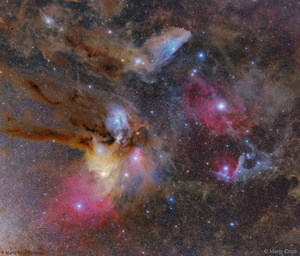
Behold: the colourful cloud complex of one of our nearest star forming regions.

And they call it a ‘dark nebula’. Honestly. To wit:

Rho Ophiuchi itself is a binary star system visible in the blue reflection nebula just to the left of the image center. The star system, located only 400 light years away, is distinguished by its multi-colored surroundings, which include a red emission nebula and numerous light and dark brown dust lanes. Near the lower left of the Rho Ophiuchi molecular cloud system is the yellow star Antares, while a distant but coincidently-superposed globular cluster of stars, M4, is visible just to the right of Antares. Near the image top lies IC 4592, the Blue Horsehead nebula. The blue glow that surrounds the Blue Horsehead’s eye — and other stars around the image — is a reflection nebula composed of fine dust. On the featured image right is a geometrically angled reflection nebula cataloged as Sharpless 1. Here, the bright star near the dust vortex creates the light of surrounding reflection nebula. Although most of these features are visible through a small telescope pointed toward the constellations of OphiuchusScorpius, and Sagittarius, the only way to see the intricate details of the dust swirls, as featured above, is to use a long exposure camera.

(Image: Mario Cogo (Galax Lux))

apod

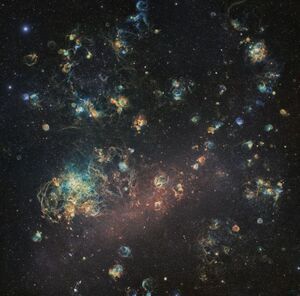
Behold: the smoky allure of the Large Magellanic Cloud (LMC) in deep and detailed telescopic view. To wit:

Spanning over 5 degrees or 10 full moons, the 4×4 panel mosaic was constructed from 3900 frames with a total of 1,060 hours of exposure time in both broadband and narrowband filters. The narrowband filters are designed to transmit only light emitted by sulfur, hydrogen, and oxygen atoms. Ionized by energetic starlight, the atoms emit their characteristic light as electrons are recaptured and the atoms transition to a lower energy state. As a result, in this image the LMC seems covered with its own clouds of ionized gas surrounding its massive, young stars. Sculpted by the strong stellar winds and ultraviolet radiation, the glowing clouds, dominated by emission from hydrogen, are known as H II(ionized hydrogen) regions. Itself composed of many overlapping H II regions, the Tarantula Nebula is the large star forming region at the left. The largest satellite of our Milky Way Galaxy, the LMC is about 15,000 light-years across and lies a mere 160,000 light-years away toward the constellation Dorado.

(Image: Team Ciel Austral – J. C. Canonne, N. Outters, P. Bernhard, D. Chaplain, L. Bourgon)

apod

Behold: NGC 6543 – the brightest and most detailed known planetary nebula, from our perspective at least. The Cat’s Eye Nebula is composed of gas expelled in the death throes of a Sun-like star. To wit:

This nebula‘s dying central star may have produced the outer circular concentric shells by shrugging off outer layers in a series of regular convulsions. The formation of the beautiful, complex-yet-symmetric inner structures, however, is not well understood. The featured image is a composite of a digitally sharpened Hubble Space Telescope image with X-ray light captured by the orbiting Chandra Observatory. The exquisite floating space statue spans over half a light-year across. Of course, gazing into this Cat’s Eye, humanity may well be seeing the fate of our sun, destined to enter its own planetary nebula phase of evolution … in about 5 billion years.

(Image: NASAESAHubble Legacy ArchiveChandra X-ray Obs.; Rudy Pohl)

apod

It could, though.

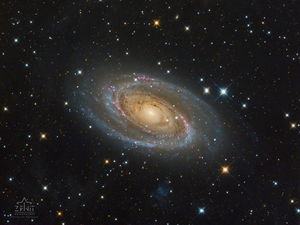
Behold the elegant swirl of Messier 81, aka NGC 3031 or Bode’s galaxy.  To wit:

this grand spiral can be found toward the northern constellation of Ursa Major, the Great Bear. The detailed telescopic view reveals M81’s bright yellow nucleus, blue spiral arms, pink starforming regions, and sweeping cosmic dust lanes. Some dust lanes actually run through the galactic disk (left of center), contrary to other prominent spiral features though. The errant dust lanes may be the lingering result of a close encounter between M81 and its smaller companion galaxy, M82. Scrutiny of variable stars in M81 has yielded one of the best determined distances for an external galaxy — 11.8 million light-years.

(Image: Paolo De Salvatore, Zenit Observatory)

apod

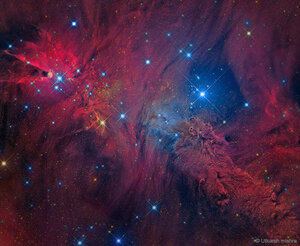
Behold: curious formations and bizarre textures visible in the vicinity of the Cone Nebula, 2,700 light years from Earth.

Well, this is how it would have been in 681BC, when – who can forget – an assassin brought the 24 year reign of Assyrian king Sennacherib to an untimely end (that’s what you get for sacking Babylon).

Anyhoo – what’s this? Some kind of interstellar dust cloud? To wit:

The unusual shapes originate from fine interstellar dust reacting in complex ways with the energetic light and hot gas being expelled by the young stars. The brightest star on the right of the featured picture is S Mon, while the region just below it has been nicknamed the Fox Fur Nebula for its color and structure. The blue glow directly surrounding S Mon results from reflection, where neighboring dust reflects light from the bright star. The red glow that encompasses the whole region results not only from dust reflection but also emission from hydrogen gas ionized by starlight. S Mon is part of a young open cluster of stars named NGC 2264, located about 2500 light years away toward the constellation of the Unicorn (Monoceros). Even though it points right at S Mon, details of the origin of the mysterious geometric Cone Nebula, visible on the far left, remain a mystery.

(Image: Chilescope; Processing & Copyright: Utkarsh Mishra)

apod

German educational design studio Kurzgesagt reveals the densest things in the Universe apart from black holes and [insert political ideology here]. To wit:

Inside neutron stars we can find the weirdest and most dangerous substance in the universe: Strange matter. What is strange matter, how dangerous is it and what can it tell us about the origin of the universe?

Previously: Blown Up Out Of All Proportion

https://www.youtube.com/watch?v=TwGnxB9BXK0

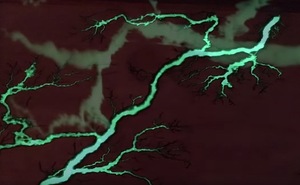
Brad Russell and the rather beautiful results of an extremely dangerous practice – connecting the 2000V transformer from a microwave oven to sheets of wood painted with sodium bicarbonate: tree-like electrical discharge patterns known as Lichtenberg figures which he then overlays, fills, colours and varnishes into art pieces.

awesomer

Saturn.

The sixth rock (well, gas giant with a rocky core) from the Sun is not always visible because, quite often, our Moon passes in front of it. To wit:

Such a Saturnian eclipse was visible along a small swathe of Earth — from Brazil to Sri Lanka — near the end of last month. The featured colour image is a digital fusion of the clearest images captured by successive videos of the event taken in red, green, and blue, and taken separately for Saturn and the comparative bright Moon.

The exposures were taken from South Africa just before occultation — and also just before sunrise. When Saturn re-appeared on the other side of the Moon almost two hours later, the Sun had risen. This year, eclipses of Saturn by the Moon occur almost monthly, but, unfortunately, are visible only to those with the right location and with clear and dark skies.

(Image: Cory Schmitz)

apod

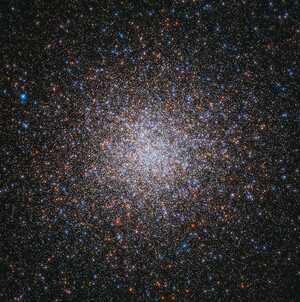
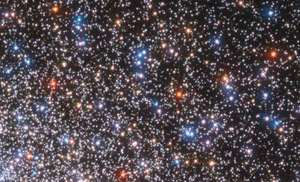
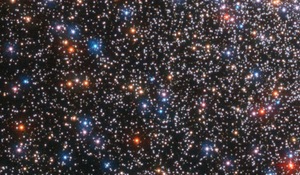
Behold: NGC 7089, a giant star cluster also known as Messier 2 after the 18th century French astronomer and comet hunter Charles Messier who first catalogued it. Prepare to feel small in the scheme of things. To wit:

 After the Crab Nebula, M1… is the second entry in 18th century astronomer Charles Messier’s famous list of things which are not comets. M2 is one of the largest globular star clusters now known to roam the halo of our Milky Way galaxy. Though Messier originally described it a nebula without stars, this stunning Hubble image [top pic, with details below] resolves stars across the central 40 light-years of M2. Its population of stars numbers close to 150,000, concentrated within a total diameter of around 175 light-years. About 55,000 light-years distant toward the constellation Aquarius, this ancient denizen of the Milky Way… is 13 billion years old.

Higher resolution image here.

apod