


A 140MP photo of Sol (across which the ISS is transiting) taken last Friday by asltrophotograpy enthusiast Andrew McCarthy.
The full sized 140 megapixel image is viewable if you support him on Patreon.



A 140MP photo of Sol (across which the ISS is transiting) taken last Friday by asltrophotograpy enthusiast Andrew McCarthy.
The full sized 140 megapixel image is viewable if you support him on Patreon.



In recent years, some have suggested that nuclear energy is the key to reducing climate change. And others have said that’s just pish.
But who is right? And just how much do those other ejects suck?
German educational design studio Kurzgesagt has the answer, but – unlike their trademark plain-science animations – it’s not straightforward.
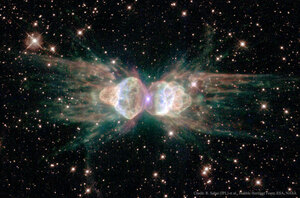
Behold Mz 3, aka the Ant Nebula. Quite unlike other planetary nebulae of its kind. To wit:
Mz3 is being cast off by a star similar to our Sun that is, surely, round. Why then would the gas that is streaming away create an ant-shaped nebula that is distinctly not round? Clues might include the high 1000-kilometer per second speed of the expelled gas, the light-year long length of the structure, and the magnetism of the star featured here at the nebula’s center. One possible answer is that Mz3 is hiding a second, dimmer star that orbits close in to the bright star. A competing hypothesis holds that the central star’s own spin and magnetic field are channeling the gas. Since the central star appears to be so similar to our own Sun, astronomers hope that increased understanding of the history of this giant space ant can provide useful insight into the likely future of our own Sun and Earth.
(Image: R. Sahai (JPL) et al., Hubble Heritage Team, ESA, NASA)
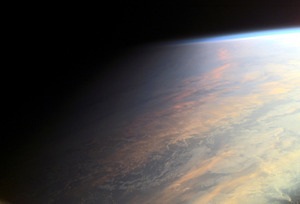
Behold: the passage of day into night as seen from the International Space Station in 2001. To wit:
…in this gorgeous view of ocean and clouds over our fair planet Earth, the shadow line or terminator is diffuse and shows the gradual transition to darkness we experience as twilight. With the Sun illuminating the scene from the right, the cloud tops reflect gently reddened sunlight filtered through the dusty troposphere, the lowest layer of the planet’s nurturing atmosphere. A clear high altitude layer, visible along the dayside’s upper edge, scatters blue sunlight and fades into the blackness of space. This picture was taken in June of 2001 from the International Space Station orbiting at an altitude of 211 nautical miles. But you can check out the vital signs of Planet Earth Now.
(Image: ISS Expedition 2 Crew, Gateway to Astronaut Photography of Earth, NASA)

Behold: the warped magnetic fields of Centaurus A – not one galaxy, but two. To wit:
When galaxies collide — what happens to their magnetic fields? To help find out, NASA pointed SOFIA, its flying 747, at galactic neighbour Centaurus A to observe the emission of polarized dust — which traces magnetic fields. Cen A’s unusual shape results from the clash of two galaxies with jets powered by gas accreting onto a central supermassive black hole. In the resulting featured image, SOFIA-derived magnetic streamlines are superposed on ESO (visible: white), APEX (submillimeter: orange), Chandra (X-rays: blue), and Spitzer (infrared: red) images. The magnetic fields were found to be parallel to the dust lanes on the outskirts of the galaxy but distorted near the centre. Gravitational forces near the black hole accelerate ions and enhance the magnetic field. In sum, the collision not only combined the galaxies’ masses — but amplified their magnetic fields. These results provide new insights into how magnetic fields evolved in the early universe when mergers were more common.
(Image: Optical: European Southern Observatory (ESO) Wide Field Imager; Submillimeter: Max Planck Institute for Radio Astronomy/ESO/Atacama Pathfinder Experiment (APEX)/A.Weiss et al; X-ray and Infrared: NASA/Chandra/R. Kraft; JPL-Caltech/J. Keene; Text: Joan Schmelz (USRA))

Something you don’t normally see. To wit:
In visible light, the Milky Way’s centre is hidden by clouds of obscuring dust and gas. But in this stunning vista, the Spitzer Space Telescope‘s infrared cameras, penetrate much of the dust revealing the stars of the crowded galactic centre region. A mosaic of many smaller snapshots, the detailed, false-colour image shows older, cool stars in bluish hues. Red and brown glowing dust clouds are associated with young, hot stars in stellar nurseries. The very centre of the Milky Way has recently been found capable of forming newborn stars. The galactic centre lies some 26,700 light-years away, toward the constellation Sagittarius. At that distance, this picture spans about 900 light-years.
(Image: NASA, JPL-Caltech, Spitzer Space Telescope, Susan Stolovy (SSC/Caltech) et al.; Reprocessing: Judy Schmidt)
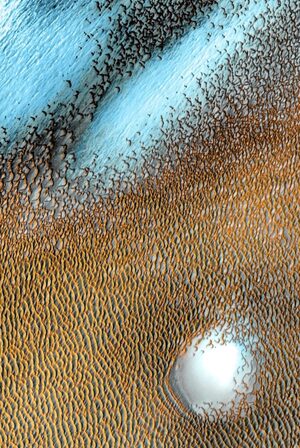
Behold: a striking composite image taken by NASA’s Odyssey Orbiter between 2002 and 2004 showing (in false colour) the long dunes surrounding the northern polar cap of Mars.
Areas touched by the sun emit a golden glow, while the chillier regions are tinted blue. The image frames dunes carved into a 19-mile swath of land extending into an area the size of Texas. The picture celebrates the 20th year of Odyssey – launched in 2001 – the longest-running spacecraft in history.


Behold: airglow. Whatnow, sez you? Airglow. Atmospheric air glows all of the time, but it’s usually hard to see. A disturbance like an approaching storm, however, can cause noticeable rippling in the Earth’s atmosphere – a phenomenon seen here as a giant repeating rainbow. But why? To wit:
These gravity waves are oscillations in air analogous to those created when a rock is thrown in calm water. The long-duration exposure nearly along the vertical walls of airglow likely made the undulating structure particularly visible. OK, but where do the colours originate? The deep red glow likely originates from OH molecules about 87-kilometers high, excited by ultraviolet light from the Sun. The orange and green airglow is likely caused by sodium and oxygen atoms slightly higher up. The featured image was captured during a climb up Mount Pico in the Azores of Portugal. Ground lights originate from the island of Faial in the Atlantic Ocean. A spectacular sky is visible through this banded airglow, with the central band of our Milky Way Galaxy running up the image center, and M31, the Andromeda Galaxy, visible near the top left.
(Image: Miguel Claro (TWAN); Rollover Annotation: Judy Schmidt)

Behold: the bright elliptical galaxy Messier 87 (M87) – home to the supermassive black hole whose spectacular image was captured in 2019 by the Event Horizon Telescope – the first ever visual of its kind. To wit:
Giant of the Virgo galaxy cluster about 55 million light-years away, M87 is the large galaxy rendered in blue hues in this infrared image from the Spitzer Space telescope. Though M87 appears mostly featureless and cloud-like, the Spitzer image does record details of relativistic jets blasting from the galaxy’s central region. Shown in the inset at top right, the jets themselves span thousands of light-years. The brighter jet seen on the right is approaching and close to our line of sight. Opposite, the shock created by the otherwise unseen receding jet lights up a fainter arc of material. Inset at bottom right, the historic black hole image is shown in context, at the center of giant galaxy and relativistic jets. Completely unresolved in the Spitzer image, the supermassive black hole surrounded by infalling material is the source of enormous energy driving the relativistic jets from the center of active galaxy M87.
(Image: NASA, JPL-Caltech, Event Horizon Telescope Collaboration)

Behold: the Pencil nebula supernova shock wave – plowing through interstellar space at over half a million kilometres per hour. To wit:
Near the middle and moving up in this sharply detailed color composite, thin, bright, braided filaments are actually long ripples in a cosmic sheet of glowing gas seen almost edge-on. Cataloged as NGC 2736, its elongated appearance suggests its popular name, the Pencil Nebula. The Pencil Nebula is about 5 light-years long and 800 light-years away, but represents only a small part of the Vela supernova remnant. The Vela remnant itself is around 100 light-years in diameter, the expanding debris cloud of a star that was seen to explode about 11,000 years ago. Initially, the shock wave was moving at millions of kilometers per hour but has slowed considerably, sweeping up surrounding interstellar material. In the featured narrow-band, wide field image, red and blue colours track, primarily, the characteristic glows of ionised hydrogen and oxygen atoms, respectively.
(Image: Greg Turgeon & Utkarsh Mishra)

