
Category Archives: Science

It’s all relative.

Behold: two very contrasting star clusters in a single field of view. To wit:

 M35, on the lower left, is relatively nearby at 2800 light years distant, relatively young at 150 million years old, and relatively diffuse, with about 2500 stars spread out over a volume 30 light years across. Bright blue stars frequently distinguish younger open clusters like M35. Contrastingly, NGC 2158, on the upper right, is four times more distant than M35, over 10 times older, and much more compact. NGC 2158’s bright blue stars have self-destructed, leaving cluster light to be dominated by older and yellower stars. In general, open star clusters are found in the plane of our Milky Way Galaxy, and contain anywhere from 100 to 10,000 stars — all of which formed at nearly the same time. Both open clusters M35 and NGC 2158 can be found together with a small telescope toward the constellation of the Twins (Gemini).

(Image: CFHT, Coelum, MegaCam, J.-C. Cuillandre (CFHT) & G. A. Anselmi (Coelum)

apod

Behold (in opposite corners of the stunning mosaic): the Horsehead nebula and the Orion nebula, 1500 light years away. To wit:

The familiar Horsehead nebula appears as a dark cloud, a small silhouette notched against the long red glow at the lower left. Alnitak is the easternmost star in Orion’s belt and is seen as the brightest star to the left of the Horsehead. Below Alnitak is the Flame Nebula, with clouds of bright emission and dramatic dark dust lanes. The magnificent emission region, the Orion Nebula (aka M42), lies at the upper right. Immediately to its left is a prominent reflection nebula sometimes called the Running Man. Pervasive tendrils of glowing hydrogen gas are easily traced throughout the region.

(Image: Roberto Colombari & Federico Pelliccia)

apod

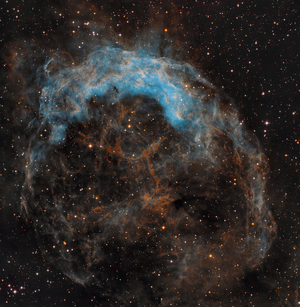
Behold: NGC 3199, aka the Banana nebula – a glowing cosmic cloud in the southern constellation of Carina, 12,000 light years away. To wit:

The nebula is about 75 light-years across in this narrowband, false-colour view. Though the deep image reveals a more or less complete bubble shape, it does look very lopsided with a much brighter edge along the top [the ‘banana’]. Near the centre is a Wolf-Rayet star, a massive, hot, short-lived star that generates an intense stellar wind. In fact, Wolf-Rayet stars are known to create nebulae with interesting shapes as their powerful winds sweep up surrounding interstellar material. In this case, the bright edge was thought to indicate a bow shock produced as the star plowed through a uniform medium, like a boat through water. But measurements have shown the star is not really moving directly toward the bright edge. So a more likely explanation is that the material surrounding the star is not uniform, but clumped and denser near the bright edge of windblown NGC 3199.

(Image: Mike Selby and Roberto Colombari

apod

Behold: STEVE – a Strong Thermal Emission Velocity Enhancement. Wait. What? To wit:

STEVEs have likely been seen since antiquity, but only in the past five years has it been realised that their colours and shapes make them different from auroras. Seen as single bright streaks of pink and purple, the origin of STEVEs remain an active topic of research. STEVEs may be related to subauroral ion drifts (SAIDs), a supersonic river of hot atmospheric ions. For reasons currently unknown, STEVEs are frequently accompanied by green “picket-fence” auroras. The featured STEVE image is a combination of foreground and background exposures taken consecutively in mid-March from Copper Harbor, Michigan, USA. This bright STEVE lasted several minutes, spanned from horizon to horizon, and appeared in between times of normal auroras.

(Image: MaryBeth Kiczenski)

apod

Behold: the most famous manned voyage of the 20th century on its way home. To wit:

After proving that humanity has the ability to go beyond the confines of planet Earth, the first humans to walk on another world — Neil Armstrong and Buzz Aldrin — flew the ascent stage of their Lunar Module back to meet Michael Collins in the moon-orbiting Command and Service Module. Pictured here on 1969 July 21 and recently digitally restored, the ascending spaceship was captured by Collins making its approach, with the Moon below, and Earth far in the distance. The smooth, dark area on the lunar surface is Mare Smythii located just below the equator on the extreme eastern edge of the Moon’s near side. It is said of this iconic image that every person but one was in front of the camera.

(Image: NASA, Apollo 11; Restoration – Toby Ord)

RIP: (the other) Big Fellah.

apod

Behold: a stunning image of our own shaded planet taken 49 years ago. To wit:

From the unfamiliar perspective, the Earth is small and, like a telescopic image of a distant planet, the entire horizon is completely within the field of view. Enjoyed by crews on board the International Space Station, only much closer views of the planet are possible from low Earth orbit. Orbiting the planet once every 90 minutes, a spectacle of clouds, oceans, and continents scrolls beneath them with the partial arc of the planet’s edge in the distance. But this digitally restored image presents a view so far only achieved by 24 humans, Apollo astronauts who traveled to the Moon and back again between 1968 and 1972. The original photograph, AS17-152-23420, was taken by the homeward bound crew of Apollo 17, on December 17, 1972. For now it’s the last picture of Earth from this planetary perspective taken by human hands.

(Image: Apollo 17, NASA; Restoration – Toby Ord)

apod

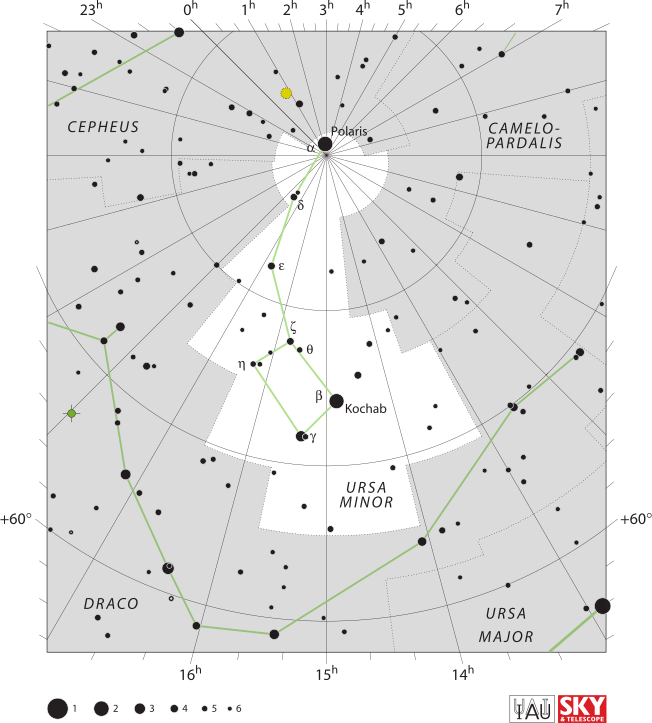
Behold: an image of Polaris – the North Star – digitally manipulated to suppress surrounding dim stars but accentuate the faint gas and dust of the Integrated Flux Nebula (IFN). Fair enough. But why is it called the North Star? To wit:

First, Polaris is the nearest bright star toward the north spin axis of the Earth. Therefore, as the Earth turns, stars appear to revolve around Polaris, but Polaris itself always stays in the same northerly direction — making it the North Star. Since no bright star is near the south spin axis of the Earth, there is currently no South Star. Thousands of years ago, Earth’s spin axis pointed in a slightly different direction so that Vega was the North Star. Although Polaris is not the brightest star on the sky, it is easily located because it is nearly aligned with two stars in the cup of the Big Dipper. Polaris is near the center of the eight-degree wide featured image (…/) The surface of Cepheid Polaris slowly pulsates, causing the star to change its brightness by a few percent over the course of a few days.

(Image: Bray Falls)

apod

The ‘Healing Grid’ by Ryota Kanai was a finalist in the 2005 Best Illusion of the Year Contest. stare at the centre for about 20 seconds and the broken edges appear to repair themselves in your peripheral vision. Kanai sez of it:

This illusion seems to indicate the preference of the visual brain to see regular patterns.

Make of that what you will.

kottke

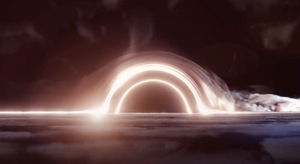
Behold: a spectacular animated representation of what happens when a star gets too close to a black hole. Cosmic dismemberment. To wit:

The black hole can rip it apart — but how? It’s not the high gravitational attraction itself that’s the problem — it’s the difference in gravitational pull across the star that creates the destruction. In the featured animated video illustrating this disintegration, you first see a star approaching the black hole. Increasing in orbital speed, the star’s outer atmosphere is ripped away during closest approach. Much of the star’s atmosphere disperses into deep space, but some continues to orbit the black hole and forms an accretion disk. The animation then takes you into the accretion disk while looking toward the black hole. Including the strange visual effects of gravitational lensing, you can even see the far side of the disk. Finally, you look along one of the jets being expelled along the spin axis. Theoretical models indicate that these jets not only expel energetic gas, but create energetic neutrinos — one of which may have been seen recently on Earth.

(Video: DESY, Science Communication Lab)

apod