



Hmm.
This afternoon
Fergus writes:
Irish Water at it again aided and abetted by RTÉ fupping News…
A drought in Ireland after a few days? Do they take us for complete idiots?
Anyone?
Irish Water lowers night-time water pressure in Dublin as heatwave continues (RTÉ)


This afternoon.
Dollymount Strand. Clontarf, Dublin.
Scenes on the hottest day of the year.
Rollingnews
Save Poolbeg
Meanwhile…

This afternoon.
Grand Canal Dock, Dublin 2
Amy writes:
Anybody working today?
Rollingnews

Raising a geek?
Trudi McDonald writes:
This Saturday at 11am, Eason on O’Connell Street in Dublin will host a book signing with authors and radio stars, Greg James and Chris Smith. Greg and James will be on hand to sign copies of their bestselling “Kid Normal” series. The laugh-out-loud funny adventure series follows Murph Cooper’s journey to become a hero…
Free but you MUST register here.


Cathal O’Rourke writes:
This BBC Spotlight thing was on the other night. Includes:
Environmental profiteering!
Dirty Ukrainian Money!
The Tories!
The DUP!
Brexit !…and a cameo from Christopher Wylie (top), of Cambridge Analytica infamy, and the FBI agent who brought down the Wolf of Wall Street
Stick the kettle on etc, and to the pitchforks afterwards.
Slurp/FIGHT!


From top: US Detenton centre near the Mexican border in Tornillo, Texas; Lissywollen Direct Provision centre, Athlone, Co. Westmeath
In the film version of David Mamet’s 1984 stage play ‘Glengarry Glen Ross’, the salesman sent from head-office to pep talk the sales team announces a new competition: first place wins a car, last place is fired.
The play describes the core principle of what today we understand as neoliberalism as it is practised by the Trump administration and others. In Mamet’s play the representation of the core value of the ideology is simple and brutal and runs like a mantra through the play. It is simply, Fuck You.
Once you see neoliberalism reduced to these two words you begin to see that aspect of the ideology everywhere.
At home it was there when the present taoiseach as minster for social welfare launched the welfare cheats campaign. It was also there when as taoiseach he promised more support for the arts, set up an organisation ostensibly to promote the arts, but then climbed aboard the new vehicle himself, revealing it as a personal PR platform.
In neo-liberalism, the arts are considered worthless, unless they’ve already made fortunes. The worth of all actions is measured on assessment of immediate, short-term financial return. First place wins a car, last place is fired.
This short-term, fast buck, fuck-youness of the system results in what president Michael D. Higgins described last week as “neo-utilitarian mediocrity”, a condition that he has identified as being widespread in the universities, where the neo-liberal ideology of competition and financial bottom-lines is polluting the Humanities at source.
The sinister aspect of the system is the monetising of people as products to be processed, whether it be through the privatisation of social services or the privatisation of prisons.
In a market economy dependent on perpetual growth, where actual jobs are in decline due to automation and environmental limitations to growth, people become the products that are bought and sold. That is where neo-liberalism leads and is leading: towards the mass processing of vulnerable people.
In September 2017 Mark Donatelli, a New Mexico attorney and an opponent of private prison services said to reporter Roz Brown of the Public News Service in Albuquerque:
“…Under the Obama administration, the Justice Department had begun a phase-out of contracts with private-prison companies. When that decision was reversed by President Trump, their stock prices soared…”
There is big money to be made in imprisoning vulnerable people. Jeff Sessions, the US attorney general is said to hold extensive shares in CoreCivic which provides private prison services all across the US.
Donatelli in the same interview went on to speculate that “…the aggressive tactics now being employed by ICE – the Immigration and Customs Enforcement agency – likely means private prisons will be utilized…” [to detain immigrants.]
Tellingly, however, while private prison services account for only 12% of all inmates in the US, the percentage share for privately-run immigration and family detention centres is 62%, according to a story by David Dayen in The Nation. This throws a whole new light on the arrests of the Mexican immigrant families.
The same publication, The Nation, ran an article in 2016, shortly after Trump won the election, speculating on how Trump would deport immigrants by branding them as criminal. This being the easiest way to “cater” for them with the systems already in existence. This is exactly what has happened.
The criminalizsng of people for profit in a system of democratic and human-rights restrictions depends primarily on selling the idea to the majority of the electorate, persuading them that certain “criminal” types need rehabilitation.
It’s not about solving the underlying problem. It’s about duping the majority into blaming a minority by identifying a scapegoat group as a focus for “improvement”. The inevitable punitive measures that follow can only happen with the co-operation of the majority of the electorate.
I wrote an article a couple of years ago called “The Investment Potential of Criminalising the Poor” that showed how one of the companies who won the Irish contracts to deliver JobPath was bought out by a major investment corporation attracted by the profit potential of the Irish contracts. I subsequently discovered that US private prisons have the right to sue local government should a certain quota of fresh prisoners not be met.
While researching that article I came across a story about a questionnaire issued by Turas Nua to jobseekers containing a question that asked, When do you next expect to commit a criminal offence?
The incident was not widely reported. It was reported in The Sun but ignored elsewhere. It was mentioned in the Dáil, but the general response appeared to be that it was some kind of clerical error. The odd question was withdrawn, apologies were made, someone said “regrettable mistake” and so on.
But in light of Trump’s deliberate criminalisation of the Mexican immigrants, that “clerical error” seems now more like a move to habituate people to the idea of unemployment as criminality. And that by two companies whose chief business interest is in private prison services from the UK to Saudi Arabia.
This monetising of vulnerable people is what connects the thinking behind private prison systems in the US and elsewhere, and, more generally, the out-sourcing of social welfare services to private companies, as is happening here.
In real terms, public monies that have seen set aside for social welfare purposes are essentially hi-jacked by these private companies for minimal return. This transference of well-intentioned social funds to private investors is facilitated by governments who simply want to write off the responsibility of providing social welfare, content to throw the most vulnerable on the mercy of the markets.
The lowest bidders almost always win the contracts, to offset costs at the outset. The entire “service” then becomes a cost-cutting exercise by the private contractor, to test how far they can strip the service without actually doing too much harm.
Inevitably however, people are harmed and some people die as a result of the inherent neglect of a system designed for minimal service and maximum profit.
It was the deaths in private prisons that prompted the Obama administration to legislate for the phasing out of private prison services and, naturally, the phasing out of private profits, a situation that Trump and his team were eager to overturn and did.
There is a difference only in degree between the imprisoned children of Mexico, their parents deliberate captives to a private prison service in which the US attorney general holds shares, and, at the milder end of the spectrum, (for the onlookers, not for the families involved,) the homeless families of Ireland, held captive in hotels as sacrifices to the hopeful rejuvenation of the private housing market, an arrangement arrived at by neglect of any serious social housing programme by a government ruling party made up of 32% private landlords.
Both sets of imprisoned families are prisoners for the profit motives of more powerful agents. Add to this the migrant families imprisoned in direct provision in Ireland, farmed out to a private company whose interests are best served financially if direct provision remains a permanent arrangement.
All this makes the taoiseach’s recent gesture of accepting immigrants that the Italians don’t want seem like a calculated PR pre-election stunt to enhance the socially progressive image he has been cultivating on the back of the marriage equality and repeal the 8th amendments.
Eamonn Kelly is a freelance writer
Pics: Getty/RTÉ

This morning.
Dublin Castle, Dublin 2.
The Disclosures Tribunal into the alleged smearing of Garda whistleblower Sgt Maurice McCabe has resumed with the final summing up of evidence by legal teams being heard.
Olga Cronin is live tweeting from the castle and can be followed here and will be on Broadsheet on the Telly from 10pm.
Rollingnews
UPDATE:

 From top: Dee Forbes, Director general of RTÉ and Tony Hall, Director general of the BBC; Vanessa Foran
When RTÉ made their YE 201E available my quick scan had a predictable response; everything is as expected. Glossy, full of talk about themselves, the movements on the balance sheet to reflect the well-known sale of land, and of course Dee Forbes’ salary.
So rather than file it under a Broadsheet standard “nothing to see here” tag I decided to measure a few values against another national broadcaster reliant on statutory licence fees; the BBC. One presents Financial Statements as Group, the Other as Consolidated. RTÉ have a Calendar Year End, the BBC have a March YE.
While scanning both I was indeed mindful to the size and reach of both organisations, alongside the licence fee income and the global reach of one, and the advertising income opportunities of the other.
Therefore, I only used total income over a full 12 month trading period as a denominator rather than split out, and convert into a single currency needed for a proper drill down. Which would be meaningless to a large degree anyway, as one would be including direct costs for special events ie. Brexit Referendum and both values are compiled from very mixed reporting periods.
So, in so far as a quick drive-by evaluation would allow, here some stats that might be considered as reasonable benchmarks within that industry.
Please also bear in mind, I have only picked off a few to run simple Ratio Analysis calculations against. The purpose of published accounts and reports of any organisation is to allow all stakeholders access themselves and form their own opinions, so here is what was interesting to me.
Some 95% of the BBC’s total expenses in the 12 months ending March 2017 was spent on Content and Delivery; in real terms, 5% is what comes out of their total income to run the organisation’s back office functions.
To put this in context; RTÉ reports a total Income of €337.6 million; of which €27.365m was spent on Acquired Programming; 8% if you are wondering. This does not include Sport Copyrights & Licences if you were wondering that too; 5.5% of total income by the way.
For those who might assume that Acquired Programming refers to content subbed in from local production companies and sub-contractors, let me also provide this figure – €38.62m for Direct Acquired Programme Costs; or 11.4% of total income.
Thankfully the RTÉ report provides an easily interpreted graphic to give you an idea of how many are employed by the Television dept:
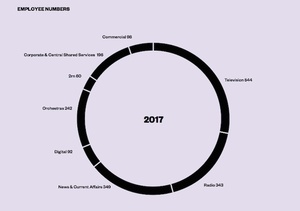
An interesting question is how much of its overall programming hours are fulfilled by these Acquired Programming and Direct Acquired Programming expenditure items.
Meanwhile, to get a look at another suite of cost:total income tests here’s one of the old reliables; Executive & Board Renumeration.
Total Board costs as a % of Total Income: BBC .06% (.0006 of total Income) RTE .1% (.001). Dee Forbes’ 338k v Tony Hall’s 467K; one hundredth of RTÉ’s total income: one thousandth of the BBC’s.
That above should be digested alongside with this; Dee Forbes leads an organisation that in its last set of accounts reported €337.6 million income, of which 55% is Licence Fees, and employs (average WTE for year) 1,924 people.
Whereas Tony Hall is responsible for almost 21,000 employees (over 10 times more than Ms Forbes) and for an organisation that collects st£3.74billion from UK Licence payers and earns itself another st£1.2billion (again way over 10 times more than Ms Forbes.)
As a % of income and staff complement there is absolutely no arguing the value of money lapse just on this benchmark alone. But I would add that Tony Hall is probably being short-changed.
Yes, I know this is flame-throwing. But it is worth noting nonetheless that straight away the TV Licence Payers in the UK get significantly more out of their National Broadcaster than the Irish Licence Payer.
RTÉ is on a road to nowhere which only exposes the Irish Taxpayer to further financial risks. It needs to radically change every way it does business and at every level within the organisation. It continues to achieve cost cuts and they have the graphic to prove it:

But even this alongside the carving from the Land & Buildings on its balance sheet, they are only fooling themselves if they think realising cash here is all they need to do. The entity’s costs are still not under control when it is having to sell its silver rather than innovate.
Commissioning a new season of a series they have not already managed to sell on is pointless and not in any way strategic or wise programming; you can also read this as using tax payers’ money to invest further in a loss-making product.
They need to develop products they can export and they need to relocate from probably the most valuable real-estate in the country instead of this piecemeal selling off from Financial Year to Financial Year. But more importantly they need their own programming to win back their viewers.
The most watched show in YE 2017 was the Late Late Toy Show; which at least is their own format, albeit older than me, probably. But its viewership is not loyal since the Toy Show is followed in the top 10 by a series of GAA All-Irelands and World Cup Play-Offs; all of which they have to compete for. Notably, the only scripted show in last year’s top ten was Mrs Brown/s New Year’s whatever. That probably makes my point.
If you are interested there is one measure between the two that is exactly spot on and nose to nose; both reports are a 192 pages long.
Vanessa Foran is a principal at Recovery Partners. Follow Vanessa on Twitter: @vef_pip /a>. Vanessa will be on Broadsheet on the Telly tonight at 10pm.
Footnote: Vanessa writes: The BBC Management and Talent personnel don’t seem to suffer from the shyness their counterparts in RTE do when it comes to declaring their income. Here is a tidy and well-presented transparent document detailing everyone employed or engaged by the BBC in Year Ending March 2017 in the 150K brackets.


Yesterday evening.
Aras An Uachtarain, Phoenix Park
Scenes from a a garden party hosted by President Higgins to mark the centenary of (some) women getting the vote in Britain and Ireland with guests that included journalists Ursula Halligan and Vincent Browne.
Sam boal/RollingNews

From top: the author as a six-year-old cowboy fan in Chicago, Illinois; Dan Boyle
I must have been five or six years old. My mother had sent me to my room for having committed some transgression. I was filled with childish fury at the injustice that had been done to me.
My infantile mind searched for a comeback, finding a word I knew would annoy my Mom. I didn’t know what the word meant, but I did know that by saying it I would get a reaction. It was the N word. Each time she would pass my bedroom door I would open it to bellow my new found mantra.
Living then in Chicago, saw me pick up more than my share of bad habits. At eight years of age, along with other friends, we broke into a neighbour’s house just because we could.
Living near a open rail line, and hanging off passing trucks, were every day hazards that made my Mother want to move the family to Ireland.
I’ve only returned to Chicago a couple of times. On the first occasion I stayed with friends of my family. They were very kind, and very generous.
When I expressed a desire to visit my old family home, they became somewhat circumspect. It was dangerous to go there, they claimed, as it now had become a black neighbourhood.
We eventually agreed to drive through the area. What I could see, but what they couldn’t, was that the area had physically improved. What had been a working class Irish American community was now a middle class African American community.
The second time I visited I went on my own, on foot. From the city centre I took the L Line railway system, getting off at the 2nd last stop. I then took a bus for about 14 blocks (a block being about a quarter of a kilometre), walking the the last four blocks.
I found the house pretty easily, the gridiron system being a boon to the easily confused. On the porch sat an African American women. From the sidewalk I preceded to have a surreal conversation with her. “I used to live here” I said. The returned Yank in reverse. She may still look on that encounter with some puzzlement.
Chicago has not had the best of times since then. Violent deaths have been commonplace in the city. Donald Trump highlighted this and made the city an exemplar of all that was wrong with Obama’s America.
In true Trump fashion, his tirades against the city were somewhat lacking in truth. The appalling number of deaths were far from being the worst in the US, and the trend had already begun to fall.
Trump’s taunts did have an effect, outside of the city, in the rest of the country. It was calculated at undermining Obama, and by extension Hillary Clinton.
Prior to his becoming a State Senator, quickly followed by being elected to the US Senate, Obama had worked a lot in the Chicago Projects, in those parts of the city where poverty and attendant social problems were most concentrated.
Hillary Clinton also came from Illinois. The two of us were born in the same hospital in Chicago, although not at the same time.
I hope someday to visit Chicago again. It is a great city. Home of The Blues. A great food culture. Brilliant museums and galleries. It’s part of who I am and who I want to be.
I don’t know when I’ll get to visit, hopefully soon. Hopefully at a time when The Great Moron is no longer casting his malevolence there.
Dan Boyle is a former Green Party TD and Senator. His column appears here every Thursday. Follow Dan on Twitter: @sendboyle