


MORE to folly.
Thanks Mick Crowley (The irish Times); Pamela McCarthy (The Irish Examiner); Enda Cunningham (The Galway City Tribune); Nick Sutton (The UK covers).
Covers to broadsheet@broadsheet.ie



MORE to folly.
Thanks Mick Crowley (The irish Times); Pamela McCarthy (The Irish Examiner); Enda Cunningham (The Galway City Tribune); Nick Sutton (The UK covers).
Covers to broadsheet@broadsheet.ie
 Stephen Buckley
Homophophic bullies.
Don’t get even.
Vote yes.
Stephen Buckley, from Maynooth, Co Kildare now living in Washington DC., writes:
I have been struggling with the decision to share this post for a few days.
The debate about the marriage equality referendum over the past several months has felt weirdly distant to me. I thought it was because I have been living away from Ireland, but over the last few days, I have slowly and painfully started to realise that it has been because I didn’t want to engage with the feelings and memories that have been resurfacing about my own experience of growing up gay in Ireland.
I have never wanted to publicly explain my experience of being gay in Ireland, but I feel that it is important for me to share my story as the national conversation about who I can marry intensifies.
As a young child, I didn’t feel so different from everyone else. I felt like me, and being me was fine. Being me was fine with my family and it was fine with the kids that I played with near my house. But as I got older, I started to feel like I was standing out more and more from the kids in my class.
By the time I got to secondary school, I felt that I was standing out like a sore thumb, mostly because I was regularly called derogatory names for a gay person in the corridors of school by people I knew and even by people that I didn’t know.
Getting called hurtful names by people who didn’t even know my actual name was a terrifying experience as it felt like there was just no place to hide. Even more terrifying for me was that I didn’t even come out until I was 20, so it felt like people were acknowledging and exposing the fact that I was gay without my permission.
The effects from the level of bullying I endured were that I tried to hide myself and I became distrustful of people’s genuine affection for me as I was so scared of being discriminated against.
The reason why I have gone into detail about my experience of growing up as a gay person is to communicate to anyone who is on the fence about how they will vote, of how painful it can be to be gay, and how important a national vote is on what a gay couple are entitled to, both in legal and in emotional terms, to Irish gay people.
I also strongly feel that the impact of a yes vote would reach far beyond improving the lives and sense of worth of gay people in Ireland. Having spoken about my experiences of being bullied to straight friends and family, I have realised that being a victim of bullying is sadly a reality for many people from all walks of life. A yes vote would affirm the Irish people’s commitment to tolerance and understanding.

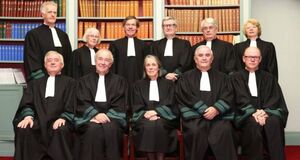 Adrian Hardiman (top) and the judges of the Supreme Court, back row, from left: Peter Charleton, Mary Laffoy, Liam McKechnie, John MacMenamin, Frank Clarke and Elizabeth Dunne; and front row, from left: Adrian Hardiman, Nicholas Kearns, Susan Denham, John Murray and Donal O’Donnell
A landmark Supreme Court decision [Director of Public Prosecutions v JC] delivered yesterday may give Gardai “effective immunity from judicial oversight”.
What on earth is it all about?
We asked Legal Coffee Drinker.
Broadsheet: “Legal Coffee Drinker, what’s it all about?
Legal Coffee Drinker: “It’s an appeal, brought by the Director of Public Prosecutions (the DPP) against the acquittal of a Mr JC (JC) for burglary on the basis that that the crucial evidence against him (his confession) was obtained as a result of a breach of constitutional rights and inadmissible.”
Broadsheet: “That sounds a bit rum.”
LCD: “The Supreme Court took the view that the trial judge had got it wrong in finding JC’s confession inadmissible and that it should have been admitted even though obtained in breach of constitutional rights. This was a big change from the position previously taken by the Supreme Court, which was that evidence obtained as breach of constitutional rights was inadmissible except in extraordinary excusing circumstances. The appeal against JC’s acquittal was allowed. Whether or not he’ll be retried is to be decided later.”
Broadsheet: “How exactly was the confession obtained?”
LCD: {pause] “There’s the thing. The confession was made by JC after he was arrested by the police in a house. The police had gained entry to the house by using a warrant issued under legislation subsequently found unconstitutional. This finding of unconstitutionality had retrospective effect, making the warrant invalid. The argument made at JC’s trial was that, because the initial entry leading to arrest had been as a result of an invalid warrant, everything obtained as a result of that warrant, including the confession, was invalid and should be excluded.”
Broadsheet: “But did they actually need the warrant in the first place? Isn’t there a general common law right to enter a house to arrest or somesuch?”
LCD: [drains coffee] “Yes, there is. And in fact the argument was made that, because of this, the confession wasn’t obtained as a result of an unconstitutionality, because it could have been obtained lawfully under the common law right of entry to arrest. However, it was felt that, because the Gardai had relied on the invalid warrant, rather than the common law right, the entry must be deemed unconstitutional.
Broadsheet: “Not the most glaring case of evidence obtained as a result of a breach of constitutional rights, in all fairness?”
LCD: “Maybe that’s one of the things which encouraged the majority of the Court to depart from previous law. There’s a saying that ‘hard cases make bad law’…”
Broadsheet: “And the ‘bad law’ made in this case?”
LCD: “Well, how ‘bad’ or ‘good’ it is remains to be seen, but it’s certainly an extremely significant change. The old law as laid down in the cases of The People v O’Brien [1965] IR 142 and DPP v Kenny [1990] 2 IR 110 was that evidence obtained as a result of a breach of constitutional rights was inadmissible except in extraordinary excusing circumstances. The majority in O’Brien did refer to this as applying only in relation to ‘deliberate and conscious’ breach, which caused some confusion. Kenny clarified matters by defining ‘deliberate and conscious’ breach very broadly so as to include unconstitutionalities resulting from a result of a deliberate and conscious act irrespective of whether or not the person breaching it had knowledge that the act was unconstitutional.”
Broadsheet: “Ignorance is no defence.”
LCD: “Ignorantia juris non excusat.”
Broadsheet: “Easy for you to say!”
LCD: [tops up cup] “But it seems that under the new law, as laid down by Clarke J in his judgment (O’Donnell J also delivered a majority judgment, overruling the old law, but left the exact definition of the new law to Clarke J), this is no longer the case, and that evidence obtained as a result of an inadvertent breach of constitutional rights will be admissible.
However, proving inadvertence is not going to be as easy as the officer concerned simply saying “I didn’t know”; According to Clarke J, a decision as to inadvertence requires an analysis of the conduct or state of mind not only of the individual who gathered the evidence but also any other senior official or officials within the investigating or enforcement authority concerned who is involved either in that decision or in decisions of that type generally or in putting in place policies concerning evidence gathering of the type concerned. Also, evidence obtained or gathered in circumstances where it could not have been constitutionally obtained or gathered should not be admissible even where inadvertence is present.”
Broadsheet: “There are more than two judges on the Supreme Court, right? Did they all agree with the views of O’Donnell and Clarke?”
LCD: “No. There was a very impassioned dissenting judgment delivered by Hardiman J. There was also dissenting judgments delivered by Murray J and McKechnie J. However they were outvoted by a majority of four to three (Clarke J, O’Donnell J, McMenamin J and Denham J comprising the majority).
There’s a considerable difference in attitude between the majority and minority regarding the balancing of interests in the criminal process. O’Donnell J began his judgment by referring to the importance of the criminal investigation process, and that the rules of evidence should not be used to frustrate the process of crime prevention. Hardiman J, on the other hand, referred to the concept of the individual’s right to a fair trial, and the risk to the rights of the individual posed if unconstitutionally obtained evidence was admitted. Although both the majority and the minority came up with manifold reasons for their various conclusions, it appears that this basic difference in attitude coloured their approach to the law they were interpreting.”
Broadsheet: “What ramifications will the JC decision have?”
LCD: “Well, in one sense it shouldn’t lead to a different approach to crime investigation, since it only covers inadvertent breaches. A lot will depend however on how ‘inadvertence’ is interpreted in practice by trial judges. If a lax approach to this term is taken, then there will be a lax approach to possible breaches of constitutional rights in the investigatory process. In addition, the decision is likely to result in more attempts by the prosecution, in criminal trials, to get in evidence which would otherwise have been excluded.”
Broadsheet: “Anything else?”
LCD: “Yes. Two things. Firstly, it’s interesting that this decision was given just over a year after disclosure of possible bugging of conversations in garda stations. In a previous post questions were raised about the extent to which this could affect criminal convictions, by reason of making the detainee’s custody unlawful and any confession subsequently made by him inadmissible under the principles in O’Brien and Kenny. Because of the JC decision, it seems that this has become significantly less of a risk.”
The other interesting thing about the JC case is that its ramifications extend well beyond the criminal process. The majority approach, on its face, represents a backtracking from the view, previously endorsed by the Supreme Court, that the rights of the individual are paramount. Will it represent a more conservative approach to individual rights generally? We shall have to wait and see.”
Broadsheet: “Thank you Legal Coffee Drinker. That calls for a frappé.
LCD: “Excuse me?
Broadsheet: “We have some free vouchers. It’s a cold coffee with foam and interesting flav… ”
LCD: *click*
Supreme Court judge criticises ruling on evidence in trials (Ruadhán Mac Cormaic, Irish Times)
Previously: LCD Answers Your Garda Bugging Questions
(Sasko Lazarov/Photocall Ireland)

High Craigton Farm, Glasgow
Formal identification of the remains, found at High Craigton farm on the outskirts of Milngavie, had not yet taken place, Police Scotland said in a statement on Wednesday night, but it was believed they may be those of Karen Buckley. Relatives were told of the discovery.
A 21-year-old man was detained by officers on Wednesday and police said they were “following a definite line of enquiry”. Early on Thursday morning they announced the arrest.
Karen Buckley: man arrested after remains found on Glasgow farm (Guardian)
Update:
‘Police can confirm that the body discovered at High Craigton farm yesterday is that of Karen Buckley’ Barry Roche joins Mary from Glasgow
— Drivetime RTE (@drivetimerte) April 16, 2015

This evening.
Grand Canal at Charlemont, Dublin 2.
Thanks Gary Byrne

Thgis evening.
Andrew T writes:
On the Nun’s Lawn at Mt Sackville, Chapelizod, [Dublin 20]…

Seasick Steve – Roy’s Gang
Hard to dislike, in fairness.
Pete Murphy writes:
With his sold-out UK tour in full swing, and irish summer festival dates in Bundoran and Royal Hospital Kilmainham, on the horizon, Seasick Steve announces the release of new single ‘Roy’s Gang’ (out May 25)…. Roy’s Gang is the second single from his new top 5 album ‘Sonic Soul Surfer’.
We have three VINYL editions of Seasick Steve’s Sonic Soul Surfer to give away.
The first three to name the car on the album cover (top) wins the Vinyl.
Lines MUST close at 5.45pm.

Jaysus.
Bibi writes:
There’s so much wrong with this, I’m not sure where to begin. Maybe at the end with the typo?
Any excuse

 Top from left: Labour senators Lorraine Higgins, John Whelan and Ivana Bacik
The unelected/able.
In pursuit of the undetected.
The proposed ‘Harmful and Malicious Electronic Communications Bill 2015’ is an act that aims to:
Protect against and mitigate harm caused to individuals by all or any digital communications and to provide such individuals with a means of redress for any such offending behaviours directed at them….
Senator Lorraine Higgins sez:
“I carried out a survey in schools in County Galway last year with Derek Nolan TD and 85% of students felt cyberbullying is a major issue, while 80% believed not enough is being done about it. Coupled with my own experience, I am now acutely aware there is a gap in our legislative armour and I am keen to address this. Modern democracies require modern laws and why should Ireland be any different in terms of international best practice?
“It is wrong that commentary online would be held to a lesser or lower standard than the print or broadcast media. It is equally wrong that it is the victims of abuse and threats online who are penalised in that their mental health may be affected – but there are no penalties or deterrents for the instigators of the abuse.
It is incumbent on us as legislators to make online platforms a safe and decent place for the people who use them, but particularly for children and vulnerable individuals. We need legislation of this sort because it is important to convey that one cannot be abused with impunity anywhere.”
Sound Senatorial proposal from cogent legal minds?
Or technically-impossible control-freaking tommy rot?
YOU must decide.
(Sasko Lazarov/Photocall Ireland)

This afternoon
Public representatives including TDs Paul Murphy and Ruth Coppinger and activists outside Leinster House, Kildare Street, Dublin to count down the non payment networks Bin your Bill Campaign, ahead of this Saturdays Water charges protest in Dublin.
(Leah Farrell/Photocall Ireland)
