
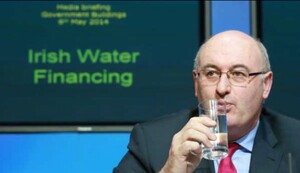
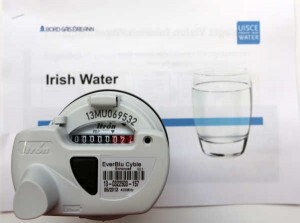
 From top: Denis O’Brien of GMC/Sierra; Phil Hogan, former environment minister who awarded the water meter contract to GMC/Sierra and a water meter.
Nothing will
Catherine Murphy TD in her Dail speech last week drew attention to the fact that GMC/SIERRA, the company which was awarded the water meter installation contract for the Dublin City, Midlands, South East and North West regions, did not come into existence, legally, until July 15, 2013.
Fifteen days after the closing date for bids.
Ms Murphy posed the question: how is it that an entity that did not exist when the deadline closed was awarded a contract?
We asked Legal Coffee Drinker, what’s it all about.
Broadsheet: “Legal Coffee Drinker, what’s it all about?
Legal Coffee Drinker: “Legally, it is possible for a company to be bound by, and benefit from, contracts entered into before it came into existence. This is because of Section 37(1) of the Companies Act 1963 which provides as follows:-
“Any contract or other transaction purporting to be entered into by a company or by any person on behalf of the company prior to its formation may be ratified by the company after its formation and thereupon the company shall become bound by it and entitled to the benefit thereof as if it had been in existence at the date of such contract or other transaction and had been a party thereto.””
Broadsheet: “So a company doesn’t have to be incorporated at the time of a tender made on its behalf to claim the benefit of that tender?”
LCD: “Correct. It just has to ratify it post-incorporation.”
Broadsheet: “So nothing to see here?”
LCD: “Not exactly. There are two issues here. First of all, whether or not there is a contract with GMC/Sierra (which it appears there is) and, secondly, whether or not the award of that contract complied with the relevant public procurement law.”
Broadsheet: “Public procurement law?”
LCD: “A set of legal rules, originating in EU Directives, governing the competitive process for public contracts. They’re summarised here. Under these rules, public contracts can only be awarded to tenderers whose treatment of their employees complies with statutory employment guidelines, who are not in a conflict of interest position and, who have tax clearance certificates.”
Broadsheet: “And the significance of this from point of the GMC/Sierra tender?”
LCD: “Well, all these requirements pre-suppose a public contract tenderer who is in existence at the date of the tender. A company still to be incorporated is not in a position to provide evidence of compliance with statutory requirements or to provide a tax clearance certificate.”
Broadsheet: “But surely a body yet to be incorporated wouldn’t owe any tax anyway?”
LCD: “Maybe, but the rules still require a tax clearance certificate. And even if they didn’t, there would be serious and very fundamental difficulties in considering the merits of a public tender by a company, which had yet to be incorporated. Look at the terms of Section 37(1) above. Where a tender bid is made by a company which has yet to be incorporated, the bid, and subsequent contract, is deemed to have been made with the promoters of the proposed company, unless the company ratifies it when incorporated, in which case the company can claim the benefit of the contract. How is it possible to assess the merits of any tender bid, in circumstances where the identity of the ultimate tenderer is not known – and cannot be known until a company yet to be set up decides whether or not to ratify the tender bid?”
Broadsheet: “So what you’re saying is that the difficulty goes deeper than the mere absence of a tax clearance certificate?”
LCD: “Yes. For the public procurement rules to be applied properly to pre-incorporation tenders there would arguably need to be a provision in these rules dealing specifically with this issue and identifying the deemed tenderer in such a case. The current rules simply don’t contemplate pre-incorporation tenders as being part of the public procurement process and because they don’t contemplate it it’s extremely difficult even on the most generous interpretation to fit them within the scheme.”
Broadsheet: “What implications does this analysis have for GMC/Sierra?”
LCD: “Well, if the public procurement process does not permit the submission of tenders by pre-incorporation companies, this means that the contract with GMC/Sierra was not reached in accordance with the public procurement process. This raises questions both about the possible judicial reviewability of the contract – although it should be noted that the time limits for judicial review are quite strict, and may be past at this stage – and about compliance by the Irish State with its public procurement obligations under EU law – something which may be of concern to the European Commission.”
Previously: Sierra Where Would You Get It
Thicker Than Uisce