An exhibition entitled 36 Ventilators, 4.7m3 Packing Chips by Swiss artist Zimoun inside the windows of the Museo d’Arte di Lugano in Switzerland against which large fans blow clouds of packaging peanuts.
Previously: The Rumble Of Balls



An exhibition entitled 36 Ventilators, 4.7m3 Packing Chips by Swiss artist Zimoun inside the windows of the Museo d’Arte di Lugano in Switzerland against which large fans blow clouds of packaging peanuts.
Previously: The Rumble Of Balls

https://vimeo.com/92271187
Smash TV’s homage to the Old West – 30 years of westerns condensed into a single hour starring Clint Eastwood.
Sure where would you get it?
Painstakingly assembled from more than 50 Western movies, ranging from Sergio Leone’s early Spaghetti Westerns all the way up to 90s reimaginings such as Desperado and Wild Wild West, Gunslinger serves as a humble attempt to pay homage to one of the longest running and most influential genres of the silver screen. Whether your loyalty lies with the trusty sheriff, the dastardly villain, the ruthless mercenary, the opportunistic thief, or the unpredictable vigilante, it provides a thrilling look at heroism, betrayal, greed, loss, and justice in a time when law and order was as rare as the gold men killed for.
If you liked that, check out the two previous hour-long specials in the series: Skinemax (an ode to late night TV and B-movies with Kurt Russell) and Memorex (50 minutes of vintage 80s adverts ripped from VHS starring Ronald McDonald).


Scenes from the Seamus Heaney memorial concert this evening at National Concert Hall, Earlsfort Terrace, Dublin .
From top: Paul Simon; Simon with Niall Hannigan [Winner of the National Library of Ireland Poetry Aloud competition] and musician Donal Lunny; poet Michael Longley and all the acts performing this evening..
(Sam Boal/Photocall Ireland)
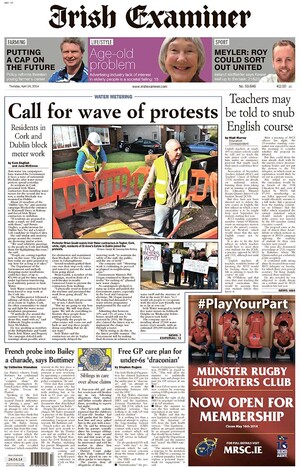
These people in Raheny, Dublin fought back the #IrishWater meter installers. pic.twitter.com/HqgKn7Oj37
— Irish Revolution (@Revolution_IRL) April 23, 2014
Earlier: Spilling Over

[Members of the Survivors of Symphysiotomy campaign group in June 2012 after addressing the justice, defence and Equality committee]
Proposals to compensate more than 250 survivors of the medical procedure symphysiotomy will be placed before the cabinet in the coming weeks.
We asked Legal Coffee Drinker what’s it all about.
Broadsheet: “Legal Coffee Drinker, what’s it all about?”
LCD: “It’s about proposals to change the law to allow for compensation for women suffering the after-effects of symphysiotomies.”
Broadsheet: “Would it not be possible through the courts? Surely carrying out this procedure without consent is actionable?”
LCD: “Indeed it is. Most recently, in Kearney v McQuillan, where a damages award of €450,000 [subsequently reduced to €325,000 by the Supreme Court] was made in respect of a symphysiotomy carried out in 1969.”
Broadsheet: “On what ground?”
LCD: “The tort of negligence. It arises where someone who owes a duty of care to another fails to exercise reasonable care towards that other, as a result of which they suffer damage. This was a case of medical negligence involving a failure to exercise reasonable care in medical treatment.”
Broadsheet: “So the symphysiotomy survivors should sue?
LCD: “Not necessarily. Firstly, whether or not a symphysiostomy represents a breach of a hospital’s duty of reasonable care depends on the circumstances of each case: whether it was necessary; whether alternative treatments were available, or if not available whether something could have been done to prevent the necessity of a symphysiotomy arising in the first place. The circumstances of the individual case need to be looked at.
Secondly, Irish law has what is known as a limitation period of six years for actions in tort and contract. In the case of a negligence action, this means that proceedings must be brought within six years of the initial damage occurring. In the case of a symphysiostomy, that would be within six years of the operation. Most of these operations were carried out more than six years ago.”
Broadsheet: “But Kearney was 1969?”
LCD: [refills coffee] “Yes. The plaintiff in that case was able to avail of a provision in the Statute of Limitations (Amendment) Act 1991 which provides that time does not start running, for the purposes of an action in negligence, until the plaintiff can be reasonably aware of the damage having occurred. It’s known as the ‘discoverability’ principle.
Basically it means the six years run from the date on which the damage is reasonably discoverable. In this case Mrs Kearney was not told about the symphysiotomy at the time of it occurring, did not become reasonably aware of it in fact until years later. That’s why she was allowed to proceed with the case. Other women may not necessarily be able to make this argument. They may have known, or had reason to know, about the operation having been carried out at the time it occurred, more than six years before initiating litigation. If so their action risks being statute-barred.”
Broadsheet: “So would they then be precluded from suing?”
LCD: “Under current Irish law, yes. Although it would be open to the Oireachtas to amend the Statute of Limitations to change this.”
Broadsheet: “Will they?”
LCD: [Drains coffee] “At the moment it seems that the statutory compensation scheme is being favoured. Whether or not the damages awarded under such scheme will be similar to those which would have been awarded by the courts is another question. These survivors have endured a lifetime of suffering. I only hope the redress reflects this. ”
Broadsheet: “It was dark time of complete deference towards the professional classes.”
LCD: [pause] “Are we done?”
Broadsheet: “Yes. Absolutely. Thank you so much Legal Coffee Drinker. Most grateful as always”
[call ends]
Previously: “The Last Thing I Remember Was My Feet Being Pulled Up Into The Stirrups”
Redress proposal due for women who had symphysiotomies (Irish Times)
(Sasko Lazarov/Photocall Ireland)





![SUN: SUN-PAGES-NEWS [1RM] ... 24/04/14](https://cf.broadsheet.ie/wp-content/uploads/2014/04/SUNFRONT240414.jpg)