Tag Archives: Abortion

Manual

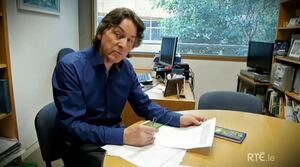
On RTÉ’s religious show Would You Believe? last night journalist Mick Peelo examined abortion laws in Ireland.

He discussed Catholic ethics committees in Catholic hospitals in America.

The programme heard how the US Conference of Bishops produces directives and a manual of Catholic healthcare ethics (above) for medical practitioners.

This manual stipulates that before early induction of labour can ever be justified ethically, there must be evidence of infection in the uterus.

Given that, in the past, many Irish hospitals had a Catholic ethos, Mr Peelo tried to find out more about the ethics committees present in Irish hospitals today.

He contacted all Irish hospitals, which deal with pregnant women, to find out which hospitals had such committees, and to find out who sits on these committees.

How did that go?

Peelox

Mr Peelo, above, reported:

“Many hospitals have clinical ethics committees but there’s little public information about their guiding principles: how these committees operate? And, who sits on them? We asked all hospitals in Ireland, that treat pregnant women, whether they had codes of ethics and ethics committees which advise on clinical practice. The response was patchy and inconclusive. Catholic hospitals were very upfront about their ethical principles but offered no information about who sits on their ethics committees, except to say they’re appointed by their boards. The HSE responded by saying: ‘There is no national policy in relation to ethics. All staff comply with their professional standards and requirements and are guided by the Irish Medical Council’s guide to professional conduct and ethics.’ Some HSE hospitals have ethics committees, others have none.”

Watch here

UPDATE:

Meanwhile, speaking of ethics committees…

Reilly1 Reilly2

Emily O’Reilly quotes secretary of the Pro-Life Campaign John O’Reilly writing about the goals of the Knights of Columbanus, in her 1992 book Masterminds of the Right, above.

Thanks Oireachtas Retort

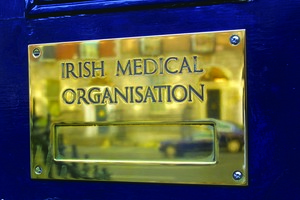
IMO Plaque Pics: Valerie O'Connor 24/06/05 Commissioned by Conor Ganly IMT

The Irish Medical Organisation has rejected a motion supporting regulation of abortion in line with the X Case following a heated and emotive debate.

The motion was defeated by 42 votes to 32 at the IMO’s annual conference.

The AGM has also rejected abortion in the case of victims of rape or incest who become pregnant.

Doctors also rejected a call for legislation for abortion in the case of a woman with a non-viable foetal abnormality.


Doctors reject abortion motions at IMO conference (RTE)

(IMO)

Meanwhile, someone’s happy:


“Holding the line”.

Really?

Screen Shot 2013-03-12 at 17.40.21crown

In an interview with the Guardian, Senator John Crown (above) has claimed Opus Dei (symbol, top) has been lobbying Irish professionals to try and thwart the expected abortion legislation.

Senator Crown said he received abuse after he told a subcommittee 30 terminations were carried out in Ireland last year.

He calls for members of the Dáil and Seanad to be required to declare their membership of organisations such as Opus Dei.

“That is something that should be declared because there are potential conflicts of interest if one believes that one is answering to a higher authority than the parliament of the republic.

“We have several examples in history where leaders of this country asked if people should state their allegiance. Garret Fitzgerald [a former taoiseach] once famously asked his cabinet to inform him if they were members of secret organisations, which I think is not a bad idea at all for the whole of the Oireachtas.”


Opus Dei accused of lobbying to prevent Irish abortion reform, Henry McDonald, Guardian)

Opus Dei, eh?

According to Dr John Roche, who was in Opus Dei for 14 years:

The Irish wing of Opus Dei numbers its membership at more than 1000 with about 30 priest-members…

Numerarii are the top people, taking private vows of chastity, poverty and obedience, from which hunchbacks, the one-eyed and stutterers were excluded. Dr. Roche said that such exclusions were common at certain levels in the Church until recently.

Next are Supernumerarii, which made up most of the membership, and are mainly married lay people, offering their first loyalty to Opus Dei, not their spouse, and who supported the organisation financially to some extent.

Associates come next, and are intellectually inferior most often to the high ranks, while the Numerarii are almost always graduates.

Cooperators have been more of a helping role, mostly financially. Freemasons and Communists are excluded, while membership of Opus Dei generally is open to all religions, but in Ireland is mainly Catholic.

Dr John Roche, Irish Times, 1998

(Pic: ProfJohnCrown)

Former taoiseach and Fine Gael leader John Bruton has created a political headache for his successor, Enda Kenny, by declaring the Government’s planned abortion legislation is contrary to the Constitution.

Mr Bruton claims it is “not consistent with the plain words of the Constitution” to include the threat of suicide in the terms of the legislation that will permit abortion where a woman’s life is at risk.

The Coalition has committed to introducing legislation to give effect to the Supreme Court judgment in the X case which found that a threat of suicide constituted a threat to a mother’s life.

Minister for Health James Reilly is due to bring the draft heads of the Bill on the subject to the Cabinet shortly.

‘Fresh divisions within the coalition’ ahoy.

John Bruton says Government abortion legislation contrary to Constitution (Stephen Collins, Irish Times)

(Laura Hutton/Photocall Ireland)

http://www.youtube.com/watch?v=3R74D9R0aUE#t=16m25s

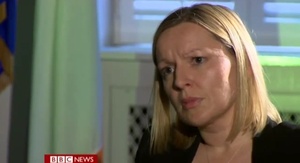
BBC’s HARDtalk was in Ireland this week to meet Minister for European Affairs, Lucinda Creighton.

Only a week ago presenter Stephen Sackur met Hamas leader, Khaled Meshaal.

Did he hear a more moderate voice on women’s rights and marriage equality in Dublin?

You decide.

Stephen Sackur: “I wonder why you have decided to take a couple of high profile positions that maybe wouldn’t fit easily into that notion of modernisation.First one, on gay marriage you’ve said you’re absolutely up for civil partnerships. You believe they’re the right way to go but you do not want to see gay marriage in Ireland. Why?”

Lucinda Creighton: “Well I suppose I have been a supporter of em the notion that em that gay people should have…”

Sackur: “Equality?”

Creighton: “…rights. Of course and have that recognised.”

Sackur: “Surely equality means that should they wish to do so they can get married in just the same way that heterosexual couples can get married.”

Creighton: “Well I suppose it is a matter of opinion, I mean in our constitution and the way it is interpreted by our courts system, marriage is and has been and continues to be defined as marriage between a man and woman.”

Sackur: “So you’re defending this on the basis of tradition?”

Creighton: “Well there’s not always something wrong with tradition I mean you know. I think…”

Sackur: “Well I’m just trying to tease out how this fits with your notion that you know Ireland needs to modernise, needs to look forward to the 21st century, not back.”

Creighton: “Oh absolutely. But I don’t think necessarily that modernisation means that you just totally abandon tradition. I think you can have both in fact, side by side. And there are many ways in which we need to modernise I just don’t believe that that’s one of them. And you know, speaking as somebody who unlike many of my colleagues in our parliament eh spoke eh on our legislation two years ago on civil partnership I spoke
passionately in favour of it because I believe it was the right thing. But that I suppose is a, a matter of opinion. One thing I do think will happen just while we’re on that subject is that I do think there will be a referendum to change the definition of marriage eh in our constitution at some point.”

Sackur: “What do you think they would decide?”

Creighton: “I really don’t know, genuinely I don’t know. Em I think there are very divided opinions.”

Sackur: “Opinions are shifting, aren’t they? And if one is going to be very blunt about it the role and influence of the Catholic Church is changing pretty rapidly in this country.”

Creighton: “Absolutely. Oh yeah I mean I think…”

Sackur: “Which brings me to another point if I may, which is your passionate defence of Ireland’s current laws and practices when it comes to abortion. It’s one of the most draconian countries in Europe when it comes to outlawing abortion em…abortions can only happen in this country if there is a substantial significant risk to the life of the mother. You want the curent status quo to be maintained even though there is a very loud and public argument now with many Irish people now who want it to change. Indeed your own government is talking about legislating to be clearer and actually a little broader about the specifications in which an abortion can be carried out. Why are you so against that?”

Creighton: “Well firstly, I would very much take issue with the view that em having a very restrictive em position on abortion in this country is somehow draconian. We have a very clear position in our constitution…”

Sackur: “What word would you choose?”

Creighton: “Well I wouldn’t call it draconian. No…Well..I…to explain, I mean firstly in our constitution, we as a country, the Irish State, values equally the right to life of mothers and babies and that includes unborn babies so there is no distinction or hierarchy.”

Sackur: “Final point on this, you know better than I do the stats here. Hundreds and hundreds of women over the last three years alone who have left the Irish Republic to get abortions abroad, many in the UK. These include nineteen rape victims, twenty one with severe health problems, more than twenty girls under the age of sixteen.
Now does it seem to you, right that the way the system works right now, those extremely vulnerable young women all have to go abroad to get abortions?”

Creighton: “Well firstly, I don’t know where your information is coming from but I think it’s..I think it’s from my point of view and I’m just speaking from my personal point of view, I feel very strongly em that you know there is virtually, very very few em circumstances that I’m aware of where treatment cannot and should not be provided for..for women who are vulnerable, who are pregnant.
I don’t see abortion as a treatment for vulnerable women em I mean it depends I suppose on your view of life and it depends on your view of unborn children. But I feel very strongly and I support very strongly our constitutional position which is that there is an equal right to life of women and unborn babies and you know that is something I think Irish people have held dear for many many years and it is something I consider to be worth defending.”


Minister for Health James Reilly has said a memorandum on planned abortion legislation will be brought to Cabinet next week and he hoped the new law could be produced before summer.

When asked when a new legal framework would be ready, he said: “I want it done as quickly as possible. I was hoping obviously that we could have something very substantial before Easter and that remains my hope.”

Asked if the planned law would be ready before the summer, he said: “I think in an ideal world that’s what I’d like to see but I mean I can’t foresee all the difficulties and potholes along the road.

Who can, Bottler? Who can?

Reilly hopes abortion law will be ready by summer (Mary Minihan, Marie O’Halloran, Irish Times)

(Sam Boal/Photocall Ireland)