

This evening.
North Quays, Dublin
Peter Doyle writes:
don’t drive in to the yellow box…
Anarchy, dude.



This evening.
North Quays, Dublin
Peter Doyle writes:
don’t drive in to the yellow box…
Anarchy, dude.
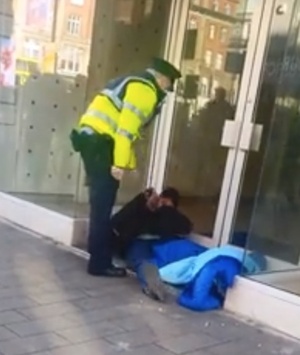
Garda response to the incident (above) on Henry Street, Dublin on Friday.
Via RTÉ
It is understood that during the incident the Garda’s pepper spray cannister was taken. The Garda recovered the cannister and used it to subdue the man who was then placed in handcuffs. Garda sources say there are a number of issues that have arisen and the matter is being investigated internally.
Garda inquiry into incident involving homeless man (RTÉ)
Reggie writes:
I know it’s RTÉ and we’ve come to expect a certain bias but the video clearly shows the man being pepper sprayed WHILE he is handcuffed…do they think we’re stupid AND blind?
Anyone?
Yesterday: Leave Him Alone

Via Rabble.ie
Philip Campion writes:
This happened on my way home from college on Friday its absolutely outrageous behavior by a Garda on Henry Street Dublin. A homeless man was treated like an animal, when a Garda tried to arrest him [for reasons unknown] he pushed him against the floor and pepper sprayed him right in the eyes when the man was clearly not making any sort of an attack or movement towards the Garda. He then stood there with his leg on the man as if the man was going to run somewhere.

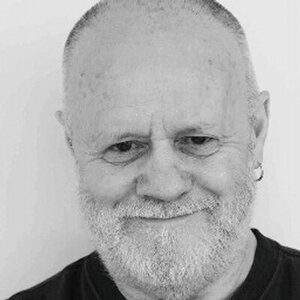 Eamonn Farrell and Irish Water protests (above) before Christmas
Eamonn Farrell is a former photo-editor of the Sunday Tribune and founder and editor of Photocall Ireland, the largest editorial photographic agency in Ireland.
He has covered all the major social issues in Ireland since 1980, including the H-Block Riots, Peace Process, Divorce, Contraception and Abortion Campaigns.
Recently his agency has extensively followed the Irish Water protests.
Eamonn writes:
As journalists, we are all deeply aware of the challenges facing us and the media in general, as a result of the digital revolution. Like previous unintended consequences resulting from technological developments i.e. the containerization of Dublin Port, and the demise of dock workers, we have to find ways to turn these events to our advantage.
However there is another serious challenge facing us, which has received very little attention and which seriously threatens our independence as a profession.
This is attempts by the Gardai, representing the State, to use journalists and in particular those working in the photographic/video/film arena as an extension of their eyes and ears.
The attempt to force journalists by default, to become agents of the state at protests and demonstrations is not only a threat to our independence and objectivity, but also to our safety and our reputations.
The agency which I represent and work for Photocall ireland has a long tradition of objectively covering events of political, social and environmental importance.
Our professional duty during such coverage, is to represent the public by objectively visually recording what we see, without fear or favour. In doing so we have often suffered the displeasure of both protestors and gardai, but carried on in the knowledge that despite our own individual opinions, we recorded events as they unfolded before us.
As suppliers of media content, we would of course have no or very little say in what imagery was eventually used by the publications or broadcasters we served.
This week our office was visited by two gardai with a summons for two of our staff to appear in a court case which the gardai were taking against a protestor or protesters involved in an event outside the Department of Justice last year, which one of our photojournalists covered.
One summons was for the journalist and the other for the office manager who had downloaded the images onto a CD for the gardai.
So why had we cooperated with the gardai? Well actually we hadn’t. We were handing copies of the images over after refusing to do so unless a warrant was produced. Eventually a warrant was procured and the images were handed over under protest and duress.
This was the third time images were demanded from various events, the third time we refused and the first time a warrant was served and images given over.
I have reason to believe we may be the only media organisation which refused each time we were asked, but maybe I am wrong. Why did we refuse to “help the gardai”. Well because of the following:
1. That is not our professional role.
2. The gardai have the means and the ability to make their own recordings.
3. To become the perceived ‘Eyes and Ears’ of the gardai at protests and demonstrations and marches undermines our ability to carry out our work.
What next? A request for visuals from meetings and briefings behind closed doors!5. Our journalists already suffer enough intimidation and threats from paramilitaries, gangsters, militants and some members of the public, while trying to carry out their work, without being put in added danger by the knowledge that whatever we record is available on demand by representatives of the state.
6. Because it is bad for democracy if the Fourth Estate ceases to be independent or seen to be independent of the other powerful arms of state. Its independence in other respects is already a topic of debate and that is as it should be. It is now important that this issue of the state through the gardai, demanding that journalists work in a supporting role to it, should also become a matter of debate among journalists, politicians and the public.


The above photograph [click to enlarge] of a confrontation between Hunger Strike marchers and the gardai at the British embassy in 1981 and the photograph (top) of journalists being threatened by baton waving gardai at the same event is a case in point.
My duty as a journalist covering the event was to record whatever I saw. Gardai beating up protesters or protesters beating up gardai, it did not matter.
As a journalist the freedom to remain objective and independent is critical to my work and any attempt to interfere with it, is an attack on democracy.
Eamonn Farrell
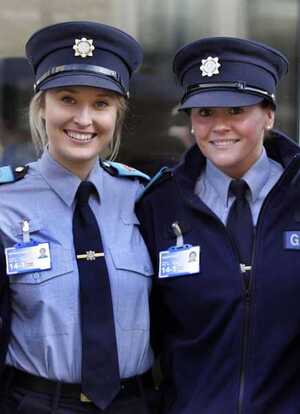
Yesterday.
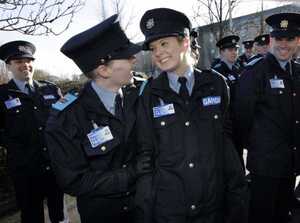
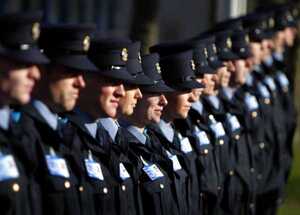
New Garda recruits at Templemore College, Co Tipperary yesterday, among 100 candidates selected from 27,000 applications.
The Government has insisted a new syllabus at the Garda College will encourage criticism, from new Garda members, of established practices.
They also claim the new training course will encourage recruits to question parts of policing culture without fear of colleagues’ reactions.
Hmm.
From top: Fionnuala Lawlor (right) and Aoife McEvoy; Some of the 100 new garda instake on parade; Rachel Killen and Angela Gavin.
New gardaí must be prepared to disobey an order, says Minister (Irish Times)
(Mark Stedman/Photocall Ireland)
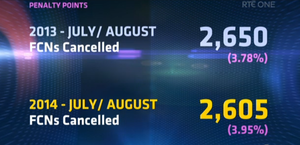

From top: RTÉ penalty points graphic and a screengrab from the Garda Professional Standards Unit’s report published yesterday
You’ll recall how Sgt Maurice McCabe claimed last September that certain gardaí were continuing to cancel penalty points for colleagues, friends and relations, despite assurances from Garda management that the practice no longer took place, particularly since new regulations were introduced on June 16.
The new regulations meant just three senior gardaí could cancel penalty points.
After Sgt McCabe’s claims were reported in The Sunday Times, the Garda Professional Standards Unit [GPSU] was ordered to carry out an investigation into the claims which led to a two-volume report.
Volume One of the report was published yesterday. Volume Two will not be published.
It shows that the GPSU examined 667 cancellation cases.
Of those 667 cases, 54 were quashed after June 16 – the date of change in legislation.
Of those 54, the GPSU says seven need further examination.
But overall, of the 667, the GPSU has concluded that 114 of them need further investigation – a fifth of which concern serving or retired gardai.
Sgt McCabe – though he wasn’t named in the report – he gave the GPSU details of 115 people who had points cancelled between January 1, 2009 to November 1, 2014.
This list included details of 31 serving or retired gardaí who had 289 cancellations. The GPSU requested access to files in relation to these cases between January 1, 2013 and November 1, 2014.
This yielded 239 case files. Of those 239 files, the GPSU did not receive 7 cancellation files. Details of these seven cancellations are in Volume Two of the report which has not been published.
In the report, the GPSU writes:
“GPSU examined these cancellations with information available from PULSE and FCPS [Fixed Charge Processing System] and have assessed them as ‘Further Investigation Required’. “
Last night, RTÉ One’s Prime Time political correspondent Katie Hannon highlighted how the report shows that, by comparing the the months of July and August 2013 with that of 2014, the GPSU shows that the number of penalty point cancellations dropped by 45.
However, as she shows in her graphic, the rate of cancellations actually rose from 3.78% to 3.95%.
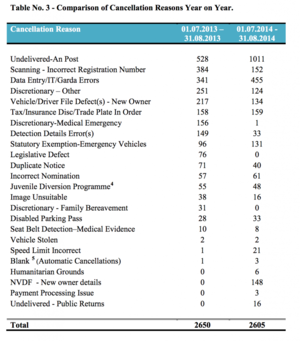
From the GPSU report
As for the reasons that penalty points were cancelled, the biggest reason was that the fixed charge notice went undelivered.
Comparing July and August of 2013 with that of 2014, the GPSU found this reason rose by 91.5%.
The ‘medical emergency’ reason dropped by 99.4%.
Yesterday, Justice Minister Frances Fitzgerald announced former president of the Circuit Court, Judge Matthew Deery will oversee the penalty points process in the future.
21 serving or retired gardai face further investigation over penalty points (Irish Examiner)
Watch Prime Time here
No one can stop them.
They can’t stop themselves.
The garda report on the penalty points system has found six senior gardaí continued to cancel penalty points in breach of policy and outside their own areas despite directions from the commissioner that the practice was to cease.
RTÉ News has also learned the report identifies nine cases where senior officers cancelled points and seven more instances where points were cancelled on questionable grounds even after the Commissioner Nóirín O’Sullivan introduced new procedures last June.

Joe Doocey.
He dated a woman that was also seeing a guard.
That was the start of the trouble, he claims.
Philip G writes:
Less than 72 hours after posting this video, Joe reported that “up to 20 Gardai and a number of detectives in riot gear” stormed his house while Joe and his family were still in bed. No warrant was shown. Joe was handcuffed. His wife and elderly father were directed to co-operate – “or else!” All Joe’s computers, phones, files and documents were seized – as well as those of his family. Joe was taken to the barracks and charged with obstructing a search warrant – despite no warrant having ever been shown – and no personal ‘obstruction’ on the part of Joe or his family having taken place!
We need to come together to support Joe and his family in face of this appalling abuse of statutory powers and an inexcusable personal attack on a citizen’s fundamental rights.
…Please stand by for more on this very disturbing development. Joe will NOT be left alone to deal with this.
Absolutly the case all around the country. A cohort of Gardai are a joke and frauds. #irishwater #Joan pic.twitter.com/gjbLXKqde1
— Maidhc Ó Ruádháin (@MykeVw) November 24, 2014

Garda Inspectorate publishes report highlighting “serious failures” in criminal investigations #TV3News pic.twitter.com/BAIsSwJM5f
— Brian O’Donovan (@BrianODTV3) November 11, 2014
Garda inspectorate Report finds in 83% of cases reclassified, reclassification resulted in a crime moving to a less serious offence — RTÉ News (@rtenews) November 11, 2014
Garda Report: A large number of incidents were moved to the non-crime category of Attention and Complaints
— RTÉ News (@rtenews) November 11, 2014
Garda Report: Some gardaí had negative attitudes towards domestic violence by referring to calls as ‘problematic’ and a ‘waste of resources’ — RTÉ News (@rtenews) November 11, 2014
Garda Report: Of 2,195 crimes reported, 946 on PULSE as detected – Meaning 43% detection rate. Inspectorate’s view is correct rate is 26%
— RTÉ News (@rtenews) November 11, 2014
Read the Garda Inspectorate’s 489-page report in full here.