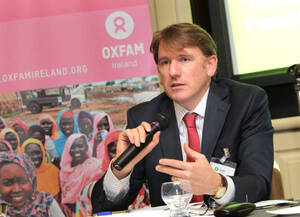
 [Dr Julien Mercille, of University College Dublin, top, and former Irish Times Economics Editor Dan O’Brien, above]
You may recall Dr Julien Mercille, who researched the role of Irish media in the property bubble and whose most recent research studied the coverage of austerity between 2008 and 2012 in the Irish Times, the Irish Independent and the Sunday Independent.
On foot of this research, Dr Mercille and the newly-appointed chief economist at the Institute of International and European Affairs and Irish Independent columnist Dan O’Brien, joined Colm Ó Mongain to debate the media’s attitude to austerity on RTÉ Radio One’s This Week with Colm Ó Mongain
Dr Julien Mercille: “Basically, the main Irish newspapers, they overwhelmingly support fiscal consolidation and austerity. There is only a minority or articles that go against it, to propose alternatives or to propose cuts or something like that. And, really, it’s about 10/12%, depending on how you count it, of articles, that oppose austerity. Basically, going in line with the Government view. So it reflects, the media reflect the viewpoints of economic elites and political elites. So, in a nutshell, that’s, that’s it.”
Colm Ó Mongain: “And what’s the reason behind it, according to your research?”
Mercille: “The reason is that, the media, they’re big corporations. And it’s only to be expected that their interests therefore will reflect those of the corporate sector, they’re a part of it.”
Ó Mongain: “Dan O’Brien, what do you make of that contention?”
Dan O’Brien: “I think it’s a little like saying that because most articles in newspapers now say that global warming is happening that the media is being taken over by the green movement. I just don’t think it stacks up. I also say that if you look at the number of elected representatives we have in this country. At the last election, there was only one political party that said ‘no austerity’, ‘no fiscal consolidation’- that was United Left Alliance. It has 3% of the elected representatives. Sinn Féin accepts that, it wants to do it in a different way. So if you add Sinn Féin up with all of the other main parties, they account for 90% of the elected representatives. What goes on in the media basically, more or less, reflects people’s political views.”
Mercille: “Well that’s simply not true. I mean global warming, it’s not true that media is completely saying…”
O’Brien: “I didn’t say completely…”
Mercille: “…there’s global warming, and the reason why popular opinion is let’s say favourable to consolidation or whatever, well, part of it, is because the media talks only about that.”
Ó Mongain: “So, as you see it, the media forms the opinions that, in turn, leads to people voting for parties who are in favour of consolidation?”
Mercille: “Yeah, not completely, I mean people have their own independent opinions. Sometimes they reject everything but if the media only says one thing, first of all, that doesn’t present alternatives so it’s harder for people, let’s say, who don’t have an economics background to come up with alternatives, and sometimes convinces people that there’s no alternative, as Dan just said.”
Ó Mongain: “Dan, that idea that politics is overwhelmingly a product of what people, their political choices are informed by what they read in the media, what they absorb through the media?”
O’Brien: “Yeah, I think that there is, certainly, some element to that but I think people get information in a whole range of ways and they form their opinions in a whole range of ways. Like some people believe that your political opinions are based around personality characteristics and there’s some evidence for that, it’s about the family you were brought up in, the sort of political history of your family, the background that you have, what you study. I think the notion that, you know, the media is all run by big business and gives one view and that brainwashes people is just the sort of conspiracy theory nonsense, frankly.”
Mercille: “Well, “the conspiracy” is something you hear all the time when people don’t know what to say against your arguments. The fact that news organisations are a big business is a fact, it’s not an interpretation. I mean, you just look at their numbers, they’re big businesses, nobody can deny that. They can deny other things but not that. That media brainwashes people, nobody says that. What I’m giving is an institutional analysis of the media, based on the fact that they are big businesses. And that’s a fact, you look at their annual report and look at their revenues and their profits: they’re big businesses. We don’t have a problem talking about the…”
O’Brien: “Well I think the media is made up of, it’s not just made up of a couple of giant organisations. Your study seems to focus on two of the bigger media organisations. You go around the country, you will find there are local papers all over the country, there are local radio stations, you know, your kind of view that the media is only big business is just not correct. There are a lot of small media organisations, there are a lot of micro media organisations, so you know, I, just again, I think this all smacks of a conspiracy theory: that there are big corporate interests that are determining how people think. Speak to a lot of people in business and their view of the media, including the Irish Times and the Irish Independent, is that these papers are actually very left-leaning and are full of left-leaning commentators. So a lot of people in business would take exactly the opposite view and they would say the media is too left-leaning.”
Ó Mongain: “Isn’t that a point, Julien, perhaps that if the media is keeping everyone unhappy all of the time, they must be doing something right, to be keeping that many people unhappy at the same time?”
Mercille: “Well the media sometimes does many things well. That’s, nobody denies that. The fact that big business criticises the media means basically nothing. I mean it’s interesting to have this discussion in Ireland. Ireland is very unique in Europe. It doesn’t have a left-of-centre media organisation. I mean there’s no Guardian here, there’s no XXXX Diplomatique (go to 5.20)??), there’s only centre-right media.”
Ó Mongain: “And from your point of view, should the political debate in terms of left and right be replicated amongst the media, or should the media try and strive towards the middle ground?”
Mercille: “Well the media should tell the truth. That’s very simple. So when you say things like ‘history shows that in an economic downturn, you need to cut spending’ – well that’s just not true. So, things like that. Or, let’s say, ‘we need to save all the banks’ in 2008, that’s just not true, there are alternatives, there were alternatives, it’s a very simple principle as a journalist, you should just tell the truth. So, if poverty is rising because of austerity you should report that. If Enda Kenny says we need more fiscal consolidation after five years and you clearly see that it doesn’t work, you should say that. And show the alternatives, based on history, based on other countries in Europe.”
Ó Mongain: “Dan?”
O’Brien: “Well, Julien uses words like objective, reality, truth – I wish it was as simple as that. But, you know, people have different interpretations of what the truth is, what reality is.”
Ó Mongain: “Before we go on, just on the broader point Julien was making Dan. This idea that fiscal consolidation came in, when austerity was being discussed, did the media interrogate it sufficiently enough to look at alternatives, were enough voices brought to the fore that might have informed the public into what they might demand in the political system?”
O’Brien: “Well I think there are two things here in this country. One is that, from 2010, we had no choice. Once we lost the capacity to borrow, or the capacity to make our own decision, we really had no choice. There is an issue from the period, around 2008 to 2010. Now, up to around 2011, the academic evidence pointed to fiscal consolidation happening and it being focused on spending cuts first and then taxes later. Subsequent academic literature would say that that’s certainly not as clear cut as the academic literature, up to 2010, so there has been a choice that would support, to some extent, Julien’s position on that, in new research, and I think that’s all been brought out. I think the media has reported that. So I’m not sure there’s been any non-reporting. Another issue Julien mentioned was that poverty increased. Of course poverty increased, you know? 330,000 people, or number of jobs in the economy, declined and I don’t think anybody in the media did not report that.”
Mercille: “Yeah, it does appear in the media, but if it’s hidden somewhere that’s not as strong as front page, that’s what I was saying. And about the fiscal consolidation and the fact that we didn’t have evidence before 2011. I don’t know what you’re reading but it was very well known. That’s how the US got out of The Depression. Since 1945, the period is divided into two broad periods: one is the Golden Age of capitalism in the 50s and 60s, where things were much better than after the 70s. There was no financial crisis basically and, at that time, they were Keynesian methods, government was more important intervention in the economy by the government was more important: that’s just very well known. I don’t know many people who would disagree with that.”
O’Brien: “Well that’s not the case, if you look at the amount Governments spent in the 1960s, relative to the size of the economy, it was lower across all the developed countries than it is today. So that’s wrong, it’s simply incorrect.”
Mercille: “Yeah well, OK, you can believe Dan O’Brien or you can believe…”
O’Brien: “Look at the data, look at the data. The data show that in a post-war era, the size of government began rising, the 50s, continued to rise in the 60s, went up in the 70s and then flattened out in the 70s. That’s what the data show.”
Mercille: “Yeah, but I mean the government had more intervention, wages were rising in real terms…”
O’Brien: “Because economically economies were rising more rapidly, as you said, it was the Golden Age. You’re attributing the Golden Age of capitalism to an idea that you believe was because of more government intervention. You know the complexity of economic growth is massive and economists don’t fully understand it. They need to be honest about that and if you think you understand it better than all the economists in the world, fair enough.”
Mercille: “No well, of course, you can debate that on ten radio shows of course but financial regulation, for example, was tighter?”
O’Brien: “Certainly.”
Mercille: “Right? So things like that. Yeah, so I mean, it’s not to say that we found out in 2011 that ‘oh my god, we’re doing the wrong things’, I mean we had evidence before that. And it’s true that, I mean economics you cannot predict anything in that, right? You can have only likelihoods and probabilities but to say that we didn’t know before 2011 that austerity didn’t work..”
O’Brien: “No I didn’t say that, I said..the Harvard academic, who is the leader in the field on fiscal consolidation was a guy called, an Italian called [Alberto] Alesina. His literature was viewed as being the gold standard. It was then subsequently challenged by a number of people and it’s no longer viewed that his point – that you increase, you cut spending first and then increase taxes, is as hard and as rock solid as it was thought in 2010. So the evidence base, because of new research, is now changed and I would support your argument that the kind of fiscal consolidation that some people advocated in the past does not have as strong an evidence base now as it had in 2010. That’s my point.”
Ó Mongain: “So should that be reported, Dan O’Brien? Or is it a situation whereby the media is mostly made up of generalists and lacks the critical tools in order to interrogate policy on that kind of basis, based on the data your talking about.”
O’Brien: “Well this is one of the difficulties in a more complex society, of getting the expertise into the general media and that can be difficult, particularly in a small country where it costs a lot of money. If you want to employ a medical doctor to write about medical affairs, you know, you’ve got to be offering quite a lot of money and small, it’s only the bug business, as Julien would call them, media groups that can afford to do that.”
Mercille: “Well in economics there is a technical knowledge that is always useful of course but, for instance, the trade unions here. Or even groups like Social Justice Ireland. They propose Budget submissions all the time. Well, you would just have to report that, and you can even do a copy and paste from their documents, if you really were under time constraints but that doesn’t appear in the media.”
O’Brien: “Every interest group has a pre-Budget submission so I’m not sure that, you know, that filling newspapers with vested interest groups’ pre-Budget submissions is either something a huge amount of people are going to have interest in, or will sell newspapers. And I suspect the reason these sort of pre-Budget submissions don’t get covered is just because they’re pretty dull things.”
Mercille: “Well they get covered. IBEC’s submission gets covered all the time – why is that? Why is IBEC always in the paper but Social Justice Ireland doesn’t appear very often?”
O’Brien: “Ok, the Nevin [Economic Research] Institute which is a trade union-backed economic think tank, it has a quarterly report and it gets covered in the media. IBEC is a business organisation and it has a quarterly economic report but it would seem to me that they both get prominent coverage because they both represent very large groups of people.”
Mercille: “Maybe today, in very recent times, you might see a small opening in the mass media, a bit more diverse views because it becomes increasingly difficult to deny that austerity is not working. But, by and large, I mean it’s a business viewpoint and Dan was saying, well IBEC and UNITE get covered, yeah, it’s true, they both get covered but if you look at how many times they get covered, IBEC gets covered much more, maybe not explicitly but my studies showed, I mean, you have, yeah, you have Social Justice Ireland writing but, what, once every year or so…”
O’Brien: “So, just to be clear, your study explicitly went back and counted the number of references to IBEC and the number of references to the trade union movements and you found that trade union movements were mentioned fewer times than IBEC, is that what you’re saying?”
Mercille: “The study counted all the outside writers, excluding journalists and opinion pieces for five years – 2008 to 2012. Trade union representatives, I think the number is about 5% of those writers, about 45% were from the financial sector, were mainstream economists. So, yeah, they both get a voice but..”
O’Brien: “When you say mainstream economists, do you mean academic economists or are they employed by banks or financial institutions.”
Mercille: “It can be both but mostly…”
O’Brien: “Ok, well there’s a very big difference: you’re an academic. There’s a very big difference between one of your colleagues writing an article and someone who is from a financial institution writing an article, I think you’ll acknowledge that.”
Mercille: “Well not necessarily, they might have the same viewpoint. Most economists…”
O’Brien: “There’s nothing wrong with that…the difference is where you’re coming from. Can you trust somebody who’s writing from a financial institution perspective to give a honest opinion or is that person reflecting the views of the interests of his organisation. An academic is paid to be independent and can have whatever views he or she wants.”
Ó Mongain: “What do you think can be or should or could be done about what you see as the media’s bias towards right-wing ideas. I mean what’s your solution to balancing the debate in society?”
Mercille: “Well if you look at the alternatives, what’s called alternative medias, like blogs, like Namawinelake or Notes On The Front, by Unite’s union – those are, they give you a different perspective.”
Ó Mongain: “Doesn’t that depend on a discerning consumer behaviour – if there is a progressive blog, if there is a left-leaning blog and there is clearly an audience that goes with that, that they themselves become a player because everybody else has to sit up and pay attention and thereby they change the dynamics of the debate.”
Mercille: “Yeah like, some of the advertising, for example, it helps if you can get advertising revenue, it helps if you can promote your viewpoint and your business but advertising, let’s say during the housing bubble, the property sector would not be likely to support a blog that would say that there’s a housing bubble and don’t buy a house right now, right, they’ll go with other viewpoints. That’s why it’s more difficult for the alternative media to get revenue like that.”
Podcast here
Dr Mercille’s paper here
Previously: Relentless Cheerleaders For Austerity
For Those Who Shouted Stop He Salutes You
Dr Mercille is the author of a forthcoming book The Role of the Media in the Financial Crisis: A Comparison of Coverage in Ireland and Europe (Routledge).




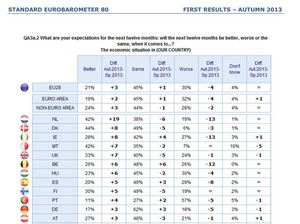 Full Eurobarometer study here