Tag Archives: Bono

the-frontman-bono-in-the-name-of-power-press council

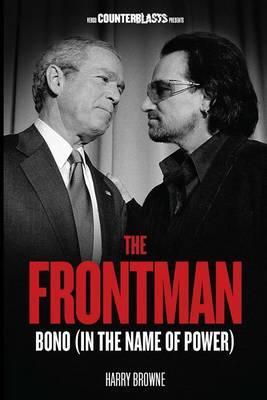
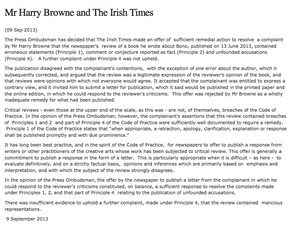
The Press Council’s decision on whether to censure the Irish Times for its scathing, in fairness, review of Harry Browne’s book on Bono, a title glowingly acclaimed outside Ireland.

Harry Browne and The irish Times (Irish Press Council)

Got those ‘bee in my bonnet about Bono’ blues (Ed O Loughlin, irish Times)

Previously: Defending Bono

article-2430796-183A593400000578-302_634x423Bono and Bill Clinton in New York on Wednesday.

Further to Bono’s wide-ranging interview in the Observer last Sunday.

Bono critic and biographer Harry Browne, writes:

The interview with Bono by Tim Adams was blessed, or cursed, with interesting timing. Within a couple of days of the piece appearing, with its headline quoting Bono’s defensive “There’s a difference between cosying up to power and being close to power”, Bono was literally jumping into Bill Clinton’s seat at a Clinton Global Initiative conference to offer his loving imitation of the ex-president’s voice. (Bono’s version of Clinton was, by happy coincidence, flattering Bono.) You gotta admit, it looks pretty cosy.

The scene was all the more ironic because Adams’ interview, and Bono’s answers, rested heavily on the proposition that the mega-rich rock star, whose access to the world’s media is as unobstructed as his route to its corridors of power, is nonetheless a beleaguered and misunderstood figure, fighting to have his ideas heard and his Bono-fides respected in a hostile world. In the Bono-Adams parallel universe, the singer is under attack not merely by lefties, but even by liberals.


More here: Bono: “Poor, Poor Pitiful Me” (Harry Browne, CounterPunch)

Previously: “U2 Is In Total Harmony With Our Government’s Philosophy”

u2+q2

Bono in an interview with Tim Adams in yesterday’s Observer.

Tim Adams: “The other persistent criticism is about the band’s decision to offshore part of their income through the Netherlands to avoid tax. Was it not hypocrisy for you to try to hold the Irish government to account for its spending while going through fairly exhaustive efforts to avoid paying into the Irish exchequer yourself?”

Bono: “It is not an intellectually rigorous position unless you understand that at the heart of the Irish economy has always been the philosophy of tax competitiveness. Tax competitiveness has taken our country out of poverty. People in the revenue accept that if you engage in that policy then some people are going to go out, and some people are coming in. It has been a successful policy. On the cranky left that is very annoying, I can see that. But tax competitiveness is why Ireland has stayed afloat. When the Germans tried to impose a different tax regime on the country in exchange for a bailout, the taoiseach said they would rather not have the bailout. So U2 is in total harmony with our government’s philosophy.”

Adams: “But surely you have given up some authority in doing so. Was it worth it?

Bono: “I think for many reasons people have taken a dislike to our band and to me. This is another one. I have worked as an activist for all my adult life, and I think overall that no one can doubt we have been pretty effective. You can criticise me for a lot of things, but probably not for my commitment of time and energy to this. I think some of the people who criticise us in Ireland and America have a history that you can trace back to our opposition to Noraid. A lot of the others probably hate our music. And a lot of other people probably have a point…”

Bono: ‘There’s a difference between cosying up to power and being close to power’ (Tim Adams, The Observer)

Previously: This Dutch In

The Letter That Prompted A Postcard From The Edge

Have You Come Here For Forgiveness?

Mark Stedman/Photocall Ireland

bonoFrench culture minister Aurélie Filipetti and Bono in Paris yesterday

Before she hung the green silk ribbon with the gold medal around Bono’s neck last night the French culture minister Aurélie Filipetti recounted his life: Protestant mother, Catholic father. Abhorrence of bloodshed during the Troubles. Scourge of apartheid, south American juntas and the martyrdom of Sarajevo. Fight against Aids, third world debt and poverty…

….Filippetti lifted the medal from a crimson cushion and held it poised. “In the name of an entire nation, won over by your immense talent… Cher Bono, … we make you a commandeur de l’ordre des arts et des lettres.”

Commander Bono grazed the hand of the tall, slender, suntanned minister with a baise-main à la francaise. The camera flashes crackled, their light bouncing off gilded mirrors and crystal chandeliers.

Lara Marlowe , Irish Times


Firstly, it can’t be denied that U2 are one of the superpowers of rock. Few bands can match their genius for stadium rock and the pick of their albums – ‘The Joshua Tree’ and ‘Achtung Baby’, to name but two – are among the finest in the genre.

Secondly, Bono has directed his considerable energies for many years now to helping those in the Third World who are incapable of helping themselves. He has bartered with the great and good and had the ear of many a powerful world leader.

Editorial, Irish Independent

Francophile Bono receives honour from a grateful nation (Lara Marlowe, Irish Times)

Taking pride in the name of our greatest rock star – Bono (Editorial, Independent.ie)

Photo: Paris Match

537001443_966c1fdd9e

eagletonthomondwideProfessor Terry Eagelton,above, reviewed Harry Browne’s critical book on Bono – glowingly – in today’s Guardian.

Not even Geldof was safe


It is no surprise that Bono and Bob Geldof, the two leading celebrity philanthropists of our time, are both Irish.

The Ireland into which they were born in the 1960s was caught between third and first worlds, and so was more likely to sympathise with the wretched of the earth than were the natives of Hampstead.

As a devoutly Christian nation, it also had a long missionary tradition. Black babies were a familiar object of charity in Ireland long before Hollywood movie stars began snapping them up. Bono himself was a member of a prayer group in the 1970s, before he stumbled on leather trousers and wrap-around shades.

…Like Geldof, he [Bono] inherited the social conscience of the 1960s without its political radicalism, which is why he has proved so convenient a front man for the neo-liberals.

In fact, as [Harry] Browne points out, he has cosied up to racists such as Jesse Helms, whitewashed architects of the Iraqi adventure such as Tony Blair and Paul Wolfowitz, and discovered a soulmate in the shock-doctrine economist Jeffrey Sachs. He has also brownnosed the Queen, sucked up to the Israelis, grovelled at the feet of corporate bullies and allied himself with rightwing anti-condom US evangelicals in Africa.

…His consistent mistake has been to regard these powers as essentially benign, and to see no fundamental conflict of interests between their own priorities and the needs of the poor.

…If Bono really knew the history of his own people, he would be aware that the Great Irish Famine of the 1840s was not the result of a food shortage. Famines rarely are. There were plenty of crops in the country, but they had to be exported to pay the landlords’ rents. There was also enough food in Britain at the time to feed Ireland several times over. What turned a crisis into a catastrophe was the free market doctrine for which the U2 front man is so ardent an apologist.

Gulp

The Frontman by Harry Browne (Terry Eagelton, Guardian)

Earlier: ‘I’m Not Warm And Fuzzy, Get Over It’

(Getty/Guardian)

Bono

Gaybo

On RTÉ’s The Meaning of Life With Gay Byrne last night, Bono spoke to host Gay Byrne about God and his tax arrangements

Essentially, U2 is a business and he’s a tough guy.

And, you know, GET OVER IT.

Gay Byrne: “If I don’t ask you this, I’ll be criticised and if I do ask you this I’ll be criticised but since you’ve touched on the subject now. The subject of U2’s taxation arrangements, whereby people are expressing their wonder at what they call your hypocrisy, not my word, their word, hypocrisy of haranguing us all and asking us to pay for more international aid, at the same time as you shift your company overseas in order to save taxation.”

Bono: “Yeah, but it’s [unintelligible] of Irish people to be critical of this is because the shock horror moment here is U2 behaving like a business. (Fake shock facial and gasp expression). And I mean our, we live in a small rock in the North Atlantic and we would be under water were it not for very clever people working in Government and in the Revenue who made tax competitiveness a central part of Irish economic life.

It is the reason we have companies like, you know, Google and Facebook and, indeed, I helped bring those companies to Ireland. So it’s more than churlish for Irish people to say well we don’t want an Irish company involved in that stuff that we do want everyone else. I mean we do pay a lot of, I want to say, we pay a lot of tax and…but we are, you know, tax sensible. But, as every business is. And why is it because I’m involved in these…some people think as idealistic things but I think as pragmatic things, why can’t U2 be tough in business? This thing of the warm, fuzzy feeling, you know we want you know this…I’d like people to get over that. Because that’s not who I am. I am tough and I may have, you know, I may sing from a very private and intimate place and I make art. But I’m tough-minded and I’m intellectually rigorous, I hope. And, I think U2’s tax business is our own business and I think it’s not just to the letter of the law, it is to the spirit of the law.”

Byrne: “In that context do you think you’re removed from the everyday lives of people in Ireland, especially today?”

Bono: “That must be true.”

Watch here (from 27.40)


ONE gives only a pittance in direct charitable support to its causes — something Borochoff said the average donor might not realize. The Bono nonprofit took in $14,993,873 in public donations in 2008, the latest year for which tax records are available. Of that, $184,732 was distributed to three charities, according to the IRS filing. Meanwhile, more than $8 million was spent on executive and employee salaries.


Nonprofit mails media $wag to ‘help’ hungry (Jeane MacIntosh, New York Post)