Tag Archives: Brexit

bbc-world-questions

Auntie’s visiting…

BBC World Service write:

As Europe grapples with the big issues of migration, the economy and securityBBC World Questions comes to Dublin on Wednesday, November 9 [at 6pm].

In an edition from The Printworks, Dublin Castle, Jonathan Dimbleby will chair the debate and invite members of the public to question a panel of politicians and thinkers on the big issues affecting Ireland and post-Brexit Europe, including Leo Varadkar, Minister for Social Protection and Mary Lou McDonald, Deputy Leader of Sinn Féin.

Crucially, no one on the panel knows what will be asked until the night itself. Be part of the audience and have your say in a debate that will be heard around the world….

Register here

Thanks Úna-Minh Caomhánach

buttercrane

airjordans

From top: Buttercrane Shopping Centre, Newry; Nike Air Jordans

Anything good in Bloomberg?

From July to September, the number of Irish registered cars visiting the Buttercrane Centre in Newry, in Northern Ireland, rose 62 percent from the year-earlier period…

It’s easy to see why they would make the journey.

On Friday, a men’s wool jumper cost 35 pounds, or 38.75 euros, at Marks & Spencer’s in the north, compared with 47.50 euros on the company’s Irish website. Nike Air Max sneakers cost 85 pounds, or 94 euros, at JD Sports in Newry, against 110 euros in the south….

Meanwhile…

Egan now runs a cafe in Dundalk, on the other side of the border from Newry. He says he now pops across to buy the ingredients for his wife’s favorite tipple, the Negroni cocktail, made of gin, vermouth and Campari. The combined cost of buying a liter of each is 33 pounds, or 36 euros, compared with as much as 70 euros in the south, Egan said.

While Northern Ireland is traditionally cheaper than the south, the plunge in sterling now more than offsets travel costs involved in heading across the border.

“When I go up there, I hear a lot of Dublin accents, ” Egan said. “The closer to Christmas, the worse it will get.

Ah heyor here.

Pound Drop Takes 15% Off Air Jordans for Irish Border Shoppers (Dara Doyle, Bloomberg)

Pics: Trip Advisor; Sports Direct

Thanks Nelly Bergman

fm17_standard_pc_packshot

This year’s Football Manager game (TAFKA Championship Manager, lapsed fans) will simulate Brexit in the transfer market.

Providing players with three perspective scenarios as time rolls on, the in-game economy will either have a soft Brexit, with free movement of players and staff around the EU; an exemption made for sportspeople similar to entertainers; or a hard Brexit that restricts movement of players and staff.

Says creator Miles Jacobson:

“We usually try and keep politics out of the game because nobody wants it rammed down their throat.

“But we were left with an interesting situation this year when the people of Britain voted to leave the EU and it wouldn’t have felt right to leave that out. It’s something we had to reflect in the game.

“So we sat down with the research guys and started to plan how we might put it in.”

Brexit is simulated in Football Manager 2017, and it’s going to make the game harder than ever

ct6pki0weaa6xa8

“And, conference, mark my words: we will make breakfast, Brexit, a success.”

Andrew RT Davies – leader of the Welsh Conservative Party – speaking this morning.

At the Conservative Party Conference in Birmingham.

Pic and video: Elliw Gwawr and David Cornock

Picture-39enda-keeny

Parliamentary correspondent at The Irish Times, Michael O’Regan; Enda and Nicolas Sarkozy in 2014

This morning.

During The Gathering slot on the Today With Sean O’Rourke show, the panel discussed the fallout of Brexit.

The panel included Stephen Donnelly, Social Democrat TD; Michael O’Regan,  parliamentary correspondent of The Irish Times; Dearbhail McDonald, Group Business Editor at Independent News and Media; and Mairead McGuinness, Fine Gael MEP and Vice-President of the European Parliament.

During their discussion, they talked about the effectiveness of Enda Kenny when it comes to  matters concerning Brexit.

Stephen Donnelly: “I would have no faith in Enda Kenny or Michael Noonan negotiating anything on behalf of Ireland, on a European level. At every single point, during the crisis,  Ireland had either the worst deal, in terms of the bailout or the joint worst deal and every single improvement we got came from Portugal or Greece or another country.”

Michael O’Regan:That’s unfair.”

Donnelly: “No, that is absolutely…”

O’Regan:That’s deeply unfair. That’s deeply unfair.”

Donnelly: “They are the facts.”

O’Regan:No, no, no. That’s deeply unfair to the negotiation skills of Enda Kenny and Michael Noonan and others. Noonan is a very wily, and Kenny…”

Donnelly: “Michael…I’m sorry, Michael…”

O’Regan: “…is recognised in Europe as being quite skilful.”

Donnelly: “And if I was in Europe and Enda Kenny kept coming over and paying me all of this money that he didn’t own, on behalf of the Irish people, I’d be telling everyone he’s a great lad as well. The facts. Let’s look at the facts.  The facts are, we had an every, single point, over the next number of years, the worst deal, or the joint worst deal. The facts are that Eamon Gilmore and Enda Kenny came back and said, ‘look, we have a seismic shift, we’re going to get retrospective recapitalisation’. And the facts are it never happened.

Sean O’Rourke: “But they got back…”

Mairead McGuinness: “The facts also are that the economy has recovered, and needs to recover more, that employment has increased, that there is stability. The option… would you have pulled the plug completely and collapsed the economy, like what Greece tried to do?

Donnelly: “It’s a non-question. Obviously…”

McGuinness: “It’s not a non-question.”

Donnelly: “Mairead, asking someone if they’d collapse the economy is a non-question. The question is when Michael Noonan…”

McGuinness: “Well it could have been the outcome of what you are proposing.”

Donnelly: “The question is when Michael Noonan and Enda Kenny went out to Europe, did they, at any time, get us a better deal?  And the answer to that question is: no, they did not. Our better deals came from Greece and Portugal negotiating better deals and then we got them as well. Just on the leadership, Sean, very quickly. The TDs kind of banging the drum is one thing, actually, the much more interesting bit is the fact that Enda Kenny’s chief economic advisor is on his way to the EIB in a few months time. You want to look at the most telling timetable for the Taoiseach’s departure, it’s when his chief economic advisor leaves, it’s not when…”

O’Rourke: “Sure he can get another one. Sure people are coming and going in the White House all the time…”

McGuinness: “Yeah, I don’t think that’s quite on the button..”

O’Rourke: “And the state department in the United States.. and look Alistair Campbell moved out of 10, Downing Street, long before Tony Blair.”

Listen back here in full

Previously: Embedded

0,,19395535_303,00 204751393-9854d7e1-3ac2-4d65-8cc9-77a75d28a047

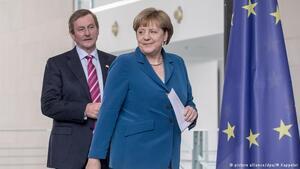
From top: Enda Kenny and Angela Merkel in Berlin yesterday; Economist David McWilliams and his tweet this morning

This morning, economist David McWilliams spoke to Seán O’Rourke on RTÉ Radio One.

They discussed Taoiseach Enda Kenny’s visit to Berlin, to meet German Chancellor Angela Merkel and their talks on the implications of Brexit on the Common Travel Area (CTA) between Ireland and the UK.

Mr Williams explained that while other EU countries should have an interest in Ireland and Britain’s CTA arrangements, they should not have a ‘commanding or a deterministic position on it’ and that Ireland should confidently assert this position.

To make his point he recalled the Dublin Regulation, which was signed in Dublin Castle in 1990, and essentially meant any asylum seeker who arrived from outside the EU had to apply for asylum in the first EU country they reached – placing the biggest burden on Italy and Greece.

Mr Williams suggested that this regulation, in a way, allowed the EU to avoid collective responsibility when it comes to responding to asylum seekers.

The interview opened with Mr O’Rourke asking Mr McWilliams about the tweet he posted this morning (above) concerning Mr Kenny’s meeting with German chancellor Angela Merkel.

Seán O’Rourke: “What prompted you to ask that question?”

David McWilliams: “Well because it struck me, it has struck me over the last six or seven years, Seán that, you know, the whole deal with the European Union that there will be a more European Germany, that’s the essence of the EU, going back to 1957. That Germany would be disciplined and would become a more European country. And, since the crisis of six or seven years ago, what we’re seeing really is what could be described as a German Europe, rather than a European Germany.

And it strikes me as kind of unusual, and a little bit undemocratic that a border between Ireland and Britain, we would have to go over to Germany to seek permission really, in a way as to which way we are going to negotiate. Now I know, the facts on the ground Seán, and we have signed Treaties and this is the implication of that. But it does seem to me a little bit odd that our leader has to go to Germany to seek permission, it seems, or to be given the green light, to have a discussion with Britain on a border between Ireland and Britain in a free labour movement area that has been free, not since 1920 Seán, since about 1420.”

Talk over each other

McWilliams: “I remember, even as a kid in the 1980s, at the height of the Troubles, going to the UK and yes, we had to show passports at Hollyhead but there was always a sense that Irish people could vote in Britain, if we lived there for a while, and this sense that somebody else is going to come in and, in a way, set the terms or conditions, particularly somebody who’s voted by a different electorate seems to me a little bit…”

Sean O’Rourke: “Yeah but here’s the point, David. I mean maybe you’re not being entirely fair to the Taoiseach. Because it’s not about looking for permission, it’s looking to build alliances. I mean he has President Hollande coming here next week and, you know perfectly well that under EU rules, we’re not in a position to now to do separate trade deals with the UK, it has to be done by the European Union, of which we are a part. And surely it makes sense, as you would in any political situation, to try to get people on your side?”

McWilliams: “Of course it makes sense to get people on your side but it would seem to me rather illogical and rather apolitical with a capital P, to have a situation where the border between two parts of Ireland needs to be mediated by people in France? I really don’t think this is actually a particularly logical way to go. And nor is it good for the people either on the south side of the border, or the north side of the border.”

“So, again, I suppose what this is exposing are these deep fissures in, these kind of chasms within the EU, where the pooling of sovereignty Seán, which is probably a good idea, OK, leads to complications and incompatibilities when specific issues come up which absolutely pertain to certain countries, over and above.”

“And I’ve always said that it would be illogical for the negotiations between Ireland and Britain, which they will be, to be dictated by the concerns of Poland or Lithuania or Latvia or other countries. And I suppose that goes to the essence of the problems of the EU now. Because, as you get bigger, Seán, you cannot mask over the cracks in a way in which you hope to do so. So, as you get bigger you’re always going to have these regional differences so therefore, for example, the relationship between Russia and Lithuania, which is existential to Lithuanians, is probably of no real consequence to us.”

O’Rourke: “Yeah but, again coming back to our border issue. Yes, it is the border between the Republic of Ireland and Northern Ireland but it’s also the border between the EU, or will be, and a non-EU country. Now that’s why the Lithuanians and the Poles and the French have an interest in the…”

McWilliams: They have an interest, no doubt, but they should not have a commanding or a deterministic position on it. And you and I must agree on that, Seán?”

O’Rourke: “Yes, but I suppose it’s part of a wider, it’s part of a wider EU context in which trade arrangements are made and also regulations about the movement of people. And nobody has yet, maybe you’ve come across it, or maybe you’ve got your own idea, come up with post-Brexit, the solution to the problems?”

McWilliams: “If you look at the Dublin Treaty. The Dublin Treaty was manufactured in Dublin Castle which is a way of stopping…”

O’Rourke: “This is immigrants now?”

McWilliams: “Precisely. But what it was a way of saying was, geographical certainties and geographical facts are as they are and, therefore, one of the ways in which you deal with immigrants is you’ll actually deal with the place where immigrants first arrive. Ok?”

“So that is a great way of the EU fudging collective responsibility for immigrants, putting it on the shoulders of those who have borders. So there’s a very clear precedent, Seán, you and I know this, for arrangements, consensual arrangements, and ideas that actually take into consideration the facts on the ground which are geographically, we have a border with Northern Ireland which happens, very soon, to be a non-EU country.” 

“So, this notion that we are in some way handless going into negotiations and there is no precedents or flexibility and you might call them fudges, I might call them flexibilities are what I would say, logical arrangements, seem to me to be a little bit a) ideological for Eurocratic fanatics and b) illogical for people who deal in the real world of politics. ”

O’Rourke: “So is the answer then to, if you like, dilute the influence and the role of the European Union. I mean like..”

McWilliams: “Well absolutely, absolutely, absolutely. The influence and the role of the European Union is going to be so ludicrous as to demand border posts with the UK when both Ireland and the UK suggest not to do so. Well then clearly it must be diluted.”

Listen back in full here

3_16

Ferg writes:

I’ve been in exile in London for 3 years – and something weird happened Friday two weeks ago apres Brexit. Not a single joke in the office about potatoes.

I paid it no mind. A full week past – nothing. Not even a “to be sure to be sure”.

Anyone else experiencing this most unsettling phenomenon?

Anyone?

Pic: Realt.by